From Real Exams Quiz
Secondary 4 Combined Science Chemistry Atomic Structure Bonding Quiz
Free Exam-Derived Gemma 4 31B Secondary 4 Combined Science Chemistry Atomic Structure Bonding quiz with questions and answers for Singapore students. This page is rendered as a direct URL so the questions and answers can be discovered without pressing in-page buttons.
These static practice materials are generated from the site's syllabus and paper-generation workflow, with source and model context shown so students and parents can evaluate the material before use.
Questions
Secondary 4 Combined Science Chemistry Quiz - Atomic Structure Bonding
Name: ____________________
Class: ____________________
Date: ____________________
Score: ________ / 45
Duration: 60 Minutes
Total Marks: 45 Marks
Instructions:
- Answer all questions.
- For structured questions, write your answers in the spaces provided.
- Use a ruler for all diagrams.
Section A: Multiple Choice Questions (1-5)
Choose the most appropriate option. (1 mark each)
-
Which of the following groups consists of mixtures only? A. Air, Steel, Vinegar B. Methane, Nickel, Crude oil C. Glucose, Limestone, Air D. Polyethene, Steel, Vinegar
-
An element X has the electronic structure 2, 8, 1. In which group and period of the Periodic Table is element X located? A. Group 1, Period 2 B. Group 1, Period 3 C. Group 3, Period 1 D. Group 3, Period 2
-
Which of the following substances is most likely to conduct electricity in both the solid and molten states? A. Sodium chloride B. Magnesium oxide C. Copper D. Diamond
-
Which of the following describes the bonding in a molecule of nitrogen gas ()? A. Two atoms sharing one pair of electrons B. Two atoms sharing two pairs of electrons C. Two atoms sharing three pairs of electrons D. Transfer of electrons from one nitrogen atom to another
-
Which particle contains 11 protons, 12 neutrons, and 10 electrons? A. atom B. ion C. atom D. ion
Section B: Short Answer and Structured Questions (6-20)
-
Complete the following table for the specified particles. (2 marks) | Particle | Protons | Electrons | Neutrons | | :--- | :---: | :---: | :---: | | (Mass No: 40, At No: 20) | | | |
-
State the number of valence electrons for an element in Group 17. (1 mark)
-
Explain why the atomic radius generally decreases as you move across a period from left to right. (2 marks)
-
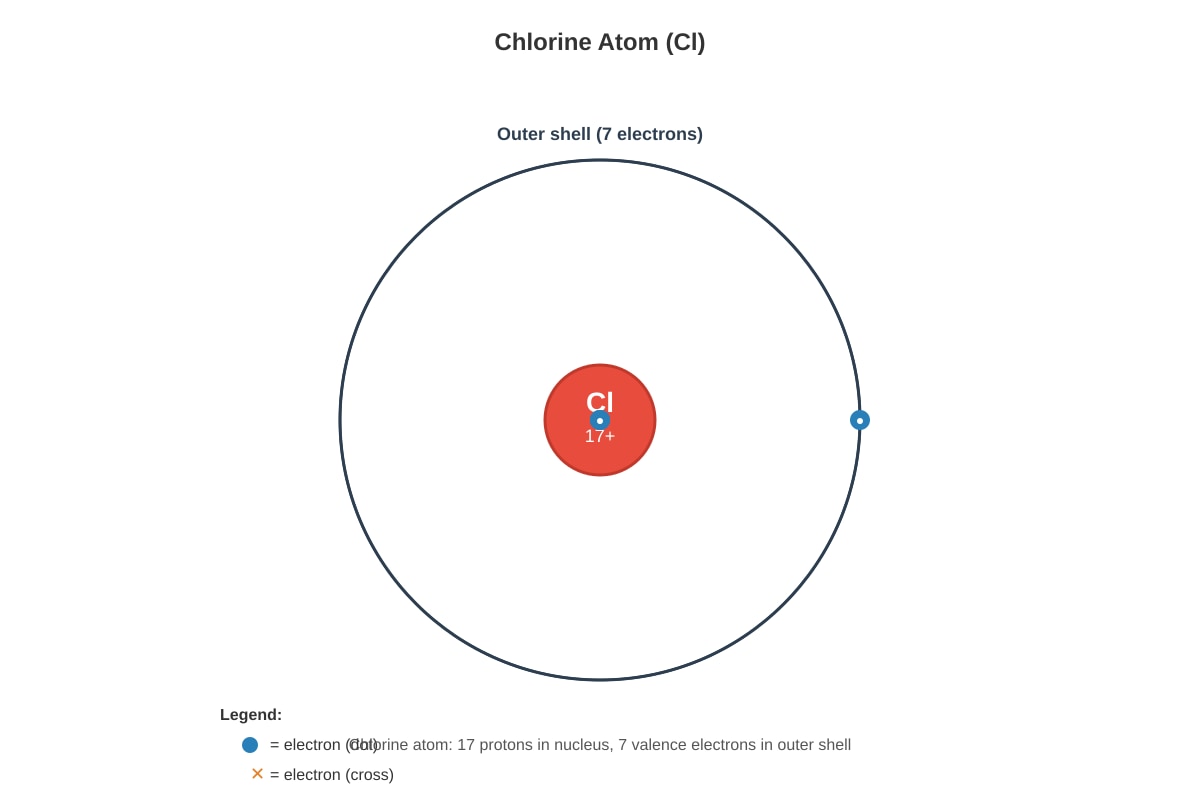
Draw the electronic structure of a chlorine atom (). Show outer electrons only. (2 marks)
\ -
Describe why aluminium is widely recycled in many countries rather than being extracted from its ore. (1 mark)
-
A substance Y has a high melting point, does not conduct electricity when solid, but conducts electricity when molten. (a) Identify the type of bonding in substance Y. (1 mark)
(b) Explain why substance Y does not conduct electricity in the solid state. (2 marks)
-
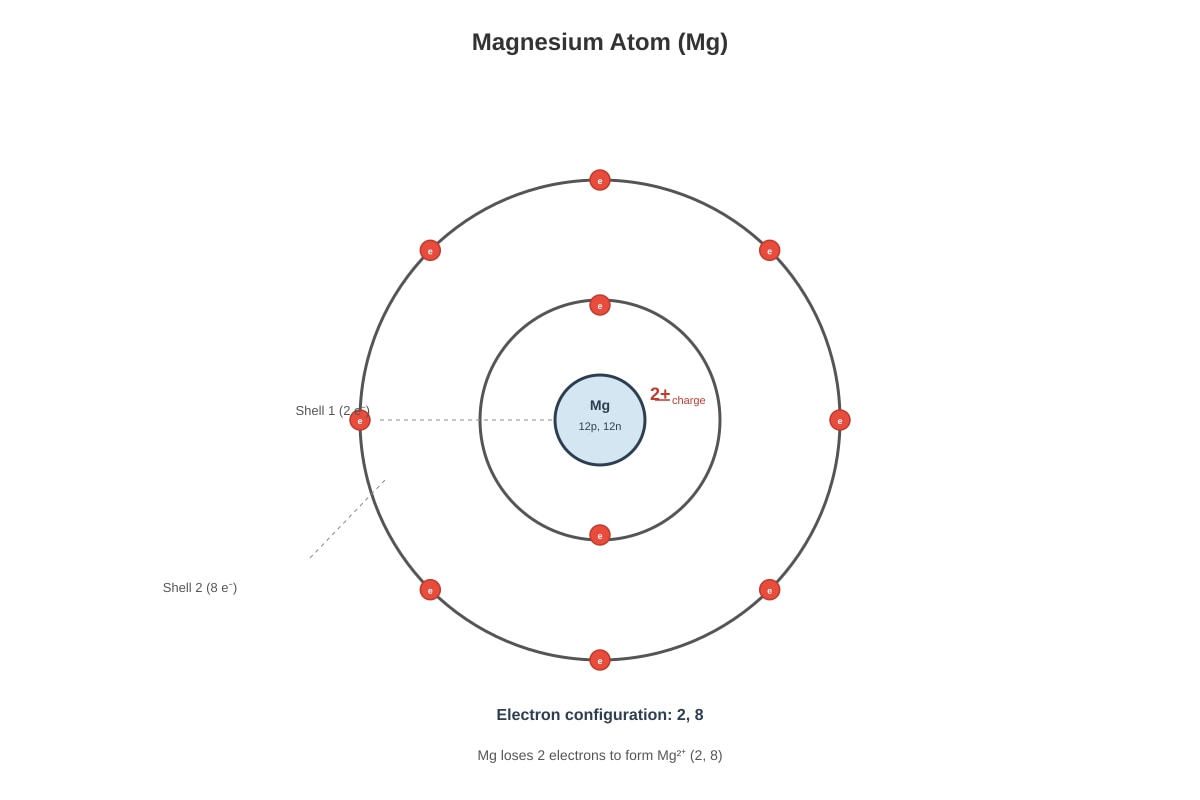
Draw the electronic structure of the ion. (2 marks)
\ -
Element Z is in Period 2 and Group 14. (a) State the electronic structure of element Z. (1 mark)
(b) Name the element Z. (1 mark)
-
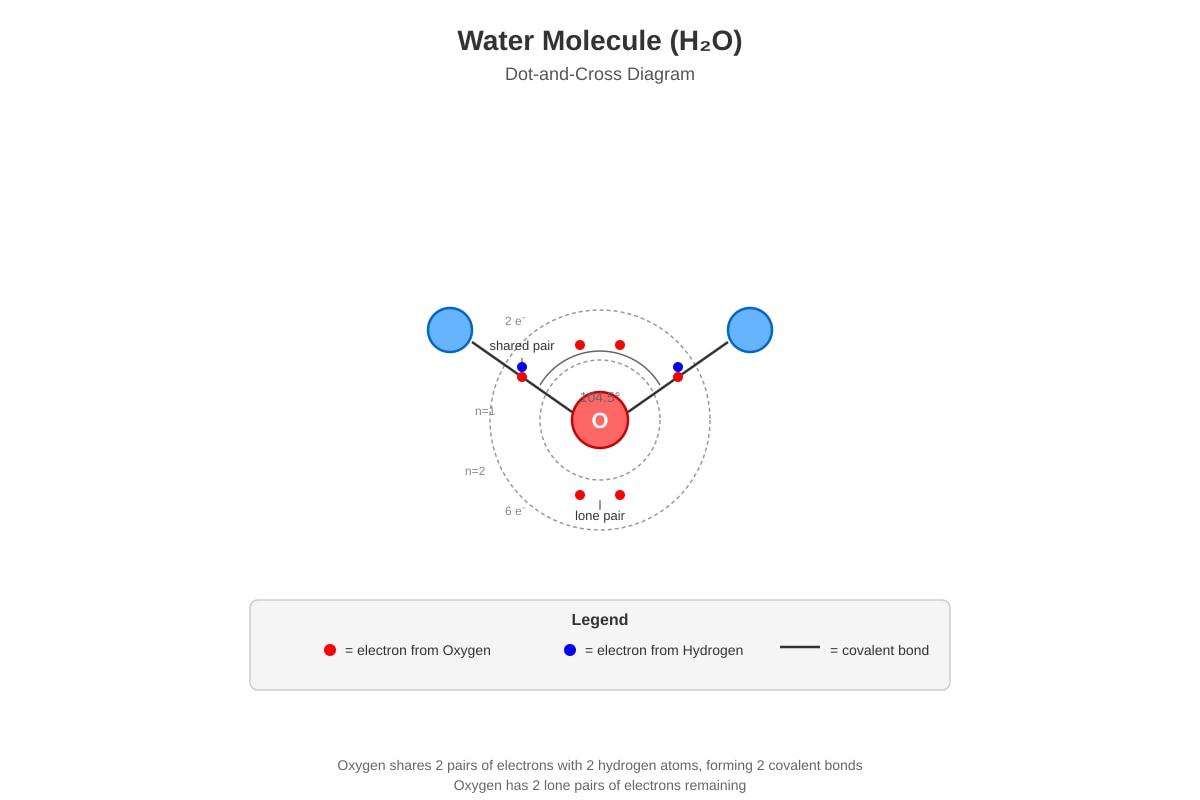
Draw the dot-and-cross diagram to show the bonding in a molecule of water (). Show outer electrons only. (2 marks)
\ -
Compare the properties of a giant covalent structure (e.g., diamond) with a simple molecular covalent structure (e.g., ). State one difference in terms of melting point. (2 marks)
-
Explain how the electronic structure of an element can be used to determine the period it belongs to. (2 marks)
-
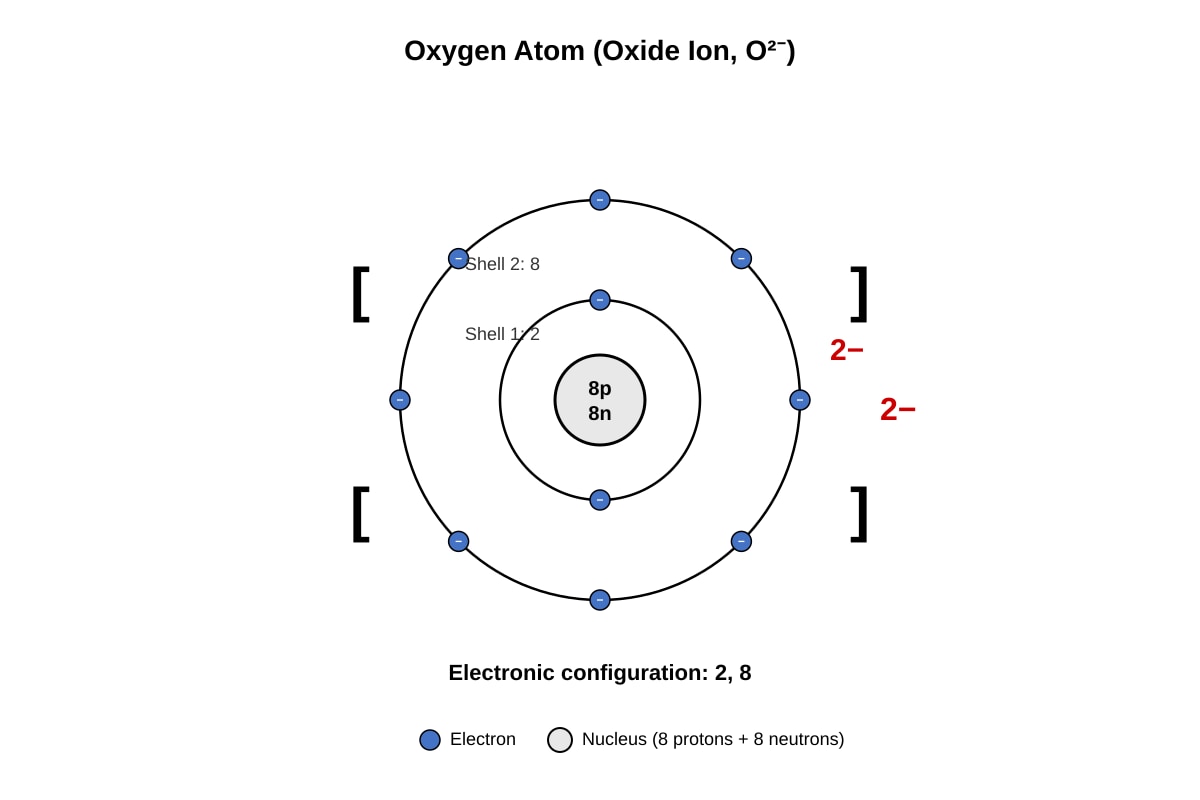
Draw the electronic structure of the ion. (2 marks)
\ -
(a) Define the term "isotope". (1 mark)
(b) Carbon has two main isotopes: Carbon-12 and Carbon-14. State one similarity and one difference in their subatomic particle composition. (2 marks) Similarity: _________________________________________________________________ Difference: ________________________________________________________________
-
Describe the bonding in a metallic lattice. (3 marks)
-
A compound is formed between element P (Group 1) and element Q (Group 17). (a) State the type of bonding in the compound. (1 mark)
(b) Write the general formula for this compound. (1 mark)
(c) Explain why this compound has a high melting point. (3 marks)
Answers
Answer Key - Atomic Structure Bonding Quiz
-
A (Air, Steel, Vinegar are all mixtures. B contains methane/nickel (pure). C contains glucose/limestone (pure). D contains polyethene (pure)).
-
B (3 shells = Period 3; 1 valence electron = Group 1).
-
C (Copper is metallic; metallic bonds allow delocalised electrons to move in all states).
-
C (Nitrogen forms a triple bond, sharing 3 pairs of electrons).
-
B ( has 11 protons. has 11 protons and electrons. Mass number ).
-
Protons: 20; Electrons: 18; Neutrons: 20. (2 marks)
-
7 (1 mark)
-
Nuclear charge increases (more protons) while electrons are added to the same shell stronger attraction between nucleus and electrons pulls electrons closer. (2 marks)
-
[Diagram: Cl nucleus with 7 dots/crosses in the outer shell] (2 marks)
-
Recycling requires significantly less energy than extraction from bauxite. (1 mark)
-
(a) Ionic bonding (1 mark) (b) In solid state, ions are held in a fixed giant lattice by strong electrostatic forces of attraction ions are not free to move to carry charge. (2 marks)
-
[Diagram: Mg nucleus with 2 shells (2,8) and a charge indicated] (2 marks)
-
(a) 2, 4 (1 mark) (b) Carbon (1 mark)
-
[Diagram: O atom in center with 2 shared pairs with H atoms and 2 lone pairs] (2 marks)
-
Giant covalent structures have very high melting points due to many strong covalent bonds; simple molecular structures have low melting points due to weak intermolecular forces. (2 marks)
-
The number of occupied electron shells corresponds to the period number. (e.g., 3 shells = Period 3). (2 marks)
-
[Diagram: O nucleus with 2 shells (2,8) and a charge indicated] (2 marks)
-
(a) Atoms of the same element with the same number of protons but different number of neutrons. (1 mark) (b) Similarity: Same number of protons/electrons. Difference: Different number of neutrons. (2 marks)
-
Positive metal ions (cations) are arranged in a regular lattice surrounded by a "sea" of delocalised electrons. The strong electrostatic attraction between the cations and the delocalised electrons holds the structure together. (3 marks)
-
(a) Ionic (1 mark) (b) (1 mark) (c) Strong electrostatic forces of attraction between oppositely charged ions and requires a large amount of energy to overcome these forces to break the lattice. (3 marks)