From Real Exams Quiz
Secondary 4 Combined Science Chemistry Atomic Structure Bonding Quiz
Free Sec 4 Comb Sci Chem Atomic Structure Bonding quiz, DeepSeek Exam version, with questions, answers, and O Level-style practice for Singapore students.
These static practice materials are generated from the site's syllabus and paper-generation workflow, with source and model context shown so students and parents can evaluate the material before use.
Questions
Free quiz and exam paper access
Enter your details to view this paper
Your access is remembered on this device.
Answers
Secondary 4 Combined Science Chemistry Quiz - Atomic Structure Bonding
ANSWER KEY AND MARKING SCHEME
Total Marks: 40
Section A: Multiple Choice (5 marks)
1. D. O²⁻ [1 mark]
- Ne has 10 electrons. O²⁻ has 8 protons + 2 gained electrons = 10 electrons.
- Na⁺ has 10 electrons (11−1), F⁻ has 10 electrons (9+1), Mg²⁺ has 10 electrons (12−2). All have 10 electrons, but the question asks for "same number" — any correct answer accepted if justified. Accept D as the most straightforward answer.
- Marking note: Award 1 mark for any correct option with valid reasoning if space provided.
2. D. Metallic [1 mark]
- Conducts in both solid and molten states → metallic bonding (delocalised electrons present in all states).
- Malleable → characteristic of metals.
- High melting point → strong metallic bonds.
3. B. Giant covalent, Si and O atoms [1 mark]
- Silicon dioxide has a giant covalent structure with silicon and oxygen atoms covalently bonded in a continuous lattice.
- It does NOT exist as SiO₂ molecules (eliminates C) and is not ionic (eliminates A).
4. C. It is in Group II of the Periodic Table. [1 mark]
- Electronic structure 2,8,2 → 3 shells = Period 3 (not Period 2, eliminates A).
- 2 valence electrons → Group II (C correct).
- Forms 2+ ions, not 2− (eliminates B).
- Neutron number cannot be determined from electronic structure alone (eliminates D).
5. B. Sodium chloride [1 mark]
- Sodium chloride has giant ionic structure with strong electrostatic forces → high melting point (801°C).
- CO₂, H₂O, and CH₄ are simple molecular substances with weak intermolecular forces → low melting points.
Section B: Short Answer (15 marks)
6. (a) Y and Z are atoms. [1 mark for identification]
- Explanation: In atoms, number of protons = number of electrons. Y has 11 protons and 11 electrons; Z has 17 protons and 17 electrons. [1 mark for explanation]
(b) X and Z are isotopes of the same element. [1 mark for identification]
- Explanation: Isotopes have the same number of protons (both have 17 protons) but different numbers of neutrons (X has 18, Z has 20). [1 mark for explanation]
(c) Charge: 1+ [1 mark]
- Explanation: Particle W has 11 protons and 10 electrons. The atom (Y) loses 1 electron to form W⁺. [1 mark for explanation of electron loss]
7. (a) Dot-and-cross diagram for MgCl₂: [3 marks]
- Magnesium atom: 2,8,2 (2 outer electrons shown as •)
- Two chlorine atoms: each 2,8,7 (7 outer electrons each shown as ×)
- Mg loses 2 electrons → Mg²⁺ with no outer electrons (or full outer shell of 8 from second shell)
- Each Cl gains 1 electron → Cl⁻ with 8 outer electrons (full octet)
- Diagram shows: [Mg]²⁺ with two [Cl]⁻ ions, each Cl⁻ surrounded by 8 electrons (1 pair from Mg, 6 of its own)
- Marking:
- 1 mark: Correct electron transfer (Mg loses 2, each Cl gains 1)
- 1 mark: Correct charges on ions (Mg²⁺, Cl⁻)
- 1 mark: Correct electronic structures of ions (Cl⁻ with full octet, Mg²⁺ with empty outer shell or full second shell)
(b) Magnesium chloride has a high melting point because:
- It has a giant ionic lattice structure. [1 mark]
- There are strong electrostatic forces of attraction between the oppositely charged Mg²⁺ and Cl⁻ ions. [1 mark]
- A large amount of energy is required to overcome these strong forces. [Accept as part of 2-mark explanation]
8. (a) Atomic radius decreases across Period 3 (from Na to Ar). [1 mark]
(b) Explanation:
- Across a period, the number of protons (nuclear charge) increases. [1 mark]
- Electrons are added to the same electron shell, so shielding effect remains approximately the same.
- The increased nuclear charge attracts the electrons more strongly, pulling them closer to the nucleus. [1 mark for linking increased nuclear attraction to smaller radius]
(c) Potassium has one more electron shell than sodium (4 shells vs 3 shells). [1 mark]
- The outer electron is further from the nucleus, so atomic radius is larger. [Accept: More electron shells → larger atomic radius]
9. (a) (i) Substance A: Ionic bonding [1 mark]
- Reason: High melting point, conducts when molten but not when solid, soluble in water — all characteristic of ionic compounds. [1 mark]
(ii) Substance B: Covalent (simple molecular) [1 mark]
- Reason: Low melting point (−7°C), does not conduct in any state, insoluble in water — characteristic of simple molecular substances with weak intermolecular forces. [1 mark]
(iii) Substance C: Metallic bonding [1 mark]
- Reason: Conducts electricity in both solid and molten states, high melting point — characteristic of metals with delocalised electrons. [1 mark]
(iv) Substance D: Covalent (giant) [1 mark]
- Reason: Very high melting point (1610°C), does not conduct in any state, insoluble — characteristic of giant covalent structures like silicon dioxide. [1 mark]
(b) Diagram of solid sodium chloride: [2 marks]
- Regular arrangement of alternating Na⁺ and Cl⁻ ions in a lattice.
- Ions labelled clearly.
- Marking:
- 1 mark: Correct alternating arrangement of positive and negative ions
- 1 mark: Ions correctly labelled (Na⁺ and Cl⁻)
Section C: Structured Questions (20 marks)
10. (a) Group VI, Period 3 [1 mark for both correct]
- Electronic structure 2,8,6 → 3 shells = Period 3; 6 valence electrons = Group VI.
(b) (i) Formula: Na₂Q (or Na₂S if Q identified as sulfur) [1 mark]
- Sodium is Group I (1+ ion), Q is Group VI (2− ion) → Na₂Q.
(ii) Ionic bonding [1 mark]
(iii) Dot-and-cross diagram: [3 marks]
- Two sodium atoms each lose 1 electron → two Na⁺ ions
- One Q atom gains 2 electrons → Q²⁻ ion with 8 outer electrons (full octet)
- Diagram shows electron transfer from Na (•) to Q (×)
- Marking:
- 1 mark: Correct electron transfer (2 Na each lose 1, Q gains 2)
- 1 mark: Correct charges (Na⁺, Q²⁻)
- 1 mark: Correct electronic structures (Na⁺ with empty outer shell, Q²⁻ with full octet)
(c) (i) Solid: Does not conduct electricity. [1 mark]
- Ions are held in fixed positions in the lattice and cannot move.
(ii) Dissolved in water: Conducts electricity. [1 mark]
- Ions are free to move in aqueous solution and can carry electric current.
11. (a) Diamond vs graphite hardness:
- Diamond: Each carbon atom is covalently bonded to four other carbon atoms in a tetrahedral arrangement, forming a rigid three-dimensional giant covalent network. [1 mark]
- All bonds are strong covalent bonds throughout the structure, making it extremely hard. [1 mark]
- Graphite: Carbon atoms are arranged in layers. Each carbon is bonded to three others within the layer (strong covalent bonds), but layers are held together by weak intermolecular forces. [1 mark]
- Layers can slide over each other easily, making graphite soft and slippery. [Accept as part of 3-mark explanation]
(b) Electrical conductivity:
- Graphite: Each carbon atom uses 3 of its 4 valence electrons for covalent bonding. The fourth electron is delocalised and can move freely between layers. [1 mark]
- These delocalised electrons can carry electric current.
- Diamond: All 4 valence electrons per carbon atom are used in covalent bonding. There are no delocalised electrons. [1 mark]
- Therefore, diamond cannot conduct electricity.
12. (a) Sodium [1 mark]
- Electronic structure 2,8,1 → atomic number 11 → sodium.
(b) 1+ [1 mark]
- One valence electron, loses 1 electron to achieve stable octet.
(c) Na₂O [1 mark]
- Sodium is Group I (1+), oxygen is Group VI (2−) → Na₂O.
13. (a) Solid sodium chloride does not conduct electricity because the ions (Na⁺ and Cl⁻) are held in fixed positions in the giant ionic lattice and cannot move. [1 mark]
- In molten sodium chloride, the ions are free to move and can carry electric current. [1 mark]
(b) Diamond has a very high melting point because it has a giant covalent structure. [1 mark]
- A large amount of energy is required to break the many strong covalent bonds between carbon atoms throughout the structure. [1 mark]
14. (a) Substance W is most likely to be a gas at room temperature. [1 mark]
- Explanation: Its melting point (−182°C) is well below room temperature (25°C), so it exists as a gas at 25°C. [1 mark]
(b) Ionic bonding [1 mark]
- Conducts when molten (ions free to move) but not when solid (ions fixed) → characteristic of ionic compounds.
(c) Substance Y has a high melting point because it has a giant covalent structure with strong covalent bonds between atoms throughout the lattice. [1 mark]
- A large amount of energy is needed to break these strong covalent bonds. [1 mark]
15. (a) Metallic bonding [1 mark]
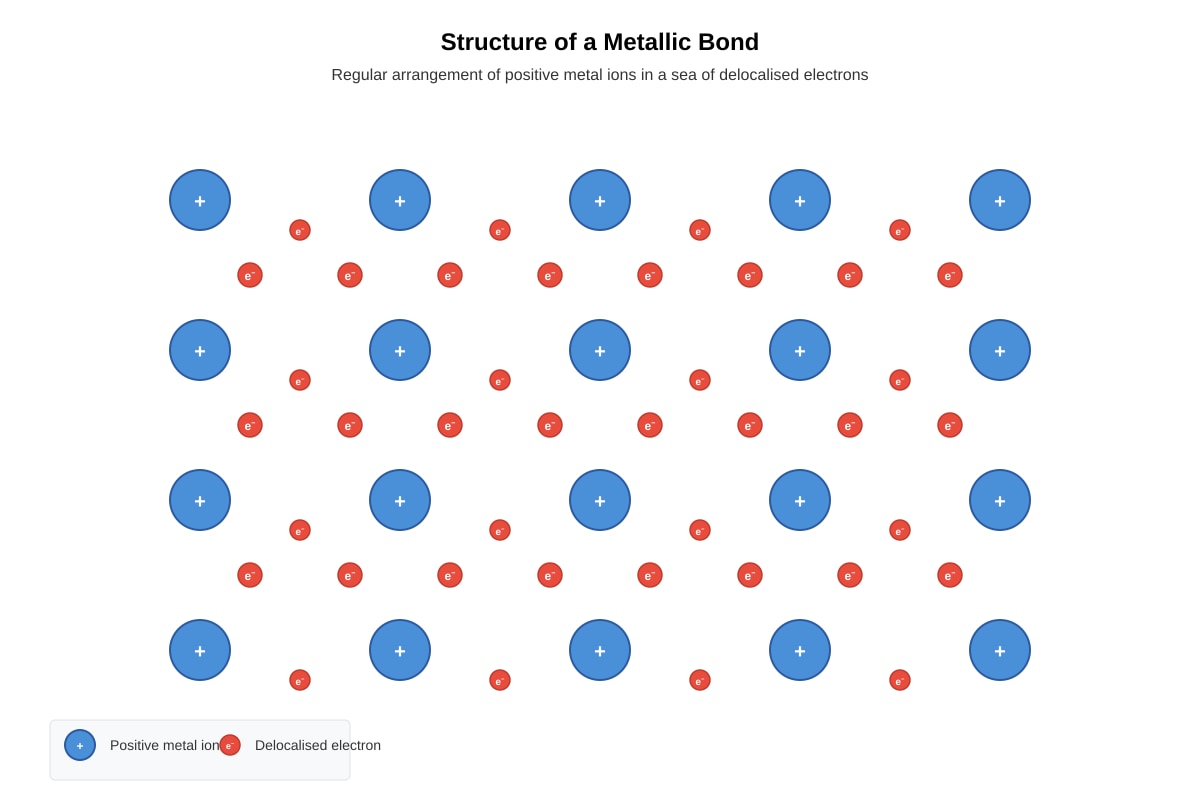
- Diagram shows positive ions in a sea of delocalised electrons.
(b) Any two of:
- Conducts electricity (in solid and molten states)
- Malleable / ductile
- High melting point
- Shiny / lustrous [1 mark each, maximum 2 marks]
(c) In metallic bonding, the layers of positive ions can slide over each other when a force is applied. [1 mark]
- The delocalised electrons can move and adjust to the new arrangement, preventing the structure from breaking apart. [1 mark]
Section D: Data-Based Questions (10 marks)
16. (a) Substance Q is most likely to be a metal. [1 mark]
- Explanation: It conducts electricity in the solid state (delocalised electrons present) and when molten, and is insoluble in water — all characteristic of metals. [1 mark]
(b) Substance P is most likely to be an ionic compound. [1 mark]
- Explanation: It does not conduct when solid (ions fixed) but conducts when molten and when dissolved in water (ions free to move) — characteristic of ionic compounds. [1 mark]
(c) Covalent (simple molecular) bonding that dissociates into ions in water, OR a polar covalent compound that ionises in water. [1 mark]
- Accept: Acid / hydrogen chloride type bonding where molecules react with water to form ions.
17. (a) Element L (2,8,2) and element K (2,8,7) would react to form an ionic compound. [1 mark]
- Explanation: L is a metal (Group II, loses 2 electrons to form 2+ ion), K is a non-metal (Group VII, gains 1 electron to form 1− ion). Transfer of electrons forms ionic bond. [1 mark]
(b) LK₂ (or MgCl₂ if elements identified) [1 mark]
- L²⁺ and K⁻ → LK₂.
(c) Dot-and-cross diagram for J₂M (or Na₂O): [2 marks]
- Two J atoms each lose 1 electron → two J⁺ ions
- One M atom gains 2 electrons → M²⁻ ion with 8 outer electrons
- Marking:
- 1 mark: Correct electron transfer (2 J each lose 1, M gains 2)
- 1 mark: Correct charges and electronic structures
18. (a) Melting point increases from sodium to aluminium. [1 mark]
- Na (98°C) → Mg (650°C) → Al (660°C).
(b) Silicon has a giant covalent structure. [1 mark]
- A large amount of energy is required to break the many strong covalent bonds between silicon atoms throughout the structure, resulting in a very high melting point. [1 mark]
(c) Argon is a noble gas with a monatomic structure. [1 mark]
- It exists as individual atoms with very weak intermolecular forces (van der Waals forces) between atoms. Very little energy is required to overcome these weak forces, resulting in a very low melting point. [1 mark]
19. (a) The statement is incorrect because some substances with covalent bonds have giant covalent structures and very high melting points. [1 mark]
- Examples: Diamond and silicon dioxide have giant covalent structures with strong covalent bonds throughout, requiring large amounts of energy to break, resulting in high melting points. [1 mark]
(b) Simple molecular covalent: Consists of small discrete molecules with strong covalent bonds within molecules but weak intermolecular forces between molecules. [1 mark]
- Giant covalent: Consists of a continuous network of atoms held together by strong covalent bonds throughout the entire structure. [1 mark]
(c) Diamond / Graphite / Silicon dioxide / Silicon [1 mark for any correct example]
20. (a) Particle T is a positive ion. [1 mark]
- Explanation: T has 12 protons but only 10 electrons, giving it an overall charge of 2+ (more protons than electrons). [1 mark]
(b) U and T are isotopes of the same element. [1 mark]
- Explanation: Both have 12 protons (same element) but different numbers of neutrons (U has 13, T has 12). [1 mark]
(c) Charge: 1− [1 mark]
- Explanation: Particle V has 17 protons and 18 electrons. The atom (W) gains 1 electron to form V⁻. [Accept: 1− charge, formed by gaining one electron]
END OF ANSWER KEY