AI Generated Exam Paper
Secondary 4 Combined Science Chemistry Practice Paper 5
Free Sec 4 Comb Sci Chem Practice Paper 5, HY3 AI version, with questions, answers, and O Level-style practice for Singapore students.
These static practice materials are generated from the site's syllabus and paper-generation workflow, with source and model context shown so students and parents can evaluate the material before use.
Questions
TuitionGoWhere Practice Paper - Combined Science Chemistry Secondary 4
TuitionGoWhere Practice Paper (AI) — Version 5
Subject: Combined Science Chemistry
Level: Secondary 4
Paper: Practice Paper (Topic: Acids, Bases & Salts)
Duration: 1 hour 15 minutes
Total Marks: 65
Name: ______________________
Class: ________
Date: ________
Instructions:
- This practice paper contains 20 questions on Acids, Bases & Salts.
- Section A: Questions 1–8 (Short Answer, 16 marks)
- Section B: Questions 9–14 (Structured, 24 marks)
- Section C: Questions 15–20 (Extended/Calculation, 25 marks)
- Show all working clearly. Use proper chemical notation.
- Marks for each question are shown in brackets [ ].
Section A (16 marks)
1. State the colour change of blue litmus paper when dipped into hydrochloric acid. [1]
2. Write the ionic equation for the reaction between an acid and a base. [1]
3. Name the salt formed when nitric acid reacts with potassium hydroxide. [1]
4. Give the formula of the anion present in all alkalis. [1]
5. State the pH value of a neutral solution at 25 °C. [1]
6. Name a suitable indicator that is yellow in alkaline solution and red in acidic solution. [1]
7. State one observable change when magnesium ribbon reacts with dilute sulfuric acid. [1]
8. Classify ammonium chloride as acidic, neutral, or alkaline salt. [1]
Section B (24 marks)
9. (a) Describe a test to show that ethanoic acid is a weak acid. [2]
(b) Explain your observation using the idea of dissociation. [2]
10. A student prepared a sample of lead(II) iodide.
(a) State the method used. [1]
(b) Describe the steps to obtain a dry sample. [3]
11. The table below shows the colour of methyl orange in solutions of different pH.
| pH range | Colour of methyl orange |
|---|---|
| 1–3 | Red |
| 4–6 | Orange |
| 7–14 | Yellow |
Solution X turns methyl orange orange. Solution Y turns it yellow.
(a) State the pH range of X. [1]
(b) Classify Y as acidic, neutral, or alkaline. [1]
(c) Explain why methyl orange is not suitable for titrating a weak acid with a strong base if the endpoint is pH 9. [2]
12. (a) Write the balanced equation for the reaction of copper(II) oxide with sulfuric acid. [2]
(b) Explain why excess copper(II) oxide is added. [2]
13. Classify each of the following reactions using terms from: neutralisation, redox, precipitation, decomposition. [4]
(a) 2KI+Pb(NO3)2→2KNO3+PbI2
(b) HCl+NaOH→NaCl+H2O
(c) 2H2O2→2H2O+O2
(d) Mg+2HCl→MgCl2+H2
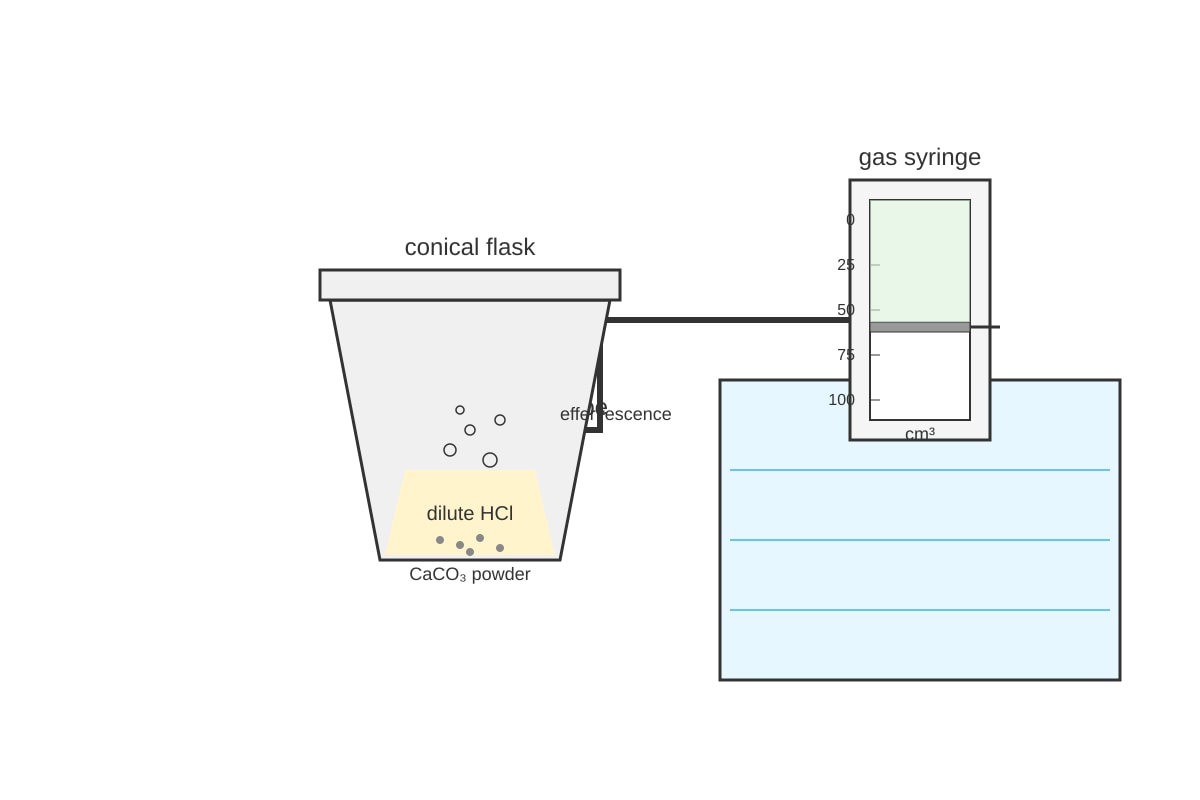
14. A student added powdered calcium carbonate to dilute hydrochloric acid in a flask fitted with a gas syringe.
Image pending generation: experimental_setup for Q14.
(a) Name the gas produced. [1]
(b) State two observations in the flask. [2]
Section C (25 marks)
15. A titration was carried out to find the concentration of sulfuric acid. 25.0 cm³ of 0.100 mol/dm³ sodium hydroxide was neutralised by 20.0 cm³ of sulfuric acid.
(a) Write the balanced equation. [2]
(b) Calculate the concentration of the sulfuric acid in mol/dm³. [4]
16. Describe how to prepare pure, dry crystals of zinc sulfate from zinc oxide and sulfuric acid. Explain each step. [6]
17. The pH values of four household solutions are given:
A: 3, B: 7, C: 9, D: 12.
(a) Arrange them from most acidic to most alkaline. [1]
(b) State which solution would turn red litmus blue. [1]
(c) Explain the difference between a strong acid and a weak acid using pH and dissociation. [3]
18. A farmer found his soil was too acidic for planting. He used calcium hydroxide to neutralise it.
(a) Write the equation for the reaction. [2]
(b) State why calcium hydroxide is preferred over sodium hydroxide for soil treatment. [2]
19. (a) Define a salt. [2]
(b) Give two examples of insoluble salts and state a test to confirm one of them. [3]
20. A student mixed equal volumes of 0.10 mol/dm³ HCl and 0.10 mol/dm³ NaOH at 20 °C and measured the temperature rise.
(a) State the type of reaction. [1]
(b) Calculate the moles of HCl in 50.0 cm³. [2]
(c) Explain why the temperature rises. [2]
End of Paper
Answers
TuitionGoWhere Practice Paper — Answer Key (Version 5)
Subject: Combined Science Chemistry
Level: Secondary 4
Topic: Acids, Bases & Salts
Total Marks: 65
Section A
1. Blue litmus turns red in acid. [1]
Teaching note: Litmus is a natural indicator; acids turn blue litmus red, alkalis turn red litmus blue.
2. H++OH−→H2O [1]
Teaching note: All neutralisations share this net ionic equation; spectator ions omitted.
3. Potassium nitrate (KNO3) [1]
Teaching note: Acid (HNO₃) + base (KOH) → salt + water; salt name from metal (potassium) + nitrate from acid.
4. Hydroxide ion, OH− [1]
Teaching note: Alkalis are soluble bases releasing OH⁻ in water.
5. pH = 7 [1]
Teaching note: At 25 °C neutral solutions have pH 7.
6. Methyl orange [1]
Teaching note: Methyl orange is red below pH 3.1, yellow above pH 4.4.
7. Effervescence (bubbles of H₂) / metal dissolves [1]
Teaching note: Mg + H₂SO₄ → MgSO₄ + H₂; gas seen as bubbles.
8. Acidic salt [1]
Teaching note: NH₄Cl from strong acid (HCl) + weak base (NH₃) gives acidic salt.
Section B
9. (a) Add methyl orange to ethanoic acid; colour is red but pH ~3 (or conductivity low). [1] Test shows partial ionisation. [1]
(b) Weak acid only partially dissociates: CH3COOH⇌CH3COO−+H+ so few H⁺ ions. [2]
Marks: 4 total.
10. (a) Precipitation. [1]
(b) Mix solutions of KI and Pb(NO₃)₂; filter precipitate; wash with distilled water; dry in oven or between filter papers. [3]
Marks: 4 total.
11. (a) pH 4–6. [1]
(b) Alkaline. [1]
(c) Endpoint pH 9 is in yellow region; methyl orange changes at pH 3–4, so no sharp colour change at pH 9. [2]
Marks: 4 total.
12. (a) CuO+H2SO4→CuSO4+H2O [2]
(b) Excess ensures all acid reacts; unreacted CuO filtered off leaving pure salt solution. [2]
Marks: 4 total.
13. (a) Precipitation [1]
(b) Neutralisation [1]
(c) Decomposition [1]
(d) Redox (also displacement) [1]
Marks: 4 total.
14. (a) Carbon dioxide, CO₂. [1]
(b) Effervescence; solid dissolves. [2]
Image note: Gas syringe shows increasing volume; flask has bubbles.
Marks: 3 total.
Section C
15. (a) 2NaOH+H2SO4→Na2SO4+2H2O [2]
(b) Moles NaOH = 0.100 × 25.0/1000 = 0.00250 mol [1]
Mole ratio NaOH:H₂SO₄ = 2:1, so moles H₂SO₄ = 0.00125 mol [1]
Conc H₂SO₄ = 0.00125 × 1000/20.0 = 0.0625 mol/dm³ [2]
Marks: 6 total.
16. 1. Add excess ZnO to warm dilute H₂SO₄. [1]
2. Filter to remove excess ZnO. [1]
3. Evaporate filtrate to crystallisation point. [1]
4. Cool to crystallise. [1]
5. Filter crystals, wash with distilled water. [1]
6. Dry between filter papers. [1]
Marks: 6 total.
17. (a) A (3), B (7), C (9), D (12). [1]
(b) C and D (pH > 7). [1]
(c) Strong acid fully dissociates (more H⁺, lower pH); weak acid partially dissociates (fewer H⁺, higher pH for same conc). [3]
Marks: 5 total.
18. (a) Ca(OH)2+2H+→Ca2++2H2O or with acid. [2]
(b) Ca(OH)₂ is less soluble, milder, adds Ca²⁺ nutrient, less harm to soil. [2]
Marks: 4 total.
19. (a) Salt = ionic compound from acid + base neutralisation (metal + anion). [2]
(b) BaSO₄, PbCl₂; test for PbCl₂: add AgNO₃ → white ppt? (or add KI → yellow ppt). [3]
Marks: 5 total.
20. (a) Neutralisation (exothermic). [1]
(b) Moles = 0.10 × 50.0/1000 = 0.0050 mol [2]
(c) Heat released when H⁺ + OH⁻ form water; raises temperature. [2]
Marks: 5 total.
Total Marks Check: 16 + 24 + 25 = 65 ✓
Free quiz and exam paper access
Enter your details to view this paper
Your access is remembered on this device.