AI Generated Exam Paper
Secondary 4 Combined Science Chemistry Practice Paper 4
Free Sec 4 Comb Sci Chem Practice Paper 4, HY3 AI version, with questions, answers, and O Level-style practice for Singapore students.
These static practice materials are generated from the site's syllabus and paper-generation workflow, with source and model context shown so students and parents can evaluate the material before use.
Questions
Free quiz and exam paper access
Enter your details to view this paper
Your access is remembered on this device.
Answers
TuitionGoWhere Practice Paper Answer Key — Combined Science Chemistry Secondary 4 (Version 4)
Topic: Acids, Bases & Salts
Total Marks: 65
Section A Answers
Q1 [1 mark] Red.
Teaching note: Litmus is red in acidic conditions (pH < 7). pH 2 is strongly acidic.
Q2 [1 mark] KNO₃
Teaching note: Nitric acid (HNO₃) + potassium hydroxide (KOH) → potassium nitrate + water. Salt formula from K⁺ and NO₃⁻.
Q3 [2 marks] Add bromine water (1 mark). Colour changes from orange/brown to colourless (1 mark).
Teaching note: Unsaturated compounds have C=C bonds that react with bromine, decolourising it.
Q4 [2 marks] Pipette (or volumetric pipette).
Teaching note: A pipette measures a fixed exact volume (e.g., 25.0 cm³) accurately; burette is for variable volume, measuring cylinder less precise.
Q5 [2 marks] Strong acid ionises completely producing more H⁺ ions (1 mark); more ions mean greater electrical conductivity (1 mark).
Teaching note: Conductivity depends on concentration of mobile ions. Weak acid only partially ionises.
Q6 [2 marks] Add calcium hydroxide / slaked lime / limestone (1 mark); base / alkali (1 mark).
Teaching note: Soil acidity neutralised by adding base; common agricultural lime is calcium carbonate or hydroxide.
Q7 [3 marks] pH 4–6 (1 mark); acidic (1 mark); methyl orange is orange only in pH 4–6 which is below 7, so acidic (1 mark).
Marking: 1 for range, 1 for classify, 1 for explanation.
Q8 [3 marks] Approx pH 6–8 (1 mark); neutral or weakly acidic/alkaline (1 mark); universal indicator green = pH ~6–8, phenolphthalein colourless = pH < 8.3 so consistent with neutral (1 mark).
Marking: Deduct if says strongly alkaline.
Section B Answers
Q9 [4 marks]
(a) redox, displacement (accept redox only) — 1 mark
(b) neutralisation — 1 mark
(c) addition — 1 mark
1 mark for clear listing.
Teaching note: Mg displaces H from acid (redox); acid+base→salt+water is neutralisation; C=C + Br₂ is addition.
Q10 [5 marks]
- Add excess CuO to warm dilute H₂SO₄ (1)
- Filter to remove excess CuO (1)
- Evaporate filtrate to crystallisation point (1)
- Cool, filter crystals, wash, dry (1)
Method suitable: CuO insoluble base, CuSO₄ soluble (1)
Teaching note: Excess base ensures all acid reacted; filtration removes solid; evaporation/cooling gives pure crystals.
Q11 [4 marks]
(a) CaCO₃ + 2HCl → CaCl₂ + CO₂ + H₂O [2]
(b) Effervescence / gas released; solid dissolves [2]
Teaching note: CO₂ gas is seen as bubbles; carbonate reacts with acid.
Q12 [5 marks]
Effects: lowers river pH, harms aquatic life, corrodes structures (2 marks).
Treatment: neutralise with lime / base before release (2 marks); reason: raises pH to safe level (1 mark).
Teaching note: Acidic discharge is environmental hazard; neutralisation is standard treatment.
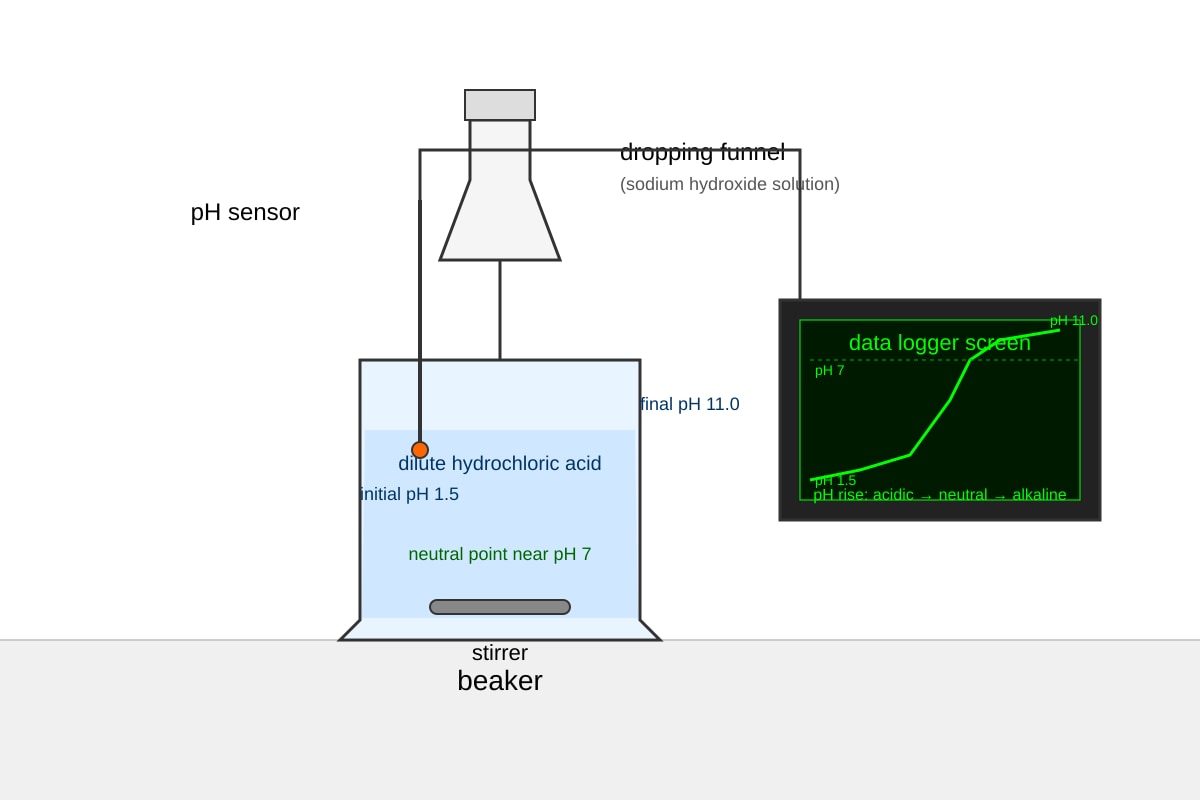
Q13 [4 marks] pH increases from 1.5 to 11.0 (1); OH⁻ from NaOH neutralise H⁺ (1); at pH 7 neutral (1); beyond, excess OH⁻ makes alkaline (1).
Image note: Setup must show pH sensor, acid, NaOH addition, rising pH curve.
Q14 [4 marks] Lower concentration → fewer acid particles in same volume (1); fewer collisions per time (1); fewer effective collisions (≥ Ea) (1); lower rate (1).
Teaching note: Collision theory: rate depends on frequency of effective collisions.
Section C Answers
Q15 [4 marks]
HCl + NaOH → NaCl + H₂O
n(HCl) = 0.100 × 25.0/1000 = 0.00250 mol [1]
Ratio 1:1 → n(NaOH) = 0.00250 mol [1]
c(NaOH) = 0.00250 × 1000 / 20.0 = 0.125 mol/dm³ [2]
Common mistake: forgetting /1000 for cm³ to dm³.
Q16 [5 marks]
(a) H₂SO₄ + 2KOH → K₂SO₄ + 2H₂O [1]
(b) n(H₂SO₄) = 0.200 × 30.0/1000 = 0.00600 mol [1]
n(KOH) = 2 × 0.00600 = 0.0120 mol [1]
c(KOH) = 0.0120 × 1000 / 25.0 = 0.480 mol/dm³ [2]
Note: Diprotic acid gives 2 moles OH⁻ per mole acid.
Q17 [4 marks] Mix solutions (1); filter precipitate (1); wash with distilled water (1); dry in oven / warm (1).
Teaching note: Insoluble salt obtained by precipitation then purification.
Q18 [2 marks] Pb²⁺(aq) + 2Cl⁻(aq) → PbCl₂(s)
Teaching note: Ionic equation shows only ions forming precipitate.
Q19 [2 marks] Acidic solution (pH < 7); can react with bases (any two valid).
Teaching note: Strong acid + weak base → acidic salt (e.g., NH₄Cl).
Q20 [2 marks] NH₄Cl hydrolyses: NH₄⁺ + H₂O ⇌ NH₃ + H₃O⁺ (1); H₃O⁺ makes solution acidic, litmus red (1).
Teaching note: Ammonium salts of weak bases are acidic in water.
End of Answer Key