AI Generated Exam Paper
Secondary 4 Combined Science Chemistry Practice Paper 4
Free Sec 4 Comb Sci Chem Practice Paper 4, DeepSeek AI version, with questions, answers, and O Level-style practice for Singapore students.
These static practice materials are generated from the site's syllabus and paper-generation workflow, with source and model context shown so students and parents can evaluate the material before use.
Questions
Free quiz and exam paper access
Enter your details to view this paper
Your access is remembered on this device.
Answers
TuitionGoWhere Practice Paper - Combined Science Chemistry Secondary 4
Answer Key and Marking Scheme (Version 4)
Total Marks: 65
Section A: Multiple Choice (10 marks)
| Question | Answer | Explanation |
|---|---|---|
| 1 | B | Ammonium ion is NH₄⁺; sulfate ion is SO₄²⁻. Two ammonium ions are needed to balance one sulfate ion: (NH₄)₂SO₄. |
| 2 | D | Blue colour with universal indicator indicates an alkaline solution. pH 11 is alkaline. pH 2 and 5 are acidic; pH 7 is neutral. |
| 3 | C | Zinc oxide (ZnO) is amphoteric—it reacts with both acids and bases. Na₂O is basic; SO₂ is acidic; CO is neutral. |
| 4 | C | Lead(II) sulfate is insoluble. It is best prepared by precipitation: mixing solutions of lead(II) nitrate and sodium sulfate, then filtering and drying the precipitate. |
| 5 | B | Aluminium ions form a white precipitate of Al(OH)₃ with a few drops of NaOH. This precipitate dissolves in excess NaOH to form a colourless solution of sodium aluminate. |
| 6 | C | A strong acid ionises completely in water, producing a high concentration of H⁺ ions. Strength is not the same as concentration. Strong acids have low pH, not high pH. |
| 7 | B | Barium sulfate (BaSO₄) is insoluble in water. All sodium, potassium, and nitrate salts are soluble; most chlorides are soluble. |
| 8 | D | A pipette is used to measure a fixed volume (e.g., 25.0 cm³) accurately. A burette measures variable volumes; a measuring cylinder is less precise; a beaker is not precise. |
| 9 | C | Acid + reactive metal → salt + hydrogen gas. Zinc reacts with HCl to produce ZnCl₂ and H₂. |
| 10 | B | Sulfuric acid is used in car batteries as the electrolyte. It is not applied directly as fertiliser, not a food flavouring, and not used in glass-making. |
Marking: 1 mark per correct answer. Total = 10 marks.
Section B: Structured Questions (35 marks)
Question 11 (7 marks)
(a) Balanced equation with state symbols: [2 marks]
- MgCO₃(s) + 2HNO₃(aq) → Mg(NO₃)₂(aq) + H₂O(l) + CO₂(g)
- Award 1 mark for correct formulae and balancing.
- Award 1 mark for correct state symbols.
- Accept correct multiples.
(b) Two observations: [2 marks]
- Effervescence / bubbles of gas produced / fizzing (1 mark)
- Solid magnesium carbonate dissolves / disappears (1 mark)
- Accept: colourless gas evolved; solution formed.
(c) Steps to obtain pure, dry crystals: [3 marks]
- Filter the reaction mixture to remove any unreacted magnesium carbonate (if excess was used) / or state that filtration is not needed if exact amounts were used (1 mark)
- Heat the filtrate to evaporate some water until the solution is saturated / until crystallisation point is reached (1 mark)
- Allow the solution to cool; crystals of magnesium nitrate will form. Filter the crystals and dry them between sheets of filter paper (1 mark)
- Note: If student states that excess MgCO₃ was used, filtration is required. If stoichiometric amounts were used, filtration may not be needed. Accept either approach with correct reasoning.
Question 12 (7 marks)
(a) Raw materials for Haber process: [2 marks]
- Nitrogen (from air) (1 mark)
- Hydrogen (from natural gas / cracking of hydrocarbons) (1 mark)
(b) Balanced equation with state symbols: [2 marks]
- N₂(g) + 3H₂(g) ⇌ 2NH₃(g)
- Award 1 mark for correct formulae and balancing.
- Award 1 mark for correct state symbols and reversible reaction arrow.
(c) Chemical test for ammonia gas: [2 marks]
- Hold a glass rod dipped in concentrated hydrochloric acid near the gas / bring concentrated HCl near the gas (1 mark)
- Dense white fumes of ammonium chloride are formed (1 mark)
- Accept: use of damp red litmus paper—turns blue (but this is less specific).
(d) Equation for ammonium nitrate formation: [1 mark]
- NH₃ + HNO₃ → NH₄NO₃
- Accept with state symbols: NH₃(g) + HNO₃(aq) → NH₄NO₃(aq)
Question 13 (6 marks)
(a) Balanced equation: [1 mark]
- 2KOH + H₂SO₄ → K₂SO₄ + 2H₂O
- Accept: 2KOH(aq) + H₂SO₄(aq) → K₂SO₄(aq) + 2H₂O(l)
(b) Moles of sulfuric acid: [1 mark]
- n(H₂SO₄) = c × V = 0.0500 × (20.0/1000) = 0.00100 mol
- Award mark for correct calculation with units.
(c) Moles of potassium hydroxide: [1 mark]
- From equation, mole ratio KOH : H₂SO₄ = 2 : 1
- n(KOH) = 2 × 0.00100 = 0.00200 mol
- Award mark for correct use of mole ratio.
(d) Concentration of KOH in mol/dm³: [1 mark]
- c(KOH) = n/V = 0.00200 / (25.0/1000) = 0.0800 mol/dm³
- Award mark for correct answer with units.
(e) Concentration of KOH in g/dm³: [2 marks]
- Molar mass of KOH = 39 + 16 + 1 = 56 g/mol (1 mark)
- Concentration = 0.0800 × 56 = 4.48 g/dm³ (1 mark)
- Accept 4.5 g/dm³ if rounded appropriately.
Question 14 (8 marks)
(a) Solution with highest [H⁺]: [2 marks]
- Solution W (1 mark)
- It has the lowest pH (pH 1). pH is a measure of hydrogen ion concentration; the lower the pH, the higher the [H⁺] (1 mark).
(b) Gas produced: [1 mark]
- Hydrogen (gas) / H₂
(c) Colour with phenolphthalein: [1 mark]
- Pink / magenta / purple
(d) Strong vs weak acid: [2 marks]
- A strong acid ionises completely in water, producing a high concentration of H⁺ ions (1 mark)
- A weak acid ionises partially in water, producing a lower concentration of H⁺ ions (1 mark)
- Accept: strong acid molecules all dissociate; weak acid molecules only some dissociate, establishing an equilibrium.
Question 15 (7 marks)
(a) Name of white precipitate: [1 mark]
- Barium sulfate
(b) Balanced equation with state symbols: [2 marks]
- BaCl₂(aq) + H₂SO₄(aq) → BaSO₄(s) + 2HCl(aq)
- Award 1 mark for correct formulae and balancing.
- Award 1 mark for correct state symbols (BaSO₄ must be (s)).
(c) Why suitable for preparing insoluble salt: [2 marks]
- Barium sulfate is insoluble in water (1 mark)
- It can be prepared by precipitation—mixing two soluble solutions (BaCl₂ and H₂SO₄) produces the insoluble salt as a precipitate, which can be easily separated by filtration (1 mark).
(d) Obtaining pure, dry sample: [2 marks]
- Filter the mixture to collect the barium sulfate precipitate as the residue (1 mark)
- Wash the precipitate with distilled water, then dry it between sheets of filter paper or in a warm oven (1 mark)
Section C: Data-Based and Extended Questions (20 marks)
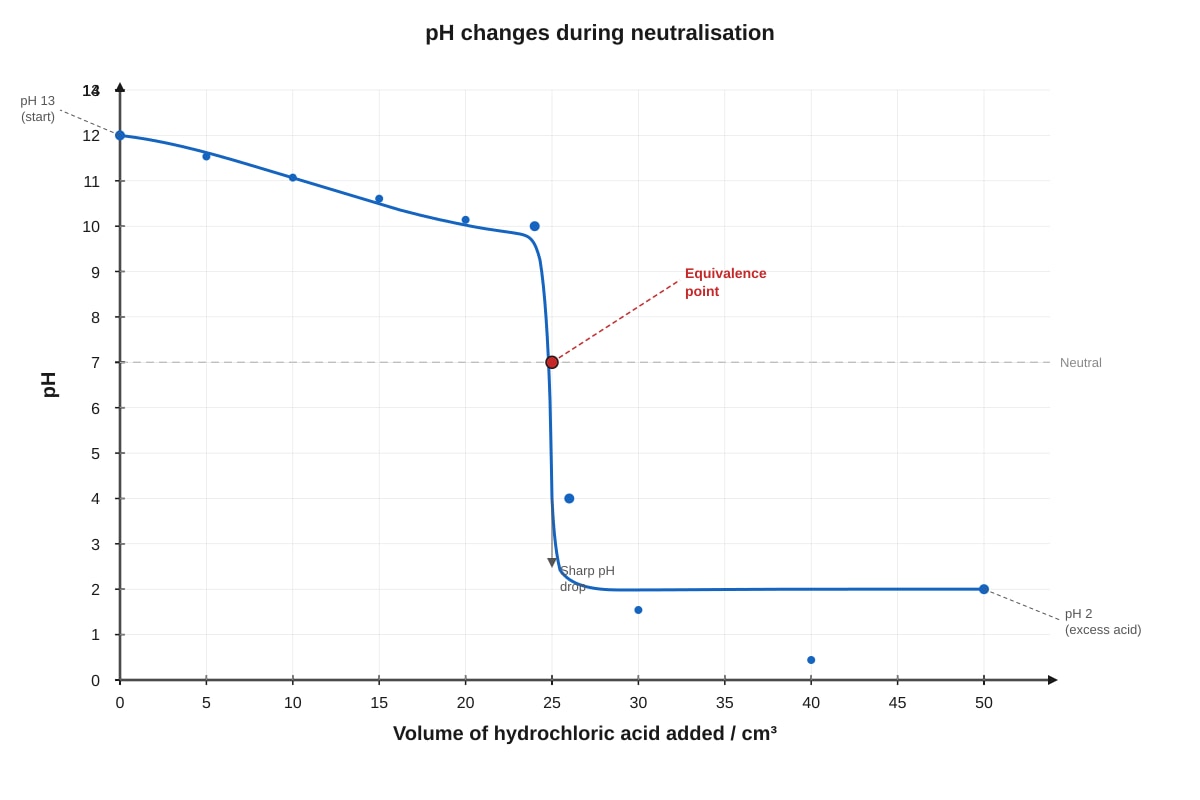
Question 16 (10 marks)
(a) Initial pH: [1 mark]
- pH 13
(b) Volume for neutralisation: [2 marks]
- 25.0 cm³ (1 mark)
- This is the volume at the equivalence point, where the pH changes most rapidly / the midpoint of the vertical section of the graph (1 mark).
(c) Explanation of pH changes: [3 marks]
- Initially (first 20 cm³), the added H⁺ ions react with the excess OH⁻ ions in the alkali. The OH⁻ concentration remains high, so pH changes very little (1 mark)
- Near the equivalence point (24–26 cm³), most of the OH⁻ ions have been neutralised (1 mark)
- A small addition of acid causes a large change in the H⁺/OH⁻ ratio, resulting in a rapid pH drop (1 mark).
(d)(i) Prediction for ethanoic acid: [2 marks]
- The vertical section of the graph would be less steep / the pH change at the equivalence point would be less sharp (1 mark)
- Ethanoic acid is a weak acid, so the solution at the equivalence point contains ethanoate ions which act as a buffer, resisting pH change / the salt formed (sodium ethanoate) is alkaline due to hydrolysis, so the equivalence point pH is higher (above 7) (1 mark).
(d)(ii) pH at equivalence point: [2 marks]
- pH > 7 / approximately 8–9 (1 mark)
- The salt formed (sodium ethanoate) undergoes hydrolysis; ethanoate ions react with water to produce OH⁻ ions, making the solution alkaline (1 mark).
Question 17 (10 marks)
(a) Acid to use: [1 mark]
- (Dilute) sulfuric acid / H₂SO₄
(b) Why add CuO in excess: [2 marks]
- To ensure all the acid is completely reacted / neutralised (1 mark)
- This ensures no acid remains in the solution, which would contaminate the copper(II) sulfate crystals (1 mark).
(c) Balanced equation with state symbols: [2 marks]
- CuO(s) + H₂SO₄(aq) → CuSO₄(aq) + H₂O(l)
- Award 1 mark for correct formulae and balancing.
- Award 1 mark for correct state symbols.
(d) Filtration explanation: [2 marks]
- Filtration is necessary to separate the unreacted (excess) copper(II) oxide from the copper(II) sulfate solution (1 mark)
- The unreacted copper(II) oxide (black solid) is collected in the filter paper as the residue; copper(II) sulfate solution (blue) is collected as the filtrate (1 mark).
(e) Obtaining crystals: [3 marks]
- Heat the filtrate gently to evaporate some water until the solution is saturated / until a small sample on a glass rod forms crystals when cooled (1 mark)
- Allow the solution to cool slowly; blue crystals of copper(II) sulfate pentahydrate (CuSO₄·5H₂O) will form (1 mark)
- The solution should not be heated to dryness because: this would produce anhydrous copper(II) sulfate (white powder) instead of the hydrated crystals / the water of crystallisation would be driven off / the crystals would decompose (1 mark).
Question 18 (7 marks)
(a) Balanced equation: [2 marks]
- H₂SO₄ + Ca(OH)₂ → CaSO₄ + 2H₂O
- Award 1 mark for correct formulae and balancing.
- Award 1 mark for correct equation (state symbols not required but accept: H₂SO₄(aq) + Ca(OH)₂(s) → CaSO₄(s) + 2H₂O(l)).
(b) Why effective: [2 marks]
- Calcium hydroxide is a base/alkali that neutralises the sulfuric acid (1 mark)
- The neutralisation reaction produces calcium sulfate (which is sparingly soluble/insoluble) and water, raising the pH of the wastewater from acidic to near neutral (pH ~7) (1 mark).
(c) Reason for preference: [1 mark]
- Calcium hydroxide is cheaper / more readily available / less corrosive than sodium hydroxide
- Accept: calcium hydroxide is less soluble, so it is easier to control the amount added / less risk of making the water too alkaline.
(d) Importance of correct amount: [2 marks]
- Too little: the wastewater will remain acidic, which can harm aquatic life / corrode pipes (1 mark)
- Too much: the wastewater will become alkaline, which can also harm aquatic life / cause environmental damage (1 mark).
Question 19 (10 marks)
(a) Cation in Solution A: [3 marks]
- Aluminium ion / Al³⁺ (1 mark)
- Evidence: White precipitate formed with a few drops of NaOH(aq) (1 mark)
- The precipitate dissolves in excess NaOH(aq), which is characteristic of Al³⁺ (and Zn²⁺ and Pb²⁺) (1 mark)
- Additional evidence: White precipitate with NH₃(aq) that does not dissolve in excess—this distinguishes Al³⁺ from Zn²⁺ (which would dissolve in excess NH₃).
(b) Two anions in Solution A: [3 marks]
- Chloride ion / Cl⁻ (1 mark)
- Evidence: White precipitate formed with dilute HNO₃ + AgNO₃(aq) (1 mark)
- Sulfate ion / SO₄²⁻ (1 mark)
- Evidence: White precipitate formed with dilute HCl + BaCl₂(aq) (1 mark)
- Award marks for correct identification with supporting evidence.
(c) Identity of Solution B: [2 marks]
- Solution B is water / a neutral solution / a solution of a salt that does not contain the ions tested for (1 mark)
- Evidence: pH 7 (neutral), no precipitates with any of the test reagents (1 mark).
(d) Anion in Solution C: [2 marks]
- Iodide ion / I⁻ (1 mark)
- Evidence: Brown precipitate formed with dilute HNO₃ + AgNO₃(aq). Silver iodide is a pale yellow/brown precipitate (1 mark).
- Note: Solution C is alkaline (pH 13), consistent with an alkali metal iodide solution.
Question 20 (10 marks)
(a) Why H₂SO₄ has lower pH than HCl: [2 marks]
- Sulfuric acid is a diprotic acid—each molecule of H₂SO₄ produces two H⁺ ions when it ionises completely (1 mark)
- Hydrochloric acid is monoprotic—each molecule produces only one H⁺ ion. At the same concentration, H₂SO₄ produces twice the concentration of H⁺ ions, resulting in a lower pH (1 mark).
(b) Why ethanoic acid has higher pH: [2 marks]
- Ethanoic acid is a weak acid; it ionises only partially in water (1 mark)
- At the same concentration (0.10 mol/dm³), ethanoic acid produces a much lower concentration of H⁺ ions than the strong acid HCl, which ionises completely. Lower [H⁺] means higher pH (1 mark).
(c) Observations and rate comparison: [3 marks]
- Observations: Effervescence / bubbles of gas; magnesium dissolves; solution may become warm (any two, 1 mark each, max 2 marks)
- Rate comparison: The rate of reaction would be fastest in sulfuric acid (highest [H⁺]), followed by hydrochloric acid and nitric acid (similar [H⁺]), and slowest in ethanoic acid (lowest [H⁺]) (1 mark)
- Accept: The rate depends on the concentration of H⁺ ions; strong acids react faster than weak acids of the same concentration.
(d) Experiment to show ethanoic acid is weak: [3 marks]
- Measure the electrical conductivity of the acid solutions (1 mark)
- Ethanoic acid solution would have a much lower electrical conductivity than HCl solution of the same concentration (1 mark)
- This is because ethanoic acid has fewer free ions (H⁺ and CH₃COO⁻) in solution due to partial ionisation, while HCl is fully ionised (1 mark)
- Alternative acceptable answer: Compare the rate of reaction with a metal (e.g., magnesium) or carbonate—ethanoic acid reacts much more slowly, indicating lower [H⁺].
- Alternative: Measure the pH of the acid after diluting it ten times. A strong acid pH increases by 1 unit; a weak acid pH changes by less than 1 unit due to the equilibrium shifting.
— END OF MARKING SCHEME —
Total marks: 65. Award marks for correct scientific reasoning even if wording differs from the scheme. ECF (error carried forward) may be applied for multi-step calculations where appropriate.