AI Generated Exam Paper
Secondary 4 Combined Science Chemistry Practice Paper 3
Free Sec 4 Comb Sci Chem Practice Paper 3, HY3 AI version, with questions, answers, and O Level-style practice for Singapore students.
These static practice materials are generated from the site's syllabus and paper-generation workflow, with source and model context shown so students and parents can evaluate the material before use.
Questions
Free quiz and exam paper access
Enter your details to view this paper
Your access is remembered on this device.
Answers
TuitionGoWhere Practice Paper — Answer Key (Version 3)
Subject: Combined Science Chemistry
Level: Secondary 4
Topic: Acids, Bases & Salts
Total Marks: 65
Section A Answers
1. [1 mark] Red.
Teaching note: Litmus is red in acidic solutions (pH < 7). pH 2 is strongly acidic.
2. [1 mark] Hydrogen ion, H⁺ (or H₃O⁺ hydronium).
Teaching note: Acids release H⁺ ions in water; this gives acidic properties.
3. [2 marks]
- Add a few drops of phenolphthalein (or litmus) to the solution. [1]
- If OH⁻ present, phenolphthalein turns pink (or litmus turns blue). [1]
Teaching note: Hydroxide ions are characteristic of bases/alkalis; indicators change colour in their presence.
4. [2 marks] HCl(aq) + NaOH(aq) → NaCl(aq) + H₂O(l)
[2 for balanced equation; allow 1 if reactants correct but state unbalanced]
Teaching note: Neutralisation: acid + base → salt + water.
5. [2 marks]
(a) Base [1]
(b) Salt [1]
Teaching note: MgO is a metal oxide (base); KCl is formed from acid + base (salt).
6. [2 marks] Pink [1]; sodium carbonate is alkaline because CO₃²⁻ reacts with water to produce OH⁻ [1].
Teaching note: Carbonates of alkali metals form alkaline solutions.
7. [3 marks] pH 8–10 [1]; alkaline [1]; because universal indicator is blue in that range [1].
Teaching note: Blue corresponds to pH 8–10 on given table; above 7 is alkaline.
8. [3 marks] MgO is a base because it reacts with acids to form salt and water [1]; it is not an alkali because it is insoluble in water and alkalis are bases soluble in water [2].
Teaching note: All alkalis are bases, but not all bases are alkalis (solubility matters).
Section B Answers
9. [4 marks]
- Add excess CuO to warm dilute H₂SO₄. [1]
- Filter to remove unreacted CuO. [1]
- Evaporate filtrate to crystallisation point, cool. [1]
- Filter crystals, wash, dry. Method suitable: CuO insoluble base + soluble salt CuSO₄. [1]
Teaching note: Excess base ensures complete reaction; filtration removes solid; crystallisation isolates pure salt.
10. [3 marks] Ethanoic acid: no change (stays orange/brown) [1]; propenoic acid: decolourises [1]; because propenoic has C=C (unsaturated), ethanoic does not [1].
Teaching note: Bromine water tests unsaturation; C=C adds Br₂, removing colour.
11. [4 marks]
(a) Precipitation [1]
(b) Decomposition [1]
(c) Neutralisation [1]; (also redox if argued? No, not redox) [1 for clear classification]
Teaching note: AgCl is insoluble solid (precipitate); H₂O₂ breaks down; acid+base→salt+water.
12. [4 marks] Add calcium hydroxide, Ca(OH)₂ (or Mg(OH)₂) [1]; it is a base that neutralises acid [1]; M(OH)₂ + 2H⁺ → M²⁺ + 2H₂O [1]; raises pH to near neutral [1].
Teaching note: Soil acidity corrected by base; equation shows H⁺ consumed.
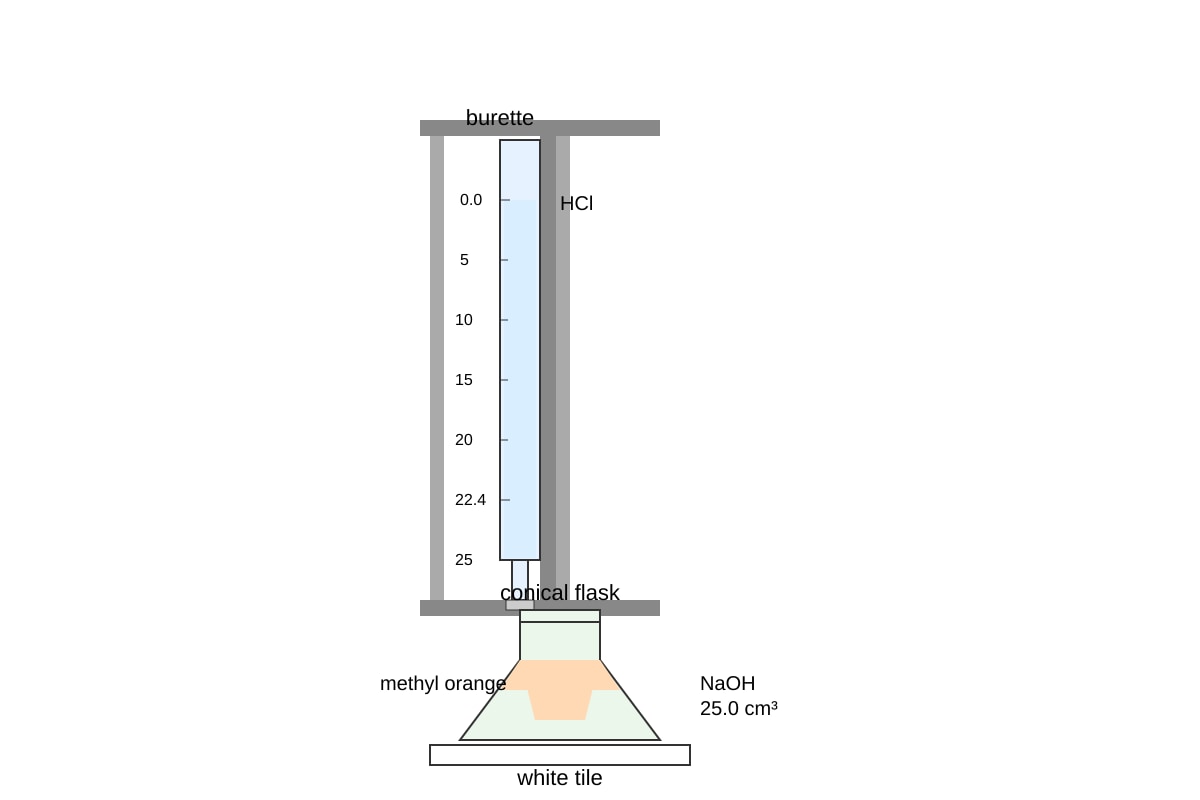
13. [4 marks] Endpoint: methyl orange changes from yellow (alkaline) to orange/red (acidic) [2]; indicator must change at pH near equivalence (~7 for strong acid–strong base, methyl orange acceptable but not ideal; must show visible change) [2].
Teaching note: Titration endpoint is sharp colour change; indicator choice depends on pH range.
14. [4 marks] Strong acid fully ionises (e.g. HCl → H⁺ + Cl⁻) [1]; weak acid partially ionises (e.g. CH₃COOH ⇌ H⁺ + CH₃COO⁻) [1]; same concentration → strong has higher [H⁺] and lower pH [2].
Teaching note: Degree of ionisation differentiates strength, not concentration.
15. [4 marks] Hold damp red litmus near gas [1]; turns blue [1]; NH₃ dissolves to form NH₄OH releasing OH⁻ [2].
Teaching note: Ammonia is alkaline gas; damp litmus required for ionisation.
Section C Answers
16. [5 marks]
(a) HCl + NaOH → NaCl + H₂O [1]
(b) Moles HCl = 0.100 × 25.0/1000 = 0.00250 mol [1]
Mole ratio 1:1 → moles NaOH = 0.00250 [1]
Conc NaOH = 0.00250 × 1000 / 20.0 = 0.125 mol/dm³ [2]
Teaching note: Convert cm³ to dm³ by /1000; use 1:1 stoichiometry.
17. [5 marks]
(a) Pb²⁺(aq) + 2Cl⁻(aq) → PbCl₂(s) [2]
(b) Filter precipitate [1]; wash with distilled water [1]; dry in oven or air-dry [1].
Teaching note: Insoluble salt by precipitation; purification removes soluble ions.
18. [4 marks] Higher concentration → more acid particles per volume [1]; more frequent collisions with metal [1]; more effective collisions (≥ activation energy) [1]; faster rate [1].
Teaching note: Collision theory: rate ∝ frequency of effective collisions.
19. [4 marks] Increasing [H⁺]: X (pH7) < Y(pH10) < W(pH3) < Z(pH1) [2]; lower pH means higher [H⁺] because pH = –log[H⁺] [2].
Teaching note: pH scale inverse logarithmic; pH1 has 10× more H⁺ than pH2.
20. [4 marks]
Ammonium: add NaOH, warm, test gas with damp red litmus → blue [2].
Sulfate: add Ba(NO₃)₂ → white ppt BaSO₄ [2].
Teaching note: NH₄⁺ releases NH₃; SO₄²⁻ forms insoluble barium sulfate.
Total Marks: 65