From Real Exams Exam Paper
Secondary 4 Combined Science Chemistry Preliminary Examination Paper 5
Free Sec 4 Comb Sci Chem Prelim Paper 5, HY3 Exam version, with questions, answers, and O Level-style practice for Singapore students.
These static practice materials are generated from the site's syllabus and paper-generation workflow, with source and model context shown so students and parents can evaluate the material before use.
Questions
TuitionGoWhere Exam Practice (AI) — Preliminary Practice Paper
Combined Science Chemistry Secondary 4 (Version 5 of 5)
School: TuitionGoWhere Secondary School (AI)
Subject: Combined Science Chemistry
Level: Secondary 4
Paper: PRELIM Practice Paper (Chemistry Component)
Version: 5 of 5
Duration: 1 hour 15 minutes
Total Marks: 65
Name: ___________________________
Class: ___________
Date: ____________
Instructions:
- Answer all questions in the spaces provided.
- Show all working clearly where calculation is required.
- Use proper chemical notation (e.g., H+, OH−, NaCl).
- Section A: Short structured questions (1–10). Section B: Data and diagram interpretation (11–15). Section C: Extended structured response (16–20).
Section A: Short Structured Questions (22 marks)
1. [2 marks] State the colour change observed when bromine water is added to an unsaturated organic acid such as cinnamic acid.
2. [1 mark] Name the ion responsible for the acidic properties of all aqueous acids.
3. [2 marks] Describe a chemical test, including reagent and observation, to show that oleic acid (contains C=C) is unsaturated.
4. [1 mark] Which apparatus is most suitable for measuring exactly 25.0 cm3 of hydrochloric acid?
A) Beaker B) Measuring cylinder C) Pipette D) Burette
5. [2 marks] Write the ionic equation for the neutralisation of hydrochloric acid by sodium hydroxide solution.
6. [2 marks] Explain, using collision theory, why decreasing the concentration of an acid lowers the rate of reaction with a metal.
7. [3 marks] 20.0 cm3 of 0.50 mol dm−3 sodium hydroxide is exactly neutralised by 25.0 cm3 of sulfuric acid. Calculate the concentration of the sulfuric acid in mol dm−3.
8. [2 marks] Classify the following reaction using terms from: {neutralisation, redox, addition, substitution, decomposition}.
2Na+2H2O→2NaOH+H2
9. [2 marks] State two effects of carbon monoxide on human beings.
10. [5 marks] A student prepares copper(II) sulfate by adding excess copper(II) oxide powder to warm dilute sulfuric acid.
(a) Write the balanced chemical equation for the reaction. [2]
(b) Describe how the student should obtain pure dry crystals of copper(II) sulfate from the mixture. [3]
Section B: Data and Diagram Interpretation (20 marks)
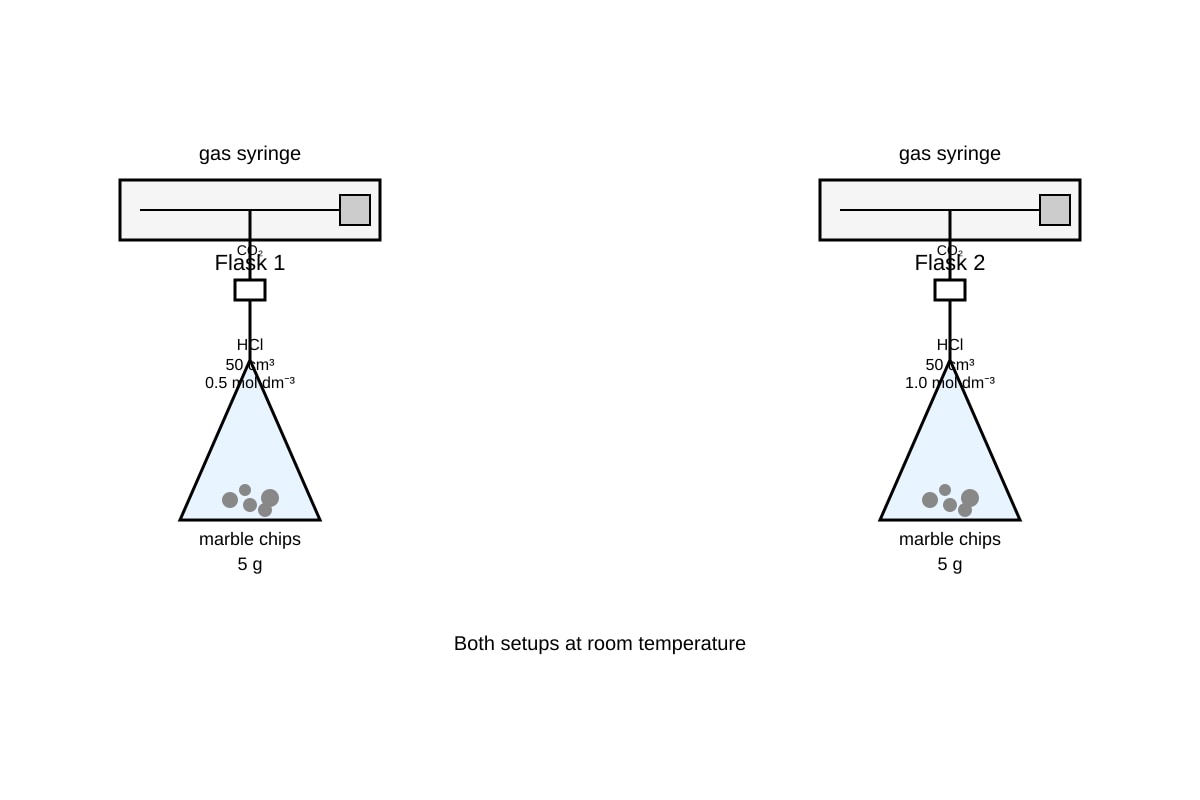
11. [4 marks] The diagram below shows an experimental setup used to compare the rate of reaction between marble chips and hydrochloric acid at two concentrations.
Image pending generation: experimental_setup for Q11.
(a) Predict which flask produces CO₂ faster. Explain using collision theory. [2]
(b) State one variable that must be kept constant. [1]
(c) Name the gas collected. [1]
12. [4 marks] The table shows pH values of solutions after adding equal volumes of 0.1 mol dm−3 NaOH to 25 cm3 of 0.1 mol dm−3 HCl.
| Volume NaOH added / cm³ | pH |
|---|---|
| 0 | 1 |
| 12.5 | 1.5 |
| 25.0 | 7 |
| 37.5 | 12.5 |
(a) State the volume of NaOH needed for neutralisation. [1]
(b) Explain why pH becomes above 7 after adding more than 25.0 cm³. [3]
13. [4 marks] A red litmus paper turns blue when dipped into solution X.
(a) State whether X is acidic, basic, or neutral. [1]
(b) Give one example of a common household substance that could be X. [1]
(c) Write the formula of the ion that causes this property. [2]
14. [4 marks] The following are terms: {addition, fermentation, neutralisation, rusting, redox, substitution}. Classify each reaction:
(a) CH3CH2OH→CH3COOH (in presence of air, bacteria) [1]
(b) Fe+O2+H2O→Fe2O3⋅xH2O [1]
(c) HCl+NaOH→NaCl+H2O [1]
(d) C2H4+Br2→C2H4Br2 [1]
15. [4 marks] A student added bromine water to sample Y and the colour remained orange/brown.
(a) Is Y saturated or unsaturated? [1]
(b) If Y is a carboxylic acid with no C=C bond, name a suitable test to confirm it is an acid. [1]
(c) State the expected observation for the acid test in (b). [2]
Section C: Extended Structured Response (23 marks)
16. [5 marks] A factory discharges waste containing hydrochloric acid into a river. Environmental officers suggest adding calcium carbonate to neutralise it.
(a) Write the balanced equation for the reaction. [2]
(b) Explain why this method is suitable, referring to products. [3]
17. [5 marks] Describe how to prepare a pure dry sample of soluble salt ammonium chloride from ammonia solution and hydrochloric acid. Include equation, method, and crystallization.
18. [4 marks] Explain the effects of carbon monoxide on human beings, including the mechanism of binding and physiological consequences.
19. [5 marks] 50.0 cm3 of 0.20 mol dm−3 barium chloride reacts with excess sodium sulfate.
(a) Write ionic equation for precipitate formation. [2]
(b) Calculate moles of precipitate formed. [3]
20. [4 marks] Using collision theory, explain why powdered calcium carbonate reacts faster with acid than lumps of the same mass.
End of Paper — Total Marks: 65
Answers
TuitionGoWhere Exam Practice (AI) — Preliminary Practice Paper
Combined Science Chemistry Secondary 4 (Version 5 of 5) — Answer Key
Total Marks: 65
Section A: 22 marks | Section B: 20 marks | Section C: 23 marks
Section A Answers
1. [2] Orange/brown bromine water decolourises to colourless.
Marking: 1 mark for “decolourises / becomes colourless”, 1 mark for stating original colour (orange/brown). Teaching: Unsaturated acids have C=C which react with Br₂, breaking the coloured bromine molecule.
2. [1] H+ (hydrogen ion).
Marking: 1 mark for H+. Teaching: Arrhenius definition — acids release H+ in water.
3. [2] Add bromine water to oleic acid; observation: orange/brown colour changes to colourless.
Marking: 1 for reagent (bromine water), 1 for observation. Teaching: C=C bond undergoes addition with bromine.
4. [1] C) Pipette.
Marking: 1 for C. Teaching: Pipette measures fixed exact volume (e.g., 25.0 cm³); burette is for variable, cylinder less precise.
5. [2] H++OH−→H2O
Marking: 1 for H+ and OH−, 1 for H2O. Teaching: Net ionic equation removes spectator ions Na⁺ and Cl⁻.
6. [2] Lower concentration means fewer acid particles in same volume → fewer collisions per time → fewer effective collisions (≥ activation energy) → lower rate.
Marking: 1 for collision frequency, 1 for effective collision/rate link.
7. [3]
Step 1: n(NaOH)=C×V=0.50×100020.0=0.0100 mol
Step 2: 2NaOH+H2SO4→Na2SO4+2H2O → mol H2SO4=0.0100/2=0.00500 mol
Step 3: C(H2SO4)=n/V=0.00500/(25.0/1000)=0.200 mol dm−3
Marking: 1 for NaOH moles, 1 for acid moles, 1 for concentration. Teaching: Stoichiometric ratio 2:1.
8. [2] Redox and neutralisation (or redox only if not accepting double). Actually: redox (Na oxidised, H reduced) and also forms base+gas; best: redox. Award 2 if both redox and neutralisation stated with justification.
Marking: 1 per correct term. Teaching: Na loses e⁻, H⁺ gains e⁻ → redox; also acid-base if considering water as acid.
9. [2] Binds to haemoglobin; reduces oxygen transport → fatigue/headache/death.
Marking: 1 for binding, 1 for effect.
10. [5]
(a) [2] CuO+H2SO4→CuSO4+H2O
(b) [3] Filter to remove excess CuO; heat filtrate to evaporate water; leave to crystallise; filter crystals; dry between paper.
Marking: eq 2; method 3 (filter, evaporate, crystallise). Teaching: Insoluble base + acid → salt + water; excess base removed by filtration.
Section B Answers
11. [4]
(a) [2] Flask 2 (1.0 mol dm⁻³) faster; higher concentration → more particles → more frequent effective collisions.
(b) [1] Temperature / mass of chips / volume of acid.
(c) [1] Carbon dioxide (CO2).
Image needed: two flasks with labels as described; gas syringe shows volume.
12. [4]
(a) [1] 25.0 cm³.
(b) [3] Excess NaOH added; OH− concentration rises; solution becomes basic; pH > 7.
Marking: 1 excess OH⁻, 1 basic, 1 pH explanation.
13. [4]
(a) [1] Basic.
(b) [1] Soap / baking soda / ammonia cleaner.
(c) [2] OH−.
Teaching: Bases turn red litmus blue due to hydroxide ions.
14. [4]
(a) [1] Fermentation (or oxidation).
(b) [1] Rusting (and redox).
(c) [1] Neutralisation.
(d) [1] Addition.
Marking: 1 each.
15. [4]
(a) [1] Saturated.
(b) [1] Add litmus / react with metal / pH paper.
(c) [2] Blue litmus stays blue / red turns blue; or effervescence with Mg.
Marking: 2 for correct observation.
Section C Answers
16. [5]
(a) [2] CaCO3+2HCl→CaCl2+CO2+H2O
(b) [3] Products are harmless salt, water, CO₂; neutralises acid safely; cheap and abundant.
Marking: eq 2, explanation 3.
17. [5]
- Equation: NH3+HCl→NH4Cl [1]
- Add HCl slowly to ammonia until pH 7 / using indicator [1]
- Evaporate gently [1], crystallise [1], filter and dry crystals [1].
Teaching: Soluble salt from alkali + acid, no excess base to remove.
18. [4] CO binds irreversibly to haemoglobin [2]; less O₂ carried → tissues starve → fatigue, headache, death [2].
19. [5]
(a) [2] Ba2++SO42−→BaSO4(s)
(b) [3] n(BaCl2)=0.20×0.050=0.0100 mol; 1:1 ratio → 0.0100 mol BaSO4.
Marking: eq 2, moles 3.
20. [4] Powder has larger surface area [2]; more particles exposed → more frequent collisions [2].
Marking: 2 per point.
Free quiz and exam paper access
Enter your details to view this paper
Your access is remembered on this device.