From Real Exams Exam Paper
Secondary 4 Combined Science Chemistry Preliminary Examination Paper 5
Free Sec 4 Comb Sci Chem Prelim Paper 5, DeepSeek Exam version, with questions, answers, and O Level-style practice for Singapore students.
These static practice materials are generated from the site's syllabus and paper-generation workflow, with source and model context shown so students and parents can evaluate the material before use.
Questions
Free quiz and exam paper access
Enter your details to view this paper
Your access is remembered on this device.
Answers
TuitionGoWhere Secondary School (AI)
Preliminary Examination 2025 – ANSWER KEY
Combined Science (Chemistry) – Paper 2
Version 5 of 5
Total Marks: 65
Section A: Structured Questions (20 marks)
1. (a) [2 marks]
Answer: The solution is an acid.
Evidence 1: Universal Indicator turns blue-violet in alkaline solutions, but the reaction with magnesium producing hydrogen gas confirms acidity. (Accept: Magnesium reacts with acids to produce hydrogen gas / effervescence with Mg indicates acid.)
Evidence 2: No reaction with sodium carbonate is unusual for a typical acid, but the positive magnesium test overrides this; the solution may be a weak acid that does not react vigorously with carbonate. (Accept reasoned argument based on evidence hierarchy.)
Marking:
- 1 mark for identifying as acidic
- 1 mark for using at least one correct piece of evidence (Mg + acid → H₂)
1. (b) [2 marks]
Answer:
Mg(s) + 2HCl(aq) → MgCl₂(aq) + H₂(g)
Marking:
- 1 mark for correct formulae and balancing
- 1 mark for correct state symbols (all four must be correct)
1. (c) [1 mark]
Answer: The acid may be too weak / the concentration of H⁺ ions may be too low to produce visible effervescence with sodium carbonate. (Accept: The acid may not be strong enough to displace CO₂ from carbonate / reaction too slow to observe.)
Marking: 1 mark for plausible reason linked to acid strength or reaction rate.
2. (a) [1 mark]
Answer: Neutralisation (Accept: Acid-base reaction)
2. (b) [2 marks]
Answer:
Ca(OH)₂(aq) + H₂SO₄(aq) → CaSO₄(aq) + 2H₂O(l)
OR Ca(OH)₂(s) + H₂SO₄(aq) → CaSO₄(aq) + 2H₂O(l)
Marking:
- 1 mark for correct formulae
- 1 mark for correct balancing and state symbols
2. (c) [3 marks]
Answer:
- Mᵣ of Ca(OH)₂ = 40 + 2(16 + 1) = 40 + 34 = 74
- Moles of Ca(OH)₂ = mass / Mᵣ = 7.4 / 74 = 0.10 mol
- Volume in dm³ = 500 / 1000 = 0.500 dm³
- Concentration = moles / volume = 0.10 / 0.500 = 0.20 mol/dm³
Marking:
- 1 mark for correct Mᵣ and moles calculation
- 1 mark for correct volume conversion
- 1 mark for correct final answer with units
2. (d) [1 mark]
Answer: Calcium hydroxide is less corrosive / safer to handle than sodium hydroxide. (Accept: Calcium hydroxide is cheaper / less soluble so less likely to cause over-alkalinity / provides calcium as a nutrient.)
Marking: 1 mark for any valid reason.
3. (a) [3 marks]
| Base | Salt name | Salt formula |
|---|---|---|
| Copper(II) oxide, CuO | Copper(II) nitrate | Cu(NO₃)₂ |
| Sodium hydroxide, NaOH | Sodium nitrate | NaNO₃ |
| Zinc carbonate, ZnCO₃ | Zinc nitrate | Zn(NO₃)₂ |
Marking: 1 mark per correct row (both name and formula must be correct).
3. (b) [2 marks]
Answer:
- Effervescence / bubbles of gas produced
- Solid zinc carbonate dissolves / disappears
(Accept: Colourless gas evolved / gas turns limewater milky.)
Marking: 1 mark for each correct observation (maximum 2).
3. (c) [3 marks]
Answer:
- Filter the mixture to remove excess (unreacted) copper(II) oxide.
- Heat the filtrate gently to evaporate some water until a saturated solution is obtained (crystals begin to form on cooling / at the point of crystallisation).
- Allow the solution to cool slowly; crystals of copper(II) nitrate will form.
- Filter the crystals and dry them between sheets of filter paper.
Marking:
- 1 mark for filtration to remove excess solid
- 1 mark for evaporation to saturation point (not to dryness)
- 1 mark for cooling/crystallisation and drying
Section B: Data-Based and Application Questions (25 marks)
4. (a) [3 marks]
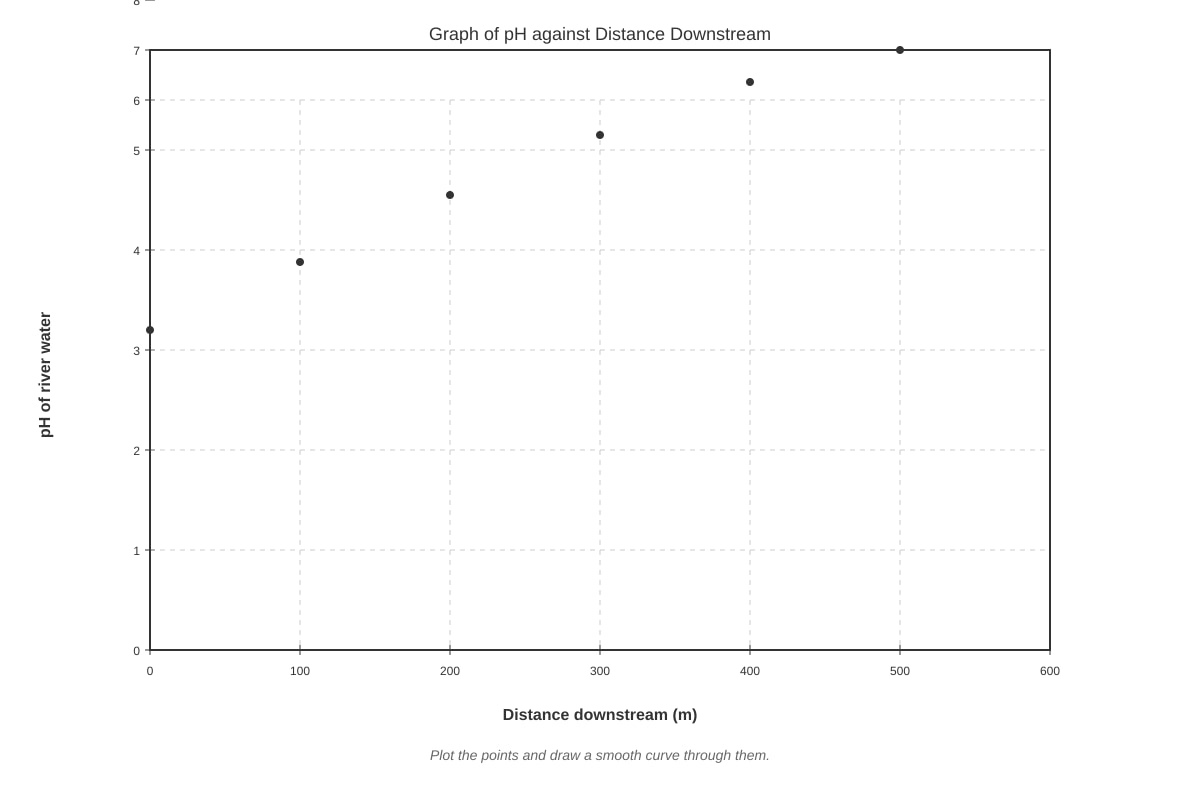
Graph requirements:
- Axes correctly labelled: pH (y-axis), Distance downstream / m (x-axis)
- Appropriate scales chosen (e.g., pH: 1 cm = 1 unit; distance: 1 cm = 50 m or 100 m)
- All 6 points plotted accurately (± half small square)
- Smooth curve drawn through points (not dot-to-dot straight lines)
Marking:
- 1 mark for correct axes and scales
- 1 mark for accurate plotting
- 1 mark for smooth curve
4. (b) [1 mark]
Answer: As distance downstream increases, the pH of the river water increases (becomes less acidic / more neutral).
Marking: 1 mark for correct trend.
4. (c) [2 marks]
Answer: The river water dilutes the acid as it flows downstream. The acid becomes less concentrated, so the concentration of H⁺ ions decreases, causing the pH to rise. (Accept: Dilution by tributaries / neutralisation by minerals in the riverbed / reaction with natural carbonates.)
Marking:
- 1 mark for dilution concept
- 1 mark for link to H⁺ concentration and pH
4. (d)(i) [2 marks]
Answer:
CaCO₃(s) + H₂SO₄(aq) → CaSO₄(aq) + H₂O(l) + CO₂(g)
Marking:
- 1 mark for correct formulae
- 1 mark for correct balancing and state symbols
4. (d)(ii) [2 marks]
Answer:
- Advantage: Calcium carbonate is cheaper / more readily available / less corrosive than sodium hydroxide.
- Disadvantage: Calcium carbonate produces carbon dioxide gas (greenhouse gas) / reaction is slower / may leave solid residue if in excess.
Marking: 1 mark for valid advantage, 1 mark for valid disadvantage.
4. (e) [1 mark]
Answer: The river water is neutral – it is neither acidic nor alkaline. The concentration of H⁺ ions equals the concentration of OH⁻ ions.
Marking: 1 mark for "neutral" or equivalent explanation.
5. (a)(i) [1 mark]
Answer: Ammonium hydroxide (Accept: Aqueous ammonia / ammonia solution)
5. (a)(ii) [2 marks]
Answer:
NH₃(g) + H₂O(l) ⇌ NH₄⁺(aq) + OH⁻(aq)
Marking:
- 1 mark for correct equation with NH₄⁺ and OH⁻ as products
- 1 mark for reversible arrow and state symbols (Accept single arrow if reversible not taught; accept NH₄OH as product if consistent with syllabus)
5. (b)(i) [1 mark]
Answer: Neutralisation (Accept: Acid-base reaction)
5. (b)(ii) [2 marks]
Answer:
- Mᵣ of (NH₄)₂SO₄ = 2(14 + 4×1) + 32 + 4×16
- = 2(18) + 32 + 64
- = 36 + 32 + 64
- = 132
Marking:
- 1 mark for correct working
- 1 mark for correct answer
5. (b)(iii) [2 marks]
Answer: Calcium hydroxide (lime) is a base/alkali. It will react with ammonium sulfate, releasing ammonia gas. This causes loss of nitrogen (the nutrient) from the fertiliser, reducing its effectiveness.
Equation: (NH₄)₂SO₄ + Ca(OH)₂ → CaSO₄ + 2NH₃ + 2H₂O (not required but supports explanation)
Marking:
- 1 mark for stating that ammonia gas is produced/lost
- 1 mark for linking to loss of fertiliser effectiveness
5. (c) [2 marks]
Answer:
- Mᵣ of NH₄NO₃ = 14 + 4×1 + 14 + 3×16 = 14 + 4 + 14 + 48 = 80
- Mass of nitrogen in one formula unit = 2 × 14 = 28
- Percentage of nitrogen = (28 / 80) × 100 = 35.0%
Marking:
- 1 mark for correct Mᵣ and nitrogen mass
- 1 mark for correct percentage
6. (a) [1 mark]
Answer: Pipette (Accept: 25.0 cm³ pipette / volumetric pipette)
6. (b) [1 mark]
Answer: From yellow (in alkali) to orange/peach (at end-point) (Accept: yellow to pink/red if using phenolphthalein equivalent; must match indicator stated)
Marking: 1 mark for both colours correct in correct order.
6. (c)(i) [2 marks]
Answer: Titration 3 should not be used. The volume (23.60 cm³) is significantly lower than the other two concordant results (24.50 and 24.40 cm³). It is an outlier / not concordant.
Marking:
- 1 mark for identifying Titration 3
- 1 mark for explanation (not concordant / outlier)
6. (c)(ii) [1 mark]
Answer: Average volume = (24.50 + 24.40) / 2 = 24.45 cm³
Marking: 1 mark for correct average.
6. (c)(iii) [1 mark]
Answer:
- Volume in dm³ = 24.45 / 1000 = 0.02445 dm³
- Moles of H₂SO₄ = concentration × volume = 0.100 × 0.02445 = 0.002445 mol (Accept: 2.445 × 10⁻³ mol)
Marking: 1 mark for correct calculation.
6. (c)(iv) [1 mark]
Answer: From equation: 2 mol NaOH react with 1 mol H₂SO₄ Moles of NaOH = 2 × 0.002445 = 0.00489 mol (Accept: 4.89 × 10⁻³ mol)
Marking: 1 mark for correct mole ratio application.
6. (c)(v) [2 marks]
Answer:
- Volume of NaOH = 25.0 cm³ = 0.0250 dm³
- Concentration = moles / volume = 0.00489 / 0.0250 = 0.196 mol/dm³ (Accept: 0.20 mol/dm³ if rounded appropriately)
Marking:
- 1 mark for correct method
- 1 mark for correct answer with units
Section C: Extended Response (20 marks)
Question 7
(a)(i) [2 marks]
Answer: A strong acid is an acid that completely ionises/dissociates in aqueous solution to produce a high concentration of H⁺ ions.
Example: Hydrochloric acid (HCl) / Sulfuric acid (H₂SO₄) / Nitric acid (HNO₃)
Marking:
- 1 mark for definition (complete ionisation)
- 1 mark for correct example
(a)(ii) [2 marks]
Answer: A weak alkali is a base that partially ionises/dissociates in aqueous solution to produce a low concentration of OH⁻ ions.
Example: Aqueous ammonia (NH₃ solution) / Calcium hydroxide solution (Accept: any sparingly soluble or weak base)
Marking:
- 1 mark for definition (partial ionisation)
- 1 mark for correct example
(b) [8 marks]
Answer:
Step 1: pH measurement
- Use Universal Indicator / pH meter / pH paper to measure the pH of each solution.
- Hydrochloric acid (0.1 mol/dm³): pH ≈ 1 (strong acid, fully ionised)
- Ethanoic acid (0.1 mol/dm³): pH ≈ 3–4 (weak acid, partially ionised)
- Sodium chloride (0.1 mol/dm³): pH ≈ 7 (neutral salt solution)
- This distinguishes sodium chloride from the two acids.
Step 2: Chemical test to distinguish the two acids
- Add a reactive metal (e.g., magnesium ribbon) or calcium carbonate to each acid.
- Both acids will produce effervescence (H₂ from metal; CO₂ from carbonate).
- To distinguish them: measure the rate of reaction.
- Hydrochloric acid (strong acid, higher [H⁺]) reacts more vigorously/faster than ethanoic acid.
- Alternative: Add Universal Indicator and compare colours more precisely; HCl gives red (pH 1), CH₃COOH gives orange/yellow (pH 3–4).
Conclusion:
- Solution with pH ≈ 7: sodium chloride
- Solution with pH ≈ 1 and vigorous reaction: hydrochloric acid
- Solution with pH ≈ 3–4 and slower reaction: ethanoic acid
Marking:
- 1 mark for using pH to identify NaCl
- 1 mark for correct pH ranges for the two acids
- 1 mark for describing a suitable chemical test
- 1 mark for explaining how the test distinguishes the two acids (rate difference / pH precision)
- 1 mark for clear expected observations for each solution
- 1 mark for logical structure and conclusions
- Up to 2 marks for detailed, accurate scientific language and completeness
(c)(i) [4 marks]
Answer:
- Hydrochloric acid is a strong acid; it completely ionises in water:
HCl(aq) → H⁺(aq) + Cl⁻(aq) - This produces a high concentration of H⁺ ions.
- Ethanoic acid is a weak acid; it partially ionises in water, establishing an equilibrium:
CH₃COOH(aq) ⇌ H⁺(aq) + CH₃COO⁻(aq) - At the same concentration (0.1 mol/dm³), ethanoic acid produces a much lower concentration of H⁺ ions because only a small fraction of molecules ionise.
- Since pH = −log[H⁺], a higher [H⁺] gives a lower pH. Therefore, HCl has a lower pH than CH₃COOH.
Marking:
- 1 mark for stating HCl is a strong acid (complete ionisation)
- 1 mark for stating CH₃COOH is a weak acid (partial ionisation)
- 1 mark for linking ionisation extent to [H⁺] concentration
- 1 mark for linking [H⁺] to pH (higher [H⁺] = lower pH)
(c)(ii) [4 marks]
Answer:
- Sodium chloride is a salt formed from the neutralisation of a strong acid (HCl) and a strong base (NaOH):
HCl(aq) + NaOH(aq) → NaCl(aq) + H₂O(l) - When NaCl dissolves in water, it dissociates completely:
NaCl(s) → Na⁺(aq) + Cl⁻(aq) - Neither Na⁺ nor Cl⁻ ions undergo hydrolysis (they do not react with water to produce H⁺ or OH⁻ ions) because:
- Na⁺ is the cation of a strong base (NaOH) – it has no tendency to accept OH⁻.
- Cl⁻ is the anion of a strong acid (HCl) – it has no tendency to accept H⁺.
- Therefore, the solution contains equal, very low concentrations of H⁺ and OH⁻ ions from the self-ionisation of water only, giving a neutral pH of 7.
Marking:
- 1 mark for identifying NaCl as a salt of strong acid + strong base
- 1 mark for stating ions do not hydrolyse
- 1 mark for explaining why Na⁺ and Cl⁻ do not affect [H⁺] or [OH⁻]
- 1 mark for concluding pH = 7 (neutral)
Question 8
(a)(i) [5 marks]
Answer:
- Method: React copper(II) oxide (an insoluble base) with warm dilute sulfuric acid.
- Why appropriate: Copper(II) oxide is insoluble, so excess solid can be added to ensure all acid is used up. The excess CuO can be removed by filtration, leaving pure copper(II) sulfate solution.
- Equation: CuO(s) + H₂SO₄(aq) → CuSO₄(aq) + H₂O(l)
- Procedure: Add excess black CuO to warm H₂SO₄ with stirring until no more dissolves. Filter to remove excess CuO. Heat filtrate to obtain saturated solution, then allow to cool for crystallisation. Filter and dry crystals.
Marking:
- 1 mark for naming correct method (insoluble base + acid)
- 1 mark for explaining why method is suitable (excess solid, filtration)
- 1 mark for correct balanced equation
- 1 mark for brief procedure outline
- 1 mark for mentioning crystallisation to obtain solid salt
(a)(ii) [5 marks]
Answer:
- Method: Precipitation (double decomposition) – mix solutions of lead(II) nitrate and sodium chloride (or hydrochloric acid).
- Why appropriate: Lead(II) chloride is insoluble in water. When two soluble salts are mixed, the insoluble salt precipitates out and can be collected by filtration.
- Equation: Pb(NO₃)₂(aq) + 2NaCl(aq) → PbCl₂(s) + 2NaNO₃(aq)
OR Pb(NO₃)₂(aq) + 2HCl(aq) → PbCl₂(s) + 2HNO₃(aq) - Procedure: Mix the two solutions. A white precipitate of PbCl₂ forms immediately. Filter the mixture, wash the residue with distilled water, and dry between filter paper.
Marking:
- 1 mark for naming precipitation method
- 1 mark for explaining why method is suitable (insoluble salt formed)
- 1 mark for correct balanced equation
- 1 mark for brief procedure (mix, filter, wash, dry)
- 1 mark for correct identification of PbCl₂ as the precipitate
(b)(i) [2 marks]
Answer: Titration is suitable because both sodium hydroxide and hydrochloric acid are soluble, and the reaction produces a soluble salt (sodium chloride). There is no visible change to indicate when the reaction is complete, so an indicator is needed to determine the end-point. Titration allows precise determination of the exact volumes needed for complete neutralisation, ensuring no excess reactant remains.
Marking:
- 1 mark for stating both reactants and product are soluble
- 1 mark for explaining need for indicator/end-point determination
(b)(ii) [4 marks]
Answer:
- After titration (without indicator for the final solution, or using a method that doesn't contaminate), transfer the neutral solution to an evaporating dish.
- Heat gently using a water bath or low flame to evaporate some of the water, concentrating the solution until a saturated solution is obtained (crystals begin to form at the edge / on cooling a drop on a glass rod).
- Do not heat to dryness, as this would produce a powder, not crystals, and may cause spitting/decomposition.
- Allow the concentrated solution to cool slowly at room temperature. Crystals of sodium chloride will form.
- Filter the crystals from the remaining solution (mother liquor).
- Dry the crystals by pressing between sheets of filter paper or leaving in a warm, dry place.
Marking:
- 1 mark for gentle heating/evaporation (not to dryness)
- 1 mark for concentrating to saturation point
- 1 mark for slow cooling to allow crystallisation
- 1 mark for filtration and drying of crystals
(b)(iii) [4 marks]
Answer:
- Salt produced: Sodium sulfate
- Balanced equation: 2NaOH(aq) + H₂SO₄(aq) → Na₂SO₄(aq) + 2H₂O(l)
- Explanation: Sulfuric acid provides the sulfate ion (SO₄²⁻), which combines with sodium ions (Na⁺) from sodium hydroxide to form sodium sulfate. The reaction is a neutralisation between an acid and an alkali.
Marking:
- 1 mark for correct salt name (sodium sulfate)
- 1 mark for correct salt formula (Na₂SO₄)
- 1 mark for correct balanced equation
- 1 mark for correct state symbols / brief explanation
END OF ANSWER KEY