From Real Exams Exam Paper
Secondary 4 Combined Science Chemistry Preliminary Examination Paper 3
Free Sec 4 Comb Sci Chem Prelim Paper 3, HY3 Exam version, with questions, answers, and O Level-style practice for Singapore students.
These static practice materials are generated from the site's syllabus and paper-generation workflow, with source and model context shown so students and parents can evaluate the material before use.
Questions
Free quiz and exam paper access
Enter your details to view this paper
Your access is remembered on this device.
Answers
TuitionGoWhere Exam Practice (AI) — Preliminary Practice Paper
Combined Science Chemistry (Secondary 4) — Version 3 of 5: Answer Key
Total Marks: 65
Section A (20 marks)
1. [2 marks]
Answer: Bromine water changes from orange/brown to colourless.
Marking: 1 mark for original colour (orange/brown), 1 mark for colourless.
Teaching: Unsaturated acids contain C=C bonds that react with Br₂, decolourising bromine water. Common mistake: saying "yellow to blue".
2. [2 marks]
Answer: Bromine water (or bromine in CCl₄).
Marking: 1 mark reagent name, 1 mark correct state/form.
Teaching: Bromine water is the standard test reagent for unsaturation.
3. [2 marks]
Answer: CO binds irreversibly to haemoglobin; reduces oxygen transport causing fatigue/headache/death.
Marking: 1 mark mechanism, 1 mark effect.
Teaching: Do not confuse with CO₂. Binding prevents O₂ carriage.
4. [2 marks]
Answer: Redox (and displacement/substitution acceptable if justified).
Marking: 1 mark redox, 1 mark correct reasoning.
Teaching: Mg is oxidised, H⁺ reduced; also a substitution of H by Mg.
5. [2 marks]
Answer: C. Pipette.
Marking: 1 mark choice, 1 mark reason (exact volume).
Teaching: Pipette measures fixed volume accurately; burette for variable.
6. [2 marks]
Answer: H⁺(aq) + OH⁻(aq) → H₂O(l)
Marking: 1 mark ions, 1 mark water.
Teaching: Spectator ions Na⁺, Cl⁻ omitted.
7. [2 marks]
Answer: Acidic; red litmus.
Marking: 1 mark acidic, 1 mark red.
Teaching: pH < 7 acidic; litmus red in acid.
8. [2 marks]
Answer: Potassium nitrate (KNO₃).
Marking: 1 mark name, 1 mark formula optional.
Teaching: Acid (nitric) + base (KOH) → salt + water.
9. [2 marks]
Answer: Rate increases because particles have more energy → more frequent effective collisions.
Marking: 1 mark rate increase, 1 mark collision link.
Teaching: Higher T → more collisions with E ≥ Ea.
10. [2 marks]
Answer: Copper(II) oxide / magnesium oxide / any insoluble base.
Marking: 1 mark substance, 1 mark insoluble stated.
Teaching: Metal oxides are bases, often insoluble.
Section B (20 marks)
11. [4 marks]
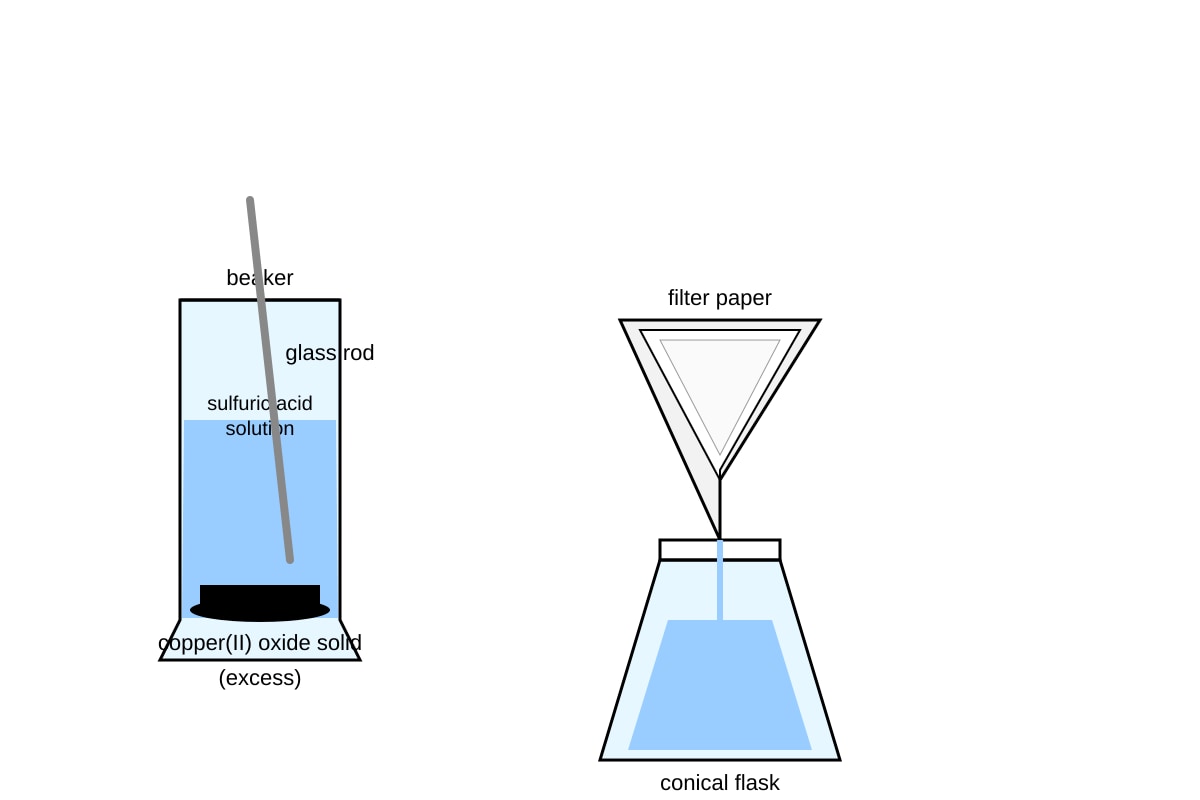
(a) [1] Filtration.
(b) [1] Blue.
(c) [2] Heat filtrate gently to evaporate water until saturated/crystals appear; cool to crystallise; filter and dry.
Teaching: Excess CuO removed by filtration; blue CuSO₄ solution yields crystals on evaporation/cooling.
12. [4 marks]
(a) [1] X.
(b) [2] Y < W < Z (since pH 10 lowest [H⁺], pH 1 highest).
(c) [1] Red.
Teaching: [H⁺] = 10⁻ᵖᴴ; lower pH → higher [H⁺]. Methyl orange red below pH 3.1.
13. [4 marks]
(a) [2] n(HCl) = C×V = 0.100 × (25.0/1000) = 0.00250 mol.
(b) [2] n(NaOH)=n(HCl)=0.00250 mol; C = n/V = 0.00250 / (20.0/1000) = 0.125 mol/dm³.
Teaching: 1:1 ratio from HCl + NaOH → NaCl + H₂O.
14. [3 marks]
P: addition; Q: neutralisation; R: redox. [1 each]
Teaching: P adds Br₂ across double bond; Q acid+carbonate (acid-base); R O₂ added, Mg oxidised.
15. [3 marks]
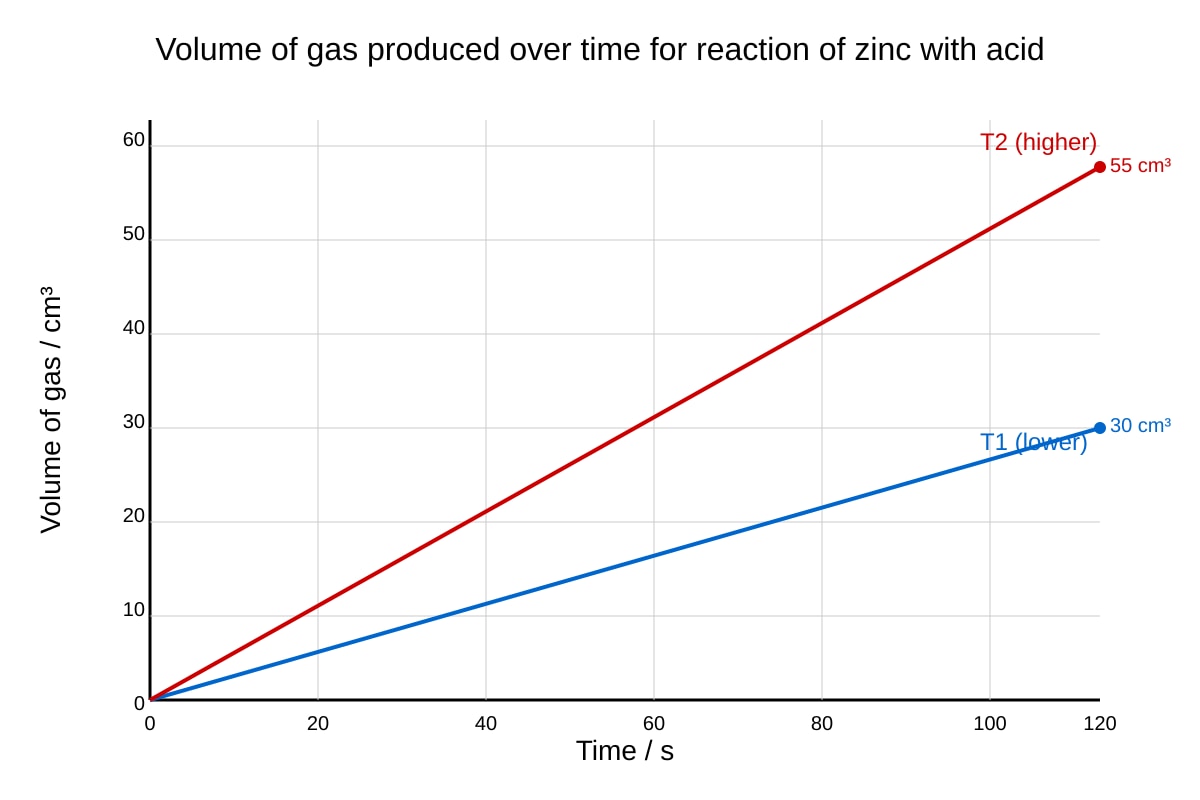
(a) [1] T2.
(b) [2] Higher T → particles move faster → more collisions per time → more effective collisions → faster rate (steeper slope).
Teaching: Collision theory requires energy ≥ activation energy.
16. [3 marks]
Sulfate: add Ba(NO₃)₂ → white ppt BaSO₄. Chloride: add AgNO₃ → white ppt AgCl. [1.5 each]
Teaching: Distinct reagents and precipitates identify anions.
Section C (25 marks)
17. [8 marks]
(a) [1] Neutralisation.
(b) [2] H₂SO₄ + 2NH₃ → (NH₄)₂SO₄.
(c) [3] Heat solution to evaporate water; cool to crystallise; filter and dry crystals.
(d) [2] NH₃ is soluble and excess can be removed by heating; no insoluble excess to filter.
Teaching: Ammonia is a soluble base (alkali); no solid excess remains.
18. [7 marks]
(a) [2] n = 0.200 × 0.0500 = 0.0100 mol.
(b) [3] 2NaOH + H₂SO₄ → Na₂SO₄ + 2H₂O; n(H₂SO₄)=0.00500 mol; V = n/C = 0.00500/0.100 = 0.0500 dm³ = 50.0 cm³.
(c) [2] Methyl orange; red to yellow (or phenolphthalein pink to colourless).
Teaching: 2:1 mole ratio of NaOH:H₂SO₄.
19. [6 marks]
(a) [3] Ca(OH)₂ base (slightly soluble alkali), NaOH alkali, NH₃ alkali.
(b) [2] Ca(OH)₂ less soluble → less corrosive, neutralises slowly, adds Ca nutrients.
(c) [1] NH₄NO₃.
Teaching: Alkali = soluble base.
20. [6 marks]
(a) [2] CaCO₃ + 2HCl → CaCl₂ + CO₂ + H₂O.
(b) [2] CO₂; limewater turns milky.
(c) [1] Remove unreacted CaCO₃ solid.
(d) [1] Wear gloves/goggles; avoid contact.
Teaching: Carbonate neutralises acid; filtrate is CaCl₂ solution.
End of Answer Key