From Real Exams Exam Paper
Secondary 4 Combined Science Chemistry Preliminary Examination Paper 1
Free Exam-Derived Secondary 4 Combined Science Chemistry Preliminary Examination Paper 1 practice paper with questions and answers for Singapore students. This page is rendered as a direct URL so the questions and answers can be discovered without pressing in-page buttons.
These static practice materials are generated from the site's syllabus and paper-generation workflow, with source and model context shown so students and parents can evaluate the material before use.
Questions
TuitionGoWhere Practice Paper - Combined Science Chemistry Secondary 4
TuitionGoWhere Secondary School (AI)
Subject: Combined Science Chemistry
Level: Secondary 4
Paper: PRELIM
Duration: 1 hour 15 minutes
Total Marks: 65
Name: _________________ Class: _______ Date: _________
Instructions
- Answer all questions in the spaces provided
- Show all working clearly for calculations
- The number of marks is given in brackets [ ] at the end of each question or part question
- You may use a calculator
- Relative atomic masses: H = 1, C = 12, N = 14, O = 16, Na = 23, Mg = 24, Al = 27, Cl = 35.5, Ca = 40, Fe = 56, Cu = 64, Zn = 65
Section A [15 marks]
1. Which apparatus would be most suitable for accurately measuring 50.0 cm³ of sodium hydroxide solution for a titration?
A. 50 cm³ beaker
B. 50 cm³ burette
C. 50 cm³ measuring cylinder
D. 50 cm³ pipette
[1]
2. A compound has the following properties:
- High melting point
- Conducts electricity when molten
- Does not conduct electricity when solid
- Soluble in water
What type of bonding does this compound have?
A. Ionic
B. Metallic
C. Covalent (giant structure)
D. Covalent (simple molecular)
[1]
3. Which row correctly shows mixtures only?
| P | Q | R | |
|---|---|---|---|
| A | air | steel | limestone |
| B | crude oil | vinegar | limewater |
| C | methane | glucose | francium |
| D | polyethene | nickel | naphtha |
[1]
4. The concentration of a solution containing 8.0 g of NaOH dissolved in 500 cm³ of solution is:
A. 0.2 mol/dm³
B. 0.4 mol/dm³
C. 0.8 mol/dm³
D. 1.6 mol/dm³
[1]
5. Which statement about carbon monoxide is correct?
A. It causes acid rain when dissolved in water
B. It binds reversibly to haemoglobin
C. It reduces the blood's ability to carry oxygen
D. It is heavier than air
[1]
Section B [50 marks]
6. A student investigates the reaction between magnesium and hydrochloric acid.
(a) Write a balanced chemical equation for this reaction, including state symbols. [2]
(b) The student uses 2.4 g of magnesium ribbon and excess hydrochloric acid.
(i) Calculate the number of moles of magnesium used. [1]
Number of moles = _________________
(ii) Calculate the volume of hydrogen gas produced at room temperature and pressure (RTP). [1 mole of gas occupies 24 dm³ at RTP] [2]
Volume of hydrogen gas = _________________ dm³
(c) The student repeats the experiment using magnesium powder instead of magnesium ribbon.
(i) State what the student would observe about the rate of reaction. [1]
(ii) Using collision theory, explain your answer in (c)(i). [2]
7. Oleic acid is an unsaturated carboxylic acid found in olive oil.
(a) Describe a chemical test to show that oleic acid is unsaturated. [2]
Test: ___________________________________________________________________
Observation: ____________________________________________________________
(b) Oleic acid can be converted to sodium oleate by reaction with sodium hydroxide.
(i) Name the type of reaction that occurs. [1]
(ii) State one use of sodium oleate. [1]
8. The following terms describe different types of chemical reactions:
addition, decomposition, neutralisation, redox, rusting, substitution
Use the most appropriate term from the list to classify each of the following reactions:
(a) CaCO₃ → CaO + CO₂ [1]
Classification: __________________________________________________________
(b) HNO₃ + KOH → KNO₃ + H₂O [1]
Classification: __________________________________________________________
(c) C₂H₄ + Br₂ → C₂H₄Br₂ [1]
Classification: __________________________________________________________
(d) 4Fe + 3O₂ + 6H₂O → 4Fe(OH)₃ [1]
Classification: __________________________________________________________
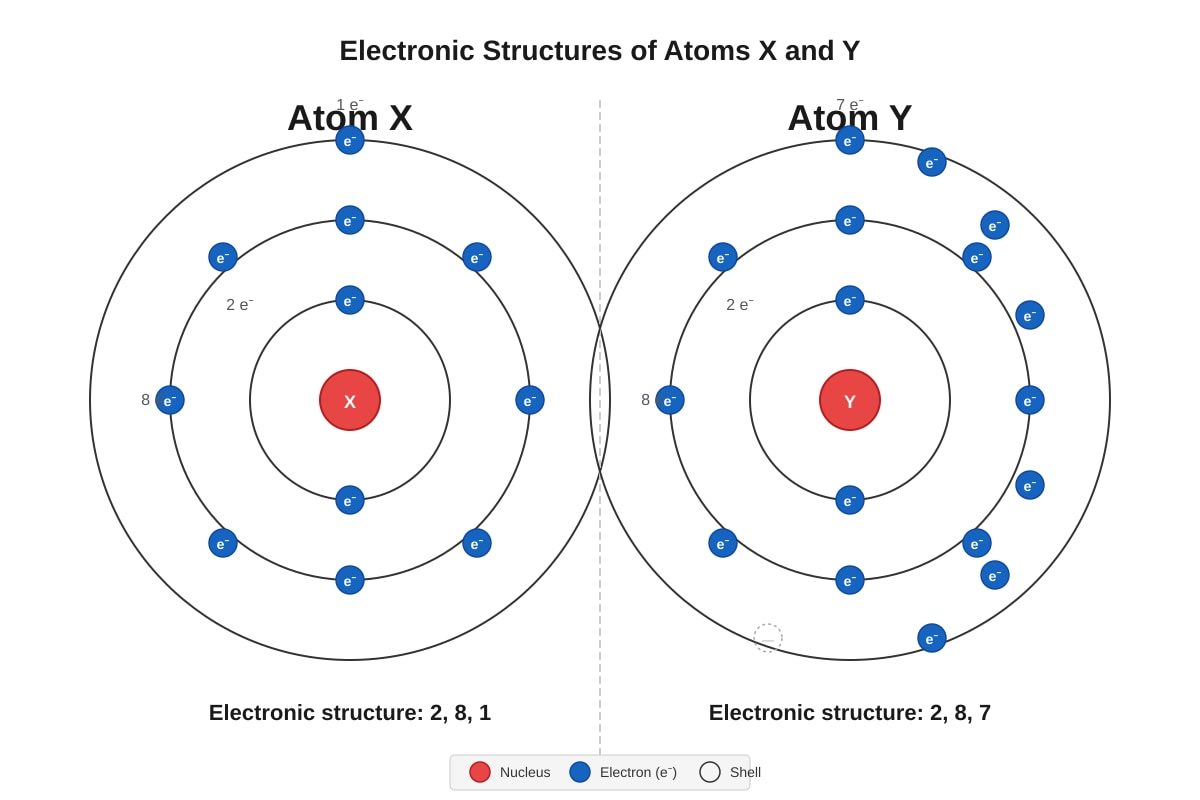
9. The diagram below shows the electronic structures of atoms X and Y.
[Diagram shows: X has electronic structure 2,8,1 and Y has electronic structure 2,8,7]
(a) (i) Identify elements X and Y. [2]
X: _____________________________________________________________________
Y: _____________________________________________________________________
(ii) State the period and group for element X. [2]
Period: _________________________________________________________________
Group: __________________________________________________________________
(b) X and Y react together to form an ionic compound.
(i) Draw diagrams showing the electronic structures of the ions formed. Show outer electrons only. [3]
(ii) Write the formula of the ionic compound formed. [1]
Formula: _______________________________________________________________
10. A student carries out a titration to find the concentration of a sodium hydroxide solution.
The student titrates 25.0 cm³ of the sodium hydroxide solution with 0.100 mol/dm³ hydrochloric acid.
The results are shown in the table below:
| Titration | 1 | 2 | 3 |
|---|---|---|---|
| Final burette reading / cm³ | 26.50 | 51.20 | 25.80 |
| Initial burette reading / cm³ | 1.20 | 26.50 | 1.10 |
| Volume of HCl used / cm³ | 25.30 | 24.70 | 24.70 |
(a) Calculate the average volume of hydrochloric acid used. [1]
Average volume = _________________ cm³
(b) Write a balanced chemical equation for the reaction between sodium hydroxide and hydrochloric acid. [1]
(c) Calculate the concentration of the sodium hydroxide solution in mol/dm³. [3]
Concentration = _________________ mol/dm³
11. Recycling of metals is important for environmental and economic reasons.
(a) Suggest why aluminium is widely recycled rather than being extracted from its ore. [1]
(b) State two environmental benefits of recycling metals. [2]
12. Complete the table below showing the properties of atoms and ions: [4]
| Particle | Protons | Electrons | Neutrons |
|---|---|---|---|
| ²³Na | 11 | _____ | _____ |
| ²³Na⁺ | _____ | _____ | 12 |
| ³⁵Cl⁻ | 17 | _____ | _____ |
| ⁴⁰Ca²⁺ | _____ | 18 | 20 |
13. A student investigates factors affecting the rate of reaction between calcium carbonate and hydrochloric acid.
CaCO₃(s) + 2HCl(aq) → CaCl₂(aq) + H₂O(l) + CO₂(g)
(a) State three factors that could affect the rate of this reaction. [3]
(b) The student measures the volume of carbon dioxide gas produced over time. Sketch a graph to show how the volume of gas changes with time. [2]
[Space for graph with labeled axes]
(c) Explain why the reaction eventually stops. [1]
Answers
TuitionGoWhere Practice Paper - Combined Science Chemistry Secondary 4 - MARKING SCHEME
Total Marks: 65
Section A [15 marks]
1. D - 50 cm³ pipette [1] Pipette provides highest accuracy for fixed volumes in titrations
2. A - Ionic [1] High melting point + conducts when molten but not solid + water soluble = ionic bonding
3. B - crude oil, vinegar, limewater [1] All three are mixtures: crude oil (hydrocarbons), vinegar (acetic acid + water), limewater (Ca(OH)₂ + water)
4. B - 0.4 mol/dm³ [1] Moles NaOH = 8.0/40 = 0.2 mol; Volume = 500/1000 = 0.5 dm³; Concentration = 0.2/0.5 = 0.4 mol/dm³
5. C - It reduces the blood's ability to carry oxygen [1] CO binds irreversibly to haemoglobin, preventing oxygen transport
Section B [50 marks]
6.(a) Mg(s) + 2HCl(aq) → MgCl₂(aq) + H₂(g) [2] 1 mark for balanced equation, 1 mark for correct state symbols
6.(b)(i) Number of moles = 2.4/24 = 0.1 mol [1]
6.(b)(ii) [2] From equation: 1 mol Mg produces 1 mol H₂ (1 mark) Volume of H₂ = 0.1 × 24 = 2.4 dm³ (1 mark)
6.(c)(i) The rate of reaction increases / reaction is faster [1]
6.(c)(ii) [2] Magnesium powder has larger surface area (than ribbon) (1 mark) More frequent collisions between Mg and HCl, so higher rate of reaction (1 mark)
7.(a) [2] Test: Add bromine water (1 mark) Observation: Orange/brown colour decolorizes/turns colourless (1 mark)
7.(b)(i) Neutralisation (or saponification) [1]
7.(b)(ii) Soap / detergent / cleaning agent [1]
8. [4] (a) decomposition (1 mark) (b) neutralisation (1 mark) (c) addition (1 mark) (d) rusting (accept redox) (1 mark)
9.(a)(i) [2] X: Sodium (1 mark) Y: Chlorine (1 mark)
9.(a)(ii) [2] Period: 3 (1 mark) Group: 1 (1 mark)
9.(b)(i) [3] Correct electronic structure diagrams showing:
- Na⁺ with 2,8 configuration (1 mark)
- Cl⁻ with 2,8,8 configuration (1 mark)
- Clear indication of charges (1 mark)
9.(b)(ii) Formula: NaCl [1]
10.(a) Average volume = (24.70 + 24.70)/2 = 24.70 cm³ [1] Ignore titration 1 as it's a rough titration
10.(b) NaOH + HCl → NaCl + H₂O [1]
10.(c) [3] Moles of HCl = 0.100 × 24.70/1000 = 0.00247 mol (1 mark) From equation: moles NaOH = moles HCl = 0.00247 mol (1 mark) Concentration of NaOH = 0.00247 × 1000/25.0 = 0.0988 mol/dm³ (accept 0.099) (1 mark)
11.(a) Extraction of aluminium requires large amounts of energy / recycling uses less energy [1]
11.(b) [2] Any two from:
- Reduces mining/quarrying (1 mark)
- Reduces pollution (1 mark)
- Conserves natural resources (1 mark)
- Reduces landfill waste (1 mark)
12. [4]
| Particle | Protons | Electrons | Neutrons |
|---|---|---|---|
| ²³Na | 11 | 11 | 12 |
| ²³Na⁺ | 11 | 10 | 12 |
| ³⁵Cl⁻ | 17 | 18 | 18 |
| ⁴⁰Ca²⁺ | 20 | 18 | 20 |
1 mark for each correct entry
13.(a) [3] Any three from:
- Temperature (1 mark)
- Concentration of HCl (1 mark)
- Surface area/particle size of CaCO₃ (1 mark)
- Pressure (1 mark)
- Catalyst (1 mark)
13.(b) [2] Graph showing:
- Volume of CO₂ on y-axis, Time on x-axis (1 mark)
- Curve starting at origin, increasing rapidly then leveling off (1 mark)
13.(c) One of the reactants is completely used up / limiting reactant is consumed [1]