AI Generated Quiz
Secondary 4 Combined Science Biology Plant Biology Quiz
Free Sec 4 Comb Sci Bio Plant Biology quiz, HY3 AI version, with questions, answers, and O Level-style practice for Singapore students.
These static practice materials are generated from the site's syllabus and paper-generation workflow, with source and model context shown so students and parents can evaluate the material before use.
Questions
Free quiz and exam paper access
Enter your details to view this paper
Your access is remembered on this device.
Answers
Secondary 4 Combined Science Biology Quiz - Plant Biology (Answer Key)
Total Marks: 40
Topic: Plant Biology
Note: Content generated from LLM-inferred syllabus-first templates (Stage 4/5). Not claimed as past-year exam derived.
Section A Answers (1 mark each)
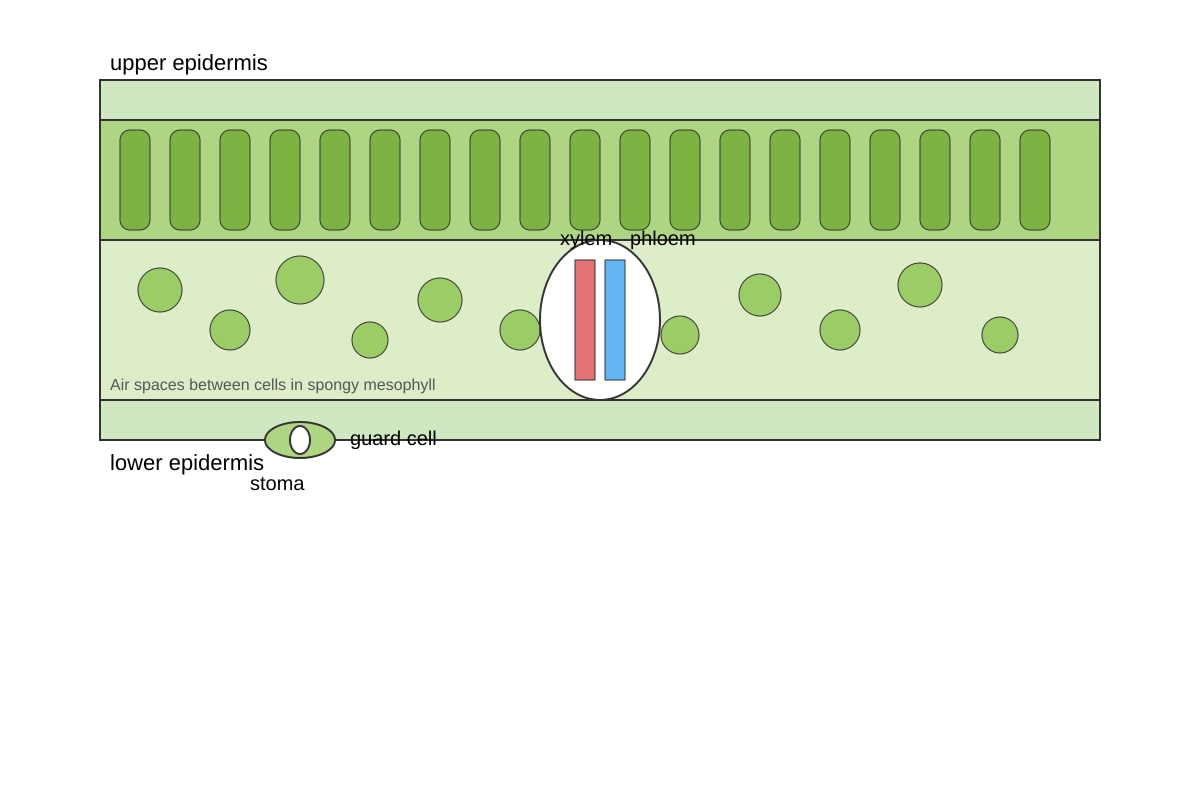
1. B – Palisade mesophyll cells contain many chloroplasts and are the main photosynthesis site.
Teaching note: Leaves are the organ for photosynthesis; palisade cells are packed with chloroplasts near the upper surface to capture light.
2. A – Guard cells change shape to open/close stomata.
Teaching note: Guard cells are kidney-shaped and regulate gas exchange and water loss.
3. B – Transpiration pull (due to evaporation from leaves) draws water up xylem.
Teaching note: Water column is pulled by negative pressure from leaf evaporation, aided by cohesion.
4. C – Chlorophyll a absorbs red and blue, reflecting green.
Teaching note: Accessory pigments absorb other wavelengths but chlorophyll a drives the light reactions.
5. C – Oxygen is a product, not a raw material.
Teaching note: Raw materials are CO₂ and H₂O; light is energy source.
Section B Answers (2 marks each)
6. Any two:
- Many stomata for gas diffusion (1)
- Spongy mesophyll with air spaces (1)
Other acceptable: thin cuticle, broad flat shape.
Teaching note: Gas exchange needs surface and internal air paths.
7. Transpiration is the loss of water vapour (1) from the aerial parts of a plant, mainly through stomata (1).
Teaching note: It is passive, driven by evaporation and diffusion.
8. Any two:
- Higher temperature (1)
- Lower humidity / higher wind speed / brighter light (1)
Teaching note: These increase evaporation gradient.
9. Phloem (2).
Teaching note: Phloem transports sucrose and amino acids by translocation.
10. Thin wall shortens diffusion distance (1); elongation increases surface area for absorption (1).
Teaching note: Root hairs absorb water and minerals from soil.
11. Label 1: palisade mesophyll (upper columnar layer) (1); Label 2: stoma (pore on lower epidermis) (1).
Teaching note: Use diagram features described in placeholder.
12. Carbon dioxide + water → glucose + oxygen (2)
(Allow: light / chlorophyll above arrow.)
Teaching note: Balanced later as .
13. Large air spaces between cells allow diffusion of gases (1) to/from mesophyll (1).
Teaching note: Increases surface area for exchange.
14. Nitrate for amino acid/protein synthesis (1); magnesium for chlorophyll formation (1).
Teaching note: Deficiency causes stunted growth / chlorosis.
15. No starch (1) because photosynthesis could not occur in darkness so starch was used up / not made (1).
Teaching note: Destarching confirms photosynthesis source.
Section C Answers (3 marks each)
16.
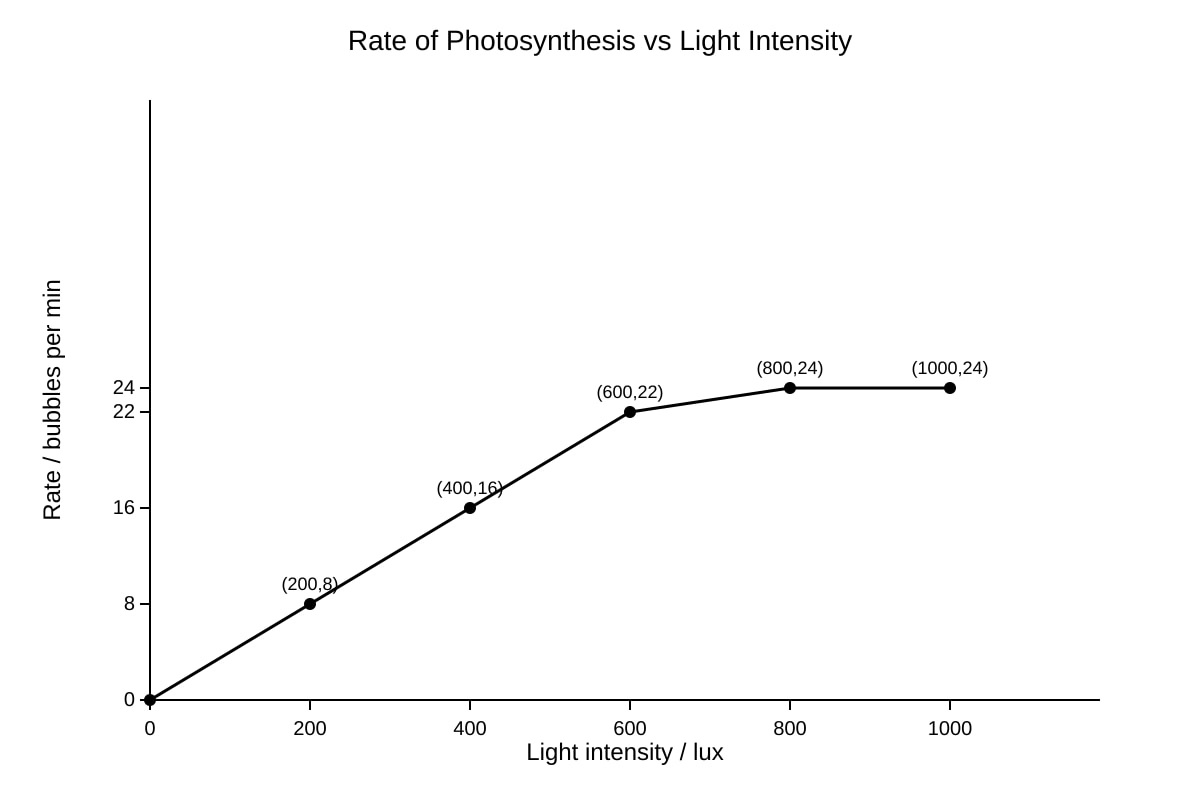
- Rate at 400 lux = 16 bubbles/min (1 mark for reading graph).
- After 800 lux rate plateaus at 24 (1).
- Light no longer limiting; CO₂ concentration or temperature becomes limiting (1).
Teaching note: Graph shows linear then plateau; limiting factor shifts.
17.
- Soil water enters root hair by osmosis (1) down water potential gradient.
- Moves across cortex via symplast/apoplast (1).
- Enters xylem by osmosis / root pressure (1).
Teaching note: Process is passive, driven by gradient.
18.
- Many chloroplasts to capture light (1).
- Tall columnar shape packed at top for light (1).
- Thin cell wall / large surface for gas exchange (1).
Teaching note: Structure matches function.
19.
- Increase CO₂ (e.g., paraffin heater) → more substrate for photosynthesis (1.5).
- Increase light intensity with lamps → light less limiting (1.5).
Teaching note: Addresses two limiting factors.
20.
- Xylem transports water/minerals upward from roots (1.5).
- Phloem transports food (sucrose) bidirectionally (1.5).
Teaching note: Xylem dead, phloem living tissue.