AI Generated Quiz
Secondary 4 Combined Science Biology Human Physiology Quiz
Free Sec 4 Comb Sci Bio Human Physiology quiz, DeepSeek AI version, with questions, answers, and O Level-style practice for Singapore students.
These static practice materials are generated from the site's syllabus and paper-generation workflow, with source and model context shown so students and parents can evaluate the material before use.
Questions
Free quiz and exam paper access
Enter your details to view this paper
Your access is remembered on this device.
Answers
Secondary 4 Combined Science Biology Quiz - Human Physiology
Answer Key and Marking Scheme
Total Marks: 40
Section A: Short Answer (10 marks)
1. State the process by which oxygen from the alveoli reaches the red blood cells in the pulmonary capillaries. [1]
- Answer: Diffusion
- Marking note: Accept "diffusion down a concentration gradient." Do not accept "active transport" or "osmosis."
2. Name the enzyme present in saliva that begins the digestion of starch. [1]
- Answer: Salivary amylase / amylase
- Marking note: Accept "ptyalin." Do not accept "pepsin" or "lipase."
3. State one function of the coronary arteries. [1]
- Answer: Supply oxygenated blood / oxygen and nutrients to the heart muscle (cardiac muscle).
- Marking note: Accept any reasonable function related to supplying the heart with blood. Do not accept "pump blood to the body."
4. Identify the blood vessel that carries deoxygenated blood from the heart to the lungs. [1]
- Answer: Pulmonary artery
- Marking note: Must specify "pulmonary artery." Do not accept "pulmonary vein" or "aorta."
5. Name the hormone that stimulates the conversion of glycogen to glucose in the liver when blood glucose concentration is low. [1]
- Answer: Glucagon
- Marking note: Do not accept "insulin."
6. State the term used to describe the movement of water molecules from a region of higher water potential to a region of lower water potential through a partially permeable membrane. [1]
- Answer: Osmosis
- Marking note: Do not accept "diffusion" alone.
7. Name the structure in the nephron where ultrafiltration occurs. [1]
- Answer: Glomerulus / Bowman's capsule / renal corpuscle
- Marking note: Accept "glomerulus and Bowman's capsule." Do not accept "proximal convoluted tubule" or "loop of Henle."
8. State one function of bile in the digestive system. [1]
- Answer: Emulsifies fats / breaks large fat droplets into smaller droplets / increases surface area of fats for lipase action / neutralises acidic chyme from the stomach.
- Marking note: Accept any one valid function. Do not accept "digests fats" (bile is not an enzyme).
9. Identify the type of blood cell that transports oxygen in the human body. [1]
- Answer: Red blood cell / erythrocyte
- Marking note: Do not accept "white blood cell" or "platelet."
10. Name the chamber of the heart that pumps oxygenated blood into the aorta. [1]
- Answer: Left ventricle
- Marking note: Must specify "left ventricle." Do not accept "left atrium" or "right ventricle."
Section B: Structured Questions (18 marks)
11. The diagram below shows the human digestive system.

Generated diagram for this question.
(a) Identify the organ labelled P where most absorption of digested food occurs. [1]
- Answer: Small intestine / ileum
- Marking note: Accept "small intestine" or "ileum."
(b) Describe how the structure of organ P is adapted for efficient absorption of digested food. [3]
- Answer: The small intestine is very long, providing a large surface area for absorption. The inner wall has many folds with finger-like projections called villi, which further increase the surface area. The epithelial cells of the villi have microvilli on their surface, maximising surface area. The villi have a dense network of blood capillaries to absorb glucose and amino acids, and lacteals (lymphatic vessels) to absorb fatty acids and glycerol. The epithelium is only one cell thick, providing a short diffusion distance.
- Marking scheme:
- 1 mark: Reference to large surface area (long length / villi / microvilli) – any one feature.
- 1 mark: Reference to thin epithelium / one-cell-thick wall for short diffusion distance.
- 1 mark: Reference to rich blood supply / capillary network / lacteals for transport of absorbed products.
- Marking note: Award marks for any three distinct structural adaptations linked to function. Do not award marks for function without structural description.
(c) Explain why the products of fat digestion are absorbed differently from the products of carbohydrate and protein digestion. [2]
- Answer: The products of fat digestion (fatty acids and glycerol) are absorbed into lacteals (lymphatic vessels) in the villi, while the products of carbohydrate and protein digestion (glucose and amino acids) are absorbed into blood capillaries. This is because fatty acids and glycerol are not water-soluble and are reassembled into fats in the epithelial cells before entering the lacteals, which eventually drain into the bloodstream. Glucose and amino acids are water-soluble and can be absorbed directly into the blood capillaries.
- Marking scheme:
- 1 mark: Products of fat digestion absorbed into lacteals; products of carbohydrate/protein digestion absorbed into blood capillaries.
- 1 mark: Explanation linked to solubility (fatty acids/glycerol are lipid-soluble/not water-soluble; glucose/amino acids are water-soluble) OR reference to transport via lymphatic system vs. blood system.
12. A student investigated the effect of temperature on the activity of the enzyme amylase.
(a) Describe the relationship between temperature and the time taken to digest starch between 10°C and 40°C. [1]
- Answer: As temperature increases from 10°C to 40°C, the time taken to digest starch decreases.
- Marking note: Accept "inverse relationship" or "negative correlation" with correct description. Must reference both variables.
(b) Explain why the time taken to digest starch decreases between 10°C and 40°C. [2]
- Answer: As temperature increases, the kinetic energy of the enzyme (amylase) and substrate (starch) molecules increases. This results in more frequent collisions between enzyme and substrate molecules, leading to more enzyme-substrate complexes being formed per unit time. Therefore, the rate of reaction increases, and the time taken to digest starch decreases.
- Marking scheme:
- 1 mark: Reference to increased kinetic energy of molecules / more frequent collisions.
- 1 mark: Reference to more enzyme-substrate complexes formed / increased rate of reaction.
(c) Explain why no digestion was observed at 60°C. [2]
- Answer: At 60°C, the enzyme amylase has been denatured. The high temperature breaks the bonds (e.g., hydrogen bonds) that maintain the specific three-dimensional shape of the enzyme's active site. The active site loses its complementary shape to the substrate (starch), so the substrate can no longer bind to the active site. No enzyme-substrate complexes can form, so no digestion occurs.
- Marking scheme:
- 1 mark: Reference to denaturation of the enzyme.
- 1 mark: Explanation that the active site changes shape / loses complementary shape, so substrate cannot bind / no enzyme-substrate complexes form.
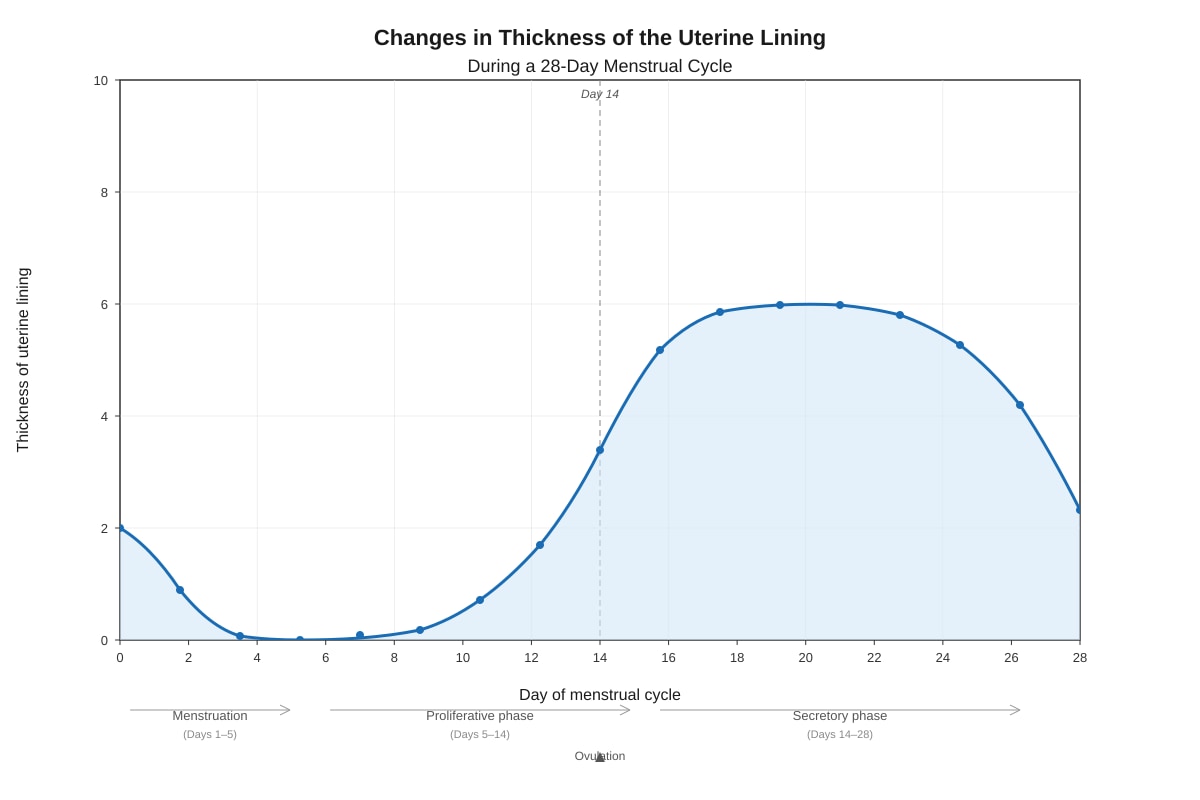
13. The graph below shows changes in the thickness of the uterine lining during a 28-day menstrual cycle.
Generated graph for this question.
(a) Name the hormone responsible for the increase in thickness of the uterine lining between day 5 and day 14. [1]
- Answer: Oestrogen
- Marking note: Do not accept "progesterone."
(b) Name the hormone responsible for maintaining the thickness of the uterine lining between day 14 and day 28. [1]
- Answer: Progesterone
- Marking note: Do not accept "oestrogen."
(c) Explain what happens to the uterine lining if fertilisation does not occur. [2]
- Answer: If fertilisation does not occur, the corpus luteum in the ovary degenerates, causing progesterone levels to fall. Without progesterone to maintain the thickened uterine lining, the lining breaks down and is shed along with blood through the vagina. This is menstruation.
- Marking scheme:
- 1 mark: Reference to falling progesterone levels / corpus luteum degenerates.
- 1 mark: Reference to breakdown and shedding of the uterine lining / menstruation.
14. A person's blood glucose concentration is regulated by hormones.
(a) Name the organ that detects changes in blood glucose concentration. [1]
- Answer: Pancreas / islets of Langerhans (in the pancreas)
- Marking note: Accept "pancreas" or "islets of Langerhans."
(b) Describe how the body responds when blood glucose concentration rises above normal levels. [2]
- Answer: The pancreas detects the high blood glucose concentration. The beta cells in the islets of Langerhans secrete the hormone insulin into the bloodstream. Insulin stimulates the liver and muscle cells to take up more glucose from the blood. It also stimulates the liver to convert excess glucose into glycogen for storage. This reduces blood glucose concentration back to normal levels.
- Marking scheme:
- 1 mark: Reference to insulin secretion by the pancreas / beta cells.
- 1 mark: Reference to increased glucose uptake by cells / conversion of glucose to glycogen in the liver / reduction of blood glucose concentration.
Section C: Data Interpretation and Extended Response (12 marks)
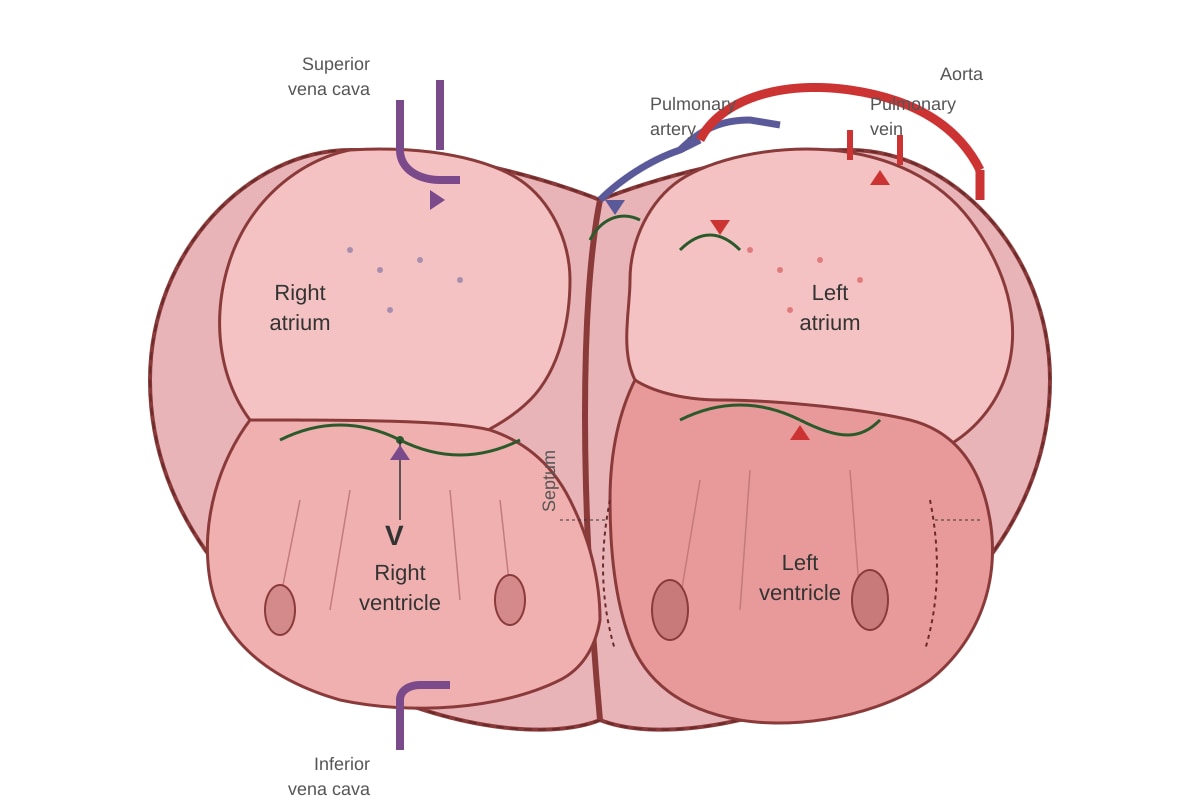
15. The diagram below shows a cross-section of the human heart.
Generated diagram for this question.
(a) State the function of the valves labelled V between the atria and ventricles. [1]
- Answer: To prevent backflow of blood from the ventricles into the atria when the ventricles contract.
- Marking note: Must mention "prevent backflow." Accept "ensure one-way flow of blood."
(b) Explain why the wall of the left ventricle is thicker than the wall of the right ventricle. [2]
- Answer: The left ventricle pumps blood to the entire body (systemic circulation), which requires higher pressure to overcome the greater resistance of the longer pathway. The right ventricle only pumps blood to the lungs (pulmonary circulation), which is a shorter distance and requires lower pressure. The thicker muscular wall of the left ventricle allows it to generate the higher pressure needed.
- Marking scheme:
- 1 mark: Left ventricle pumps blood to the whole body / systemic circulation (vs. right ventricle to lungs only).
- 1 mark: Needs to generate higher pressure / overcome greater resistance.
(c) Describe the pathway of a red blood cell from the right atrium to the aorta, naming all the structures it passes through. [3]
- Answer: Right atrium → tricuspid valve (right atrioventricular valve) → right ventricle → semilunar valve (pulmonary valve) → pulmonary artery → lungs (pulmonary capillaries) → pulmonary vein → left atrium → bicuspid valve (left atrioventricular valve / mitral valve) → left ventricle → semilunar valve (aortic valve) → aorta.
- Marking scheme:
- 1 mark: Correct pathway from right atrium to pulmonary artery (including valves).
- 1 mark: Correct pathway through lungs to left atrium (pulmonary vein).
- 1 mark: Correct pathway from left atrium to aorta (including valves).
- Marking note: Award marks for correct sequence. Deduct marks for missing valves or incorrect vessel names. Accept "right AV valve" for tricuspid and "left AV valve" for bicuspid/mitral.
16. The table below shows the composition of blood plasma, glomerular filtrate, and urine in a healthy person.
(a) Explain why protein is present in blood plasma but absent from glomerular filtrate. [2]
- Answer: During ultrafiltration in the glomerulus, blood is filtered under high pressure. The capillary walls and the basement membrane act as a filter. Small molecules such as water, glucose, urea, and mineral salts can pass through the filter into the Bowman's capsule. However, protein molecules are too large to pass through the filtration membrane, so they remain in the blood and are absent from the glomerular filtrate.
- Marking scheme:
- 1 mark: Reference to ultrafiltration / filtration under pressure in the glomerulus.
- 1 mark: Protein molecules are too large to pass through the filtration membrane / basement membrane.
(b) Explain why glucose is present in glomerular filtrate but absent from urine. [2]
- Answer: Glucose is a small molecule that passes through the filtration membrane during ultrafiltration, so it is present in the glomerular filtrate. However, all glucose is selectively reabsorbed from the filtrate back into the blood in the proximal convoluted tubule by active transport. Therefore, no glucose remains in the urine of a healthy person.
- Marking scheme:
- 1 mark: Glucose passes through during ultrafiltration (small molecule).
- 1 mark: All glucose is selectively reabsorbed in the proximal convoluted tubule by active transport.
(c) Calculate how many times more concentrated urea is in urine compared to blood plasma. Show your working. [2]
- Answer: Concentration in urine = 2.0 g per 100 cm³; Concentration in blood plasma = 0.03 g per 100 cm³.
- 2.0 ÷ 0.03 = 66.67
- Urea is approximately 67 times more concentrated in urine than in blood plasma.
- Marking scheme:
- 1 mark: Correct working (2.0 ÷ 0.03).
- 1 mark: Correct answer (66.7 or 67 times). Accept 66.67.
17. Describe the mechanism of inhalation in humans. [4]
- Answer: During inhalation, the diaphragm contracts and flattens. At the same time, the external intercostal muscles contract, pulling the rib cage upwards and outwards. These movements increase the volume of the thoracic cavity. As the volume increases, the pressure inside the thoracic cavity and lungs decreases to below atmospheric pressure. Air from the atmosphere, which is at a higher pressure, rushes into the lungs down the pressure gradient to equalise the pressure.
- Marking scheme:
- 1 mark: Diaphragm contracts and flattens.
- 1 mark: External intercostal muscles contract; ribs move up and out.
- 1 mark: Volume of thoracic cavity increases; pressure decreases.
- 1 mark: Air rushes into lungs down the pressure gradient (from higher to lower pressure).
18. Explain how the structure of an alveolus is adapted for efficient gas exchange. [3]
- Answer: Alveoli have several structural adaptations for efficient gas exchange. The alveolar wall is only one cell thick (squamous epithelium), providing a short diffusion distance for gases. The alveoli are surrounded by a dense network of blood capillaries, which also have walls one cell thick, further reducing diffusion distance and maintaining a steep concentration gradient by carrying gases away. The alveoli are numerous and have a spherical shape, providing a large total surface area for gas exchange. A thin film of moisture on the inner surface of the alveoli allows gases to dissolve before diffusing.
- Marking scheme:
- 1 mark: Thin walls (one cell thick) for short diffusion distance.
- 1 mark: Dense capillary network to maintain concentration gradient / transport gases.
- 1 mark: Large surface area (numerous alveoli / spherical shape) for maximum gas exchange.
- Marking note: Award marks for any three distinct adaptations with functional explanations.
19. A person eats a meal rich in carbohydrates. Describe how the body digests and absorbs the starch from this meal. [4]
- Answer: Digestion of starch begins in the mouth, where salivary amylase breaks down starch into maltose. The food is swallowed and passes down the oesophagus to the stomach. In the stomach, the acidic conditions denature salivary amylase, stopping starch digestion temporarily. In the small intestine, pancreatic amylase continues breaking down any remaining starch into maltose. Maltase, an enzyme on the epithelial cells of the small intestine, breaks maltose into glucose. Glucose is then absorbed by the epithelial cells of the villi in the small intestine by active transport. The glucose enters the blood capillaries in the villi and is transported to the liver via the hepatic portal vein.
- Marking scheme:
- 1 mark: Starch broken down by salivary amylase in mouth to maltose; pancreatic amylase in small intestine continues digestion.
- 1 mark: Maltase breaks maltose to glucose in the small intestine.
- 1 mark: Glucose absorbed by active transport into epithelial cells of villi.
- 1 mark: Glucose enters blood capillaries and is transported to the liver.
20. Compare the processes of aerobic and anaerobic respiration in humans. Include in your answer the site of each process, the products formed, and the relative amounts of energy released. [4]
- Answer: Aerobic respiration occurs in the mitochondria and requires oxygen. It completely breaks down glucose into carbon dioxide and water, releasing a large amount of energy (approximately 38 ATP molecules per glucose molecule). Anaerobic respiration occurs in the cytoplasm and does not require oxygen. It partially breaks down glucose into lactic acid, releasing a small amount of energy (only 2 ATP molecules per glucose molecule). Aerobic respiration is the more efficient process, releasing about 19 times more energy than anaerobic respiration.
- Marking scheme:
- 1 mark: Site – aerobic in mitochondria; anaerobic in cytoplasm.
- 1 mark: Products – aerobic produces CO₂ and H₂O; anaerobic produces lactic acid.
- 1 mark: Energy – aerobic releases large amount / 38 ATP; anaerobic releases small amount / 2 ATP.
- 1 mark: Oxygen requirement – aerobic requires oxygen; anaerobic does not require oxygen.
END OF ANSWER KEY