AI Generated Quiz
Secondary 4 Combined Science Biology Genetics Inheritance Quiz
Free Sec 4 Comb Sci Bio Genetics Inheritance quiz, HY3 AI version, with questions, answers, and O Level-style practice for Singapore students.
These static practice materials are generated from the site's syllabus and paper-generation workflow, with source and model context shown so students and parents can evaluate the material before use.
Questions
Secondary 4 Combined Science Biology Quiz - Genetics Inheritance
Name: ___________________________
Class: ______________
Date: ______________
Score: _______ / 40
Duration: 50 minutes
Total Marks: 40
Topic: Genetics Inheritance (genetics-inheritance)
Version: 1 of 5 (Practice Quiz, AI-generated)
Instructions:
- Answer all 20 questions.
- Section A: Short structured questions (1–8). Section B: Data and diagram interpretation (9–14). Section C: Extended structured response (15–20).
- Write your answers in the spaces provided.
- Use pen. Show working where marks are awarded for reasoning.
- This quiz is syllabus-first practice content generated from LLM-inferred templates. It is not derived from past-year exam papers.
Section A: Short Structured Questions (1–8)
1. [1 mark] State the term used for the different forms of a gene that occupy the same locus on a chromosome.
2. [1 mark] Name the type of cell division that produces gametes in humans.
3. [1 mark] Define the term "homozygous".
4. [2 marks] A pea plant has the genotype Tt for plant height where T = tall (dominant) and t = short (recessive). State its phenotype and explain your answer.
Phenotype: ________________________________________________
Explanation: ________________________________________________________
5. [2 marks] In humans, the allele for free earlobes (F) is dominant over attached earlobes (f). A child has attached earlobes. State the genotype of the child and the possible genotype(s) of the parents.
Child genotype: ______________
Parent genotypes: ________________________________________________
6. [1 mark] State the chromosomal sex of a human female.
7. [2 marks] Colour blindness is a sex-linked recessive trait carried on the X chromosome. A carrier female (X^C X^c) marries a normal male (X^C Y). State the probability that their son will be colour blind. Show your reasoning in one sentence.
Probability: ______________
Reasoning: ________________________________________________________
8. [2 marks] State two differences between mitosis and meiosis in terms of chromosome number of daughter cells and number of divisions.
Section B: Data and Diagram Interpretation (9–14)
9. [3 marks] A cross is made between two heterozygous pea plants (Rr × Rr) for seed shape, where R = round (dominant) and r = wrinkled (recessive).
(a) Complete the Punnett square below. [2]
| R | r | |
|---|---|---|
| R | ||
| r |
(b) State the phenotypic ratio of the offspring. [1]
10. [3 marks] The table below shows the results of a family study for a genetic disease caused by a recessive allele d.
| Individual | Phenotype | Genotype (inferred) |
|---|---|---|
| Father | Affected | dd |
| Mother | Unaffected | Dd |
| Son 1 | Unaffected | ? |
| Daughter 1 | Affected | ? |
(a) Give the genotype of Son 1. [1]
(b) Give the genotype of Daughter 1. [1]
(c) State the probability that a next child is unaffected. [1]
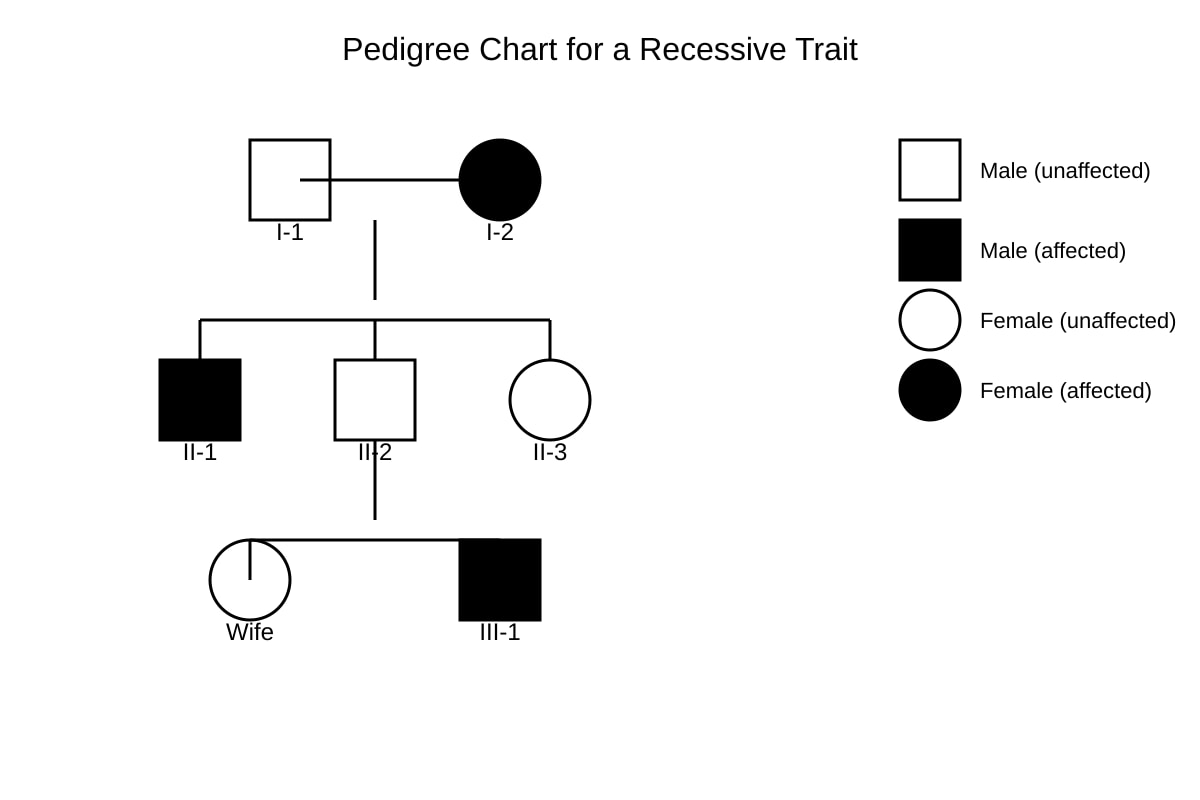
11. [3 marks] Use the pedigree chart described below.
Image pending generation: diagram for Q11.
(a) State whether the trait is dominant or recessive. Give one reason. [2]
(b) If II-3 is unaffected, state her possible genotype if the disease allele is a. [1]
12. [2 marks] A student counted 400 offspring from a Drosophila cross: 298 red-eyed and 102 white-eyed. Suggest the likely inheritance pattern (autosomal or sex-linked) if white-eyed appeared only in males. Give a reason.
Pattern: ________________________________________________
Reason: ________________________________________________________
13. [3 marks] The DNA sequence of a normal allele codes for a protein. A mutation changes one base, producing a truncated protein.
(a) State the term for this type of gene change. [1]
(b) Explain how a single base change can result in a non-functional protein. [2]
14. [2 marks] Blood group alleles I^A, I^B, and i show codominance. State the phenotype of genotype I^A i and I^A I^B.
I^A i: ________________________________________________
I^A I^B: ________________________________________________
Section C: Extended Structured Response (15–20)
15. [3 marks] Describe how alleles are passed from parents to offspring during sexual reproduction. Include the role of meiosis and fertilisation.
16. [4 marks] A man with blood group A (genotype I^A i) marries a woman with blood group B (genotype I^B i).
(a) Draw a genetic cross to show the possible offspring blood groups. [3]
(b) State the probability of a child with blood group O. [1]
17. [4 marks] Haemophilia is a sex-linked recessive disorder (X^h). A normal female whose father had haemophilia marries a normal male.
(a) State the genotype of the female. [1]
(b) State the genotype of the male. [1]
(c) What is the probability that their daughter is a carrier? [1]
(d) What is the probability that their son has haemophilia? [1]
18. [3 marks] Explain why genetic variation is increased by meiosis. Give two distinct mechanisms.
19. [3 marks] A farmer crosses a pure-breeding black goat (BB) with a pure-breeding white goat (bb). All F1 are black. He then crosses F1 × F1.
(a) State the F1 genotype. [1]
(b) State the expected phenotypic ratio in F2. [1]
(c) Explain why the white phenotype reappears in F2. [1]
20. [4 marks] Cystic fibrosis is caused by a recessive allele c. A man (Cc) and woman (Cc) are both carriers.
(a) Complete a Punnett square for this cross. [2]
(b) State the probability their child will have cystic fibrosis. [1]
(c) State the probability their child will be a carrier. [1]
Answers
Secondary 4 Combined Science Biology Quiz - Genetics Inheritance (Answer Key)
Topic: Genetics Inheritance
Version: 1 of 5 (Practice Quiz, AI-generated)
Total Marks: 40
Section A Answers
1. [1 mark] Alleles.
Teaching note: A gene is a section of DNA coding for a trait. Different versions of that gene (e.g., tall vs short) are called alleles and they sit at the same locus on homologous chromosomes.
2. [1 mark] Meiosis.
Teaching note: Gametes (sperm and egg) are haploid (n). Meiosis reduces chromosome number from diploid (2n) to haploid through two divisions.
3. [1 mark] Having two identical alleles for a gene (e.g., TT or tt).
Teaching note: "Homo" = same. Contrast with heterozygous (different alleles, e.g., Tt).
4. [2 marks]
Phenotype: Tall [1]
Explanation: T is dominant over t, so one copy of T expresses the tall trait. [1]
Common mistake: Writing "short" because a small t is present — recessive only shows if homozygous.
5. [2 marks]
Child genotype: ff [1]
Parent genotypes: Ff × Ff (both carriers) OR Ff × ff [1]
Teaching note: Attached is recessive, so child must be ff. Each parent contributes one f.
6. [1 mark] XX.
Teaching note: Females have two X chromosomes; males are XY.
7. [2 marks]
Probability: 50% (or 1/2) [1]
Reasoning: Sons inherit X from mother only; mother is X^C X^c so 50% chance of passing X^c (colour blind). [1]
Marking: 1 for value, 1 for correct reasoning about X from mother.
8. [2 marks]
- Mitosis: one division; meiosis: two divisions. [1]
- Mitosis: daughter cells diploid (2n); meiosis: daughter cells haploid (n). [1]
Alternative acceptable: Mitosis produces 2 cells, meiosis produces 4 cells.
Section B Answers
9. [3 marks]
(a) Punnett square: [2]
| R | r | |
|---|---|---|
| R | RR | Rr |
| r | Rr | rr |
| (1 mark for correct top row, 1 for correct left column and inner fill) | ||
| (b) Phenotypic ratio: 3 round : 1 wrinkled [1] |
10. [3 marks]
(a) Son 1: Dd [1] (unaffected, must get d from father and D from mother)
(b) Daughter 1: dd [1] (affected, gets d from each parent)
(c) Probability unaffected: 50% (or 1/2) [1] — cross Dd × dd gives 1/2 Dd, 1/2 dd.
11. [3 marks]
(a) Recessive [1]. Reason: unaffected parents (II-3 × spouse) produced an affected son (III-1), so trait skips generations and both parents must carry allele. [1]
(b) AA or Aa [1]
Image note: Pedigree must show filled = affected; II-3 unfilled means not expressing recessive trait.
12. [2 marks]
Pattern: Sex-linked (X-linked recessive) [1]
Reason: white-eyed only in males suggests gene on X chromosome; males have one X so express recessive more readily. [1]
13. [3 marks]
(a) Point mutation (or substitution mutation) [1]
(b) A single base change can alter a codon, causing wrong amino acid or early stop codon; truncated protein loses function. [2]
Teaching note: DNA → mRNA → protein; one base shift can change reading frame or stop signal.
14. [2 marks]
I^A i: Blood group A [1]
I^A I^B: Blood group AB [1] (codominance — both antigens expressed)
Section C Answers
15. [3 marks]
- Parents have diploid cells with homologous chromosomes carrying alleles. [1]
- Meiosis produces haploid gametes, each with one allele per gene randomly sorted. [1]
- Fertilisation joins sperm and egg alleles restoring diploid zygote with combined alleles. [1]
16. [4 marks]
(a) Cross I^A i × I^B i: [3]
| I^A | i | |
|---|---|---|
| I^B | I^A I^B | I^B i |
| i | I^A i | ii |
| Offspring: A, B, AB, O in 1:1:1:1. | ||
(b) Probability blood group O (ii): 25% (1/4) [1] |
17. [4 marks]
(a) Female: X^H X^h (father affected so gave X^h) [1]
(b) Male: X^H Y [1]
(c) Daughter carrier probability: 50% (all daughters get X^H from dad, 50% get X^h from mum) [1]
(d) Son haemophilia probability: 50% (sons get Y from dad, 50% X^h from mum) [1]
18. [3 marks]
- Crossing over (exchange of chromatid segments in prophase I). [1.5]
- Independent assortment of homologous chromosomes. [1.5]
Also accept random fertilisation as third but only two needed.
19. [3 marks]
(a) F1 genotype: Bb [1]
(b) F2 phenotypic ratio: 3 black : 1 white [1]
(c) White reappears because b alleles from both F1 parents recombine in bb offspring. [1]
20. [4 marks]
(a) Punnett square Cc × Cc: [2]
| C | c | |
|---|---|---|
| C | CC | Cc |
| c | Cc | cc |
(b) Probability cystic fibrosis (cc): 25% (1/4) [1] | ||
(c) Probability carrier (Cc): 50% (2/4) [1] |
Free quiz and exam paper access
Enter your details to view this paper
Your access is remembered on this device.