AI Generated Quiz
Secondary 4 Combined Science Biology Evolution Diversity Quiz
Free Sec 4 Comb Sci Bio Evolution Diversity quiz, HY3 AI version, with questions, answers, and O Level-style practice for Singapore students.
These static practice materials are generated from the site's syllabus and paper-generation workflow, with source and model context shown so students and parents can evaluate the material before use.
Questions
Free quiz and exam paper access
Enter your details to view this paper
Your access is remembered on this device.
Answers
Secondary 4 Combined Science Biology Quiz - Evolution Diversity (Answers)
Teaching notes included for each item. Syllabus-first content; not exam-derived.
1. (1 mark)
Answer: Biodiversity is the variety of living organisms in an area / variety of species / genetic and habitat variety.
Teaching: Define as variety of life at all levels. Accept any correct simple definition.
2. (1 mark)
Answer: Natural selection.
Teaching: Process where favourable traits increase in frequency.
3. (1 mark)
Answer: E.g., camouflage, sharp claws, thick fur.
Teaching: Structural = physical feature.
4. (1 mark)
Answer: Fossil.
Teaching: Preserved remains.
5. (1 mark)
Answer: Directional selection (or disruptive if extreme both ends; but "extreme over intermediate" = disruptive; clarify: favours extremes = disruptive).
Accepted: Disruptive selection.
Teaching: Disruptive favours both extremes.
6. (2 marks)
Answer: Variation gives differences in traits; those with advantageous traits survive and reproduce (1). Without variation, all would be equally affected by change (1).
Teaching: Link variation to differential survival.
7. (2 marks)
Answer: Show intermediate forms (1); show chronological change in species (1).
Teaching: Fossils show sequence.
8. (2 marks)
Answer: Brown beetles survive more (1); over generations brown becomes common (1).
Teaching: Predation is selection pressure.
9. (2 marks)
Answer: Deforestation, pollution, overfishing (any two).
Teaching: Human impact.
10. (2 marks)
Answer: Convergent: unrelated species develop similar traits (1). Divergent: related species become different (1).
Teaching: Opposite patterns.
11. (3 marks)
Answer: Mutation creates resistant individuals (1); antibiotics kill non-resistant (1); resistant reproduce, resistance spreads (1).
Teaching: Stepwise selection.
12. (3 marks)
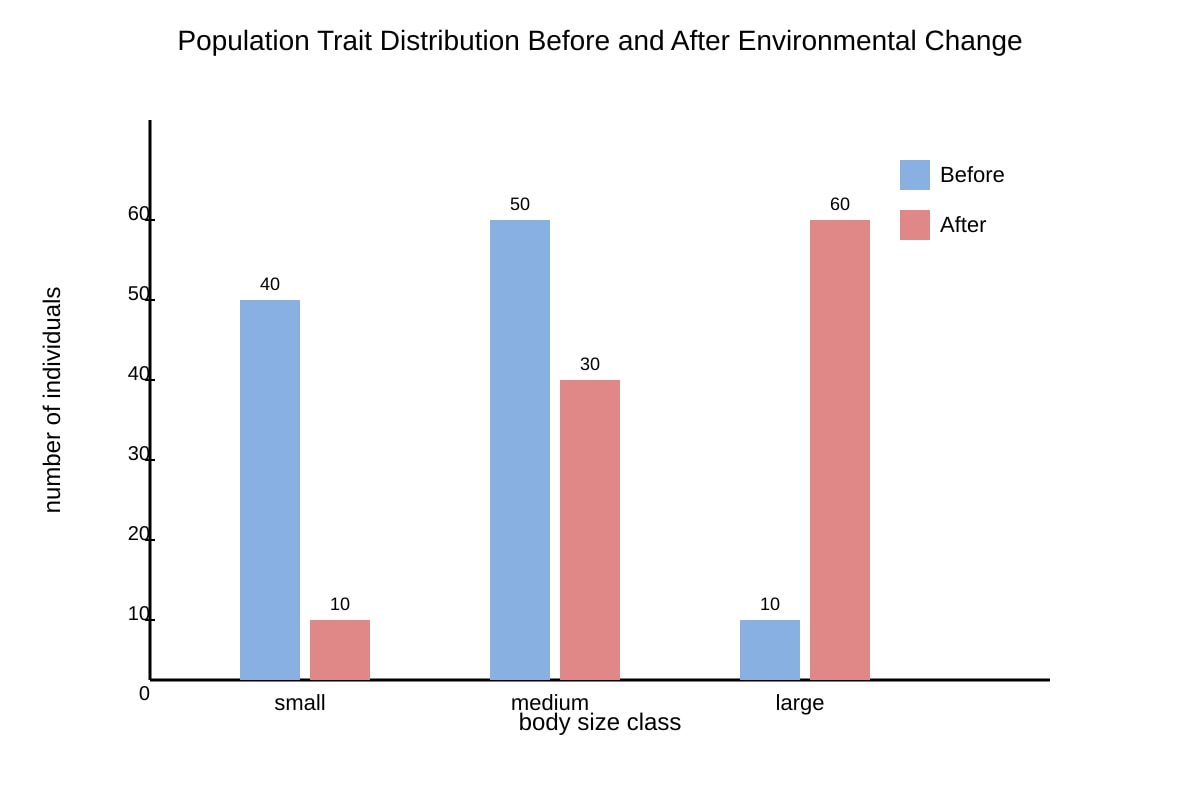
Answer: Graph shows shift to large size = directional selection (1); after change large favoured (1); small reduced (1).
Teaching: Use values: small 40→10, large 10→60.
13. (4 marks)
Answer: Natural: environment selects, e.g., peppered moth (2). Artificial: humans select, e.g., dog breeds (2).
Teaching: Agent differs.
14. (3 marks)
Answer: Physical barrier separates population (1); no gene flow (1); different selection leads to new species (1).
Teaching: Isolation speciates.
15. (4 marks)
Answer: Isolation (1); independent evolution (1); adaptation to each pond (1); possible speciation if reproductively isolated (1).
Teaching: Ridge = barrier.
16. (3 marks)
Answer: Genetic, species, ecosystem diversity. (1 each)
Teaching: Three levels.
17. (5 marks)
Answer: Habitat A higher (1); more species in each group (1); total 65 vs 15 (1); stability from varied roles (1); resilience to change (1).
Teaching: Count and explain.
18. (3 marks)
Answer: Same structure different function (1); indicates shared ancestor (1); e.g., limb bones (1).
Teaching: Homology.
19. (4 marks)
Answer: Mutation gave dark form (1); pollution changed background (1); birds select light less (1); dark increases (1).
Teaching: Mutation + selection.
20. (5 marks)
Answer: Ecological balance (1-2); resources like medicine (1-2); ethical/aesthetic (1). Total 5.
Teaching: Multiple reasons.