From Real Exams Quiz
Secondary 4 Combined Science Biology Plant Biology Quiz
Free Sec 4 Comb Sci Bio Plant Biology quiz, HY3 Exam version, with questions, answers, and O Level-style practice for Singapore students.
These static practice materials are generated from the site's syllabus and paper-generation workflow, with source and model context shown so students and parents can evaluate the material before use.
Questions
Free quiz and exam paper access
Enter your details to view this paper
Your access is remembered on this device.
Answers
Secondary 4 Combined Science Biology Quiz - Plant Biology (Answer Key)
Total Marks: 40
Duration: 45 minutes
Section A (1 mark each)
1. Diffusion [1]
Teaching note: Carbon dioxide moves from high concentration in air to lower concentration inside leaf cells through stomata by diffusion (passive, no energy). Common mistake: writing "osmosis" (osmosis is for water only).
2. Chloroplast [1]
Teaching note: Chloroplasts contain chlorophyll which absorbs light for photosynthesis.
3. Water (or sunlight/light energy) [1]
Teaching note: Photosynthesis equation: . Water and light are required.
4. Xylem [1]
Teaching note: Xylem vessels transport water and minerals upward from roots.
5. Oxygen [1]
Teaching note: Oxygen is a by-product released via stomata.
Section B (2 marks each)
6. [2]
- Flattened shape increases surface area for light capture. [1]
- Thin blade allows short diffusion distance for gases. [1]
Teaching note: Surface area to volume ratio matters for exchange.
7. [2]
- Root hair cells are underground, no light available. [1]
- Photosynthesis cannot occur, so chloroplasts (with chlorophyll) are absent. [1]
Teaching note: Chloroplasts needed only where light reaches.
8. [2]
Any two: light intensity, carbon dioxide concentration, temperature. [1+1]
Teaching note: These are classic limiting factors from F. F. Blackman's law.
9. [2]
- Soil water has higher water potential than root hair cell sap. [1]
- Water enters by osmosis across cell membrane. [1]
Teaching note: Osmosis = water diffusion through semi-permeable membrane.
10. [2]
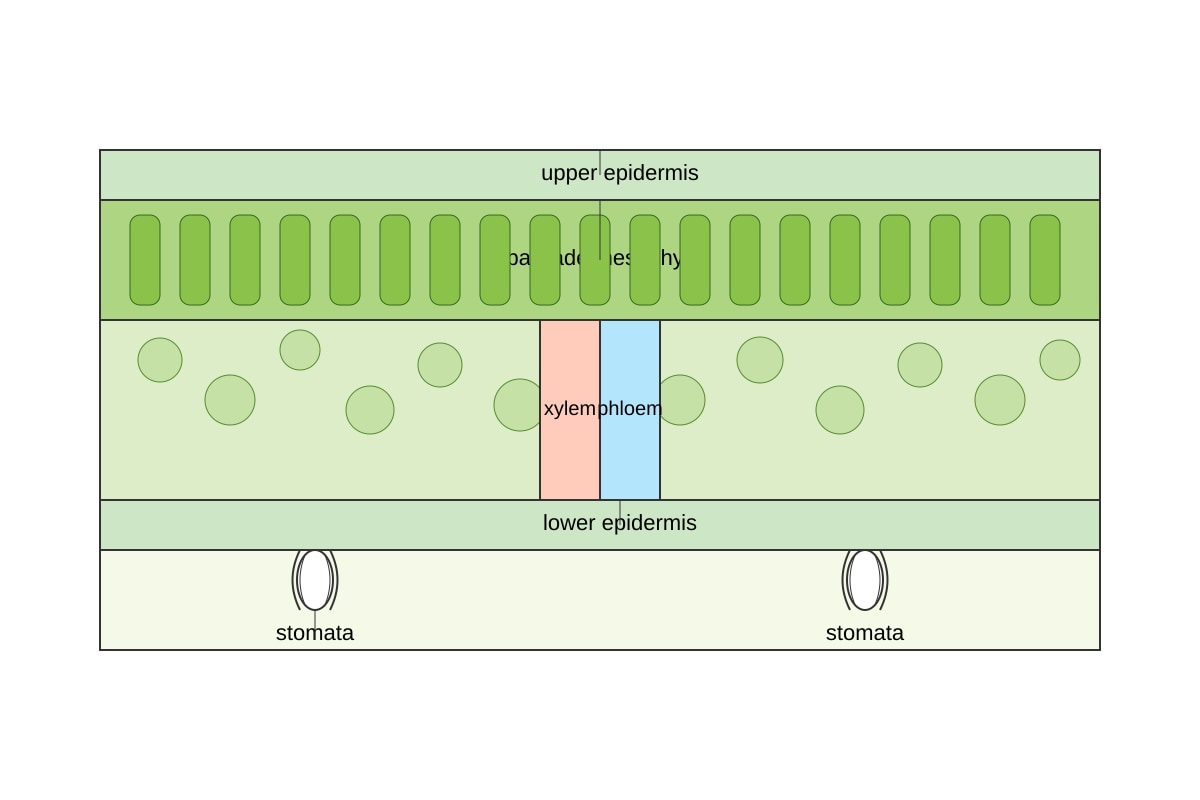
- Palisade cells near top receive most light. [1]
- Column arrangement reduces light obstruction between cells. [1]
Section C (3–4 marks each)
11. [3]
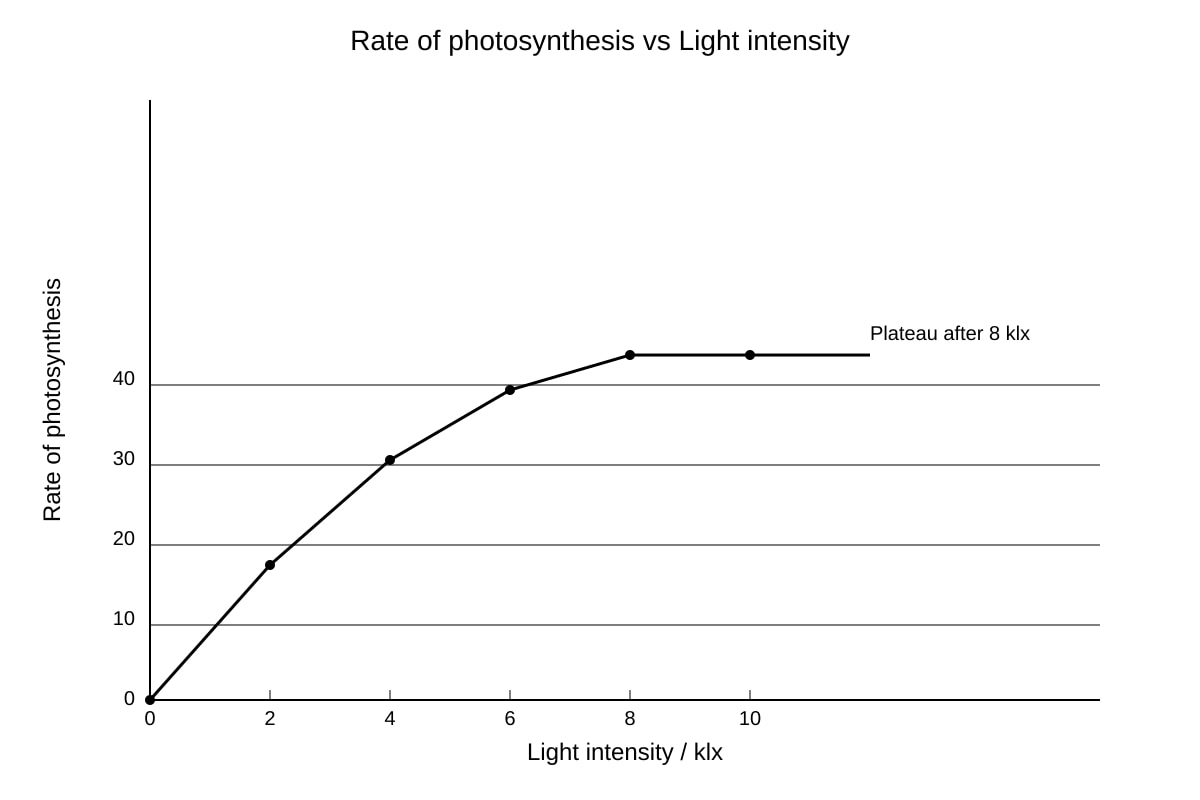
- Rate increases with light intensity up to ~8 klx. [1]
- Then plateaus (no further increase). [1]
- At high intensity, light is no longer limiting; CO₂ or temperature limits. [1]
12. [3]
- Stomata are pores on leaf surface. [1]
- Allow CO₂ to diffuse in for photosynthesis. [1]
- Allow O₂ (by-product) to diffuse out. [1]
13. [4]
- Soil → root hair cell (osmosis). [1]
- Root xylem → stem xylem → leaf xylem. [1]
- Mesophyll cell → air space. [1]
- Out via stomata (transpiration). [1]
14. [3]
- Water lost from leaves by transpiration. [1]
- Vapour condenses on bag inner surface as droplets. [1]
- Shows water vapour released via stomata. [1]
15. [3]
- Transpiration rate increases with temperature. [1]
- Higher temp → faster evaporation / more kinetic energy. [1]
- Stomata may open wider or water vapour diffuses faster. [1]
16. [4]
- Palisade layer near top, tightly packed, many chloroplasts. [1]
- Captures maximum light before it reaches lower layers. [1]
- Spongy layer has air spaces for gas diffusion. [1]
- Thin cuticle/epidermis lets light through. [1]
17. [4]
- Xylem: transports water + minerals, one-way up, dead cells, no cytoplasm. [2]
- Phloem: transports sugars (food), both directions, living cells. [2]
18. [4]
- Place pondweed in water with funnel + test tube inverted. [1]
- Vary distance of lamp to change light intensity. [1]
- Count oxygen bubbles / measure gas volume per time. [1]
- Control temp, CO₂, same plant size. [1]
19. [3]
- Photosynthesis removes CO₂ from atmosphere. [1]
- Converts to glucose, storing carbon in biomass. [1]
- Balances respiration/decomposition releases. [1]
20. [4]
- Foil block prevents light reaching covered part. [1]
- No photosynthesis → no starch made there. [1]
- Uncovered part photosynthesises → starch produced. [1]
- Iodine tests starch: blue-black = present. [1]