From Real Exams Quiz
Secondary 4 Combined Science Biology Genetics Inheritance Quiz
Free Sec 4 Comb Sci Bio Genetics Inheritance quiz, HY3 Exam version, with questions, answers, and O Level-style practice for Singapore students.
These static practice materials are generated from the site's syllabus and paper-generation workflow, with source and model context shown so students and parents can evaluate the material before use.
Questions
Free quiz and exam paper access
Enter your details to view this paper
Your access is remembered on this device.
Answers
Answer Key: Secondary 4 Combined Science Biology Quiz - Genetics Inheritance
Total Marks: 40
Topic: Genetics Inheritance
Section A (1 mark each)
1. Phenotype
Teaching note: Phenotype = observable traits (e.g., height, eye colour) shaped by genotype + environment. Do not confuse with genotype (genes only).
2. Meiosis
Teaching note: Meiosis reduces chromosome number from diploid (2n) to haploid (n) for gametes.
3. aa
Teaching note: Homozygous = same alleles; recessive shown with lowercase. TT would be homozygous dominant.
4. Thalassemia (or Niemann-Pick disease)
Teaching note: From context evidence, these were real exam contexts for genetic disease inheritance.
5. Segregation
Teaching note: Mendel's law of segregation: alleles separate in gamete formation.
Section B (2–3 marks each)
6. (a) [1] Allele = alternative form of a gene (e.g., T or t at same locus).
(b) [1] Dominant allele expressed in heterozygous (Tt); recessive only expressed in homozygous recessive (tt).
Teaching note: Capital letter = dominant, lowercase = recessive.
7. [2] Punnett: Tt x tt → Tt, Tt, tt, tt. Phenotypic ratio tall:short = 2:2 = 1:1.
Marking: 1 for gametes correct, 1 for ratio 1:1.
8. [2] Blood group O genotype is ii (homozygous recessive). Child gets one allele from each parent, so both parents must have at least one i allele (carrier or O).
Marking: 1 for genotype ii, 1 for inheritance explanation.
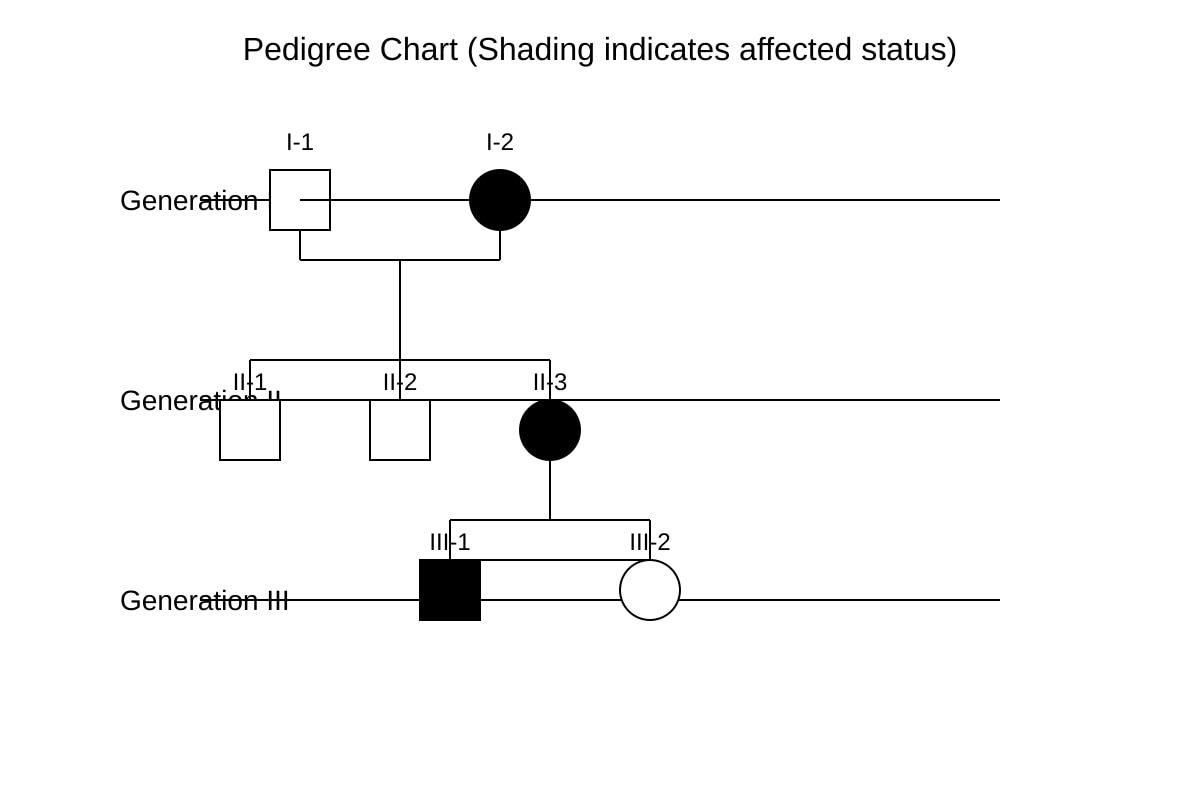
9. [2] Recessive. Reason: unaffected parents (I-1 unshaded, I-2 shaded? Actually I-2 shaded = affected; if trait appears in offspring of unaffected x affected, likely dominant — but based on labels: I-2 shaded, II mostly unshaded, III shaded from II-3 shaded → likely dominant because affected parent passes to some children).
Correction: From description, I-2 affected, II-3 affected, III-1 affected → dominant trait (does not skip generations).
Answer: Dominant. Reason: affected individuals appear in every generation and an affected parent has affected child.
Marking: 1 trait, 1 reason.
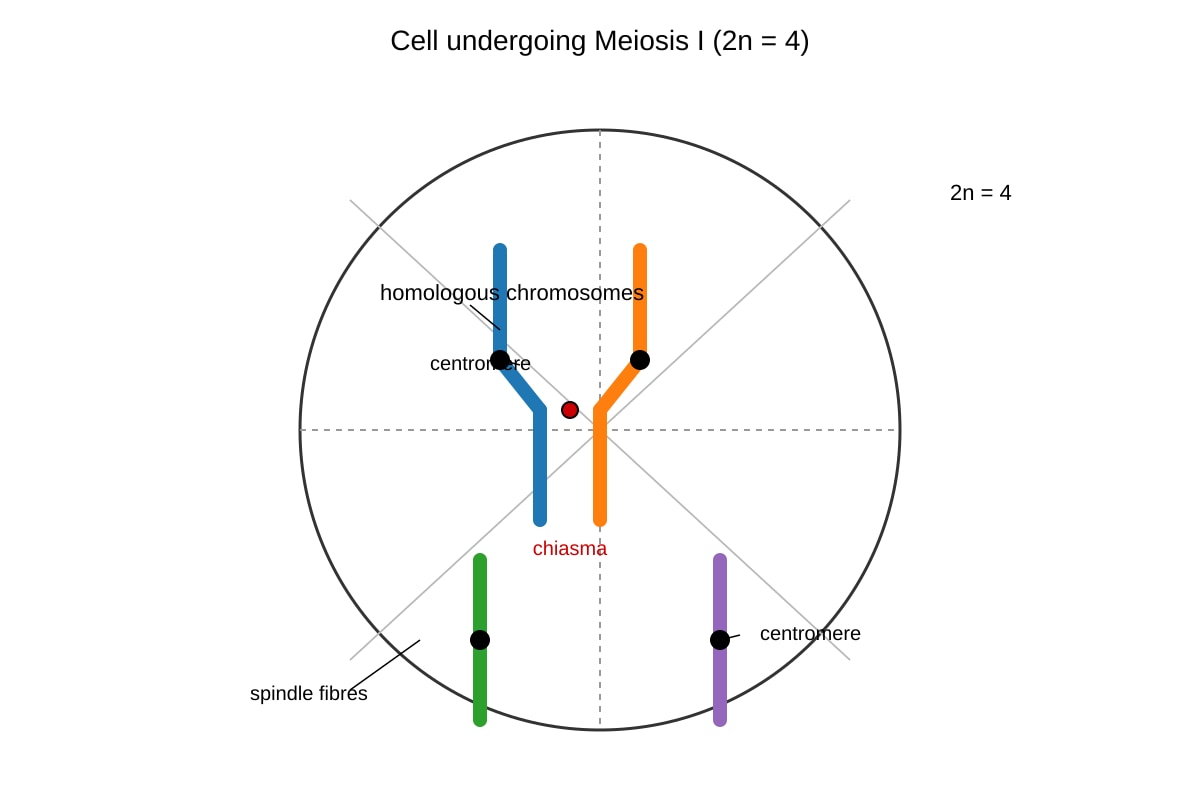
10. [3] Meiosis contributes variation by: (1) crossing over in prophase I exchanges segments; (2) independent assortment of homologous chromosomes; (3) random fusion of gametes.
Marking: 1 each point.
Section C (4–6 marks each)
11. [4] Cross Tt x Tt. Gametes: T, t from each. Punnett: TT, Tt, Tt, tt. Affected = tt = 1/4 = 25%.
Marking: gametes [1], square [1], genotype ratio [1], probability [1].
12. [4] DNA replication: (1) helix unwinds by helicase; (2) strands separate; (3) free nucleotides pair (A-T, C-G) by DNA polymerase; (4) two identical DNA molecules formed (semi-conservative).
Marking: 1 per point.
13. [4] Observed ratio 547:183 ≈ 3:1 (547/183 = 2.99). Expected Mendelian Rr x Rr = 3 round : 1 wrinkled. Matches.
Marking: calculation [2], comparison [2].
14. [3] Genotype = genetic makeup (e.g., Tt); phenotype = expressed trait (tall). Example: TT and Tt both tall phenotype but different genotype.
Marking: def genotype [1], def phenotype [1], example [1].
15. [3] Incomplete dominance: heterozygote shows blended phenotype (grey). Neither allele fully dominant.
Marking: pattern named [1], explanation [1], example link [1].
16. [4] Chiasma = point of crossing over where non-sister chromatids exchange segments. Significance: increases genetic recombination/variation.
Marking: description [2], significance [2].
17. [4] Aa x aa → Aa, Aa, aa, aa. Carriers (Aa) = 2/4 = 50%. Working shown by Punnett.
Marking: cross [2], probability [2].
18. [5] Environment affects phenotype despite fixed genotype: e.g., hydrangea flower colour changes with soil pH; identical genotype different colour. Or human height limited by nutrition.
Marking: definition [1], example [2], explanation [2].
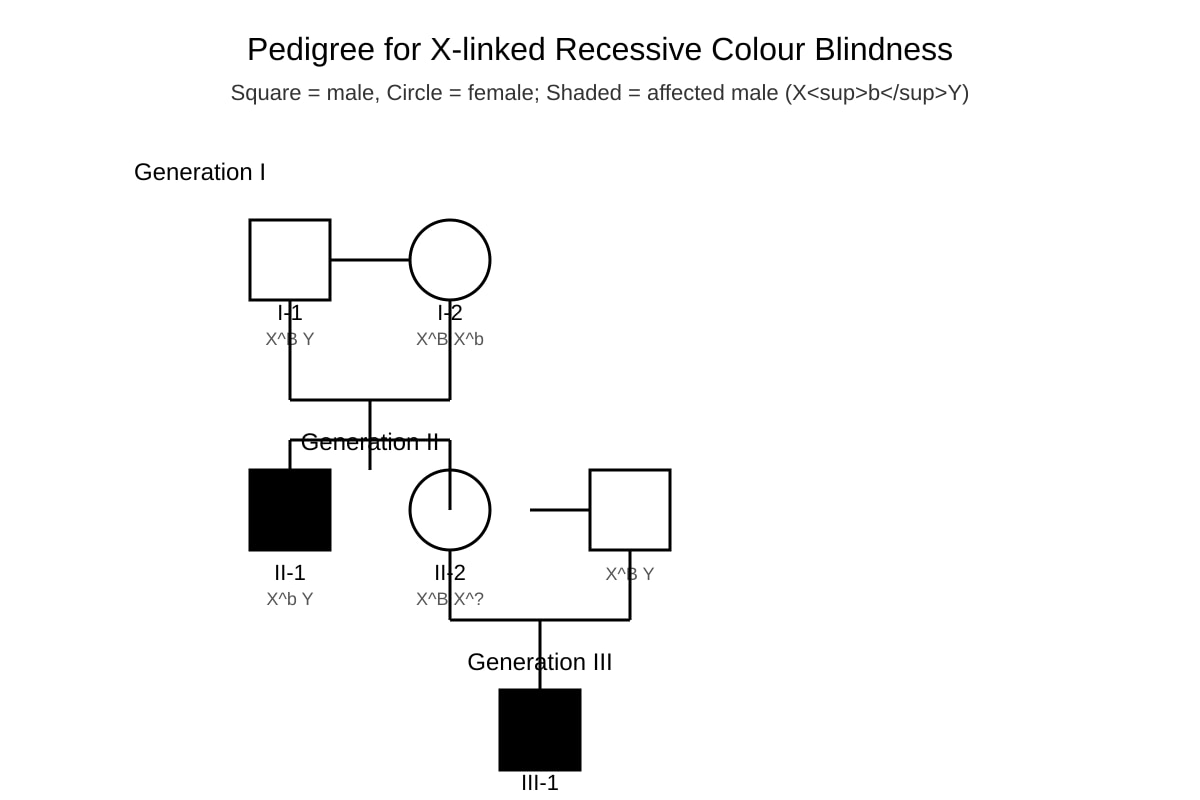
19. [5] X-linked recessive: males have one X, so if they inherit X^b they are affected. Females need two X^b to be affected; carriers unaffected. Thus more males affected.
Marking: X-link note [2], male vulnerability [2], female resistance [1].
20. [6] Statement false. Tall parents could be Tt x Tt → tt child short. Dominance does not guarantee all offspring show trait; depends on parental genotype. Use Punnett to show 25% short possible.
Marking: eval [2], genetic reason [2], example [2].