From Real Exams Quiz
Secondary 4 Combined Science Biology Evolution Diversity Quiz
Free Sec 4 Comb Sci Bio Evolution Diversity quiz, HY3 Exam version, with questions, answers, and O Level-style practice for Singapore students.
These static practice materials are generated from the site's syllabus and paper-generation workflow, with source and model context shown so students and parents can evaluate the material before use.
Questions
Free quiz and exam paper access
Enter your details to view this paper
Your access is remembered on this device.
Answers
Answer Key: Secondary 4 Combined Science Biology Quiz - Evolution Diversity
Total Marks: 40
Topic: Evolution Diversity
Section A (1 mark each)
Q1. Mutation (or sexual reproduction / gene flow / genetic recombination).
Teaching note: Variation is the raw material for natural selection. Mutation changes DNA sequence; sexual reproduction mixes alleles.
Q2. Charles Darwin.
Teaching note: Darwin and Wallace independently proposed natural selection in 1858.
Q3. Homologous structures.
Teaching note: Same bone layout from common ancestor, changed function.
Q4. Horizontal gene transfer / conjugation / plasmids / from parent to offspring (vertical).
Teaching note: Bacteria share resistance genes via plasmids.
Q5. Human arm and bat wing (or whale flipper and cat leg).
Teaching note: Must be same structure, different species, similar anatomy.
Section B (2 marks each)
Q6. [2 marks: 1 for variation, 1 for survival link]
Greater genetic variation means some individuals likely have traits suited to new conditions (1). These survive and reproduce, so population continues (1).
Mistake: Saying variation itself causes survival without selection.
Q7. [2 marks: 1 for fossil sequence, 1 for change over time]
Fossils show older layers have simpler/different organisms (1) and successive layers show gradual changes in form (1).
Note: Must mention strata/age order.
Q8. [2 marks: 1 for predation selecting green, 1 for inheritance]
Birds eat more red beetles, so green beetles survive more (1) and pass green genes to offspring, increasing green proportion (1).
Q9. [2 marks: 1 each]
Any two: DNA/Protein sequences, homologous structures, embryology, biogeography, molecular evidence.
Q10. [2 marks: 1 for interbreeding, 1 for same species]
Different dog breeds can still interbreed and produce fertile offspring (1), so they remain one species (1).
Note: Species defined by reproductive isolation, not appearance.
Section C
Q11. [3 marks]
- Giraffe, human, whale all have 7 neck vertebrae despite different neck lengths (1).
- Same bone number indicates inherited from a common ancestor (1).
- Differences in size/function evolved later (1).
Teaching: Homology from shared ancestry.
Q12. [2 marks]
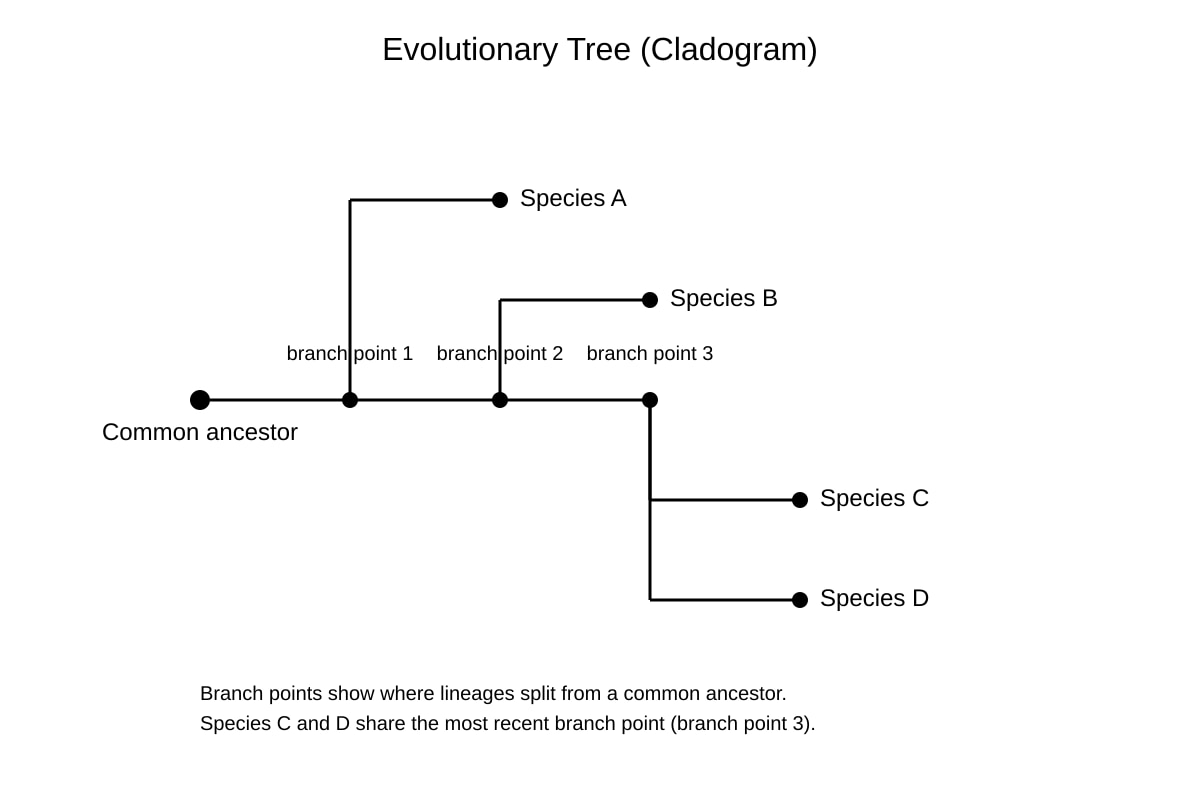
Most closely related: C and D (1) because they share the most recent branch point (1).
From diagram: Branch point 3 is latest split.
Q13. [4 marks]
- Some bacteria naturally have resistance mutation (1).
- Antibiotic kills susceptible bacteria, resistant survive (1).
- Resistant bacteria reproduce, passing resistance (1).
- Repeated use selects for resistance, population becomes mostly resistant (1).
Q14. [4 marks]
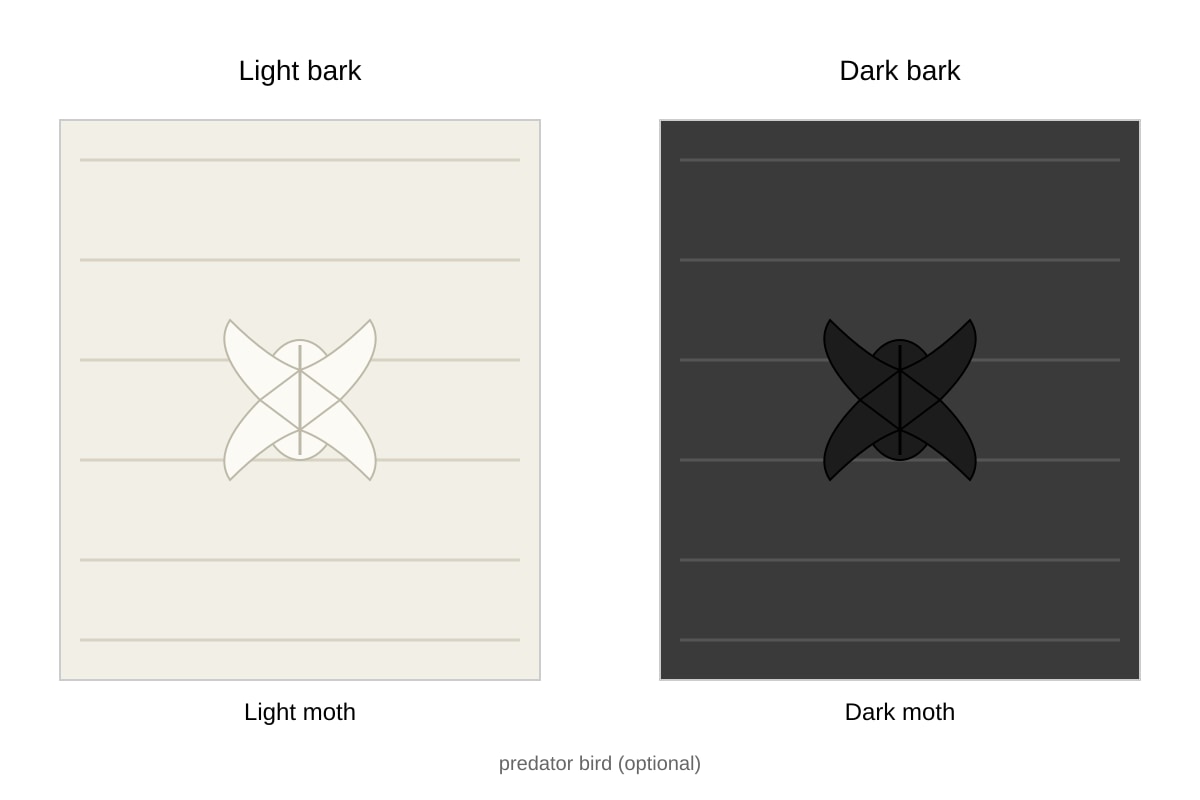
- Before pollution, light moths camouflaged on light trees, dark eaten by birds (1).
- Pollution darkened trees, now dark moths camouflaged (1).
- Birds ate more light moths, so dark survived (1).
- Dark trait increased in population over generations (1).
Q15. [2 marks]
Dark moth on dark bark (1) is harder for predators to see, so more likely to survive (1).
Q16. [2 marks]
A species is a group of organisms that can interbreed (1) and produce fertile offspring (1).
Note: Reproductive isolation from other groups.
Q17. [4 marks]
- Pest population had variation in pesticide tolerance (1).
- Pesticide killed susceptible, tolerant survived (1).
- Tolerant reproduced, increasing tolerant proportion (1).
- After years, most pests tolerant, so pesticide less effective (1).
Q18. [2 marks]
Any two: soft bodies don't fossilize; erosion destroys fossils; few conditions for fossilization; discovered incompletely.
Q19. [3 marks]
X and Y are more closely related (1) because higher DNA similarity (98%) means recent common ancestor (1). X and Z less related (90%) (1).
Concept: Molecular homology.
Q20. [5 marks]
- Statement false (1).
- Evolution is about adaptation, not complexity (1).
- Example: parasites lost structures (simpler) (1).
- Example: bacteria stayed simple but successful (1).
- Complexity only if environment favors it (1).
Marking: Evaluation + 2 correct examples + reasoning.