From Real Exams Quiz
Secondary 4 Combined Science Biology Evolution Diversity Quiz
Free Sec 4 Comb Sci Bio Evolution Diversity quiz, DeepSeek Exam version, with questions, answers, and O Level-style practice for Singapore students.
These static practice materials are generated from the site's syllabus and paper-generation workflow, with source and model context shown so students and parents can evaluate the material before use.
Questions

Free quiz and exam paper access
Enter your details to view this paper
Your access is remembered on this device.
Answers
Secondary 4 Combined Science Biology Quiz - Evolution Diversity
ANSWER KEY AND MARKING SCHEME
Total Marks: 40
Section A: Short Answer Questions (10 marks)
1. State what is meant by the term "natural selection." [2 marks]
Answer:
- The process by which organisms better adapted to their environment / with advantageous traits (1 mark)
- Are more likely to survive and reproduce, passing on these favourable traits to their offspring (1 mark)
Award:
- 1 mark for "better adapted / advantageous traits / favourable variations"
- 1 mark for "survive and reproduce / pass on traits to offspring / differential reproductive success"
2. Name the scientist who, along with Charles Darwin, independently proposed the theory of evolution by natural selection. [1 mark]
Answer: Alfred Russel Wallace
Award: 1 mark for correct name. Accept "Wallace" only.
3. Define the term "species." [2 marks]
Answer:
- A group of organisms that can interbreed / reproduce with one another (1 mark)
- To produce fertile offspring (1 mark)
Award:
- 1 mark for "interbreed / reproduce together"
- 1 mark for "fertile offspring" (must specify fertile; "offspring" alone is insufficient)
4. State one source of genetic variation within a population. [1 mark]
Answer: Any ONE of the following:
- Mutation
- Meiosis / crossing over during meiosis
- Random fertilisation / sexual reproduction
- Independent assortment of chromosomes
Award: 1 mark for any valid source.
5. Explain why antibiotic resistance in bacteria is considered an example of evolution by natural selection. [4 marks]
Answer:
- Within a bacterial population, there is genetic variation; some bacteria possess a mutation / gene that confers resistance to an antibiotic (1 mark)
- When the antibiotic is applied, non-resistant bacteria are killed (1 mark)
- Resistant bacteria survive and reproduce (1 mark)
- The resistance gene is passed to offspring; over generations, the proportion of resistant bacteria in the population increases (1 mark)
Award:
- 1 mark for identifying pre-existing variation / mutation for resistance
- 1 mark for selective pressure (antibiotic kills non-resistant bacteria)
- 1 mark for survival and reproduction of resistant bacteria
- 1 mark for inheritance of resistance / increase in resistant population over time
Section B: Structured Questions (10 marks)
6. Forelimb structures of vertebrates.
(a) Name the type of structure represented by these forelimbs. [1 mark]
Answer: Homologous structures / homologous organs
Award: 1 mark for "homologous structures" or "homologous organs."
(b) Explain how these structures provide evidence for evolution. [3 marks]
Answer:
- The forelimbs have a similar basic skeletal structure / pentadactyl limb pattern (same arrangement of bones: humerus, radius, ulna, carpals, metacarpals, phalanges) (1 mark)
- This similarity suggests that these organisms share a common ancestor (1 mark)
- The structures have been modified over time through natural selection for different functions (e.g., swimming, flying, grasping), demonstrating divergent evolution / adaptive radiation (1 mark)
Award:
- 1 mark for identifying similar basic structure / pentadactyl limb
- 1 mark for linking to common ancestry
- 1 mark for explaining modification for different functions / divergent evolution
(c) The whale forelimb is adapted for swimming, while the bat forelimb is adapted for flying. Explain how structures with a common origin can develop different functions. [2 marks]
Answer:
- Organisms with the common ancestral structure faced different environmental pressures / occupied different ecological niches (1 mark)
- Natural selection favoured different modifications of the basic structure in each lineage, leading to different adaptations / functions over many generations (1 mark)
Award:
- 1 mark for different environmental pressures / niches
- 1 mark for natural selection favouring different modifications / adaptations
7. Snail population and predation.
(a) State the term used to describe the differences in shell colour among the snails. [1 mark]
Answer: Variation
Award: 1 mark for "variation" (accept "genetic variation" or "phenotypic variation").
(b) Using the theory of natural selection, explain what is likely to happen to the snail population over several generations. [2 marks]
Answer:
- There is variation in shell colour within the snail population (light and dark shells) (1 mark)
- The bird predator can more easily spot light-coloured snails against the dark forest floor, so light-coloured snails are more likely to be eaten (selective pressure) (1 mark)
- Dark-coloured snails are better camouflaged, so they are more likely to survive and reproduce (differential survival) (1 mark)
- The dark shell trait is inherited by offspring; over several generations, the proportion of dark-coloured snails in the population will increase (1 mark)
Award:
- 1 mark for identifying variation
- 1 mark for selective pressure (predation on light snails)
- 1 mark for differential survival/reproduction of dark snails
- 1 mark for inheritance / change in population over generations
(c) Suggest one environmental change that could reverse this trend. [1 mark]
Answer: Any ONE of the following:
- The forest floor becomes lighter in colour (e.g., due to change in vegetation / leaf litter colour)
- The bird predator is removed from the habitat
- A new predator that preferentially targets dark-coloured snails is introduced
- Change in habitat to lighter-coloured substrate
Award: 1 mark for any plausible environmental change that would favour light-coloured snails.
Section C: Data Interpretation Questions (10 marks)
8. Antibiotic resistance data.
(a) Describe the trend shown in the table. [2 marks]
Answer:
- The percentage of penicillin-resistant bacteria increased over the 10-year period (1 mark)
- The increase was from 5% in 2010 to 82% in 2020 / the percentage increased steadily / more than 16-fold increase (1 mark)
Award:
- 1 mark for identifying increasing trend
- 1 mark for quoting data to support (start and end values, or describing rate of increase)
(b) Explain the trend described in (a) using your knowledge of natural selection. [4 marks]
Answer:
- Within the bacterial population, there was genetic variation; some bacteria possessed a gene/mutation conferring resistance to penicillin (1 mark)
- When penicillin was used in the hospital, it acted as a selective pressure, killing non-resistant bacteria (1 mark)
- Resistant bacteria survived and reproduced, passing the resistance gene to their offspring (1 mark)
- Over time (10 years), the proportion of resistant bacteria in the population increased, as shown by the rising percentage in the table (1 mark)
Award:
- 1 mark for pre-existing variation / resistance gene
- 1 mark for selective pressure (penicillin kills non-resistant)
- 1 mark for survival and reproduction of resistant bacteria / inheritance
- 1 mark for linking to the trend over time
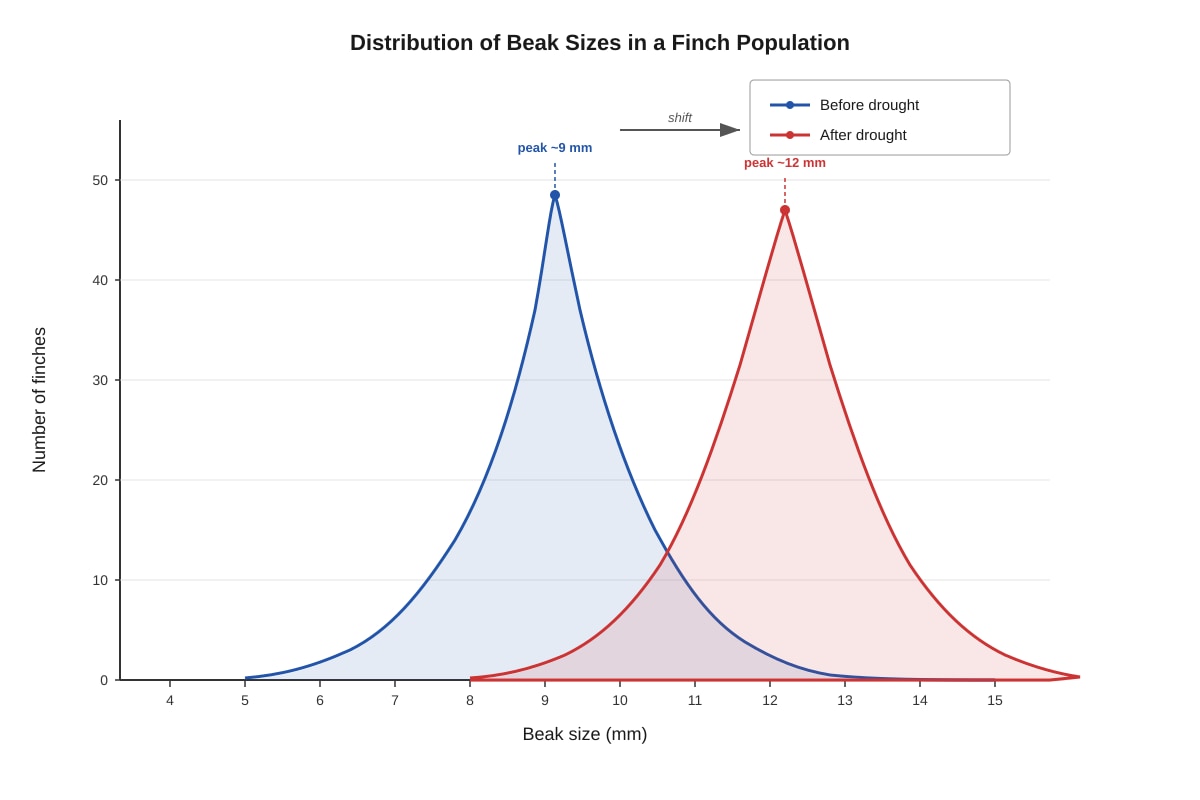
9. Finch beak size distribution.
(a) Compare the distribution of beak sizes before and after the drought. [2 marks]
Answer:
- Before the drought, the distribution showed a peak at medium beak sizes (8-10 mm) / most finches had medium-sized beaks (1 mark)
- After the drought, the peak shifted to larger beak sizes (11-13 mm) / the average beak size increased / more finches had larger beaks (1 mark)
Award:
- 1 mark for describing the "before" distribution (medium peak)
- 1 mark for describing the "after" distribution (shift to larger beaks)
(b) During the drought, only large, hard seeds were available as a food source. Explain how this led to the change in beak size distribution shown in the graph. [2 marks]
Answer:
- Finches with larger beaks were better able to crack open and eat the large, hard seeds (1 mark)
- These finches were more likely to survive the drought and reproduce, passing on their genes for larger beak size to their offspring (1 mark)
- Over generations, the proportion of finches with larger beaks increased, shifting the distribution to the right (1 mark)
Award:
- 1 mark for linking larger beaks to survival advantage (access to food)
- 1 mark for differential reproduction and inheritance / shift in distribution
10. This change in beak size distribution (from Question 9) is an example of evolution. Explain why. [2 marks]
Answer:
- Evolution is defined as a change in the heritable characteristics of a population over generations (1 mark)
- The shift in beak size distribution represents a change in the heritable trait (beak size) within the finch population from one generation to the next (1 mark)
Award:
- 1 mark for definition of evolution (change in heritable traits over generations)
- 1 mark for applying definition to the finch example
Section D: Extended Response Questions (10 marks)
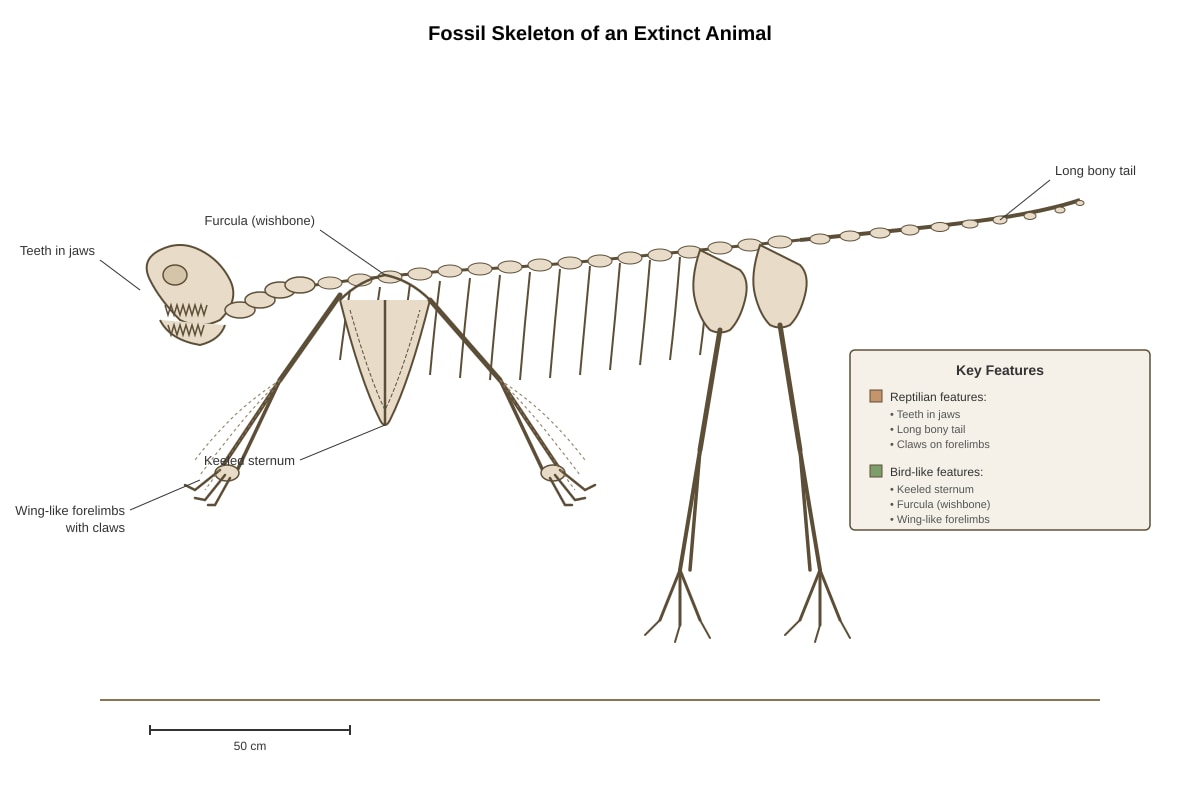
11. Fossil evidence.
(a) Suggest why fossils with features of two different groups of organisms are considered strong evidence for evolution. [2 marks]
Answer:
- Such fossils (transitional fossils / intermediate forms) show characteristics of both an ancestral group and a derived group (1 mark)
- They provide evidence that one group evolved from the other / demonstrate the evolutionary link / common ancestry between the two groups (1 mark)
Award:
- 1 mark for identifying as transitional fossils / intermediate forms
- 1 mark for linking to evolutionary relationship / common ancestry
(b) Explain why the fossil record is incomplete, and state one limitation of using fossils as evidence for evolution. [2 marks]
Answer:
- Why incomplete: Fossilisation requires specific conditions (e.g., rapid burial, hard body parts); most organisms do not fossilise / many fossils are yet to be discovered / geological processes can destroy fossils (1 mark)
- Limitation: Any ONE of the following:
- Gaps in the fossil record mean evolutionary pathways are not always clear
- Fossil record is biased towards organisms with hard body parts
- Dating fossils can be imprecise
- Only provides morphological evidence, not behavioural or genetic (1 mark)
Award:
- 1 mark for valid reason for incompleteness
- 1 mark for valid limitation
12. Explain how geographical isolation can lead to the formation of a new species. [4 marks]
Answer:
- A population of a species becomes separated by a geographical barrier (e.g., mountain range, river, ocean) (1 mark)
- The separated populations experience different environmental conditions / selective pressures (1 mark)
- Natural selection favours different traits in each population; over many generations, they accumulate different genetic variations (1 mark)
- Eventually, the populations become so genetically different that they can no longer interbreed to produce fertile offspring, forming a new species (reproductive isolation) (1 mark)
Award:
- 1 mark for geographical barrier / separation
- 1 mark for different selective pressures
- 1 mark for accumulation of genetic differences through natural selection
- 1 mark for reproductive isolation / formation of new species
13. Compare the processes of artificial selection and natural selection. [2 marks]
Answer:
- Similarity: Both processes result in changes in the heritable traits of a population over generations / both act on existing variation (1 mark)
- Difference: In artificial selection, humans select which organisms reproduce based on desired traits; in natural selection, the environment / nature determines which organisms survive and reproduce (1 mark)
Award:
- 1 mark for valid similarity
- 1 mark for valid difference
14. Explain how comparative embryology provides evidence for evolution. [2 marks]
Answer:
- Embryos of different vertebrate species show similar structures / stages in early development (e.g., pharyngeal pouches, post-anal tail) (1 mark)
- These similarities suggest that these organisms share a common ancestor / common developmental genes (1 mark)
Award:
- 1 mark for identifying similar embryonic structures/stages
- 1 mark for linking to common ancestry
15. A farmer uses a pesticide to control insect pests on crops. After several years, the pesticide becomes less effective. Explain how this occurred, using the theory of natural selection. [4 marks]
Answer:
- Within the insect pest population, there was genetic variation; some insects possessed a gene/mutation that conferred resistance to the pesticide (1 mark)
- When the pesticide was applied, it acted as a selective pressure, killing susceptible insects (1 mark)
- Resistant insects survived and reproduced, passing the resistance gene to their offspring (1 mark)
- Over several years/generations, the proportion of resistant insects in the population increased, making the pesticide less effective (1 mark)
Award:
- 1 mark for pre-existing variation / resistance gene
- 1 mark for selective pressure (pesticide kills susceptible)
- 1 mark for survival and reproduction of resistant insects / inheritance
- 1 mark for increase in resistant population over time / reduced effectiveness
16. Distinguish between convergent evolution and divergent evolution, giving an example of each. [4 marks]
Answer:
- Convergent evolution: Unrelated species evolve similar traits independently due to similar environmental pressures / analogous structures (1 mark)
- Example: Wings of birds and insects / streamlined bodies of dolphins and sharks (1 mark)
- Divergent evolution: Related species evolve different traits from a common ancestor due to different environmental pressures / homologous structures (1 mark)
- Example: Pentadactyl limb in vertebrates (human hand, whale flipper, bat wing) / Darwin's finches' beak shapes (1 mark)
Award:
- 1 mark for definition of convergent evolution
- 1 mark for valid example of convergent evolution
- 1 mark for definition of divergent evolution
- 1 mark for valid example of divergent evolution
17. Explain how DNA sequencing and molecular biology provide evidence for evolution. [2 marks]
Answer:
- Comparing DNA sequences / amino acid sequences of proteins between different species reveals similarities (1 mark)
- Species that are more closely related share a higher percentage of similar DNA sequences, indicating common ancestry (1 mark)
Award:
- 1 mark for comparing DNA/protein sequences
- 1 mark for linking similarity to evolutionary relatedness / common ancestry
18. Describe how the overuse of antibiotics in agriculture can contribute to the spread of antibiotic resistance in human pathogens. [2 marks]
Answer:
- Antibiotics used in livestock select for antibiotic-resistant bacteria in the animals (1 mark)
- These resistant bacteria can be transmitted to humans through the food chain / direct contact / environmental contamination, spreading resistance genes to human pathogens (1 mark)
Award:
- 1 mark for selection of resistant bacteria in livestock
- 1 mark for transmission to humans / human pathogens
19. Explain why individuals do not evolve, but populations do. [2 marks]
Answer:
- An individual's genes / genotype do not change during its lifetime in response to the environment (1 mark)
- Evolution is defined as a change in the allele frequencies / heritable characteristics of a population over generations (1 mark)
Award:
- 1 mark for individual's genes not changing
- 1 mark for evolution occurring at the population level over generations
20. Discuss how both the fossil record and comparative anatomy support the theory of evolution. [4 marks]
Answer:
- Fossil record:
- Shows that organisms have changed over time (simple to complex) (1 mark)
- Provides evidence of transitional forms / extinct species linking different groups (1 mark)
- Comparative anatomy:
- Homologous structures (e.g., pentadactyl limb) indicate common ancestry / divergent evolution (1 mark)
- Analogous structures indicate convergent evolution due to similar environmental pressures (1 mark)
- Vestigial structures (e.g., human appendix) are remnants of organs that had a function in ancestors (1 mark)
Award:
- 1 mark for fossil record showing change over time
- 1 mark for fossil record showing transitional forms
- 1 mark for comparative anatomy showing homologous structures / common ancestry
- 1 mark for comparative anatomy showing analogous/vestigial structures (any one valid point)
END OF ANSWER KEY