From Real Exams Quiz
Secondary 4 Combined Science Biology Cells Biomolecules Quiz
Free Sec 4 Comb Sci Bio Cells Biomolecules quiz, HY3 Exam version, with questions, answers, and O Level-style practice for Singapore students.
These static practice materials are generated from the site's syllabus and paper-generation workflow, with source and model context shown so students and parents can evaluate the material before use.
Questions

Free quiz and exam paper access
Enter your details to view this paper
Your access is remembered on this device.
Answers
Secondary 4 Combined Science Biology Quiz - Cells Biomolecules (Answer Key)
Total Marks: 40
Topic: Cells Biomolecules
Section A Answers (Q1–5)
Q1. [1 mark] Diffusion
Teaching note: Oxygen moves from high concentration in alveoli/blood to low concentration in muscle cell by diffusion, a passive process. Common mistake: naming "respiration" (a process using oxygen, not transporting it).
Q2. [1 mark] Mitochondrion (or mitochondria)
Teaching note: Mitochondria are the sites of aerobic respiration where ATP is produced. Do not accept "nucleus".
Q3. [1 mark] Red blood cell (erythrocyte)
Teaching note: Biconcave shape and lack of nucleus are identifying features. Common mistake: confusing with white blood cell which has a nucleus.
Q4. [1 mark] Oxygen / Carbon dioxide / Water vapour (any one)
Teaching note: Gases diffuse out of leaf cells into air spaces then out through stomata. Accept any correct gas produced or exchanged.
Q5. [1 mark] DNA (deoxyribonucleic acid)
Teaching note: DNA carries genetic instructions. Do not accept "gene" as the molecule name.
Section B Answers (Q6–12)
Q6. [3 marks total]
(a) [1] Diffusion
(b) [2] Diffusion is movement down a concentration gradient (from high to low CO₂ concentration) and needs no energy because it is passive; kinetic energy of molecules causes random movement.
Marking: 1 mark for gradient idea, 1 mark for passive/no energy.
Q7. [2 marks] Liver cells carry out many metabolic processes needing ATP, so many mitochondria produce energy; red blood cells have no mitochondria because they lack a nucleus and organelles to maximise space for haemoglobin and do not use aerobic respiration.
Marking: 1 mark each cell explanation.
Q8. [6 marks]
- Oxygen enters alveoli in lungs during inhalation. [1]
- Diffuses across alveolar epithelium and capillary wall into blood plasma. [1]
- Binds to haemoglobin in red blood cells. [1]
- Transported via pulmonary vein → left atrium → left ventricle → aorta → coronary artery. [2]
- Diffuses from capillary into tissue fluid and across heart muscle cell membrane into mitochondrion. [1]
Teaching note: Must name structures and processes. Common trap: stopping at lung or blood.
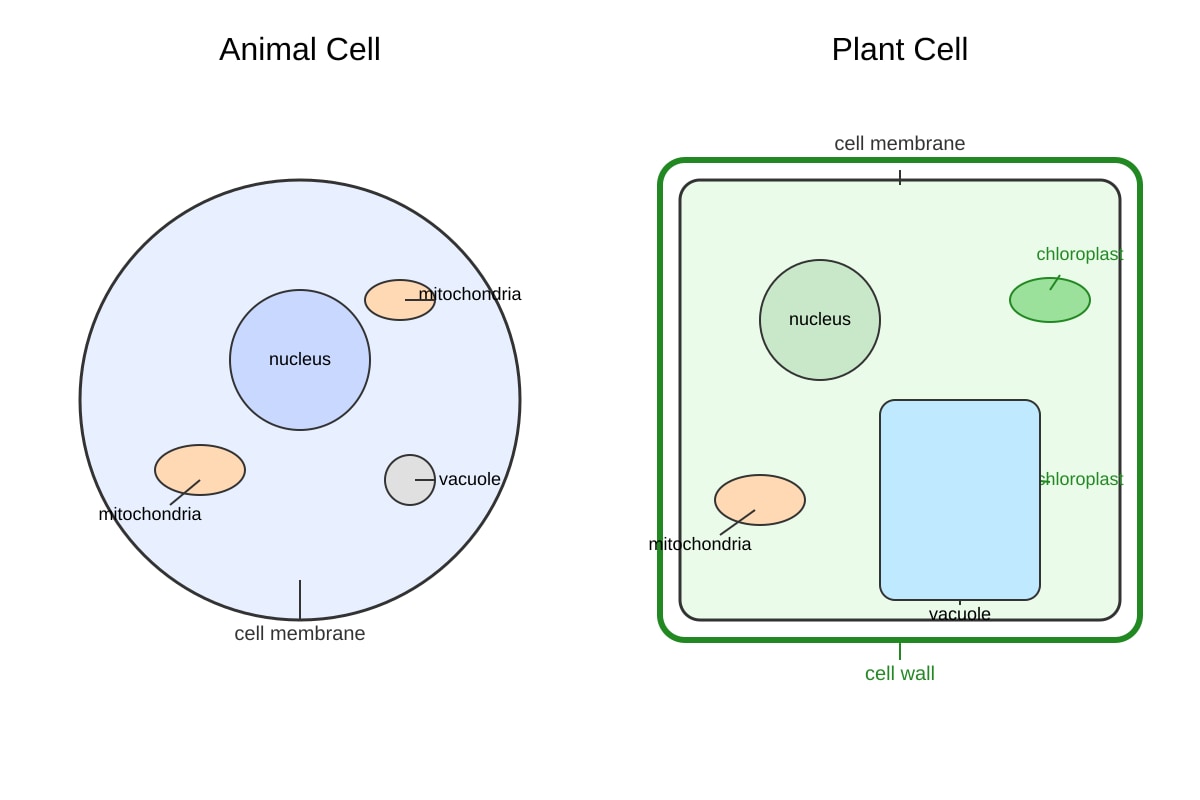
Q9. [1 mark] Plant cell has cell wall / large vacuole / chloroplasts (any one difference).
Teaching note: Animal cells lack these. Accept "plant has chloroplasts, animal does not".
Q10. [2 marks] It allows some substances (e.g., water, oxygen) to pass but blocks others (e.g., large proteins); controls entry/exit by size/charge.
Marking: 1 mark for selective, 1 mark for example or mechanism.
Q11. [2 marks]
(a) [1] Active transport
(b) [1] Yes (requires energy / ATP)
Teaching note: Against gradient = active transport, energy needed.
Q12. [2 marks] Osmosis is diffusion of water across a partially permeable membrane; diffusion is movement of any substance (not only water) down gradient, not necessarily through membrane.
Marking: 1 mark each correct distinction.
Section C Answers (Q13–20)
Q13. [3 marks]
- Muscle cell: 2500 mitochondria because it contracts and needs high ATP. [1]
- Skin cell: 200 because lower metabolic demand. [1]
- Red blood cell: 0 because no nucleus/organelles, carries oxygen not respires aerobically. [1]
Q14. [2 marks] Cell wall; Chloroplast; Large vacuole (any two).
Based on image_placeholder Q14-fig1: Plant cell shows wall, vacuole, chloroplasts; animal lacks them.
Q15. [2 marks] Pancreas cell secretes protein enzymes, ribosomes make proteins, so more ribosomes needed; fat cell stores fat, less protein synthesis.
Marking: 1 mark ribosome function, 1 mark link to pancreas.
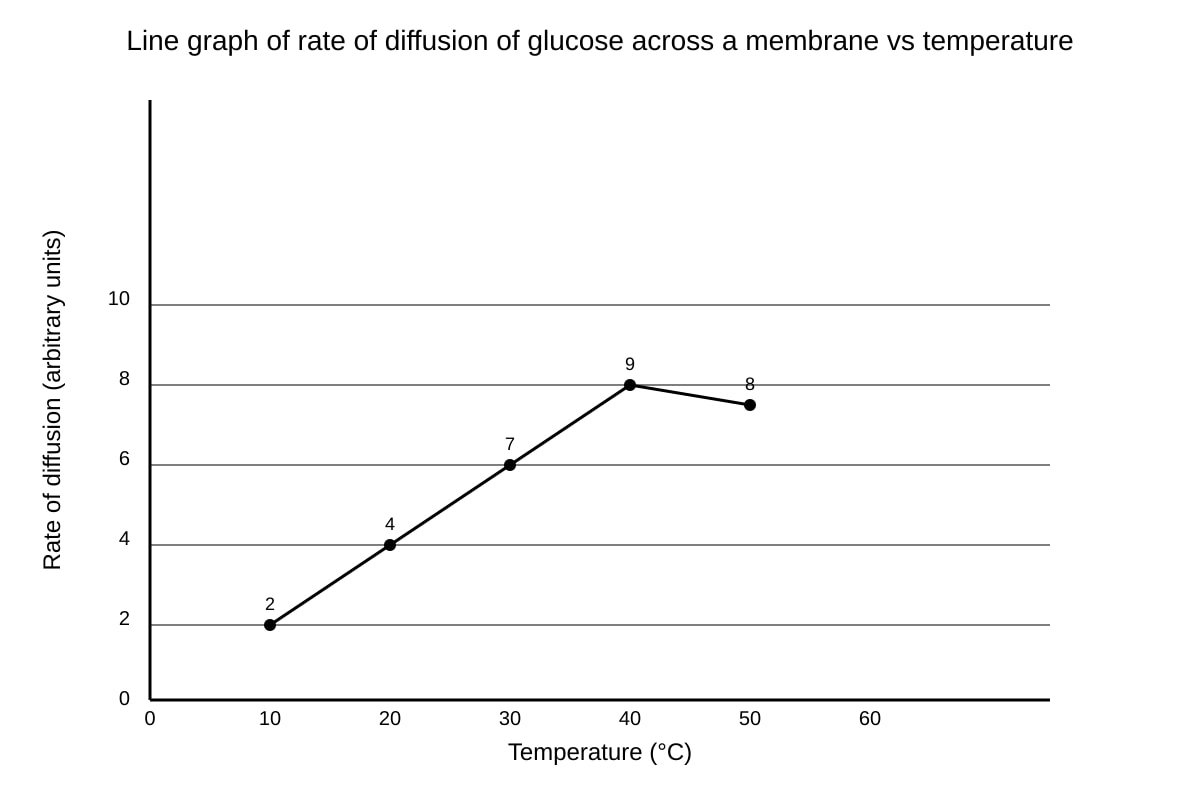
Q16. [2 marks] Highest at 40°C (rate 9). Trend: rate increases from 10°C to 40°C then decreases at 50°C (denaturation/reduced).
Based on graph: points given; student reads peak.
Q17. [3 marks]
(a) [1] Cell membrane (plasma membrane)
(b) [2] Outside water concentration higher than inside (cell sap more concentrated); water moves in by osmosis down water potential gradient.
Marking: 1 concentration diff, 1 movement direction.
Q18. [1 mark] Water moved into potato by osmosis, raising level.
Based on setup: level +2 cm shows net inflow.
Q19. [3 marks] Inner folded membrane (cristae) gives large surface area for reactions; matrix has enzymes for respiration; double membrane separates reactions. [1 each]
Q20. [1 mark] Nucleus / mitochondria / membrane-bound organelles (any one). Bacteria are prokaryotic, lack nucleus.