From Real Exams Quiz
Secondary 4 Combined Science Biology Cells Biomolecules Quiz
Free Sec 4 Comb Sci Bio Cells Biomolecules quiz, DeepSeek Exam version, with questions, answers, and O Level-style practice for Singapore students.
These static practice materials are generated from the site's syllabus and paper-generation workflow, with source and model context shown so students and parents can evaluate the material before use.
Questions
Free quiz and exam paper access
Enter your details to view this paper
Your access is remembered on this device.
Answers
Secondary 4 Combined Science Biology Quiz - Cells Biomolecules
ANSWER KEY AND MARKING SCHEME
Total Marks: 40
Section A: Cell Structure and Function (Questions 1–5)
1. State the process by which oxygen from the surroundings reaches a muscle cell in the leg. [1]
Answer: Diffusion
Marking Notes:
- Accept: "Diffusion down a concentration gradient"
- Do not accept: "Active transport" or "Osmosis"
2. The table below shows the number of mitochondria in different types of human cells.
(a) Identify the cell type that has no mitochondria. [1]
Answer: Red blood cell
Marking Notes:
- Accept: "Erythrocyte"
- Do not accept: "Skin cell" or "Muscle cell"
(b) Suggest why muscle cells have a much greater number of mitochondria compared to skin cells. [2]
Answer: Muscle cells carry out more respiration / require more energy (ATP) for contraction / movement [1], so they need more mitochondria to produce the required energy / ATP [1].
Marking Notes:
- Award [1] for stating that muscle cells have higher energy demand (respiration/ATP)
- Award [1] for linking higher energy demand to more mitochondria
- Accept: "Muscle cells are more metabolically active" for [1]
- Do not award marks for simply stating the difference without explanation
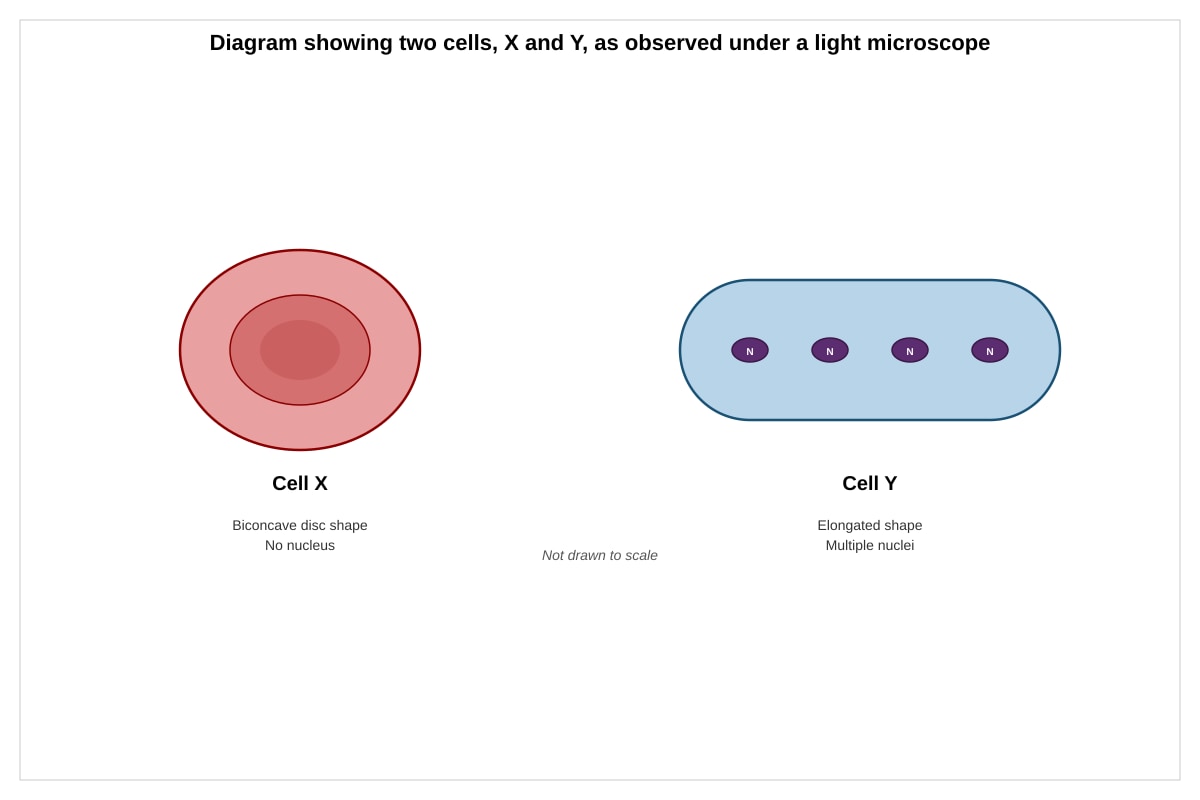
3. The diagram below shows two cells, X and Y, as observed under a light microscope.
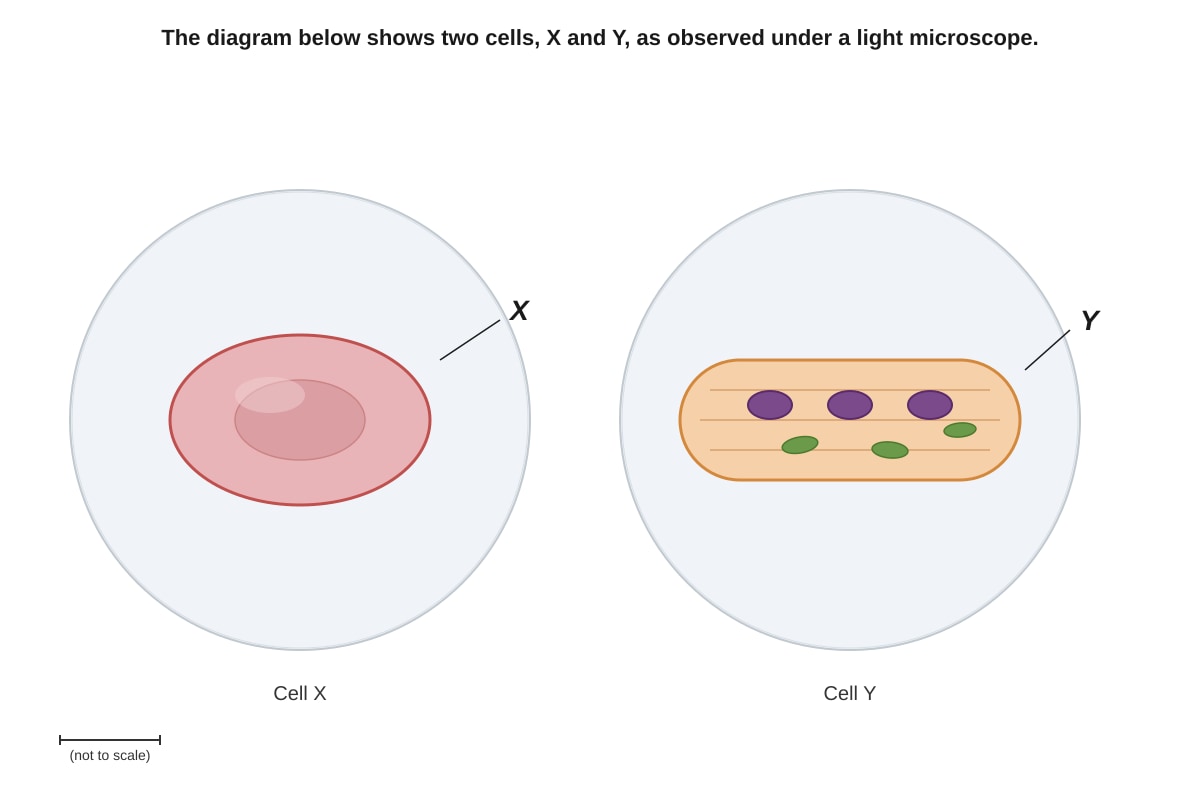
Generated diagram for this question.
(a) Identify cell X. [1]
Answer: Red blood cell / Erythrocyte
Marking Notes:
- Accept either "Red blood cell" or "Erythrocyte"
- Do not accept: "White blood cell" or "Platelet"
(b) Explain one advantage of the shape of cell X for its function. [2]
Answer: The biconcave disc shape increases the surface area to volume ratio [1], which allows for faster / more efficient diffusion of oxygen into and out of the cell [1].
Marking Notes:
- Award [1] for identifying the shape advantage (increased surface area to volume ratio)
- Award [1] for linking to function (faster oxygen diffusion/transport)
- Alternative answer: "The biconcave shape allows the cell to squeeze through narrow capillaries" [1] + "enabling it to reach all body tissues" [1]
- Do not award marks for "no nucleus" (this is not a shape advantage)
4. A student prepared a slide of onion epidermal cells and observed them under a microscope.
(a) Name the structure that gives plant cells their rigid shape. [1]
Answer: Cell wall
Marking Notes:
- Accept: "Cellulose cell wall"
- Do not accept: "Cell membrane" or "Vacuole"
(b) Explain why animal cells do not have this structure. [2]
Answer: Animal cells do not have a cell wall because they do not need rigid support [1]; animals have skeletons / structural support systems, and animal cells need to be flexible for movement and shape changes [1].
Marking Notes:
- Award [1] for stating that animal cells do not require rigid support
- Award [1] for linking to animal body support systems or flexibility needs
- Accept: "Animal cells need to change shape for functions like phagocytosis/muscle contraction" for [1]
5. A red blood cell was placed in distilled water. After a few minutes, the cell burst.
Explain why the red blood cell burst in distilled water. [2]
Answer: Distilled water has a higher water potential than the red blood cell [1], so water entered the cell by osmosis from a region of higher water potential to a region of lower water potential [1]. The cell membrane could not withstand the increased pressure, causing the cell to burst/haemolyse.
Marking Notes:
- Award [1] for identifying the water potential gradient (higher water potential outside)
- Award [1] for describing water movement into the cell by osmosis
- Accept: "The cell swelled and burst because too much water entered" for [1] if linked to osmosis
- Do not award marks if "diffusion" is used instead of "osmosis"
Section B: Movement of Substances (Questions 6–10)
6. A potato strip was placed in a concentrated sugar solution. After 30 minutes, the potato strip became soft and flaccid.
(a) Name the process that caused the potato strip to become flaccid. [1]
Answer: Osmosis
Marking Notes:
- Do not accept: "Diffusion" or "Active transport"
- Accept: "Exosmosis" or "Water loss by osmosis"
(b) Explain why the potato strip became soft in terms of water movement. [2]
Answer: The concentrated sugar solution has a lower water potential than the potato cells [1], so water moved out of the potato cells by osmosis from a region of higher water potential to a region of lower water potential [1], causing the cells to become plasmolysed/flaccid.
Marking Notes:
- Award [1] for identifying the water potential gradient (lower water potential outside)
- Award [1] for describing the direction of water movement (out of cells)
- Accept: "Water moved from the potato cells into the sugar solution" for [1]
- Do not award full marks if "diffusion" is used instead of "osmosis"
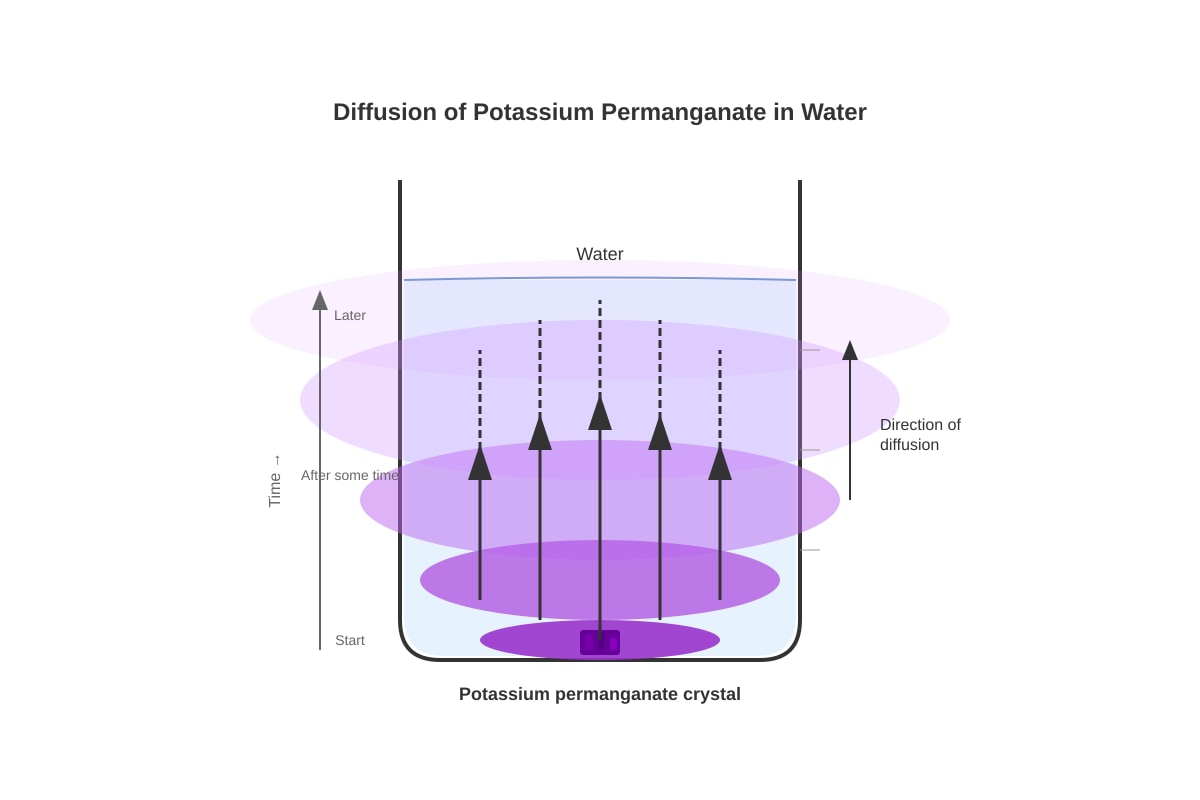
7. The diagram below shows an experiment set up to investigate diffusion.
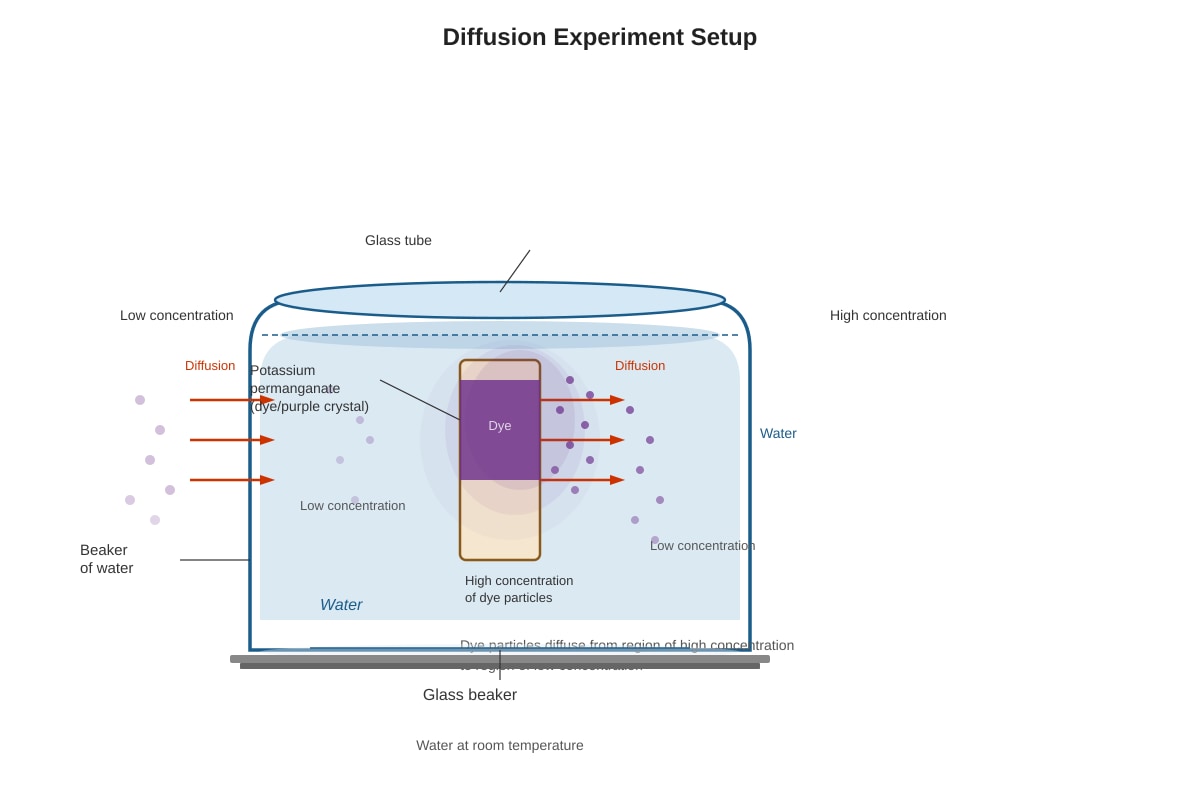
Generated diagram for this question.
(a) State what is meant by the term diffusion. [1]
Answer: Diffusion is the net movement of particles from a region of higher concentration to a region of lower concentration down a concentration gradient.
Marking Notes:
- Award [1] for "net movement" AND "from high to low concentration"
- Accept: "Movement of particles down a concentration gradient"
- Do not accept: "Movement of water" (this is osmosis)
(b) Explain why the purple colour spreads throughout the water without any stirring. [2]
Answer: The potassium permanganate particles are in constant random motion [1] and move from the region of high concentration (near the crystal) to regions of lower concentration (throughout the water) down the concentration gradient [1].
Marking Notes:
- Award [1] for mentioning random particle motion/kinetic energy
- Award [1] for describing movement down the concentration gradient
- Accept: "Particles diffuse from high to low concentration" for [1]
8. Glucose is absorbed from the small intestine into the blood even when the glucose concentration in the blood is higher than in the small intestine.
(a) Name the process by which glucose is absorbed against its concentration gradient. [1]
Answer: Active transport
Marking Notes:
- Do not accept: "Diffusion" or "Osmosis" or "Facilitated diffusion"
(b) State the source of energy required for this process. [1]
Answer: ATP (adenosine triphosphate) / Energy from respiration
Marking Notes:
- Accept: "ATP" or "Energy released from respiration"
- Do not accept: "Energy from the sun" or "Kinetic energy"
9. A student investigated the effect of pH on the activity of amylase enzyme.
(a) State the optimum pH for amylase activity. [1]
Answer: pH 7
Marking Notes:
- Must state "pH 7" or "7"
- Do not accept: "Between pH 6 and 8" (too vague)
(b) Explain why the time taken for starch digestion increases at pH 10. [2]
Answer: At pH 10, the enzyme amylase becomes denatured [1]. The shape of the active site changes, so the substrate (starch) can no longer bind to the enzyme, reducing the rate of digestion [1].
Marking Notes:
- Award [1] for stating the enzyme is denatured
- Award [1] for explaining the effect on the active site and substrate binding
- Accept: "The enzyme loses its specific three-dimensional shape" for [1]
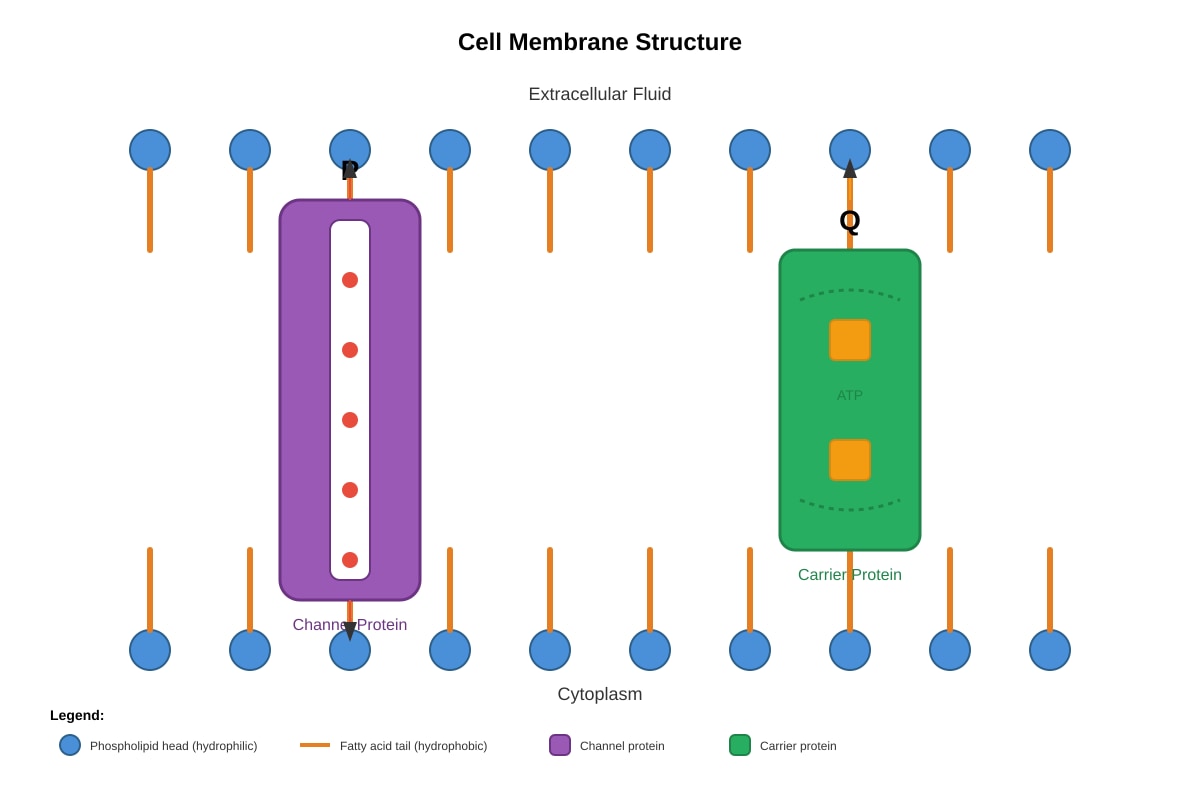
10. The diagram below shows part of a cell membrane.
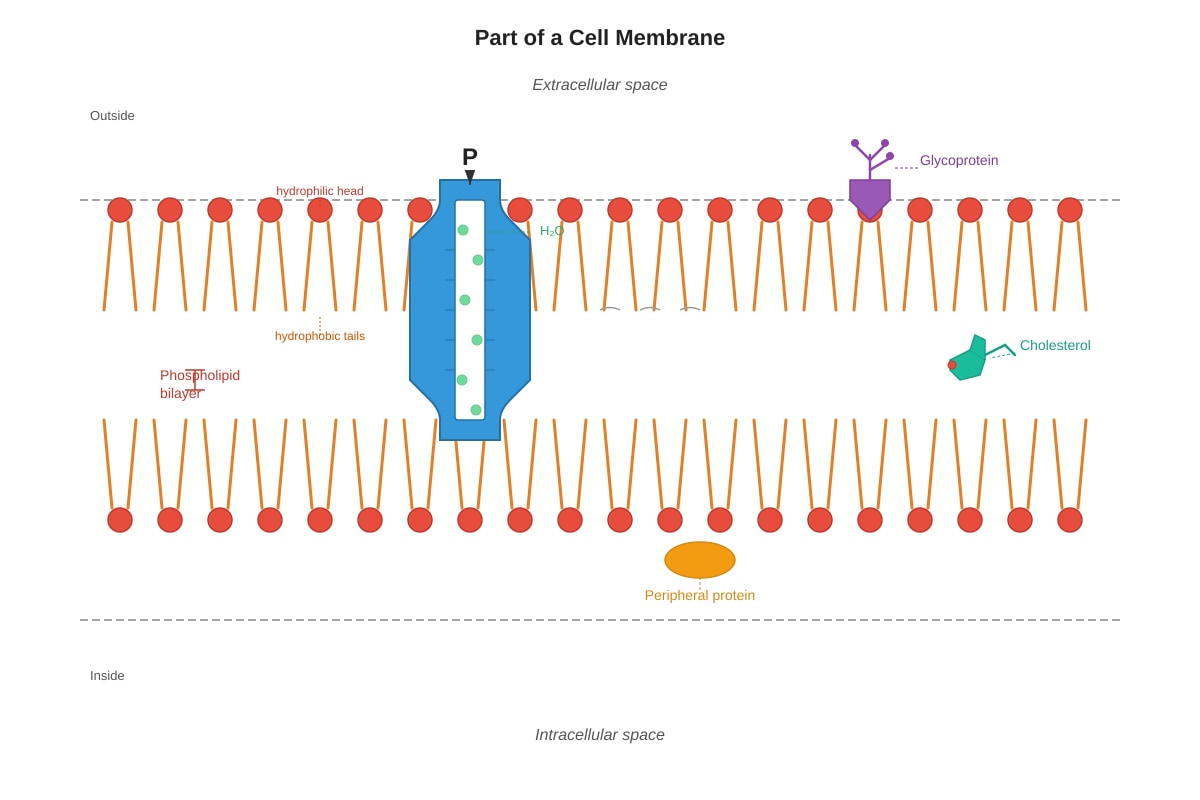
Generated diagram for this question.
(a) Name the molecule labelled P that allows small, water-soluble molecules to pass through the membrane. [1]
Answer: Channel protein / Pore protein
Marking Notes:
- Accept: "Channel protein" or "Pore protein"
- Do not accept: "Carrier protein" or "Phospholipid"
(b) Explain how the molecule labelled Q transports substances across the membrane during active transport. [2]
Answer: The carrier protein (Q) binds to the specific molecule/ion on one side of the membrane [1]. Using energy from ATP, the carrier protein changes shape/conformation to transport the molecule across the membrane against its concentration gradient [1].
Marking Notes:
- Award [1] for describing binding of the substance
- Award [1] for linking shape change to ATP/energy and transport against the gradient
- Do not award marks if "diffusion" or "osmosis" is mentioned
Section C: Biomolecules and Enzymes (Questions 11–15)
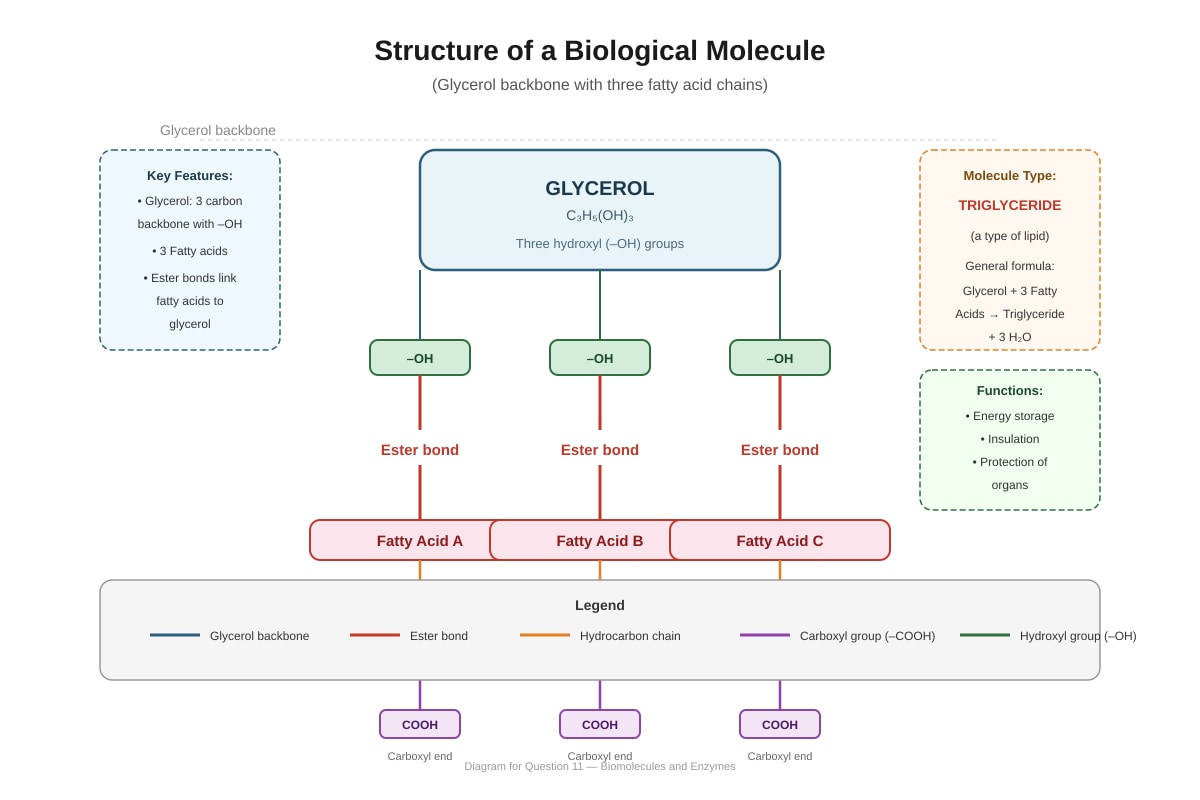
11. The diagram below shows the structure of a biological molecule.
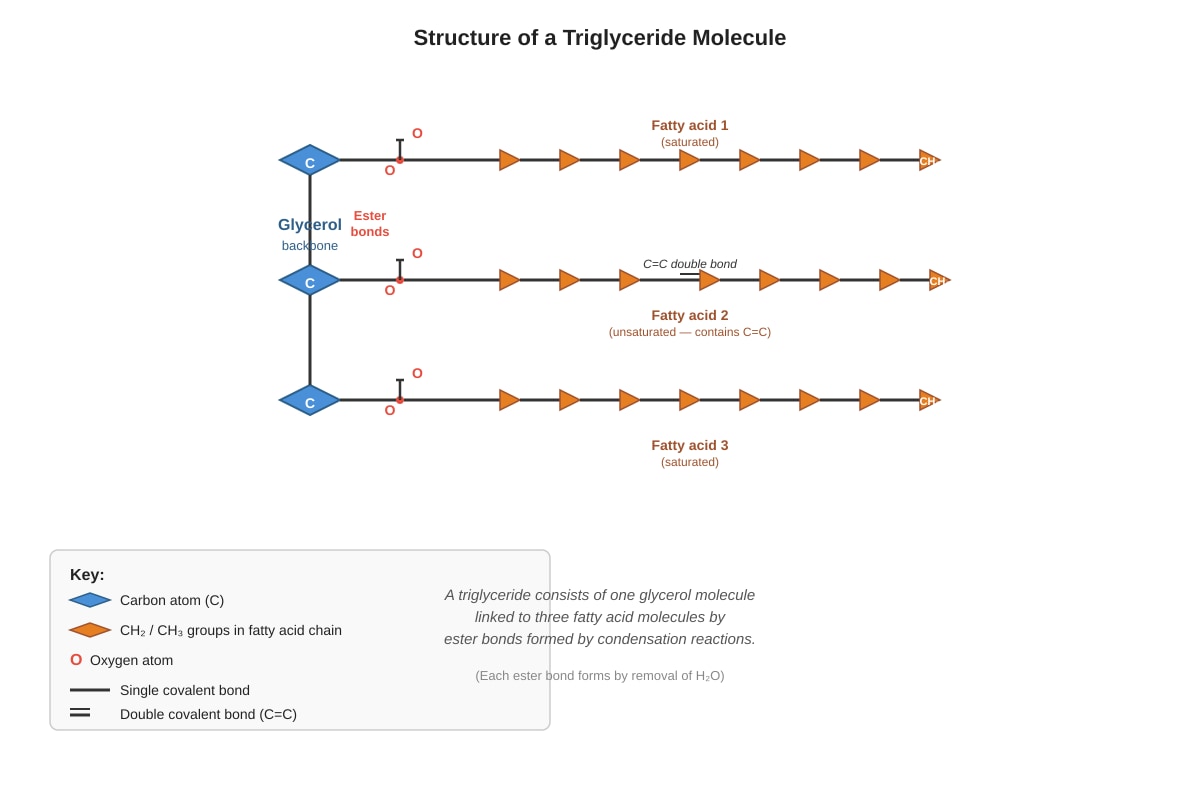
Generated diagram for this question.
(a) Name the type of biological molecule shown in the diagram. [1]
Answer: Lipid / Fat / Triglyceride
Marking Notes:
- Accept: "Lipid," "Fat," or "Triglyceride"
- Do not accept: "Phospholipid" or "Fatty acid" (the diagram shows the complete molecule)
(b) State one function of this type of molecule in living organisms. [1]
Answer: Energy storage / Insulation / Protection of organs / Component of cell membranes (if phospholipid context)
Marking Notes:
- Accept any one valid function
- Accept: "Long-term energy storage," "Thermal insulation," "Shock absorption/protection of vital organs"
- Do not accept: "Immediate energy source" (this is glucose/carbohydrates)
12. An experiment was carried out to investigate the effect of temperature on enzyme activity.
(a) State the optimum temperature for this enzyme. [1]
Answer: 40°C
Marking Notes:
- Must state "40°C" with units
- Do not accept: "Between 30°C and 50°C" (too vague)
(b) Explain why the rate of reaction decreases at temperatures above 40°C. [2]
Answer: At temperatures above 40°C, the enzyme becomes denatured [1]. The high temperature breaks the bonds maintaining the enzyme's three-dimensional shape, changing the shape of the active site so the substrate can no longer bind [1].
Marking Notes:
- Award [1] for stating the enzyme is denatured
- Award [1] for explaining the effect on bonds/active site shape and substrate binding
- Accept: "The enzyme loses its specific shape" for [1]
13. A student carried out food tests on an unknown solution.
(a) Identify the food substances present in the unknown solution. [2]
Answer: Reducing sugar (glucose) [1] AND protein [1]
Marking Notes:
- Award [1] for identifying reducing sugar (from Benedict's test)
- Award [1] for identifying protein (from Biuret test)
- Accept: "Glucose" or "Reducing sugar" for [1]
- Do not accept: "Starch" (iodine test was negative)
(b) Explain why the iodine test result indicates that starch is absent. [1]
Answer: Iodine solution turns blue-black in the presence of starch. Since the solution remained brown, no starch is present.
Marking Notes:
- Award [1] for stating the expected positive result (blue-black) and linking the brown colour to absence
- Accept: "Iodine remains brown in the absence of starch"
14. Proteins are made up of smaller subunits.
(a) Name the smaller subunits that make up proteins. [1]
Answer: Amino acids
Marking Notes:
- Do not accept: "Fatty acids" or "Glucose"
(b) State one function of proteins in the human body. [1]
Answer: Growth and repair of tissues / Enzymes / Hormones / Antibodies / Haemoglobin for oxygen transport
Marking Notes:
- Accept any one valid function
- Do not accept: "Energy storage" (this is primarily lipids/carbohydrates)
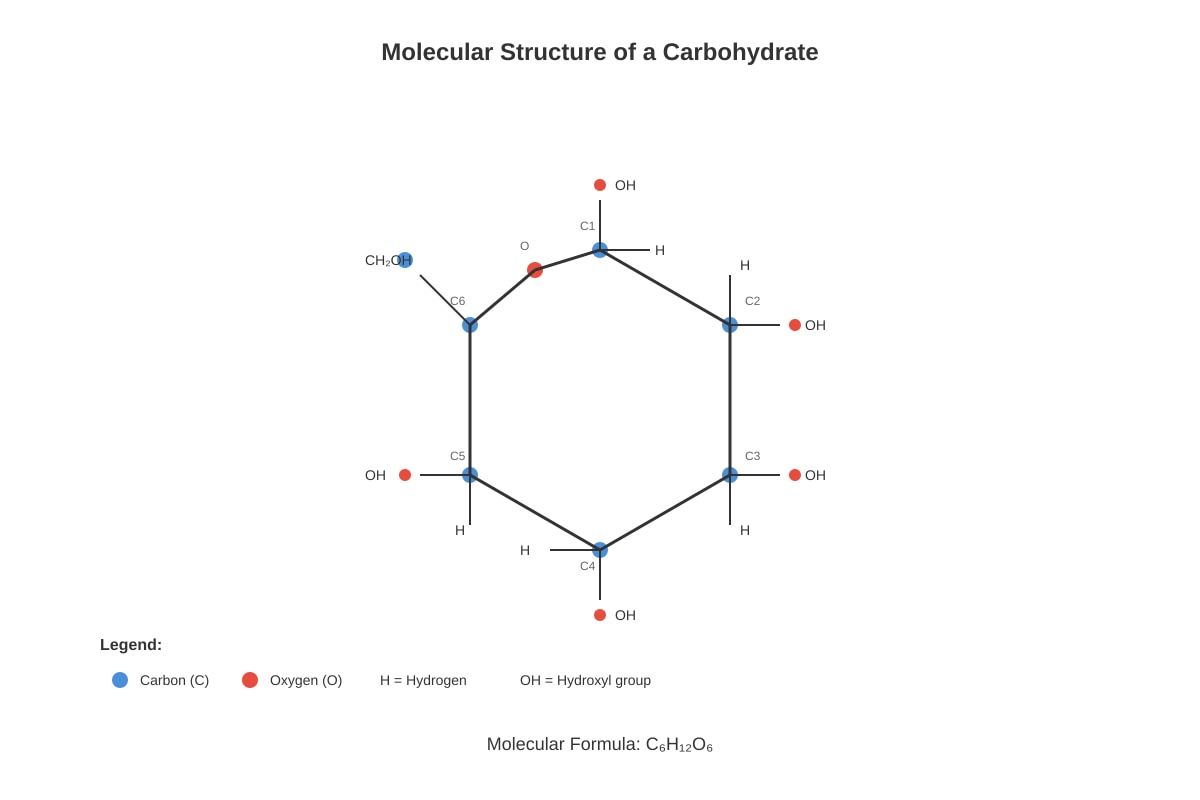
15. The diagram below shows the molecular structure of a carbohydrate.
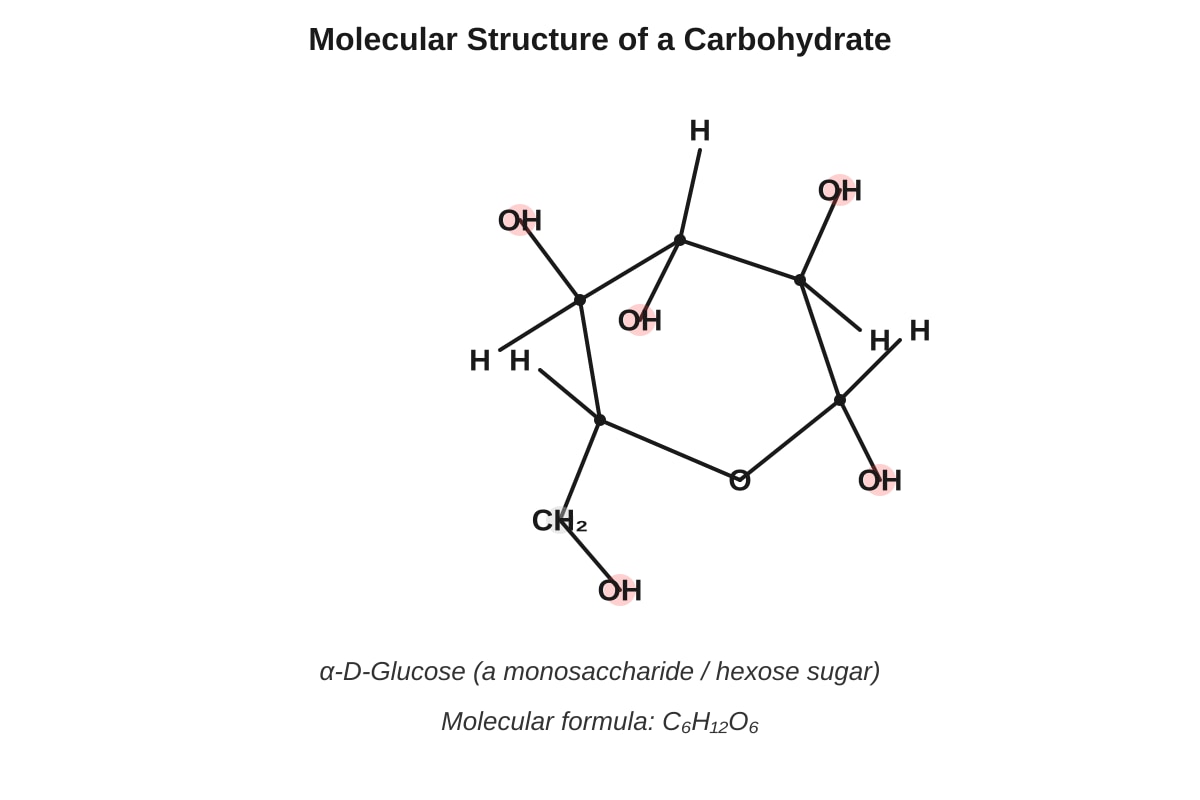
Generated diagram for this question.
(a) Name the carbohydrate molecule shown. [1]
Answer: Glucose
Marking Notes:
- Accept: "Glucose"
- Do not accept: "Sucrose" or "Starch" (the diagram shows a monosaccharide ring)
(b) State one function of this carbohydrate in living organisms. [1]
Answer: Source of energy for respiration / Energy source for cellular activities
Marking Notes:
- Accept: "Provides energy through respiration," "Immediate energy source"
- Do not accept: "Energy storage" (this is glycogen/starch)
Section D: Data Interpretation and Application (Questions 16–20)
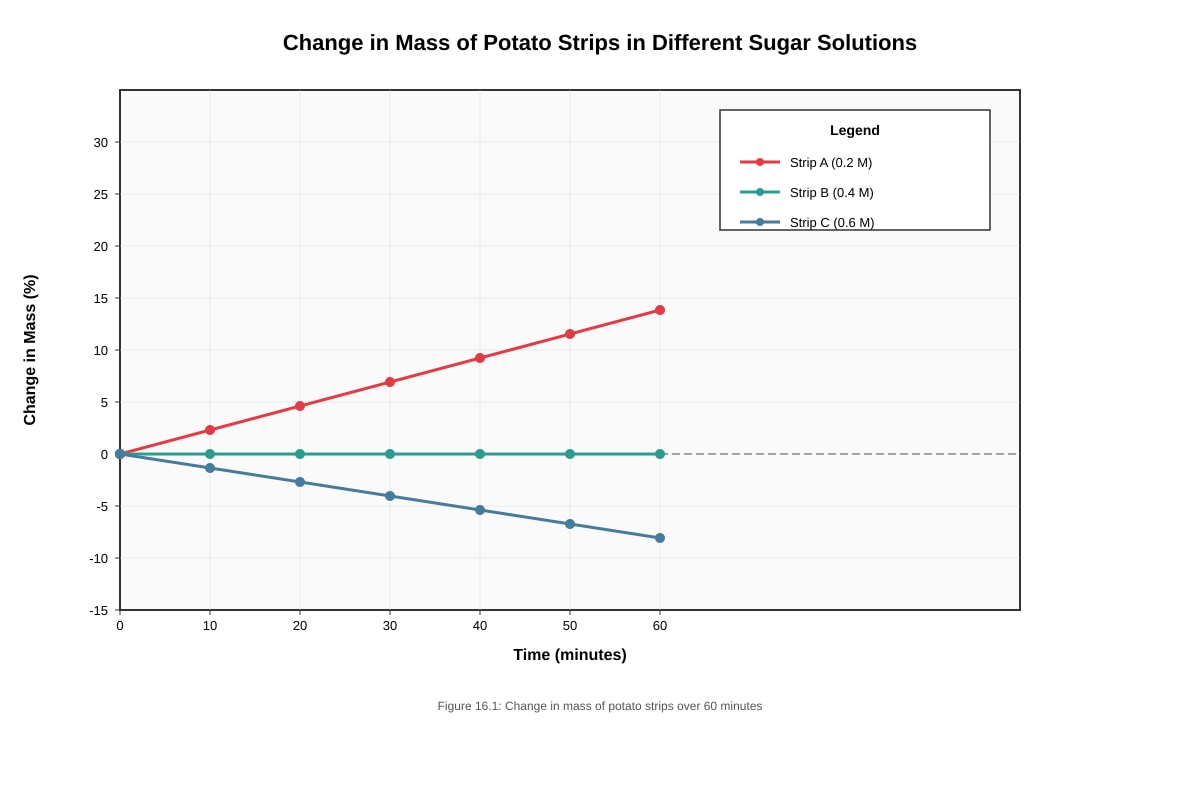
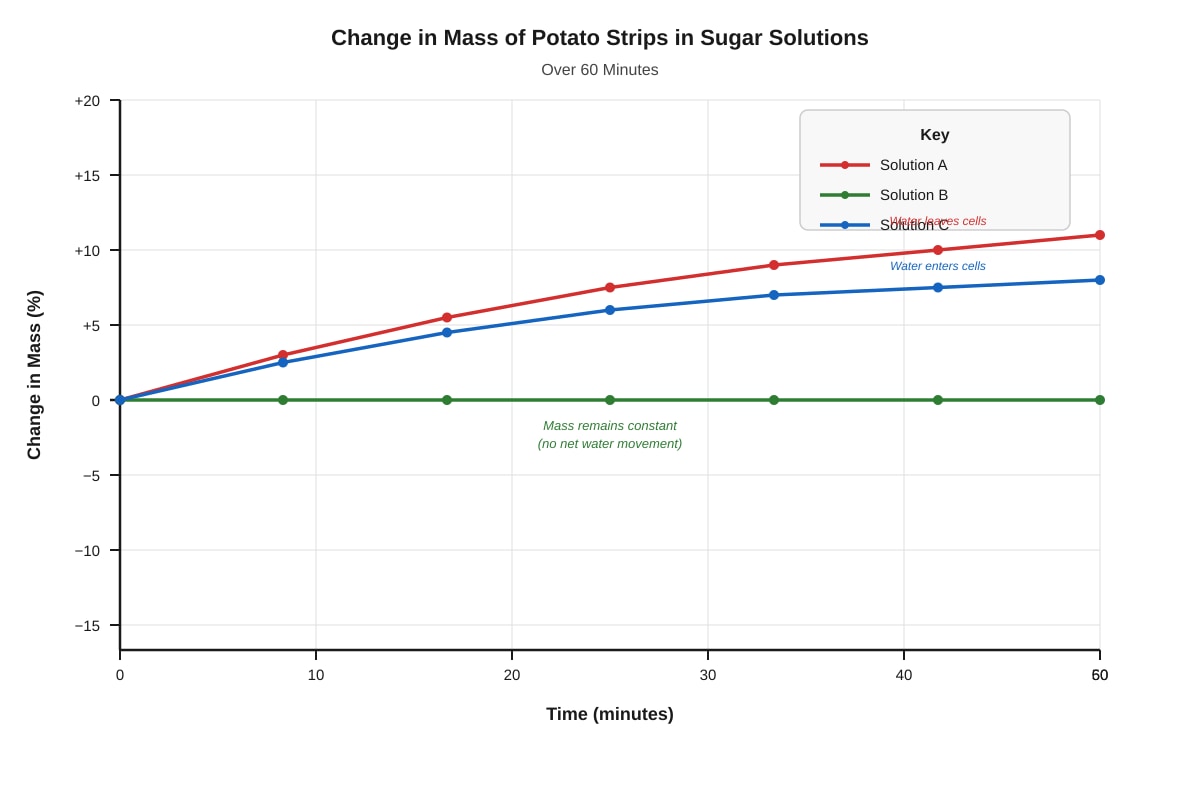
16. The graph below shows the change in mass of three potato strips placed in different concentrations of sugar solution over 60 minutes.
Generated graph for this question.
(a) Which sugar solution (A, B, or C) is isotonic to the potato cells? Explain your answer. [2]
Answer: Solution B (0.4 M) is isotonic [1]. The mass of the potato strip remained constant, indicating no net movement of water into or out of the cells, meaning the water potential inside and outside the cells is equal [1].
Marking Notes:
- Award [1] for identifying solution B
- Award [1] for explaining that constant mass means no net water movement / equal water potential
(b) Predict what would happen to the mass of a potato strip placed in a 0.8 M sugar solution. Explain your prediction. [2]
Answer: The mass of the potato strip would decrease [1]. The 0.8 M sugar solution has a lower water potential than the potato cells, so water would move out of the cells by osmosis [1].
Marking Notes:
- Award [1] for predicting a decrease in mass
- Award [1] for explaining water movement out of cells due to the water potential gradient
17. A student investigated the effect of temperature on the rate of diffusion of a dye in water.
(a) Describe the relationship between temperature and the time taken for the dye to spread evenly. [1]
Answer: As temperature increases, the time taken for the dye to spread evenly decreases.
Marking Notes:
- Accept: "Higher temperature results in faster diffusion/shorter time"
- Do not accept: "Temperature increases time" (incorrect relationship)
(b) Explain why temperature affects the rate of diffusion in this way. [2]
Answer: At higher temperatures, the dye particles gain more kinetic energy [1] and move faster, so they diffuse more quickly throughout the water [1].
Marking Notes:
- Award [1] for linking higher temperature to increased kinetic energy
- Award [1] for linking faster particle movement to faster diffusion
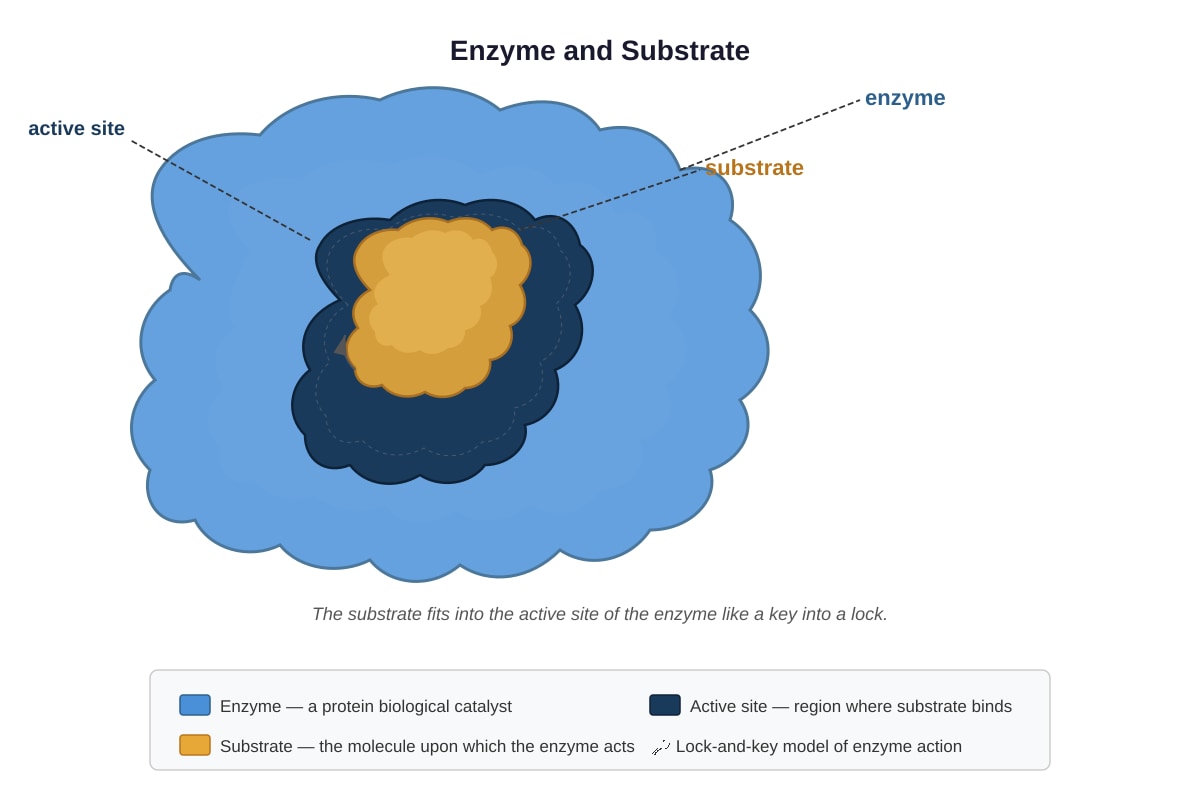
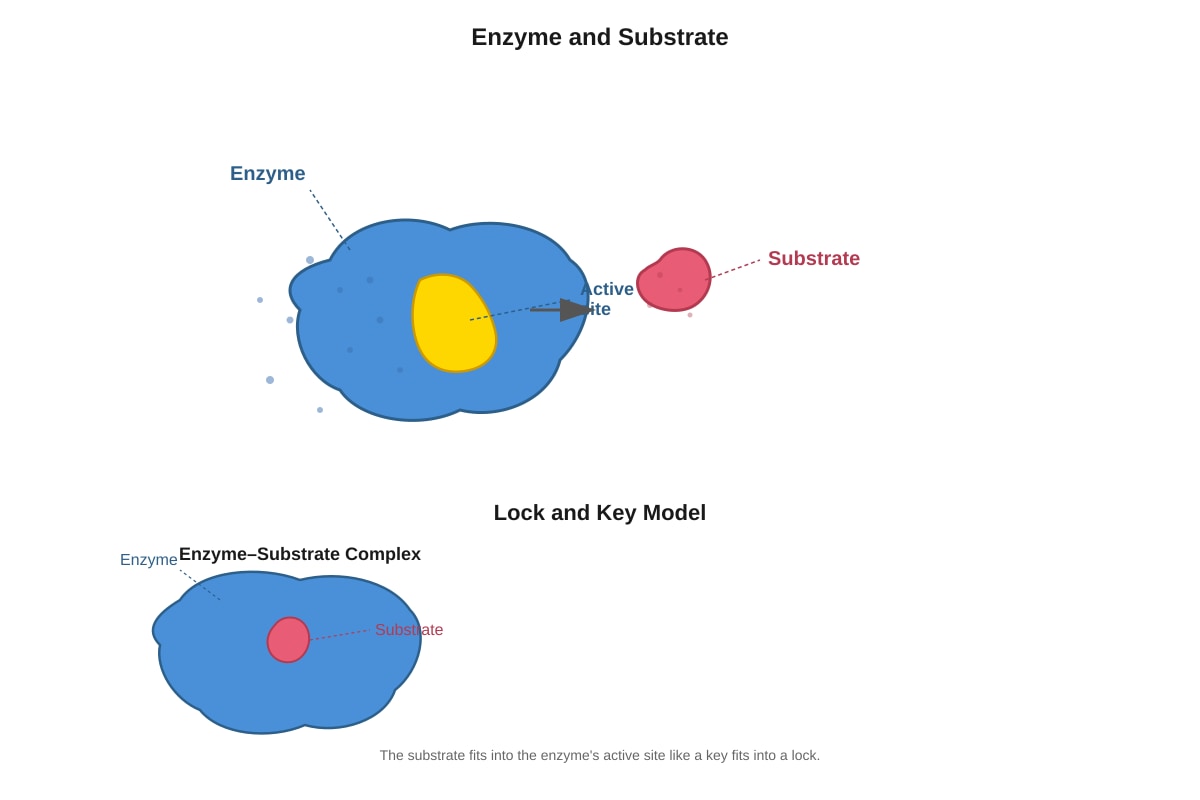
18. The diagram below shows an enzyme and its substrate.
Generated diagram for this question.
(a) Name the model of enzyme action shown in the diagram. [1]
Answer: Lock and key model / Lock and key hypothesis
Marking Notes:
- Accept: "Lock and key model" or "Lock and key hypothesis"
- Do not accept: "Induced fit model" (unless diagram clearly shows conformational change)
(b) Explain why an enzyme can only bind to a specific substrate. [2]
Answer: The enzyme has an active site with a specific three-dimensional shape [1] that is complementary to the shape of the substrate, so only the specific substrate can fit into the active site [1].
Marking Notes:
- Award [1] for describing the specific shape of the active site
- Award [1] for explaining complementarity between active site and substrate
- Accept: "The active site and substrate fit together like a lock and key" for [1]
19. A student set up an experiment using a Visking tubing filled with starch solution, placed in a beaker of distilled water.
(a) Predict the result of the iodine test on the water outside the Visking tubing. Explain your answer. [2]
Answer: The iodine solution will remain brown / no blue-black colour will form [1]. Starch molecules are too large to pass through the pores of the Visking tubing, so no starch is present in the water outside [1].
Marking Notes:
- Award [1] for predicting a negative result (brown/no colour change)
- Award [1] for explaining that starch molecules are too large to diffuse through the tubing
(b) Predict the result of the Benedict's test on the water outside the Visking tubing. Explain your answer. [2]
Answer: The Benedict's test will remain blue / no brick-red precipitate will form [1]. Starch molecules are too large to pass through the Visking tubing, and starch is not a reducing sugar, so no reducing sugar is present in the water outside [1].
Marking Notes:
- Award [1] for predicting a negative result (blue/no precipitate)
- Award [1] for explaining that starch cannot pass through and is not a reducing sugar
- Accept: "No reducing sugar is present outside the tubing" for [1]
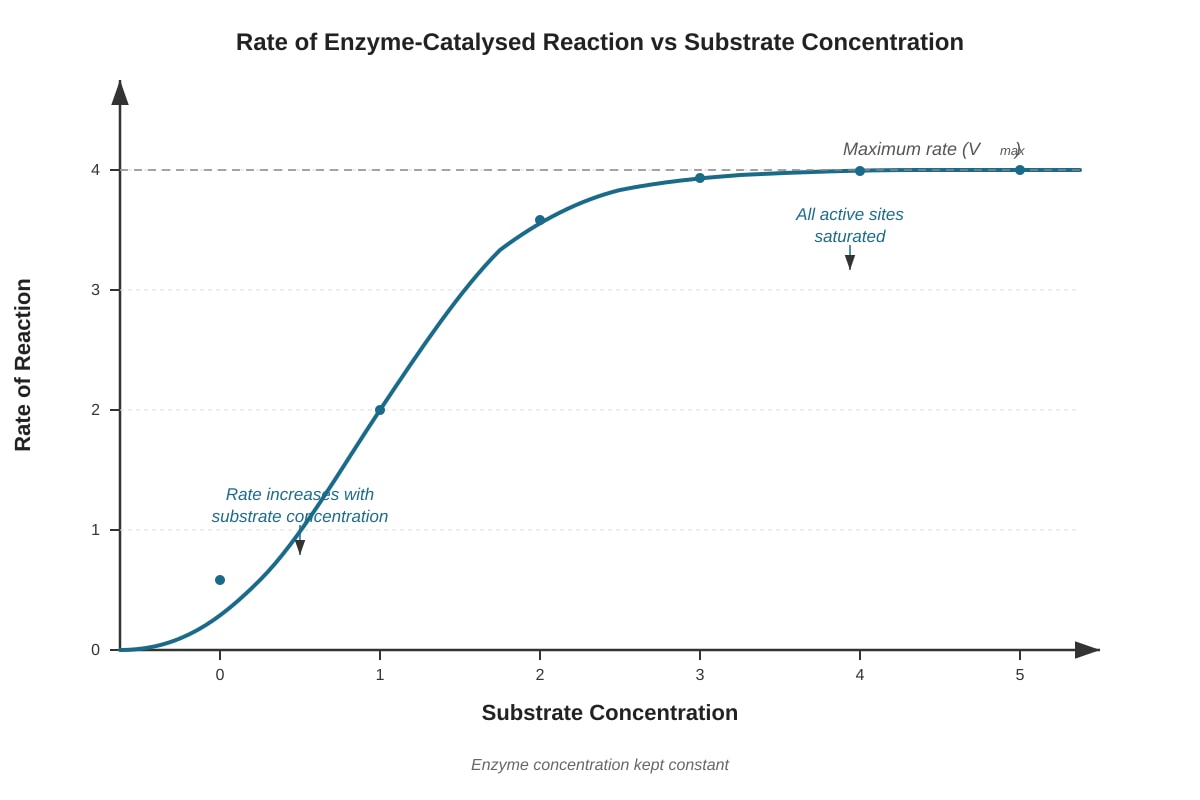
20. The graph below shows the rate of an enzyme-catalysed reaction at different substrate concentrations.
Generated graph for this question.
(a) Explain why the rate of reaction levels off at high substrate concentrations. [2]
Answer: At high substrate concentrations, all the enzyme active sites are occupied/saturated with substrate [1], so increasing the substrate concentration further has no effect on the rate of reaction because there are no free active sites available [1].
Marking Notes:
- Award [1] for stating that all active sites are occupied/saturated
- Award [1] for explaining that the rate cannot increase further due to limited enzyme molecules
(b) Suggest one way to increase the maximum rate of reaction without changing the substrate concentration. [1]
Answer: Increase the enzyme concentration / Increase the temperature (up to the optimum) / Add more enzyme
Marking Notes:
- Accept any one valid suggestion
- Accept: "Increase the amount of enzyme," "Add more enzyme molecules"
- Do not accept: "Increase substrate concentration" (contradicts the question)
END OF ANSWER KEY