AI Generated Exam Paper
Secondary 4 Combined Science Biology Practice Paper 5
Free Sec 4 Comb Sci Bio Practice Paper 5, HY3 AI version, with questions, answers, and O Level-style practice for Singapore students.
These static practice materials are generated from the site's syllabus and paper-generation workflow, with source and model context shown so students and parents can evaluate the material before use.
Questions
Free quiz and exam paper access
Enter your details to view this paper
Your access is remembered on this device.
Answers
TuitionGoWhere Practice Paper — Answer Key (Version 5)
Subject: Combined Science Biology
Level: Secondary 4
Topic: Cells Biomolecules
Total Marks: 40
Section A Answers
1. [1 mark]
Answer: Controls what enters and leaves the cell (or maintains cell shape, or separates cell from environment).
Teaching note: The cell membrane is a phospholipid bilayer that acts as a boundary. It regulates transport of substances.
2. [1 mark]
Answer: Mitochondrion (mitochondria).
Teaching note: Aerobic respiration releases energy as ATP in the mitochondria.
3. [1 mark]
Answer: Plant cell.
Teaching note: Cell wall, chloroplasts, and large vacuole are features of plant cells, not animal cells.
4. [1 mark]
Answer: Diffusion.
Teaching note: Oxygen moves from high concentration in alveolus to low concentration in blood by diffusion.
5. [1 mark]
Answer: Diffusion is the net movement of particles from a region of higher concentration to a region of lower concentration.
Teaching note: This is the standard definition; no energy required.
6. [1 mark]
Answer: Protein.
Teaching note: Proteins are polymers of amino acids linked by peptide bonds.
7. [1 mark]
Answer: Plant cells have a cell wall (or chloroplasts, or large vacuole); animal cells do not.
Teaching note: Any single correct difference earns the mark.
8. [1 mark]
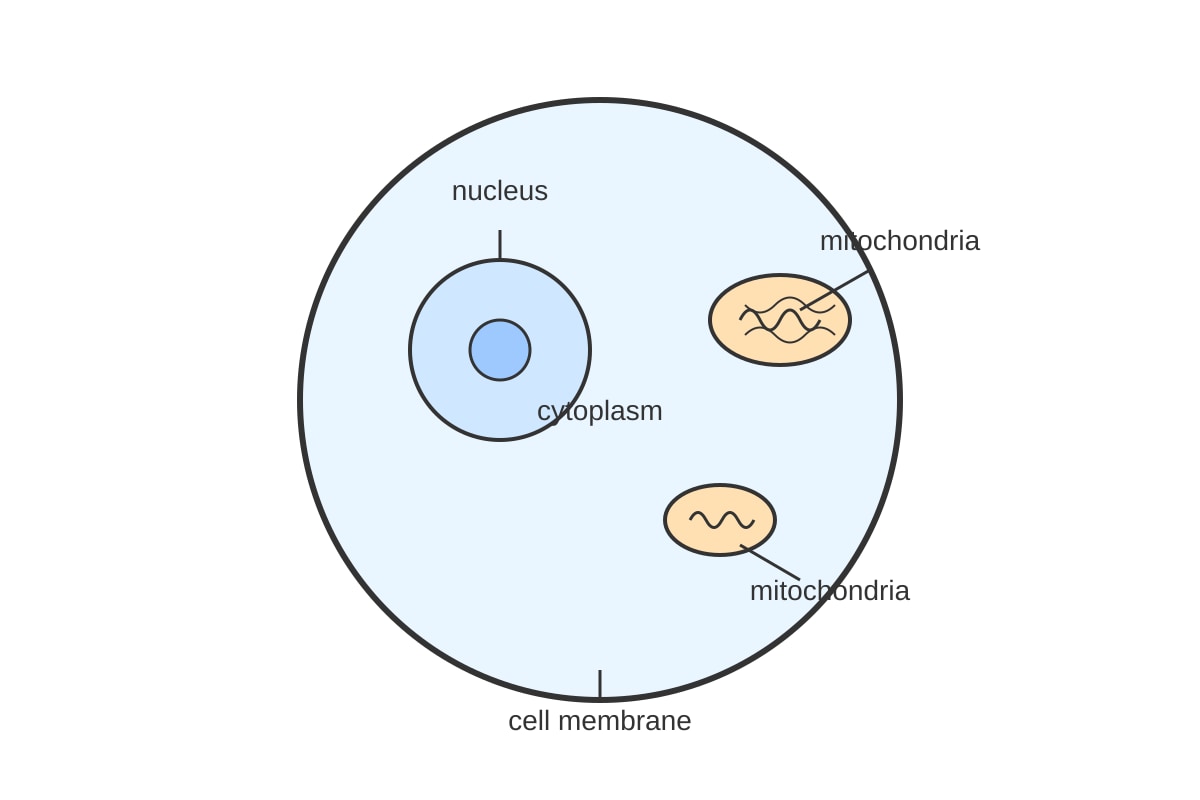
Answer: Mitochondrion.
Teaching note: From the placeholder diagram, the oval organelle with folds is the mitochondrion.
Section B Answers
9. [2 marks]
Answer: Skeletal muscle cells contract actively and need large amounts of ATP; mitochondria produce ATP via respiration, so more mitochondria are present. Skin cells have lower energy demand.
Marking: 1 mark for linking muscle function to energy need, 1 mark for explaining mitochondria produce ATP.
10. [3 marks]
Answer: Active transport. Energy (ATP) is needed because ions move against their concentration gradient (from low to high concentration).
Marking: 1 mark process name, 2 marks explanation of against gradient and ATP use.
11. [3 marks]
Answer: Contains chloroplasts to capture light; thin cell wall and large surface area for gas exchange; many mitochondria for energy. (Any 3 valid points)
Marking: 1 mark per adapted feature correctly explained.
12. [3 marks]
Answer: Facilitated diffusion through carrier proteins down glucose concentration gradient; no ATP needed. Rate affected by concentration gradient steepness (or number of carriers, temperature).
Marking: 1 mark process, 1 mark no ATP/gradient, 1 mark factor.
13. [3 marks]
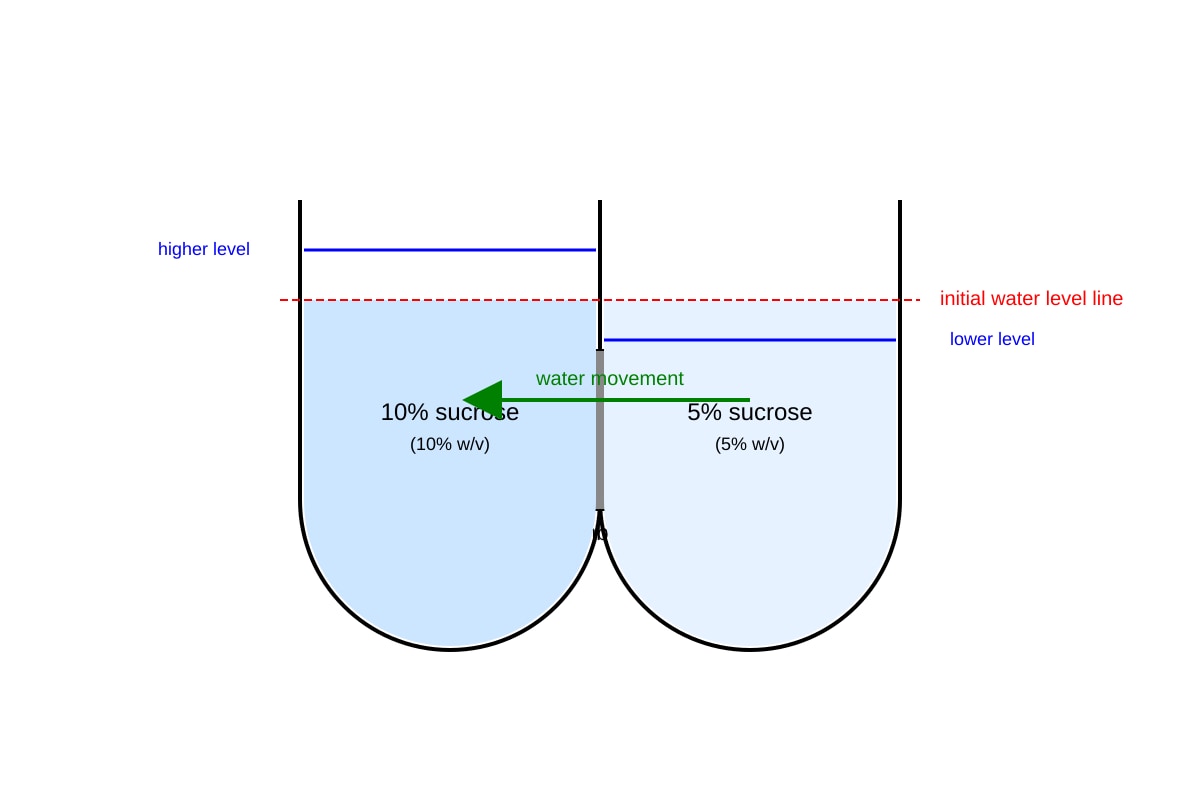
Answer: Osmosis; water moves from 5% sucrose (higher water potential) to 10% sucrose (lower water potential) through membrane, so left level rises.
Marking: 1 mark process name, 2 marks correct direction and reason.
14. [2 marks]
Answer: Both release energy; both use glucose; both produce ATP (any 2).
Marking: 1 mark each.
Section C Answers
15. [4 marks]
Answer: Oxygen enters alveoli → diffuses into capillary blood → binds haemoglobin → pumped via heart to leg artery → capillary → diffuses into muscle cell → mitochondrion.
Marking: 1 mark alveoli, 1 mark blood transport, 1 mark capillary diffusion, 1 mark cell entry.
16. [3 marks]
Carbohydrate – subunit glucose (or monosaccharide), function energy source.
Protein – subunit amino acid, function growth/repair/enzymes.
Fat – subunit fatty acid + glycerol, function energy store/insulation.
Marking: 0.5 each column correctly filled.
17. [3 marks]
Answer: Membrane allows some substances (e.g., O₂, H₂O) to pass but blocks others (e.g., large proteins); this controls internal environment and protects cell.
Marking: 1 mark definition, 2 marks explanation of help.