AI Generated Exam Paper

Secondary 4 Combined Science Biology Practice Paper 4

Free AI-Generated DeepSeek V4 Pro Secondary 4 Combined Science Biology Practice Paper 4 practice paper with questions and answers for Singapore students. This page is rendered as a direct URL so the questions and answers can be discovered without pressing in-page buttons.

These static practice materials are generated from the site's syllabus and paper-generation workflow, with source and model context shown so students and parents can evaluate the material before use.

Secondary 4 Combined Science Biology AI Generated Generated by DeepSeek V4 Pro Updated 2026-06-03

Questions

<!-- TuitionGoWhere generation metadata: stage=5-2; model=deepseek/deepseek-v4-pro; model_label=DeepSeek V4 Pro; generated=2026-05-29; Sources: Stage 4-0 LLM templates, syllabus context, and Stage 2 evidence where available. -->

TuitionGoWhere Practice Paper - Combined Science Biology Secondary 4

TuitionGoWhere Practice Paper (AI)

Subject: Combined Science Biology (5087/5088) Level: Secondary 4 Paper: Practice Paper 4 (Cells & Biomolecules) Duration: 1 hour 15 minutes Total Marks: 65 Version: 4 of 5

Name: _________________________ Class: _________________________ Date: _________________________


Instructions to Candidates

  1. This paper consists of three sections: Section A, Section B, and Section C.
  2. Answer all questions in the spaces provided.
  3. Write your name, class, and date in the spaces above.
  4. The number of marks is given in brackets [ ] at the end of each question or part question.
  5. You are advised to spend no more than 20 minutes on Section A, 25 minutes on Section B, and 30 minutes on Section C.
  6. Use scientific terminology accurately and show all working where calculations are required.

Section A: Multiple Choice (10 marks)

Answer all questions. Circle the correct answer. Each question carries 1 mark.

1. Which organelle is responsible for the release of energy through aerobic respiration?

A. Ribosome B. Nucleus C. Mitochondrion D. Chloroplast

[1]


2. A red blood cell is placed in a concentrated salt solution. What will happen to the cell?

A. It will swell and burst. B. It will shrink and become crenated. C. It will remain unchanged. D. It will undergo plasmolysis.

[1]


3. Which of the following processes requires energy in the form of ATP?

A. Diffusion of oxygen into a muscle cell B. Osmosis of water into a root hair cell C. Active transport of mineral ions into a root hair cell D. Diffusion of carbon dioxide out of a leaf

[1]


4. The diagram below shows an enzyme-catalysed reaction. What does structure X represent?

Substrate  +  Enzyme  →  [Enzyme-Substrate Complex]  →  Enzyme  +  Products
                                     ↑
                                     X

A. Active site B. Product C. Substrate D. Enzyme-substrate complex

[1]


5. Which statement about osmosis is correct?

A. It requires energy from ATP. B. It involves the movement of solute molecules. C. It occurs through a partially permeable membrane. D. It moves water from a region of lower water potential to higher water potential.

[1]


6. A student investigated the effect of pH on enzyme activity. The enzyme was most active at pH 7. At pH 2, no activity was observed. What is the most likely explanation?

A. The enzyme was used up in the reaction. B. The substrate was completely broken down. C. The enzyme was denatured. D. The temperature was too low.

[1]


7. Which feature of a root hair cell is an adaptation for its function?

A. Presence of many chloroplasts B. Thick, waxy cuticle C. Long, narrow extension D. Biconcave shape

[1]


8. The table shows the number of mitochondria in four different cell types.

Cell TypeNumber of Mitochondria
Skin cell200
Muscle cell2500
Red blood cell0
Liver cell1000

Which cell type requires the most energy for its function?

A. Skin cell B. Muscle cell C. Red blood cell D. Liver cell

[1]


9. What is the function of the cell membrane?

A. To provide rigid support to the cell B. To control the movement of substances in and out of the cell C. To store genetic material D. To carry out protein synthesis

[1]


10. A piece of potato was placed in distilled water for 30 minutes. Its mass increased. Which statement explains this observation?

A. Water entered the potato cells by active transport. B. Water left the potato cells by osmosis. C. Water entered the potato cells by osmosis. D. Solutes entered the potato cells by diffusion.

[1]


Section B: Structured Questions (25 marks)

Answer all questions in the spaces provided.

11. The diagram below shows two types of cells, A and B, as seen under a light microscope.

[Diagram description: Cell A is an animal cell with nucleus, cytoplasm, cell membrane, and mitochondria. Cell B is a plant cell with nucleus, cytoplasm, cell membrane, cell wall, chloroplasts, and a large central vacuole.]

(a) Identify cell A and cell B. [2]

Cell A: _________________________

Cell B: _________________________

(b) State one structural feature present in cell B that is absent in cell A, and explain its function. [2]

Feature: _________________________

Function: _________________________

(c) Both cells contain mitochondria. Explain why muscle cells, which are similar to cell A, contain many more mitochondria than skin cells. [2]


[Total: 6 marks]


12. A student set up an experiment to investigate the effect of temperature on the rate of diffusion. A crystal of potassium permanganate was placed in a beaker of water at different temperatures. The time taken for the purple colour to spread evenly throughout the water was recorded.

Temperature (°C)Time taken for colour to spread (s)
10180
20120
3080
4055
5040

(a) Describe the relationship between temperature and the time taken for the colour to spread. [1]


(b) Explain why increasing temperature affects the rate of diffusion. [2]


(c) Predict the time taken at 60°C, assuming the trend continues. Explain your prediction. [2]


(d) Suggest one precaution the student should take to ensure the results are reliable. [1]


[Total: 6 marks]


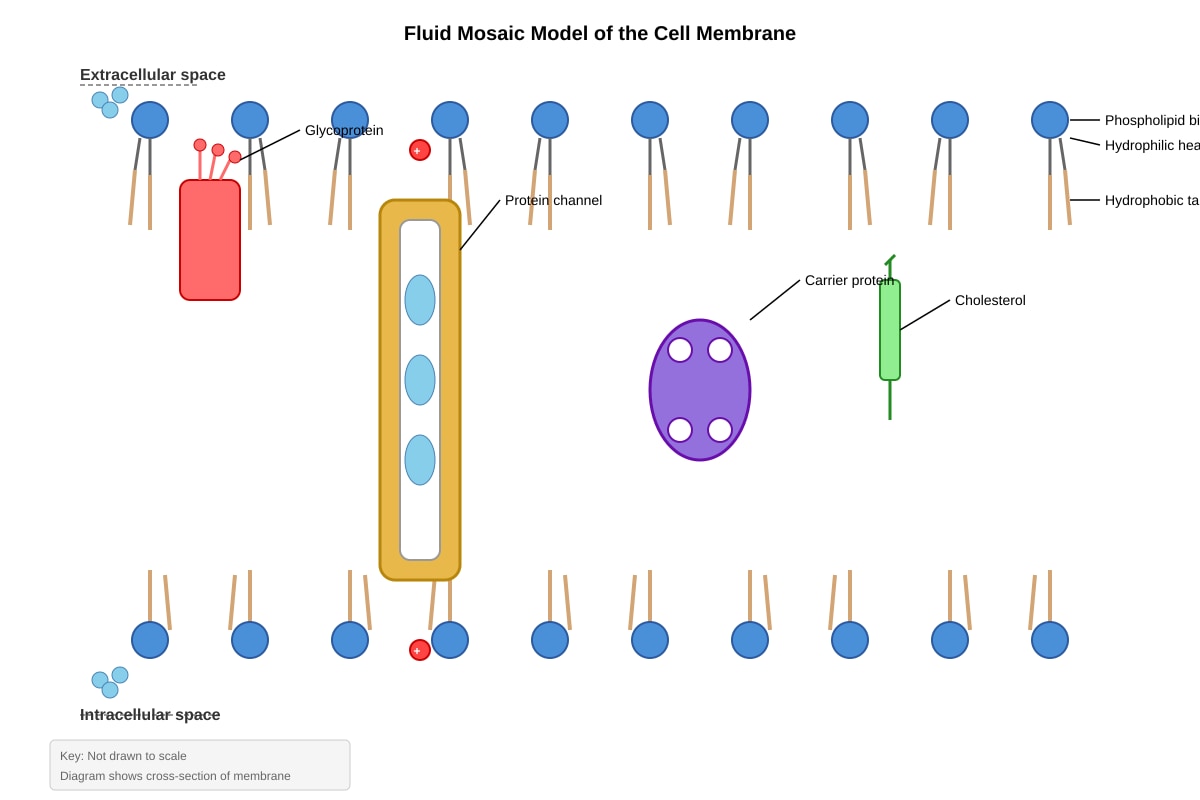
13. The diagram below shows the fluid mosaic model of the cell membrane.

[Diagram description: Phospholipid bilayer with hydrophilic heads and hydrophobic tails, protein channels, and carrier proteins embedded.]

(a) Label the following structures on the diagram: [2]

(i) Phospholipid bilayer (ii) Protein channel

(b) Explain why the cell membrane is described as "partially permeable". [2]


(c) Oxygen molecules can pass directly through the phospholipid bilayer, but glucose molecules cannot. Explain why. [3]


[Total: 7 marks]


14. Enzymes are biological catalysts that speed up chemical reactions in living organisms.

(a) Define the term "catalyst". [1]


(b) Explain the "lock and key" hypothesis of enzyme action. [3]


(c) Amylase is an enzyme that breaks down starch into maltose. A student added amylase to a starch solution and measured the concentration of starch every minute. After 10 minutes, the starch concentration stopped decreasing even though starch was still present. Suggest two reasons why the reaction stopped. [2]

Reason 1: _________________________________________________________________________

Reason 2: _________________________________________________________________________

[Total: 6 marks]


Section C: Free-Response Questions (30 marks)

Answer all questions in the spaces provided. The mark allocation guides the depth of response required.

15. Describe and explain how the structure of a mitochondrion is adapted for its function in aerobic respiration. [4]


16. A student investigated osmosis using potato cylinders. Five potato cylinders of equal mass were placed in sucrose solutions of different concentrations for 24 hours. The results are shown in the table below.

Concentration of sucrose solution (mol/dm³)Initial mass (g)Final mass (g)Change in mass (g)Percentage change in mass (%)
0.05.05.6+0.6+12.0
0.25.05.3+0.3+6.0
0.45.05.00.00.0
0.65.04.6-0.4-8.0
0.85.04.2-0.8-16.0

(a) Calculate the missing percentage change in mass for the 0.2 mol/dm³ solution. Show your working. [2]


(b) Explain why the potato cylinders gained mass in the 0.0 mol/dm³ and 0.2 mol/dm³ solutions. [3]


(c) Explain why the potato cylinders lost mass in the 0.6 mol/dm³ and 0.8 mol/dm³ solutions. [3]


(d) Estimate the water potential of the potato cells. Explain your answer using the data. [2]


[Total: 10 marks]


17. A student investigated the effect of temperature on the activity of catalase, an enzyme found in potato tissue. Potato discs were placed in hydrogen peroxide solution, and the volume of oxygen gas produced was measured every 30 seconds for 5 minutes. The experiment was repeated at 10°C, 20°C, 30°C, 40°C, and 50°C.

The results at 30°C are shown in the table below.

Time (s)Volume of oxygen produced (cm³)
00.0
304.5
608.0
9010.5
12012.0
15013.0
18013.5
21013.8
24014.0
27014.0
30014.0

(a) Plot a graph of the results on the grid provided. Label the axes clearly. [4]

[Grid space for graph plotting]

(b) Describe the shape of the graph and explain the changes in the rate of oxygen production over time. [4]


(c) Predict and explain how the graph would differ if the experiment were carried out at 50°C. [3]


(d) The student repeated the experiment at 20°C. The initial rate of reaction was slower than at 30°C, but the final volume of oxygen produced was the same. Explain these observations. [3]


(e) Suggest two variables that must be controlled in this experiment to ensure valid results. [2]

Variable 1: _________________________________________________________________________

Variable 2: _________________________________________________________________________

[Total: 16 marks]


END OF PAPER


This practice paper was generated by TuitionGoWhere AI based on the O-Level Combined Science Biology syllabus (5087/5088). It is designed for practice purposes and is not derived from any specific past examination paper.

Answers

<!-- TuitionGoWhere generation metadata: stage=5-2; model=deepseek/deepseek-v4-pro; model_label=DeepSeek V4 Pro; generated=2026-05-29; Sources: Stage 4-0 LLM templates, syllabus context, and Stage 2 evidence where available. -->

TuitionGoWhere Practice Paper - Combined Science Biology Secondary 4

Answer Key and Marking Scheme (Version 4)

Paper: Practice Paper 4 (Cells & Biomolecules) Total Marks: 65


Section A: Multiple Choice (10 marks)

QuestionAnswerExplanation
1CMitochondria are the sites of aerobic respiration, releasing energy in the form of ATP.
2BIn a hypertonic solution, water leaves the cell by osmosis, causing it to shrink (crenation). Plasmolysis occurs in plant cells, not animal cells.
3CActive transport requires ATP to move substances against the concentration gradient. Diffusion and osmosis are passive processes.
4DX represents the enzyme-substrate complex, formed when the substrate binds to the enzyme's active site before being converted to products.
5COsmosis is the net movement of water molecules through a partially permeable membrane from a region of higher water potential to lower water potential. It is passive and does not require energy.
6CExtreme pH values cause denaturation of enzymes by altering the shape of the active site. The enzyme is not "used up" in reactions.
7CRoot hair cells have a long, narrow extension that increases surface area for absorption of water and mineral salts.
8BMuscle cells have the highest number of mitochondria (2500) because they require large amounts of ATP for contraction.
9BThe cell membrane is partially permeable and controls the movement of substances into and out of the cell.
10CDistilled water has a higher water potential than the potato cells. Water enters the cells by osmosis, increasing mass.

Marking: 1 mark per correct answer. Total = 10 marks.


Section B: Structured Questions (25 marks)

Question 11 (6 marks)

(a) [2 marks]

  • Cell A: Animal cell [1]
  • Cell B: Plant cell [1]

(b) [2 marks]

  • Feature: Cell wall / Chloroplasts / Large central vacuole [1] (accept any one correct feature)
  • Function (must match chosen feature):
    • Cell wall: Provides structural support and protection / prevents cell from bursting [1]
    • Chloroplasts: Site of photosynthesis / contains chlorophyll for light absorption [1]
    • Large central vacuole: Stores water and solutes / maintains turgor pressure [1]

(c) [2 marks]

  • Muscle cells carry out more contraction / require more energy / have higher metabolic rate [1]
  • Therefore, they need more mitochondria to produce more ATP through aerobic respiration [1]

Question 12 (6 marks)

(a) [1 mark]

  • As temperature increases, the time taken for the colour to spread decreases / the rate of diffusion increases [1]

(b) [2 marks]

  • Increasing temperature increases the kinetic energy of particles [1]
  • Particles move faster, so they diffuse more quickly / spread through the water more rapidly [1]

(c) [2 marks]

  • Predicted time: approximately 28–30 seconds [1]
  • Explanation: The trend shows the time decreasing as temperature increases; extrapolating the pattern gives a value around 28–30 seconds / the relationship is approximately linear [1]

(d) [1 mark]

  • Any one reasonable precaution:
    • Use the same volume of water each time [1]
    • Use crystals of the same size/mass [1]
    • Start timing immediately after adding the crystal [1]
    • Repeat each measurement and calculate an average [1]

Question 13 (7 marks)

(a) [2 marks]

  • (i) Phospholipid bilayer correctly labelled [1]
  • (ii) Protein channel correctly labelled [1]

(b) [2 marks]

  • The cell membrane allows some substances to pass through but not others [1]
  • Small, non-polar molecules (e.g., oxygen, carbon dioxide) can pass through the phospholipid bilayer, while larger or charged molecules cannot pass through directly / require protein channels or carriers [1]

(c) [3 marks]

  • Oxygen is a small, non-polar molecule [1]
  • Oxygen can dissolve in and diffuse through the hydrophobic core of the phospholipid bilayer [1]
  • Glucose is a larger, polar molecule that cannot pass through the hydrophobic tails of the phospholipid bilayer / requires a specific carrier protein for transport [1]

Question 14 (6 marks)

(a) [1 mark]

  • A catalyst is a substance that speeds up a chemical reaction without being chemically changed or used up in the reaction [1]

(b) [3 marks]

  • The substrate molecule has a specific shape that is complementary to the shape of the enzyme's active site [1]
  • The substrate fits into the active site like a key fits into a lock, forming an enzyme-substrate complex [1]
  • The reaction occurs, and products are released; the enzyme remains unchanged and can be reused [1]

(c) [2 marks]

  • Any two reasonable reasons:
    • All the enzyme's active sites were saturated / occupied by substrate [1]
    • The enzyme was denatured (e.g., by temperature or pH changes) [1]
    • The reaction reached equilibrium [1]
    • An inhibitor was present [1]

Section C: Free-Response Questions (30 marks)

Question 15 (4 marks)

Marking guidance: Award marks for structure–function links.

  • The mitochondrion has a double membrane; the inner membrane is highly folded into cristae [1]
  • The cristae provide a large surface area for the attachment of enzymes involved in aerobic respiration / the electron transport chain [1]
  • The matrix (fluid-filled interior) contains enzymes for the Krebs cycle / link reaction [1]
  • The large surface area and enzyme packaging allow efficient ATP production to meet the cell's energy demands [1]

Question 16 (10 marks)

(a) [2 marks]

  • Percentage change = (Change in mass ÷ Initial mass) × 100 [1]
  • = (+0.3 ÷ 5.0) × 100 = +6.0% [1]

(b) [3 marks]

  • The 0.0 mol/dm³ solution (distilled water) and 0.2 mol/dm³ solution have a higher water potential than the potato cells [1]
  • Water enters the potato cells by osmosis from a region of higher water potential (solution) to lower water potential (cell sap) through a partially permeable membrane [1]
  • This causes the cells to become turgid, increasing the mass of the potato cylinders [1]

(c) [3 marks]

  • The 0.6 mol/dm³ and 0.8 mol/dm³ solutions have a lower water potential than the potato cells [1]
  • Water leaves the potato cells by osmosis from a region of higher water potential (cell sap) to lower water potential (solution) through a partially permeable membrane [1]
  • This causes the cells to become plasmolysed/flaccid, decreasing the mass of the potato cylinders [1]

(d) [2 marks]

  • The water potential of the potato cells is approximately equal to that of a 0.4 mol/dm³ sucrose solution [1]
  • At this concentration, there is no net movement of water (no change in mass), indicating the water potentials are equal / the solution is isotonic to the cell sap [1]

Question 17 (16 marks)

(a) [4 marks] Graph plotting marks:

  • Axes correctly labelled: Time (s) on x-axis, Volume of oxygen produced (cm³) on y-axis [1]
  • Appropriate scales chosen for both axes [1]
  • All points plotted accurately [1]
  • Smooth curve drawn through points (not dot-to-dot) [1]

(b) [4 marks]

  • Initially (0–60 s), the rate of oxygen production is high / the graph shows a steep increase [1]
  • This is because there is a high concentration of substrate (hydrogen peroxide) available, and many enzyme active sites are occupied / frequent enzyme-substrate collisions occur [1]
  • The rate gradually decreases (60–240 s) as the graph levels off [1]
  • This is because the substrate concentration decreases / substrate becomes limiting / fewer enzyme-substrate complexes form [1]
  • After 240 s, the graph plateaus because all the substrate has been used up / the reaction is complete [1]

(c) [3 marks]

  • At 50°C, the enzyme catalase would be denatured [1]
  • The active site would lose its specific three-dimensional shape, so the substrate can no longer bind [1]
  • Little or no oxygen would be produced / the graph would show a very low or flat line [1]

(d) [3 marks]

  • At 20°C, the enzyme and substrate molecules have lower kinetic energy than at 30°C [1]
  • This results in fewer successful collisions per unit time / fewer enzyme-substrate complexes formed per unit time, so the initial rate is slower [1]
  • However, the same amount of substrate is eventually broken down because the enzyme is not denatured at 20°C, so the same final volume of oxygen is produced [1]

(e) [2 marks]

  • Any two controlled variables:
    • Mass/size/surface area of potato discs [1]
    • Concentration/volume of hydrogen peroxide solution [1]
    • pH of the solution [1]
    • Number of potato discs used [1]

END OF ANSWER KEY

Marking notes: Accept alternative correct scientific terminology and equivalent explanations. Spelling errors should not be penalised unless they change the scientific meaning. Where a range of answers is acceptable, use professional judgement.