AI Generated Exam Paper
Secondary 4 Combined Science Biology Practice Paper 3
Free Sec 4 Comb Sci Bio Practice Paper 3, LongCat AI version, with questions, answers, and O Level-style practice for Singapore students.
These static practice materials are generated from the site's syllabus and paper-generation workflow, with source and model context shown so students and parents can evaluate the material before use.
Questions
Free quiz and exam paper access
Enter your details to view this paper
Your access is remembered on this device.
Answers
TuitionGoWhere Practice Paper — Combined Science Biology Secondary 4
Answer Key — Cells & Biomolecules (Version 3 of 5)
Total Marks: 40
Section A: Multiple Choice & Short Recall (Questions 1–8)
1. Mitochondrion (1)
Marking note: Accept "mitochondria" (plural). Do not accept "mitochondria matrix" or "cristae" — these are parts of the mitochondrion, not the organelle itself.
2. Controls/regulates the movement of substances into and out of the cell / partially permeable barrier / maintains cell shape (1)
Marking note: Any one valid function. Do not accept vague answers like "protects the cell" without further qualification.
3. Carbohydrate / glucose (1)
Marking note: "Carbohydrate" is the most precise answer. "Glucose" is also accepted as it is the primary monosaccharide used for quick energy. "Sugar" alone is too vague — do not award the mark.
4. Nucleus (1)
Marking note: Accept "nucleus" only. Do not accept "chromosomes" or "chromatin" — these are structures within the nucleus that carry DNA, but the organelle itself is the nucleus.
5. Any one of the following: Plant cell has a cell wall / chloroplasts / large permanent vacuole; animal cell does not. (1)
Marking note: The answer must state a difference, not just name a feature. "Plant cell has a cell wall" is acceptable. "Chloroplast" alone is not sufficient — it must be framed as a difference.
6. Anaerobic respiration / fermentation (1)
Marking note: Either term is accepted. Do not accept "glycolysis" alone, as glycolysis is only the first stage of both aerobic and anaerobic respiration.
7. Vesicle (1)
Marking note: Accept "vesicle" or "transport vesicle". Do not accept "vacuole" — vacuoles are for storage, not transport between organelles.
8. Protein (1)
Marking note: Enzymes are biological catalysts made of protein. Do not accept "biomolecule" — this is too general.
Section B: Structured Response (Questions 9–15)
9.
(a) Organelle B: Mitochondrion
Function: Site of aerobic respiration / produces ATP / releases energy from glucose (2)
Marking note: 1 mark for correct identification, 1 mark for function. "Produces energy" alone is acceptable but "produces ATP" is more precise.
(b) Organelle D: Golgi apparatus / Golgi body
Function: Modifies, sorts, and packages proteins for secretion / forms lysosomes / processes proteins from the ER (2)
Marking note: 1 mark for correct identification, 1 mark for function. Any one valid function is accepted.
(c) The rough endoplasmic reticulum appears "rough" because it has ribosomes attached to its surface. (2)
Marking note: 1 mark for mentioning ribosomes, 1 mark for stating they are attached to/on the surface of the ER. Simply saying "it has ribosomes" without reference to the surface is insufficient for full marks.
10.
(a) The red blood cells will swell and eventually burst (haemolyse). This is because distilled water has a higher water potential than the cytoplasm of the red blood cells. Water molecules move by osmosis from the distilled water (high water potential) into the cells (low water potential) through the partially permeable cell membrane. (3)
Marking note: 1 mark for the prediction (swell/burst/haemolyse), 1 mark for explaining water potential difference, 1 mark for naming osmosis as the process. "Water moves in" alone is not sufficient — the mechanism (osmosis) and direction (down water potential gradient) must be stated.
(b) Isotonic (1)
Marking note: Accept "isotonic" only. Do not accept "isotonic solution" as a phrase — the term itself is "isotonic".
11.
(a) Sample: A
Reason: It has the highest carbohydrate content (75%), and carbohydrates are the primary source of quick energy. (2)
Marking note: 1 mark for correct sample, 1 mark for linking high carbohydrate content to quick energy. The reason must reference the data in the table.
(b) Sample: C
Reason: It has the highest water content (83%), which is characteristic of fruits. (2)
Marking note: 1 mark for correct sample, 1 mark for linking high water content to fruit. Accept alternative valid reasons such as "low fat and protein content, which is typical of fruit."
12. Oxygen moves from the alveoli into the red blood cells by diffusion. The concentration of oxygen in the alveoli is higher than in the blood in the surrounding capillaries. Oxygen molecules move down the concentration gradient (from high to low concentration) across the thin walls of the alveoli and capillaries. The oxygen then binds to haemoglobin in the red blood cells. (3)
Marking note: 1 mark for naming diffusion, 1 mark for stating the direction of movement (down the concentration gradient / from high to low), 1 mark for mentioning the thin walls / short diffusion distance / binding to haemoglobin. The answer must show understanding that this is a passive process driven by a concentration gradient.
13. Muscle cells require a large amount of energy (ATP) for contraction. Mitochondria are the sites of aerobic respiration, where glucose is broken down to release energy in the form of ATP. Therefore, muscle cells contain many mitochondria to meet their high energy demand. (3)
Marking note: 1 mark for linking muscle function to high energy demand, 1 mark for stating that mitochondria produce ATP / carry out aerobic respiration, 1 mark for connecting the large number of mitochondria to meeting the energy demand. The answer must show a clear chain of reasoning.
14.
(a) Solution: X
Explanation: Benedict's test produced a brick-red precipitate, which indicates the presence of reducing sugar (glucose). (2)
Marking note: 1 mark for correct solution, 1 mark for correct explanation linking the brick-red precipitate to glucose/reducing sugar.
(b) Solution: Y
Explanation: Iodine test turned blue-black, which indicates the presence of starch. (2)
Marking note: 1 mark for correct solution, 1 mark for correct explanation linking the blue-black colour to starch.
(c) Solution: Z
Explanation: Biuret test turned purple, which indicates the presence of protein. (2)
Marking note: 1 mark for correct solution, 1 mark for correct explanation linking the purple colour to protein.
(d) Solution: Z
Explanation: Ethanol emulsion test produced a white emulsion, which indicates the presence of fat/lipid. (2)
Marking note: 1 mark for correct solution, 1 mark for correct explanation linking the white emulsion to fat/lipid.
15.
(a) 35°C (1)
Marking note: Accept "35°C" only. The optimum is the temperature at which the reaction rate is highest.
(b) As temperature increases, the kinetic energy of the enzyme and substrate molecules increases. This leads to more frequent and more energetic collisions between enzyme and substrate, resulting in a higher rate of reaction. (2)
Marking note: 1 mark for mentioning increased kinetic energy / molecular motion, 1 mark for linking this to more frequent/successful collisions. The answer must show understanding of the collision theory.
(c) Above 35°C, the enzyme denatures. The active site changes shape so that the substrate can no longer fit into it. This is due to the breaking of bonds (hydrogen bonds / ionic bonds) that maintain the enzyme's three-dimensional structure. (2)
Marking note: 1 mark for stating that the enzyme denatures, 1 mark for explaining that the active site changes shape / substrate no longer fits. Simply saying "the enzyme is destroyed" is not precise enough — denaturation refers to a change in shape, not destruction.
Section C: Application & Data Interpretation (Questions 16–20)
16.
(a) *
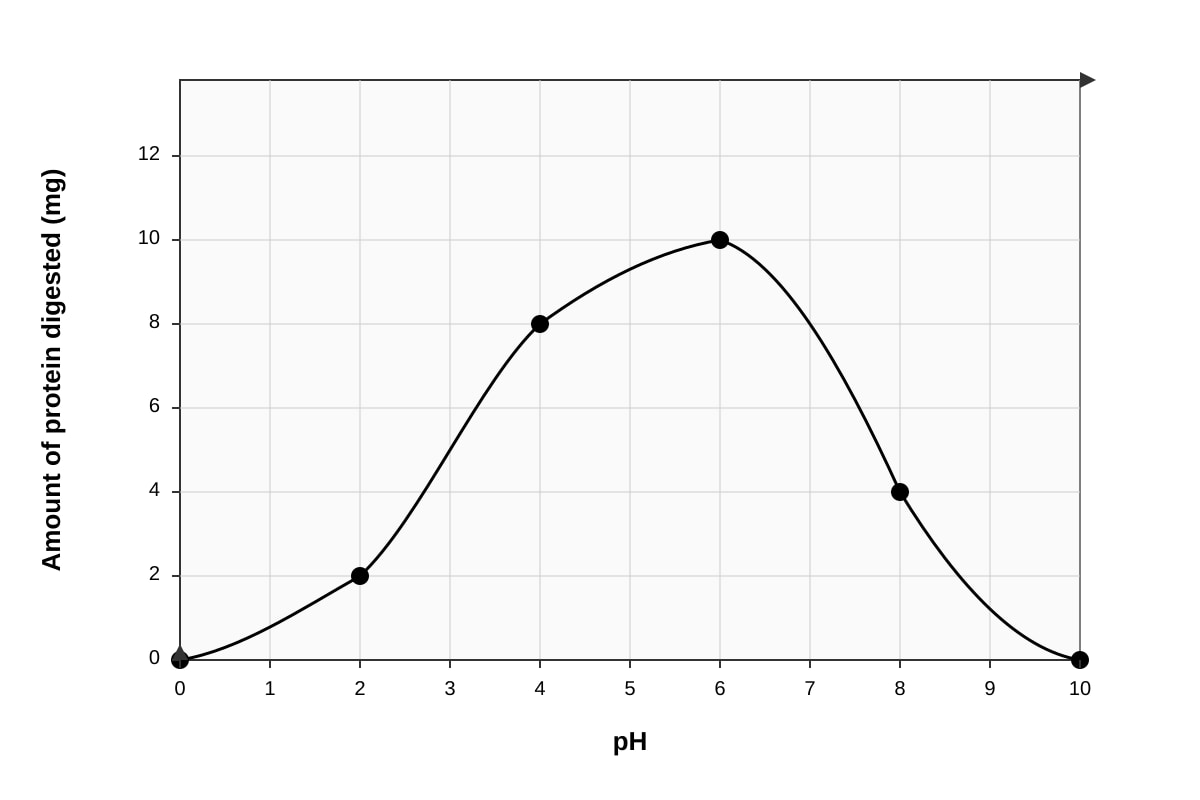
Generated graph for this question.
Marking criteria for graph (3 marks):
- 1 mark: Correct labelling of x-axis as "pH" and y-axis as "Amount of protein digested (mg)"
- 1 mark: Correct plotting of all 5 data points
- 1 mark: Smooth curve drawn through the points (not a straight line or bar chart)
Common mistakes: Drawing a bar chart instead of a curve; incorrect axis labels; not plotting all points; drawing straight lines between points instead of a smooth curve.
(b) pH 2.0 (1)
Marking note: Accept "pH 2" or "pH 2.0". This is the pH at which the maximum amount of protein was digested (9.8 mg).
(c) Pepsin is found in the stomach, where the pH is acidic (around pH 2). The shape of the active site of pepsin is adapted to work best at this pH. At other pH values, the enzyme may denature or the active site may not bind the substrate as effectively. (2)
Marking note: 1 mark for linking the optimum pH to the stomach environment, 1 mark for explaining that the enzyme's active site is adapted to this pH / denaturation occurs at other pH values.
(d) Prediction: Approximately 0 mg (or close to 0)
Explanation: The trend in the data shows that as pH increases above the optimum, the amount of protein digested decreases sharply. At pH 5.0, only 0.5 mg was digested, so at pH 6.0, the enzyme would be almost completely denatured and little to no protein would be digested. (2)
Marking note: 1 mark for a reasonable prediction (0–1 mg), 1 mark for explaining the prediction based on the trend in the data and enzyme denaturation. The prediction must be consistent with the observed trend.
17.
(a) Any one of: Long, thin extension (root hair) increases surface area for absorption / thin cell wall for easy entry of water and ions / large vacuole to maintain water potential gradient (1)
Marking note: The feature must be linked to the function of absorption. Simply saying "it is long" is insufficient — the answer must explain how the feature aids absorption.
(b) Any one of: Many chloroplasts for photosynthesis / tall, column-shaped to receive maximum light / thin cell wall for easy entry of carbon dioxide / large surface area for gas exchange (1)
Marking note: The feature must be linked to photosynthesis. Simply saying "it has chloroplasts" is acceptable as it directly relates to the function.
(c) Function 1: Maintains turgor pressure / keeps the cell turgid / provides structural support
Function 2: Stores water, nutrients, and waste products / maintains cell shape (2)
Marking note: 1 mark per valid function. The two functions must be distinct. "Stores water" and "stores nutrients" count as one function (storage).
18.
(a) Result: No colour change / remains brown
Explanation: Starch molecules are too large to pass through the partially permeable membrane of the Visking tubing. (2)
Marking note: 1 mark for correct result, 1 mark for correct explanation. The answer must state that starch cannot pass through because of its large molecular size.
(b) Result: Brick-red precipitate
Explanation: Glucose molecules are small enough to pass through the partially permeable membrane by diffusion into the surrounding water. (2)
Marking note: 1 mark for correct result, 1 mark for correct explanation. The answer must state that glucose can pass through because of its small molecular size.
(c) Starch is a large molecule (polymer) that cannot pass through the pores of the partially permeable membrane, whereas glucose is a small molecule (monomer) that can pass through. The membrane is selectively permeable — it allows small molecules to pass but not large ones. (2)
Marking note: 1 mark for comparing the sizes of starch and glucose molecules, 1 mark for explaining that the membrane is partially/selectively permeable based on molecular size.
19.
(a) Cell type: Muscle cell
Explanation: It has the highest number of mitochondria (2,500), which means it has the highest energy demand because mitochondria produce ATP through aerobic respiration. (2)
Marking note: 1 mark for correct cell type, 1 mark for linking high mitochondrial count to high energy demand.
(b) The liver cell carries out many metabolic processes (e.g., detoxification, protein synthesis, glycogen storage) that require a lot of energy, whereas the skin cell has a mainly protective function that requires less energy. (2)
Marking note: 1 mark for describing the liver cell's high-energy functions, 1 mark for contrasting with the skin cell's lower-energy function. The answer must show a comparison.
(c) Any one of: Muscle cells contract frequently and require more energy for movement / nerve cells primarily transmit electrical signals which require less energy than muscle contraction / muscle cells have more active transport processes requiring ATP (2)
Marking note: 1 mark for a valid reason, 1 mark for linking the reason to energy demand. The answer must explain why the muscle cell needs more mitochondria than the nerve cell.
20.
(a) As enzyme concentration increases from 0% to 40%, the volume of oxygen produced increases proportionally / linearly. At 50% enzyme concentration, the volume remains constant at 16 cm³. (2)
Marking note: 1 mark for describing the increasing trend, 1 mark for noting the plateau at higher concentrations. The answer must describe both parts of the relationship.
(b) At 40% enzyme concentration, all the substrate (hydrogen peroxide) is already being broken down at the maximum rate. Increasing the enzyme concentration further does not increase the rate because there is no more substrate available for the additional enzyme molecules to act on. The substrate concentration is the limiting factor. (2)
Marking note: 1 mark for stating that the substrate is fully used up / limiting, 1 mark for explaining that adding more enzyme has no effect when substrate is the limiting factor. Simply saying "the reaction has finished" is not sufficient — the concept of limiting factor must be addressed.
(c) Any one of: Temperature / volume of hydrogen peroxide / concentration of hydrogen peroxide / pH / time of reaction (1)
Marking note: Any one valid controlled variable. The variable must be one that would affect the rate of the reaction if it were not kept constant.
(d) Hydrogen peroxide → Water + Oxygen (1)
Marking note: Accept the word equation with or without "catalase" above the arrow. Accept chemical formulas (H₂O₂ → H₂O + O₂) as an alternative. The equation must be balanced.
END OF ANSWER KEY