AI Generated Exam Paper
Secondary 4 Combined Science Biology Practice Paper 3
Free Sec 4 Comb Sci Bio Practice Paper 3, HY3 AI version, with questions, answers, and O Level-style practice for Singapore students.
These static practice materials are generated from the site's syllabus and paper-generation workflow, with source and model context shown so students and parents can evaluate the material before use.
Questions
Free quiz and exam paper access
Enter your details to view this paper
Your access is remembered on this device.
Answers
TuitionGoWhere Practice Paper — Combined Science Biology Secondary 4 (Version 3) Answer Key
Total Marks: 40
Section A (8 marks)
1. Diffusion [1]
Teaching note: Oxygen moves from alveolus (high concentration) to muscle cell (low concentration) by diffusion, a passive process needing no energy.
2. Mitochondrion (plural: mitochondria) [1]
Teaching note: Mitochondria are the sites of aerobic respiration where ATP is produced.
3. Cell wall is made of cellulose and is rigid; cell membrane is a phospholipid bilayer and is flexible / selectively permeable. [1]
Accept any one clear difference.
4. Red blood cell (erythrocyte) [1]
Teaching note: Mature mammalian red blood cells lack a nucleus and are biconcave to increase surface area for oxygen transport.
5. Osmosis [1]
Teaching note: Osmosis is diffusion of water across a partially permeable membrane.
6. Protein [1]
Teaching note: Proteins are polymers of amino acids; they include enzymes and structural molecules.
7. Facilitated diffusion [1]
Teaching note: Glucose uses a carrier protein but moves down its gradient without energy.
8. Ribosome [1]
Teaching note: Ribosomes link amino acids to form proteins.
Section B (16 marks)
9. [2]
- Skeletal muscle cells need more ATP for contraction (1 mark).
- Therefore they have more mitochondria to carry out respiration and release energy (1 mark).
Common mistake: Stating "they are bigger" without linking to energy need.
10. [3]
- Glucose moves by facilitated diffusion through carrier proteins down its concentration gradient (1 mark).
- It does not require energy from ATP (1 mark).
- Rate is affected by concentration gradient steepness; steeper gradient = faster rate (1 mark).
Teaching note: Facilitated diffusion is passive; carriers are specific.
11. [2]
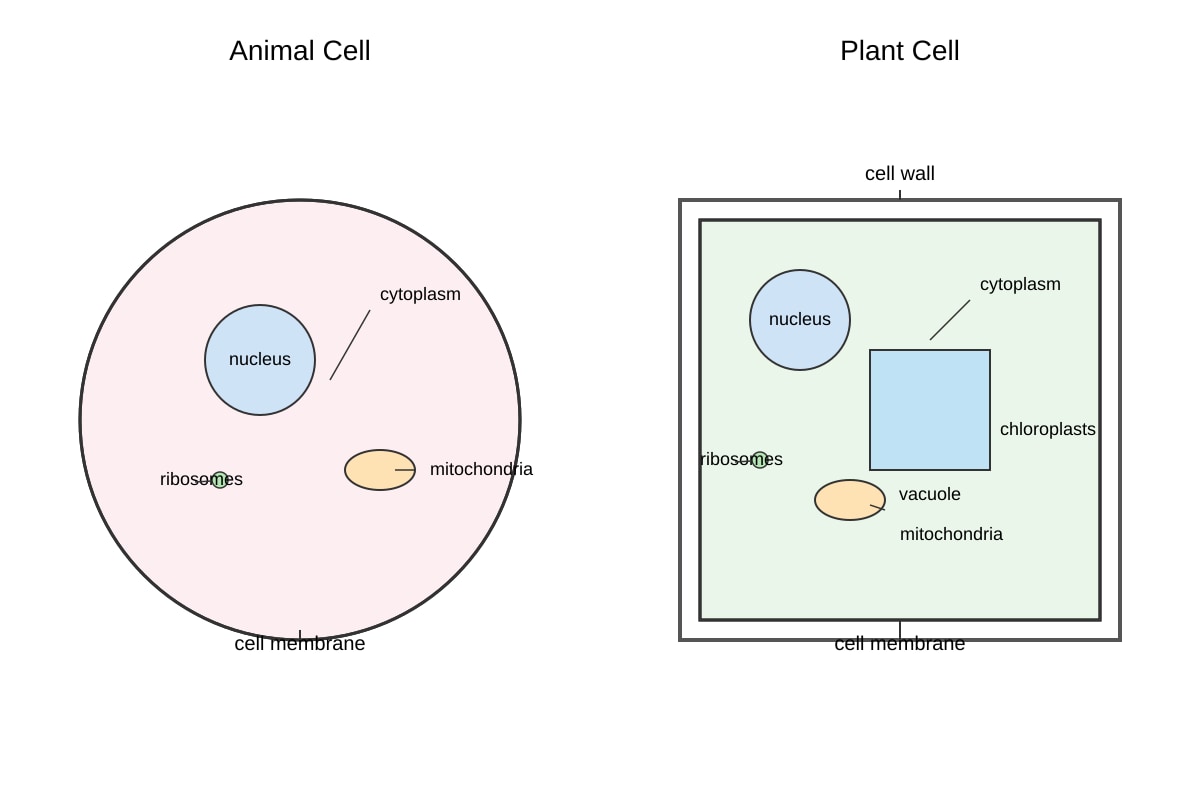
Any two from: cell wall, chloroplasts, large central vacuole (1 mark each, max 2).
Based on Q11-fig1: Plant cell shows wall, chloroplasts, vacuole absent in animal cell.
12. [2]
- Diffusion is passive movement down a concentration gradient; no energy needed (1 mark).
- Active transport uses energy (ATP) to move substances against a gradient (1 mark).
Marking: 1 mark per correct contrast.
13. [2]
- Water enters by osmosis; cell swells and may burst (lysis) (1 mark).
- Because outside has higher water potential; water moves in across membrane (1 mark).
14. [2]
- Fat cells store energy as lipids (1 mark).
- Liver cells need proteins for metabolism; fat cells specialize in storage so more lipid (1 mark).
15. [2]
Any two: controls entry/exit of substances; receptor site; separates cell from environment; maintains shape (1 mark each, max 2).
Section C (16 marks)
16. [4]
Mark breakdown:
- Oxygen diffuses from alveolus to blood capillary (1)
- Binds haemoglobin, pumped via pulmonary vein, left heart, aorta to coronary artery (1)
- Diffuses from capillary to heart muscle tissue fluid (1)
- Diffuses into mitochondrion of heart muscle cell (1)
Structures named: alveolus, capillary, red blood cell, heart (left atrium/ventricle), aorta, coronary artery, muscle cell membrane, mitochondrion.
17. [4 total: 1+2+1]
(a) Active transport [1]
(b) Higher temperature increases kinetic energy and protein carrier motion; faster movement until 30 °C [2]
(c) Enzymes/proteins denature or already near max rate [1]
18. [3]
(a) Bacteria lack nucleus (DNA free in cytoplasm); animal has nucleus [1+1]
(b) Bacteria have peptidoglycan wall; animal cells have no wall (membrane only) [1]
Marking: 1 mark per valid contrast point.
19. [3]
- High temperature breaks H-bonds in protein [1]
- Enzyme loses 3D shape = denaturation [1]
- Active site changes, substrate no longer fits, no catalysis [1]
20. [4]
- Disagree [1]
- Diffusion moves any small molecules (e.g. O₂) down gradient; osmosis is only water [1]
- Osmosis needs partially permeable membrane; diffusion may not [1]
- Osmosis is water-specific, diffusion is general [1]
Marking descriptors: clear comparison = 4; partial = 2–3.