AI Generated Exam Paper
Secondary 4 Combined Science Biology Practice Paper 3
Free Sec 4 Comb Sci Bio Practice Paper 3, DeepSeek AI version, with questions, answers, and O Level-style practice for Singapore students.
These static practice materials are generated from the site's syllabus and paper-generation workflow, with source and model context shown so students and parents can evaluate the material before use.
Questions
Free quiz and exam paper access
Enter your details to view this paper
Your access is remembered on this device.
Answers
TuitionGoWhere Practice Paper - Combined Science Biology Secondary 4
Answer Key and Marking Scheme
Paper: Practice Paper 3 (Cells & Biomolecules) Total Marks: 65
Section A: Multiple Choice (10 marks)
| Question | Answer | Explanation |
|---|---|---|
| 1 | C | Mitochondria are the sites of aerobic respiration where glucose is broken down to release energy (ATP). |
| 2 | C | In a concentrated salt solution (hypertonic), water leaves the red blood cell by osmosis, causing it to shrink and become crenated. |
| 3 | B | Diffusion is the net movement of particles from a region of higher concentration to a region of lower concentration down a concentration gradient; it is a passive process requiring no energy. |
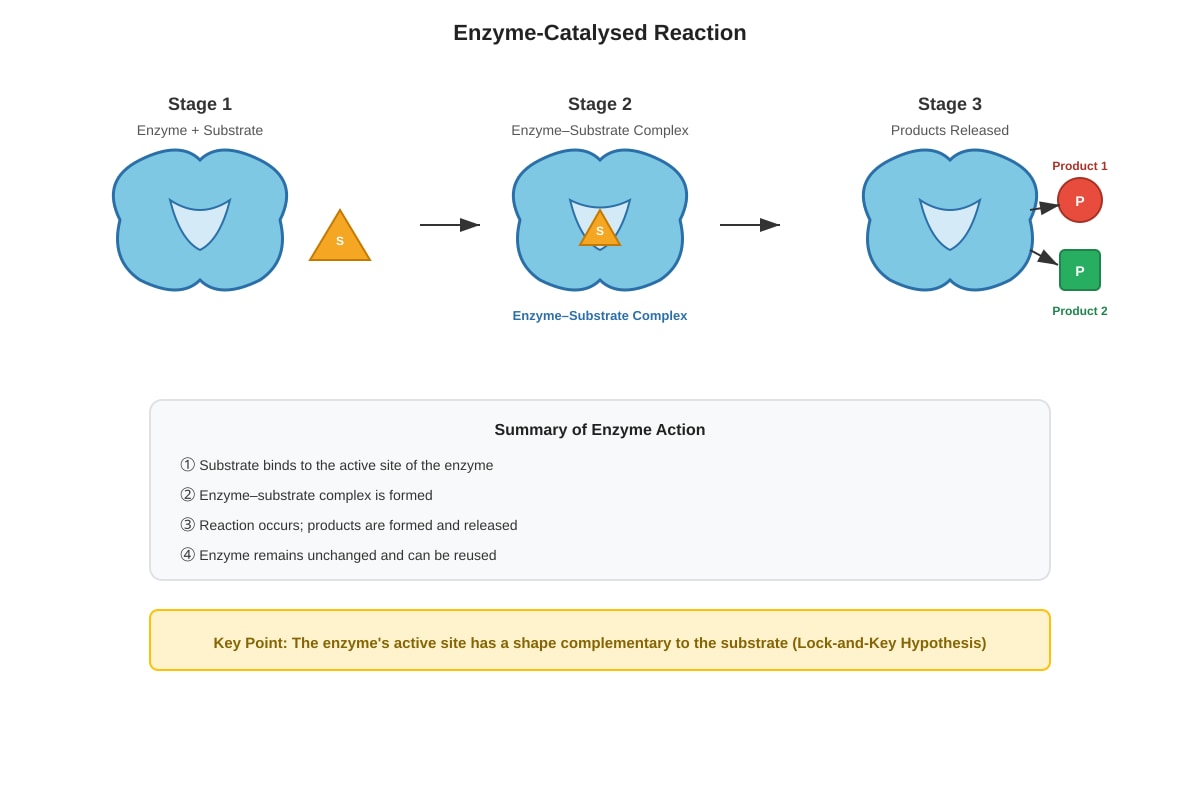
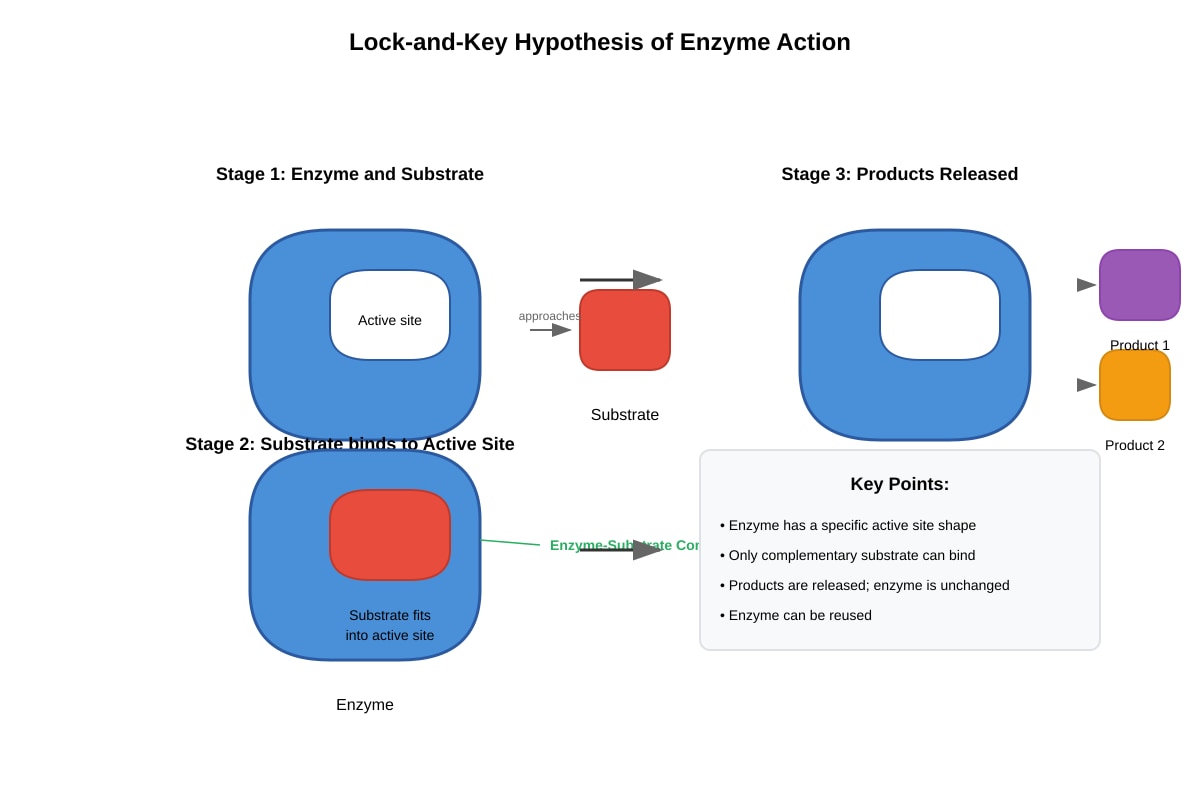
| 4 | A | The diagram illustrates the lock-and-key hypothesis, where the enzyme's active site has a specific shape complementary to the substrate. |
| 5 | C | Storing genetic information is a function of DNA (nucleic acids), not proteins. Proteins function as enzymes, structural components, and transport molecules. |
| 6 | C | The optimum pH is pH 7, where the rate of reaction is highest (18 arbitrary units). |
| 7 | C | Glycogen is the main storage form of glucose in animal cells (stored in liver and muscle cells). Starch is the storage form in plants. |
| 8 | B | In distilled water (hypotonic), water enters the plant cell by osmosis. The cell becomes turgid but does not burst because of the rigid cell wall. |
| 9 | C | DNA is a nucleic acid made up of nucleotide building blocks. Proteins are made of amino acids; starch is made of glucose; lipids are made of glycerol and fatty acids. |
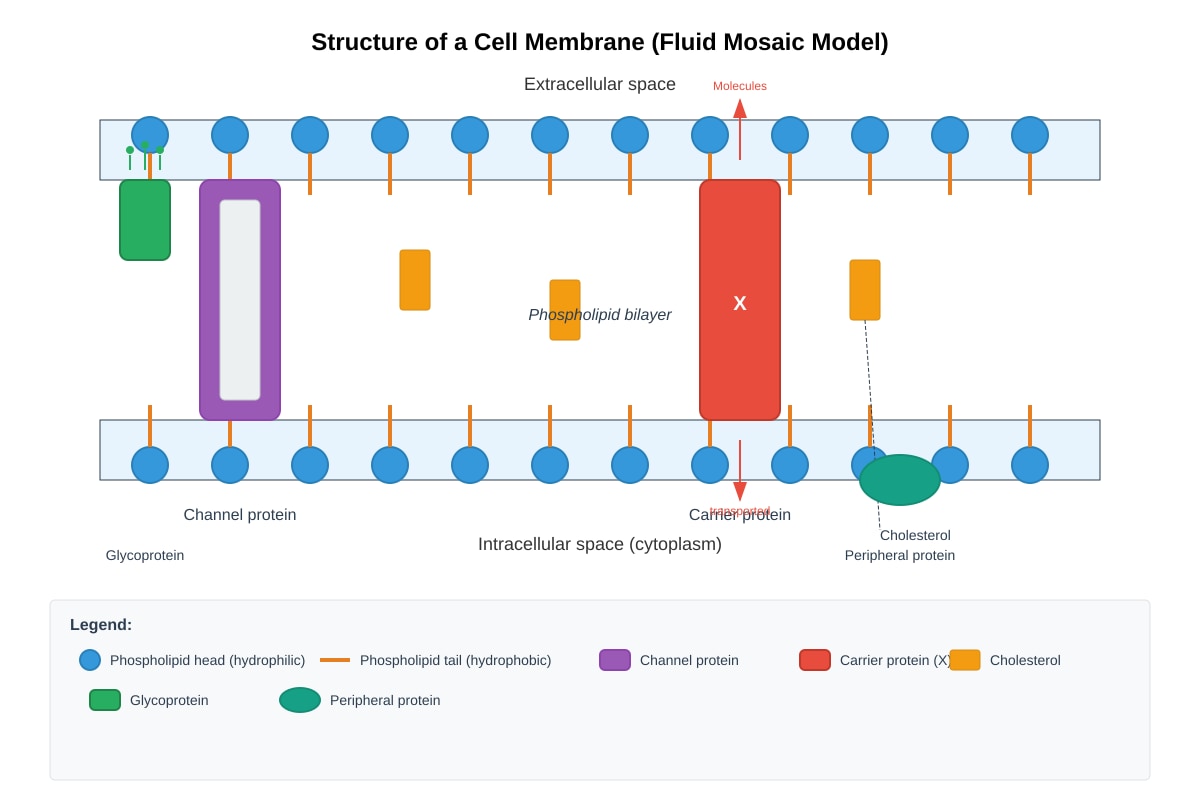
| 10 | C | Carrier proteins transport specific molecules across the membrane, sometimes using energy (ATP) for active transport against the concentration gradient. |
Section B: Structured Questions (35 marks)
Question 11 (6 marks)
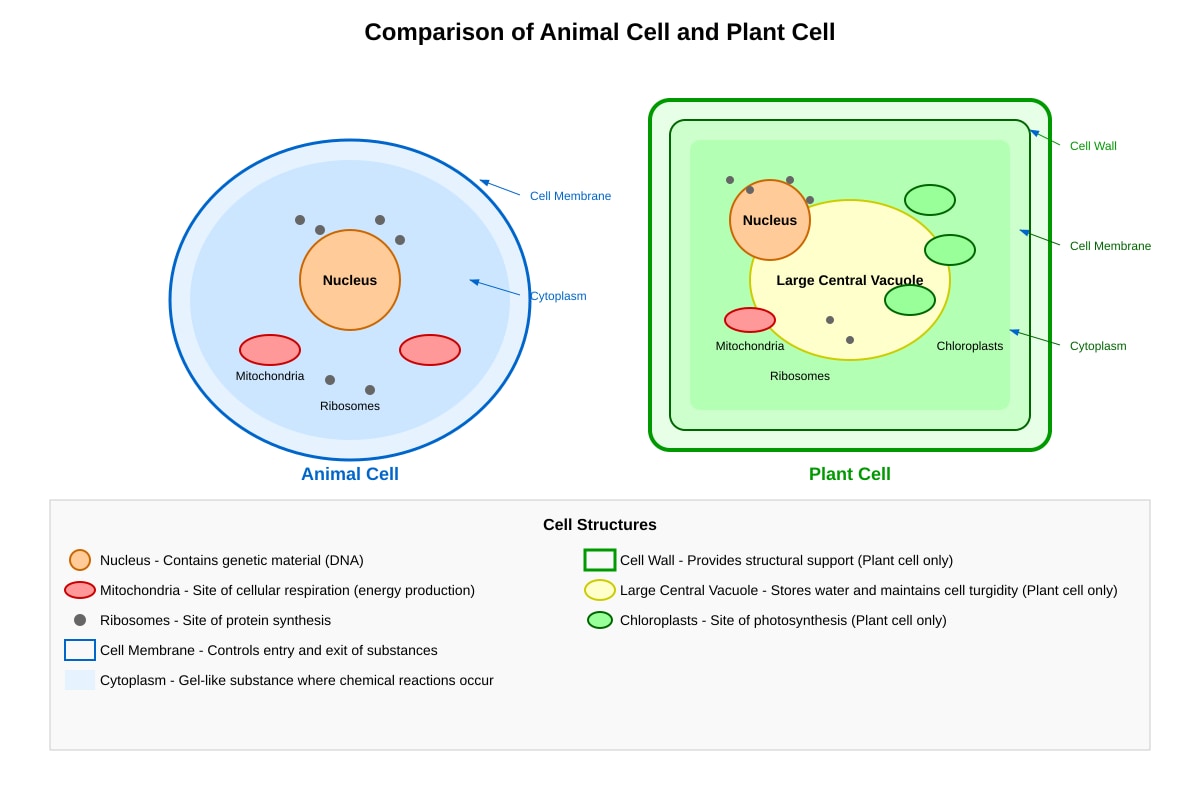
(a) Structure P: Nucleus [1 mark]
Function: Contains genetic material (DNA) / controls cell activities / controls cell division [1 mark]
Accept any one correct function.
(b) Structure: Chloroplast / Cell wall / Large central vacuole [1 mark]
Function (chloroplast): Site of photosynthesis / absorbs light energy to produce glucose [1 mark]
OR
Function (cell wall): Provides structural support and protection / prevents cell from bursting / maintains cell shape [1 mark]
OR
Function (large central vacuole): Contains cell sap / stores water and dissolved substances / maintains turgor pressure [1 mark]
Accept any one correct structure with matching function.
(c) Muscle cells require more energy (ATP) for contraction [1 mark]. Mitochondria are the sites of aerobic respiration where ATP is produced [1 mark]. Therefore, muscle cells have more mitochondria to meet their higher energy demands compared to skin cells.
Marking notes: Must link higher energy requirement to increased mitochondrial number. Award 1 mark for identifying energy demand difference, 1 mark for linking to mitochondrial function.
Question 12 (7 marks)
(a) Graph plotting [3 marks]:
- Correctly labelled axes: x-axis "Temperature (°C)" and y-axis "Volume of oxygen produced (cm³)" [1 mark]
- Appropriate scales on both axes [0.5 marks]
- All 6 points plotted accurately [1 mark]
- Points joined with a smooth curve or straight lines between points [0.5 marks]
Deduct 0.5 marks for each error up to maximum 3 marks.
(b) As temperature increases from 10°C to 40°C, the volume of oxygen produced increases [1 mark].
Accept: The rate of reaction increases with increasing temperature.
(c) At temperatures above 50°C, the enzyme catalase denatures [1 mark]. The active site loses its specific three-dimensional shape, so the substrate (hydrogen peroxide) can no longer bind to the active site [1 mark]. This results in a decrease in the rate of reaction and less oxygen produced.
Marking notes: Must mention denaturation and active site shape change. Award 1 mark for denaturation, 1 mark for explanation of effect on active site/substrate binding.
(d) Any one of: Concentration/volume of hydrogen peroxide / Concentration/volume of catalase / pH / Time of reaction (2 minutes stated in question) [1 mark]
Accept any valid controlled variable.
Question 13 (7 marks)
(a) Structure A: Phospholipid (or phospholipid bilayer) [1 mark]
Description: The phospholipid bilayer has hydrophilic (water-loving) heads facing outwards and hydrophobic (water-fearing) tails facing inwards [1 mark]. This arrangement allows small, non-polar molecules (e.g., oxygen, carbon dioxide) to pass through freely, while large, polar molecules and ions cannot pass through without the help of proteins [1 mark].
Marking notes: Award 1 mark for naming, 1 mark for describing the arrangement, 1 mark for explaining selective permeability.
(b) Carrier proteins (structure C) bind to specific molecules on one side of the membrane [1 mark]. Using energy from ATP, the carrier protein changes shape to transport the molecule across the membrane against its concentration gradient [1 mark].
Marking notes: Must mention ATP/energy and movement against concentration gradient.
(c) Respiring cells use oxygen during aerobic respiration, so the concentration of oxygen inside the cell is lower than in the tissue fluid [1 mark]. Oxygen diffuses down its concentration gradient from the tissue fluid (higher concentration) into the cell (lower concentration) [1 mark].
Marking notes: Must mention concentration gradient and direction of movement.
Question 14 (5 marks)
(a) Any one of:
- Starch is made of α-glucose while cellulose is made of β-glucose [1 mark]
- Starch has α-1,4 and α-1,6 glycosidic bonds while cellulose has β-1,4 glycosidic bonds [1 mark]
- Starch is coiled/helical while cellulose is straight/unbranched chains [1 mark]
- Starch contains amylose (unbranched) and amylopectin (branched) while cellulose has unbranched chains [1 mark]
Accept any one valid structural difference.
(b) Glycogen is highly branched [1 mark], which allows for rapid hydrolysis to release glucose when energy is needed quickly. It is also compact and insoluble, so it does not affect the osmotic balance of cells [1 mark].
Marking notes: Award 1 mark for branching/structure, 1 mark for linking to function (rapid release or osmotic effect).
(c) Test: Add a few drops of iodine solution (iodine in potassium iodide) to the sample [1 mark]
Positive result: The solution changes from brown/yellow to blue-black [1 mark]
Accept: iodine test with correct colour change.
Question 15 (6 marks)
(a) The distilled water has a higher water potential than the potato cells [1 mark]. Water enters the potato cells by osmosis from a region of higher water potential (distilled water) to a region of lower water potential (cell sap) through a partially permeable membrane [1 mark].
Marking notes: Must mention water potential gradient and osmosis.
(b) The 1.0 M sucrose solution has a lower water potential than the 0.5 M sucrose solution [1 mark]. Therefore, there is a steeper water potential gradient between the potato cells and the 1.0 M solution, so more water leaves the cells by osmosis [1 mark].
Marking notes: Must compare water potential gradients and link to amount of water lost.
(c) Observation: The cell membrane pulls away from the cell wall / the cell becomes plasmolysed [1 mark]
Process: Plasmolysis [1 mark]
Accept: cell becomes flaccid (but plasmolysis is more precise for a plant cell in strong sugar solution).
Question 16 (4 marks)
(a) An enzyme has a specific three-dimensional active site shape [1 mark]. Only a substrate with a complementary shape can fit into the active site to form an enzyme-substrate complex, like a key fitting into a specific lock [1 mark].
Marking notes: Must mention complementary shape between active site and substrate.
(b) At very high temperatures, the enzyme denatures [1 mark]. The high temperature breaks the bonds (hydrogen bonds, ionic bonds) that maintain the enzyme's specific three-dimensional shape, causing the active site to lose its shape. The substrate can no longer bind, so the rate of reaction decreases [1 mark].
Marking notes: Must mention denaturation and active site shape change.
Section C: Free-Response Questions (20 marks)
Question 17 (6 marks)
Quality of written communication assessed.
Marking scheme:
| Marks | Criteria |
|---|---|
| 5–6 | Comprehensive description of membrane structure linked clearly to function. Covers phospholipid bilayer, channel proteins, and carrier proteins with accurate explanations of how each contributes to selective permeability and transport. Well-structured, logical answer with correct scientific terminology. |
| 3–4 | Good description of membrane structure with some links to function. Covers at least two of the three components (phospholipid bilayer, channel proteins, carrier proteins). Some minor errors or omissions. |
| 1–2 | Basic description of membrane structure with limited links to function. May only cover one component or contain significant errors. |
| 0 | No relevant or correct information. |
Model answer:
The cell membrane is composed of a phospholipid bilayer with proteins embedded in it (fluid mosaic model). The phospholipid bilayer has hydrophilic heads facing outwards towards the aqueous environments and hydrophobic tails facing inwards. This arrangement allows small, non-polar molecules such as oxygen and carbon dioxide to diffuse freely through the membrane, while preventing the passage of large, polar molecules and ions. This makes the membrane selectively permeable.
Channel proteins are embedded in the membrane and provide hydrophilic pores that allow specific ions and small polar molecules to pass through by facilitated diffusion, moving down their concentration gradient without the use of energy.
Carrier proteins bind to specific molecules on one side of the membrane. For facilitated diffusion, they change shape to transport molecules down their concentration gradient. For active transport, carrier proteins use energy from ATP to change shape and transport molecules against their concentration gradient.
Together, these structures enable the cell membrane to control which substances enter and leave the cell, maintaining a constant internal environment.
Question 18 (9 marks)
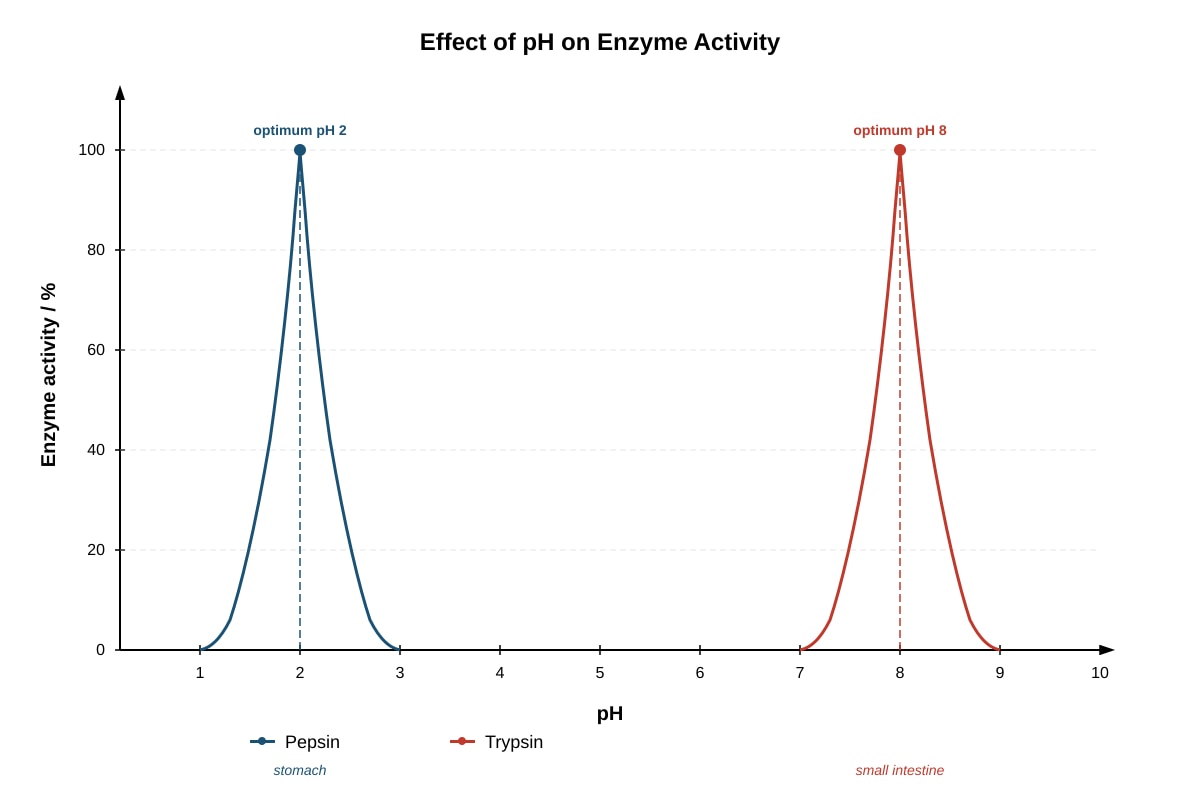
(a) Description and explanation of pepsin curve (4 marks):
| Marks | Criteria |
|---|---|
| 3–4 | Clear description of curve shape with accurate explanation linking to enzyme activity, active site, and denaturation. |
| 1–2 | Basic description with limited explanation. May not fully explain both increase and decrease. |
| 0 | No relevant or correct information. |
Model answer:
Between pH 1 and pH 2, the rate of reaction increases because the pH is approaching the optimum pH for pepsin (pH 2). At the optimum pH, the active site of pepsin has the correct shape for the substrate to bind, so the rate of reaction is highest.
Between pH 2 and pH 5, the rate of reaction decreases. As the pH moves away from the optimum, the hydrogen bonds and ionic bonds that maintain the enzyme's specific three-dimensional shape are disrupted. The active site loses its shape (the enzyme denatures), so the substrate can no longer bind effectively. This causes the rate of reaction to decrease.
(b) Explanation of different optimum pH values (3 marks):
| Marks | Criteria |
|---|---|
| 3 | Clear explanation linking enzyme structure to the environment where each enzyme functions. |
| 1–2 | Partial explanation; may mention environment but not link to enzyme structure. |
| 0 | No relevant or correct information. |
Model answer:
Pepsin and trypsin have different optimum pH values because they function in different parts of the digestive system. Pepsin works in the stomach, which has an acidic environment (pH 2) due to the presence of hydrochloric acid. Pepsin's structure is adapted to be stable and active at this low pH.
Trypsin works in the small intestine, which has an alkaline environment (pH 8) due to the secretion of bile and pancreatic juice. Trypsin's structure is adapted to be stable and active at this higher pH.
The different amino acid sequences of pepsin and trypsin result in different three-dimensional structures, including differently shaped active sites that are stable at their respective optimum pH values.
(c) Explanation of enzymes as biological catalysts (2 marks):
Model answer:
Enzymes are described as biological catalysts because they speed up the rate of chemical reactions in living organisms [1 mark] without being used up or chemically changed in the process [1 mark].
Accept: Enzymes lower the activation energy required for a reaction to occur, allowing reactions to proceed more quickly at body temperature.
Question 19 (5 marks)
(a) Red blood cell in distilled water (2 marks):
Model answer:
Water enters the red blood cell by osmosis from the distilled water (higher water potential) into the cell (lower water potential) through the partially permeable cell membrane [1 mark]. The cell swells and eventually bursts (haemolysis) because there is no cell wall to resist the pressure [1 mark].
(b) Plant cell in distilled water (2 marks):
Model answer:
Water enters the plant cell by osmosis from the distilled water (higher water potential) into the cell sap (lower water potential) through the partially permeable cell membrane [1 mark]. The cell becomes turgid (swollen) but does not burst because the rigid cell wall prevents over-expansion [1 mark].
(c) Explanation of different outcomes (1 mark):
Model answer:
The plant cell has a rigid cell wall that prevents it from bursting, while the red blood cell lacks a cell wall and therefore bursts when too much water enters [1 mark].
END OF ANSWER KEY
This answer key was generated by TuitionGoWhere AI. Marking notes are provided to guide assessment and indicate the level of detail expected in student responses.