AI Generated Exam Paper
Secondary 4 Combined Science Biology Practice Paper 2
Free Sec 4 Comb Sci Bio Practice Paper 2, DeepSeek AI version, with questions, answers, and O Level-style practice for Singapore students.
These static practice materials are generated from the site's syllabus and paper-generation workflow, with source and model context shown so students and parents can evaluate the material before use.
Questions
Free quiz and exam paper access
Enter your details to view this paper
Your access is remembered on this device.
Answers
TuitionGoWhere Practice Paper - Combined Science Biology Secondary 4
Answer Key and Marking Scheme (Version 2)
Total Marks: 65
Section A: Structured Questions (20 marks)
1. (a) Name the process by which water enters the root hair cell from the soil. [1]
Answer: Osmosis
Marking note: Accept "osmosis" only. Do not accept "diffusion" alone.
1. (b) Explain two structural adaptations of the root hair cell that help it absorb water efficiently. [4]
Answer:
- Adaptation 1: The root hair cell has a long, narrow extension/projection that increases the surface area to volume ratio for faster absorption of water by osmosis. [2 marks: 1 for naming adaptation, 1 for explanation linking to water absorption]
- Adaptation 2: The cell membrane is thin, which reduces the diffusion/osmosis distance, allowing water to enter more quickly. [2 marks: 1 for naming adaptation, 1 for explanation linking to water absorption]
Alternative acceptable adaptations:
- Numerous mitochondria provide ATP/energy for active transport of mineral ions, which lowers water potential in the cell, promoting water entry by osmosis.
- The cell wall is fully permeable, allowing water to pass through easily.
Marking note: Award 2 marks per adaptation (1 for identification, 1 for correct explanation linked to water absorption). Maximum 4 marks.
2. (a) Plot a graph of the results on the grid below. Label both axes clearly. [3]
Answer:
- X-axis: pH (with appropriate scale, e.g., 0–14) [1 mark]
- Y-axis: Rate of reaction (arbitrary units) (with appropriate scale, e.g., 0–25) [1 mark]
- Plotting: All 7 points plotted accurately (± half a small square); smooth curve drawn through points showing optimum at pH 7 and decrease at extremes. [1 mark]
Marking note: Deduct 1 mark if axes are unlabelled or incorrectly labelled. Deduct 1 mark if points are inaccurately plotted or curve is poorly drawn.
2. (b) State the optimum pH for enzyme X. [1]
Answer: pH 7
Marking note: Accept "7" or "pH 7". Do not accept a range.
2. (c) Explain why the rate of reaction decreases sharply at pH 12. [2]
Answer: At pH 12, the enzyme is denatured. The high pH (alkaline conditions) disrupts the hydrogen/ionic bonds that maintain the specific three-dimensional shape of the enzyme's active site. The active site loses its shape, so the substrate can no longer bind/fit into the active site, and enzyme-substrate complexes cannot form. [2 marks: 1 for stating denaturation/active site shape change, 1 for explaining that substrate can no longer bind]
Marking note: Award 1 mark for "denatured" or "active site changes shape". Award 1 mark for linking to substrate binding. Do not accept "enzyme is killed".
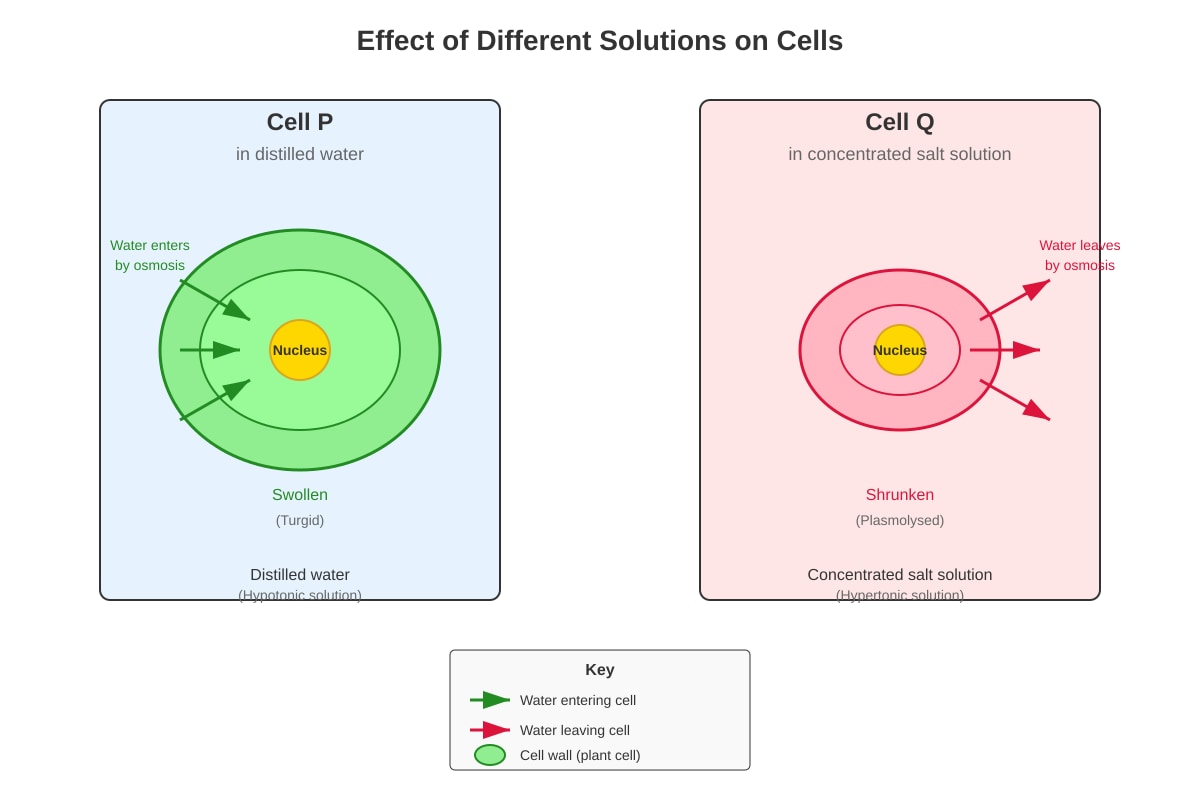
3. (a) Identify the type of cell shown in the diagram. Give a reason for your answer. [2]
Answer: Red blood cell / erythrocyte. [1 mark] Reason: The cell has a biconcave shape / lacks a nucleus / is disc-shaped. [1 mark]
Marking note: Accept any valid identifying feature of red blood cells.
3. (b) Explain why cell P became swollen. [3]
Answer: Cell P was placed in distilled water, which has a higher water potential than the cytoplasm of the cell. Water moved into the cell by osmosis from a region of higher water potential (distilled water) to a region of lower water potential (cell cytoplasm) through the partially permeable cell membrane. The cell swelled as water entered. [3 marks: 1 for identifying water potential gradient, 1 for naming osmosis and partially permeable membrane, 1 for describing direction of water movement and result]
Marking note: Must mention water potential gradient and osmosis for full marks.
3. (c) Name the condition observed in cell Q. [1]
Answer: Crenation / the cell is crenated.
Marking note: Accept "crenation" or "crenated". Do not accept "plasmolysed" (this applies to plant cells only).
4. (a) Calculate the rate of water uptake in still air. Give your answer in cm per minute. [1]
Answer: 2.5 cm ÷ 10 min = 0.25 cm/min
Marking note: Award 1 mark for correct answer with units. Accept 0.25 cm/min or 0.25 cm min⁻¹.
4. (b) Explain why the rate of water uptake is higher in windy conditions compared to still air. [2]
Answer: Wind removes water vapour from around the stomata/leaf surface, maintaining a steep concentration gradient of water vapour between the leaf's internal air spaces and the external environment. This increases the rate of transpiration/diffusion of water vapour out of the leaf, so more water is pulled up the xylem, increasing water uptake. [2 marks: 1 for mentioning concentration gradient, 1 for linking to increased transpiration/water uptake]
Marking note: Must mention concentration gradient for full marks.
Section B: Data Interpretation and Application (25 marks)
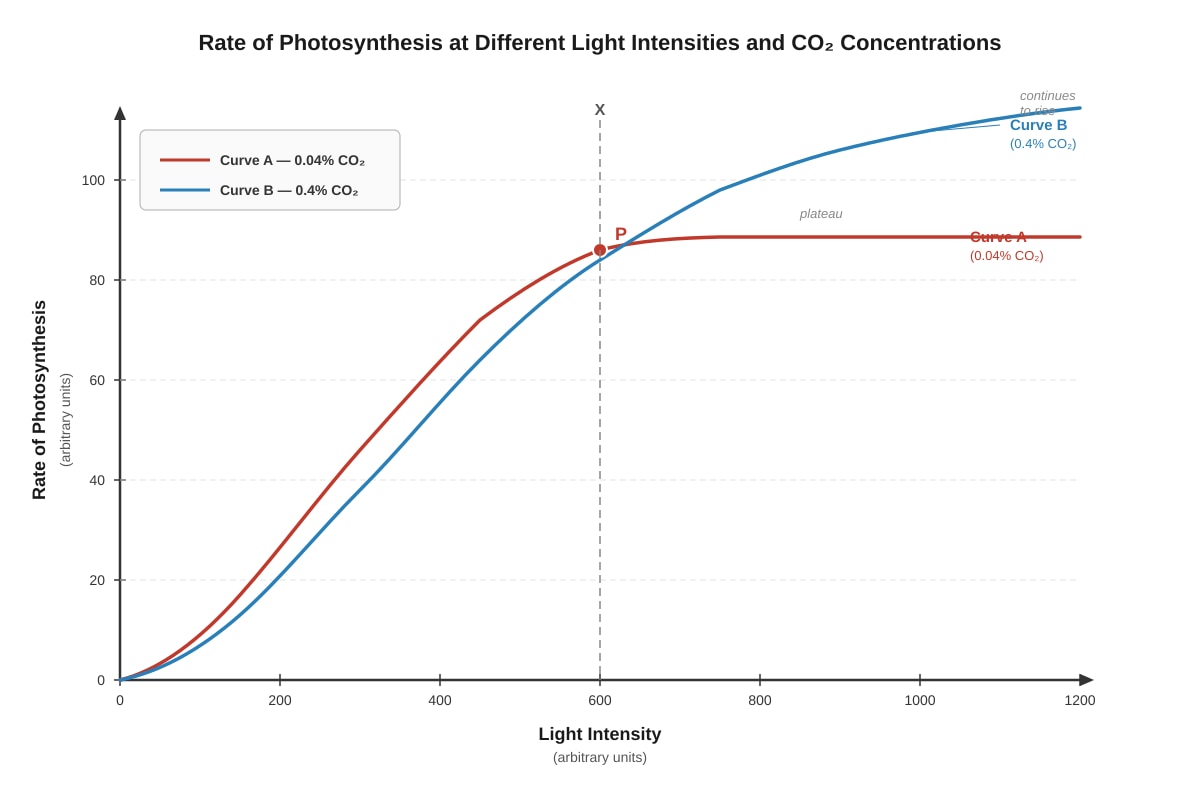
5. (a) Identify the limiting factor for photosynthesis at point P on Curve A. Explain your answer. [3]
Answer: The limiting factor is carbon dioxide concentration. [1 mark] Explanation: At point P, increasing light intensity does not increase the rate of photosynthesis (the curve plateaus). However, when carbon dioxide concentration is increased to 0.4% (Curve B), the rate of photosynthesis increases further at the same light intensity. This shows that light intensity was not limiting; carbon dioxide concentration was the factor restricting the rate. [2 marks: 1 for identifying plateau, 1 for using Curve B as evidence]
Marking note: Must use evidence from the graph to support the answer.
5. (b) Explain why the rate of photosynthesis increases as light intensity increases from 0 to X on Curve A. [2]
Answer: As light intensity increases, more light energy is available for the light-dependent reactions of photosynthesis. This increases the rate at which water is split (photolysis) and ATP/NADPH is produced, providing more energy and reducing power for the light-independent reactions. Therefore, the overall rate of photosynthesis increases. [2 marks: 1 for linking light energy to photosynthesis, 1 for explaining increased rate]
Marking note: Accept simpler explanation: "Light provides energy for photosynthesis; more light means more energy, so the rate increases."
5. (c) A farmer wants to increase the yield of crops in a greenhouse. Suggest two ways the farmer could increase the rate of photosynthesis, based on the information in the graph. [2]
Answer:
- Suggestion 1: Increase the light intensity (e.g., by using artificial lighting). [1 mark]
- Suggestion 2: Increase the carbon dioxide concentration (e.g., by burning fuel or releasing CO₂ gas). [1 mark]
Marking note: Accept any two valid suggestions based on the graph. Award 1 mark per suggestion.
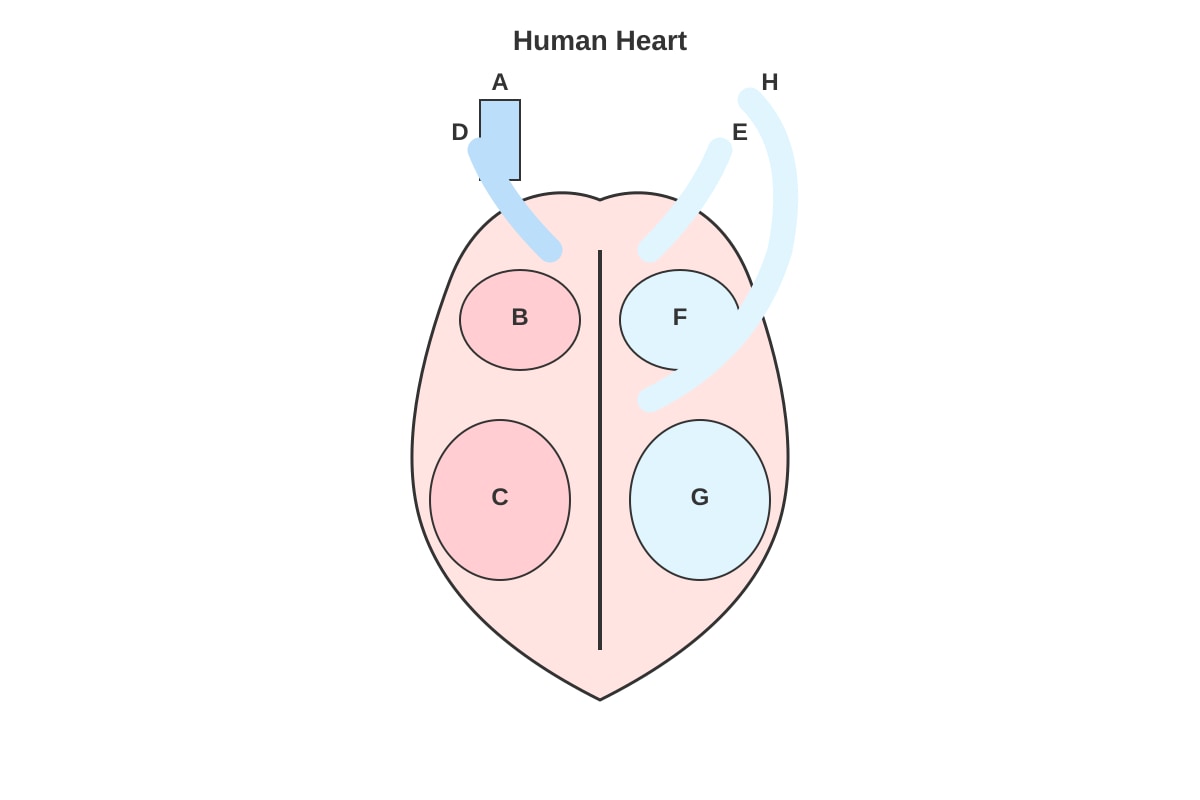
6. (a) Identify structures A, D, and H. [3]
Answer:
- A: Vena cava [1 mark]
- D: Pulmonary artery [1 mark]
- H: Aorta [1 mark]
Marking note: Must use full correct names. Accept "superior/inferior vena cava" for A.
6. (b) Describe the pathway of a red blood cell from structure A to structure H, naming all the chambers and valves it passes through. [4]
Answer: Vena cava (A) → right atrium (B) → tricuspid valve → right ventricle (C) → semilunar valve → pulmonary artery (D) → lungs (pulmonary capillaries) → pulmonary vein (E) → left atrium (F) → bicuspid valve/mitral valve → left ventricle (G) → semilunar valve → aorta (H). [4 marks: 1 for correct pathway through right side, 1 for pulmonary circulation, 1 for correct pathway through left side, 1 for naming valves]
Marking note: Deduct 1 mark for each major omission (e.g., missing lungs, missing a valve). Must include both valves.
6. (c) Explain why the wall of chamber G is thicker than the wall of chamber C. [2]
Answer: Chamber G is the left ventricle, which pumps blood to the entire body (systemic circulation). It needs a thicker muscular wall to generate higher pressure to pump blood over a longer distance. Chamber C is the right ventricle, which only pumps blood to the lungs (pulmonary circulation), a shorter distance requiring less pressure. [2 marks: 1 for identifying different destinations, 1 for linking to pressure/distance]
Marking note: Must mention the different destinations (body vs lungs) for full marks.
7. (a) Explain why muscle cells contain the highest number of mitochondria. [2]
Answer: Muscle cells contract and relax frequently, which requires a large amount of energy in the form of ATP. Mitochondria are the site of aerobic respiration, where ATP is produced. Therefore, muscle cells have many mitochondria to meet their high energy demands. [2 marks: 1 for linking muscle activity to high energy demand, 1 for linking mitochondria to ATP/respiration]
Marking note: Must mention energy/ATP demand and mitochondrial function.
7. (b) Red blood cells contain no mitochondria. Suggest a reason for this. [2]
Answer: Red blood cells transport oxygen by binding it to haemoglobin. If red blood cells had mitochondria, they would use some of the oxygen they carry for their own aerobic respiration, reducing the amount of oxygen delivered to body tissues. Additionally, the absence of mitochondria (and a nucleus) creates more space for haemoglobin, maximising oxygen-carrying capacity. [2 marks: 1 for oxygen use reasoning, 1 for space/haemoglobin reasoning]
Marking note: Accept either reasoning for 2 marks if well explained. Award 1 mark for a partial explanation.
7. (c) Name the process that occurs in mitochondria and write a word equation for this process. [3]
Answer:
- Process: Aerobic respiration [1 mark]
- Word equation: Glucose + oxygen → carbon dioxide + water (+ energy/ATP) [2 marks: 1 for correct reactants, 1 for correct products]
Marking note: Accept "respiration" but "aerobic respiration" is preferred. The word equation must have correct reactants and products.
8. (a) Describe the relationship between temperature and the time taken for the dye to spread evenly. [2]
Answer: As temperature increases, the time taken for the dye to spread evenly decreases. The relationship is inversely proportional / negative correlation. [2 marks: 1 for stating the trend, 1 for describing the type of relationship]
Marking note: Accept "as temperature increases, diffusion time decreases" or similar.
8. (b) Explain this relationship using the kinetic particle theory. [2]
Answer: At higher temperatures, the water and dye particles have more kinetic energy and move faster. This increases the rate of diffusion as particles collide more frequently and spread out more quickly. [2 marks: 1 for mentioning increased kinetic energy/particle movement, 1 for linking to faster diffusion]
Marking note: Must reference kinetic particle theory for full marks.
Section C: Extended Response (20 marks)
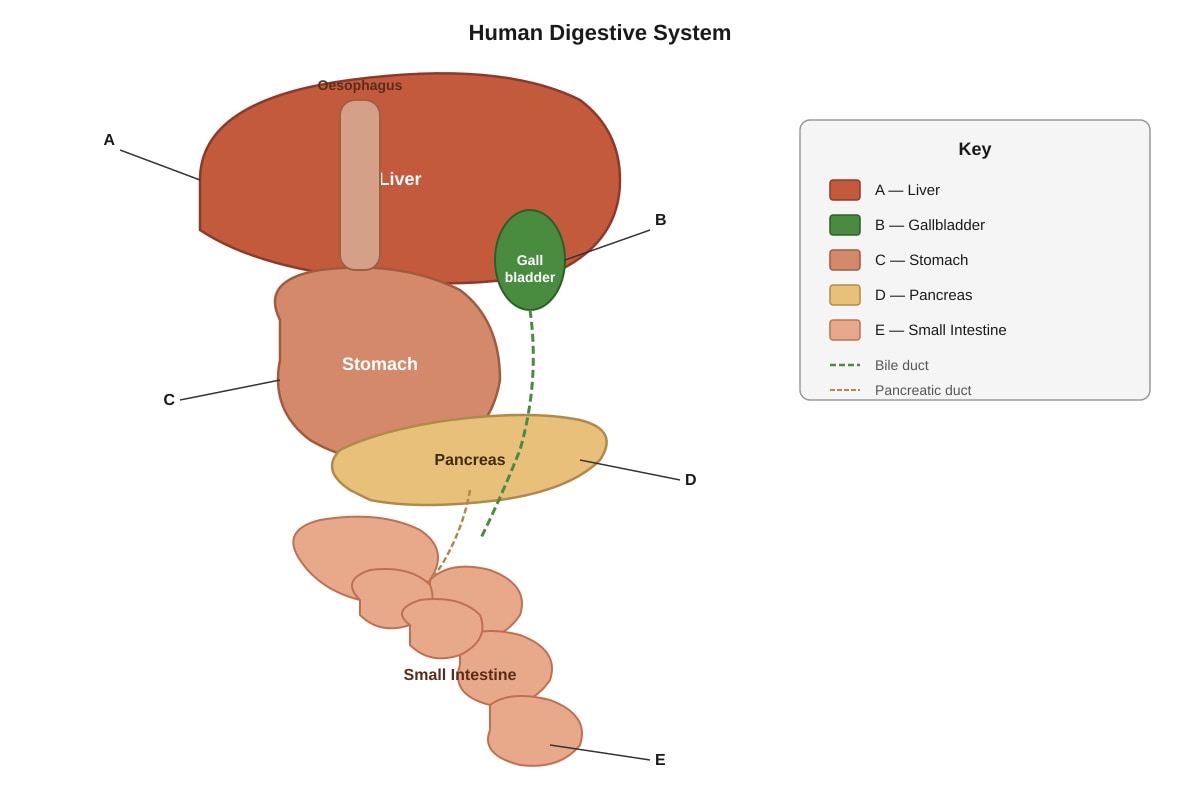
9. (a) Name the enzyme present in gastric juice that digests proteins. State the optimum pH for this enzyme. [2]
Answer:
- Enzyme: Pepsin [1 mark]
- Optimum pH: pH 2 (or approximately pH 1.5–2.5) [1 mark]
Marking note: Accept "pepsin" only. Accept pH 1.5–2.5 for optimum pH.
9. (b) Describe the role of bile in the digestion of fats. Explain why bile is not an enzyme. [4]
Answer:
- Role of bile: Bile emulsifies fats, breaking large fat globules into smaller fat droplets. This increases the surface area of fats for lipase enzyme action, speeding up the digestion of fats into fatty acids and glycerol. Bile also neutralises acidic chyme from the stomach, providing an alkaline pH suitable for lipase and other intestinal enzymes. [2 marks: 1 for emulsification and surface area, 1 for neutralisation/pH]
- Why bile is not an enzyme: Bile does not catalyse a chemical reaction or chemically break down fats. It is not a protein and is not used up in a reaction. Enzymes are biological catalysts that speed up chemical reactions without being changed; bile only physically breaks up fat droplets. [2 marks: 1 for stating bile is not a catalyst/does not chemically break down fats, 1 for contrasting with enzyme properties]
Marking note: Award marks for clear explanation of emulsification and the distinction from enzyme action.
9. (c) Explain how the structure of the small intestine is adapted for the absorption of digested food molecules. [4]
Answer:
- The small intestine is very long, providing a large surface area and sufficient time for absorption. [1 mark]
- The inner wall has many folds/villi, which increase the surface area for absorption. [1 mark]
- Each villus has microvilli on its epithelial cells, further increasing the surface area. [1 mark]
- The epithelium of the villi is one cell thick, providing a short diffusion distance for absorbed molecules. [1 mark]
- Each villus contains a dense network of blood capillaries and a lacteal (lymphatic vessel) to transport absorbed nutrients (glucose, amino acids into blood; fatty acids and glycerol into lacteal). [1 mark for mentioning transport networks]
Marking note: Maximum 4 marks. Award 1 mark for each valid adaptation with explanation. Must include at least 4 distinct points for full marks.
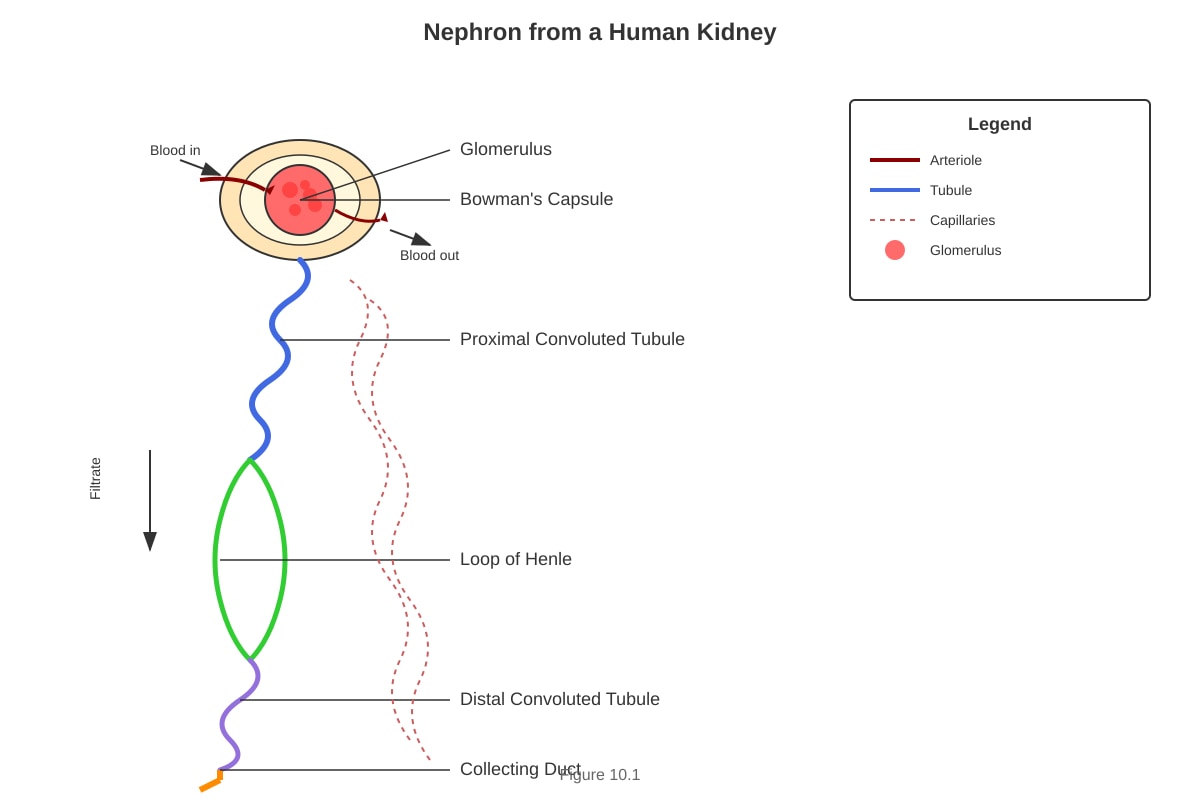
10. (a) Name the process that occurs at the glomerulus and Bowman's capsule. [1]
Answer: Ultrafiltration / pressure filtration
Marking note: Accept "ultrafiltration" or "pressure filtration".
10. (b) Describe how the structure of the glomerulus and Bowman's capsule facilitates this process. [3]
Answer:
- The afferent arteriole bringing blood into the glomerulus is wider than the efferent arteriole taking blood away, creating high hydrostatic pressure in the glomerulus. [1 mark]
- The capillary walls of the glomerulus are fenestrated/have pores, and the inner wall of the Bowman's capsule is made of podocytes with filtration slits. [1 mark]
- The basement membrane acts as a filter, allowing small molecules (water, glucose, urea, salts) to pass through but preventing large molecules (proteins, blood cells) from passing. [1 mark]
Marking note: Award 1 mark for each structural feature linked to filtration function.
10. (c) Explain why glucose is present in the glomerular filtrate but absent in the urine of a healthy person. [3]
Answer: Glucose is a small molecule, so it passes through the basement membrane during ultrafiltration and is present in the glomerular filtrate. [1 mark] However, in the proximal convoluted tubule, all glucose is selectively reabsorbed back into the blood capillaries by active transport. [1 mark] Therefore, no glucose remains in the filtrate by the time it reaches the collecting duct and forms urine. [1 mark]
Marking note: Must mention ultrafiltration, selective reabsorption, and active transport for full marks.
10. (d) A person's urine is found to contain glucose. Suggest a possible medical condition and explain why glucose appears in the urine. [3]
Answer:
- Medical condition: Diabetes mellitus [1 mark]
- Explanation: In diabetes mellitus, the blood glucose concentration is too high (hyperglycaemia). The glucose concentration in the glomerular filtrate exceeds the maximum rate at which the proximal convoluted tubule can reabsorb glucose (exceeds the renal threshold). As a result, not all glucose is reabsorbed, and the excess glucose remains in the filtrate and is excreted in the urine. [2 marks: 1 for high blood glucose, 1 for exceeding reabsorption capacity/renal threshold]
Marking note: Accept "diabetes" for 1 mark. Award 2 marks for clear explanation of why reabsorption is incomplete.
END OF ANSWER KEY
This answer key was generated by TuitionGoWhere AI. Mark allocations are suggested guidelines based on typical O-Level Combined Science Biology marking schemes.