AI Generated Exam Paper
Secondary 4 Combined Science Biology Practice Paper 1
Free Sec 4 Comb Sci Bio Practice Paper 1, AI version, with questions, answers, and O Level-style practice for Singapore students.
These static practice materials are generated from the site's syllabus and paper-generation workflow, with source and model context shown so students and parents can evaluate the material before use.
Questions
Free quiz and exam paper access
Enter your details to view this paper
Your access is remembered on this device.
Answers
TuitionGoWhere Practice Paper - Combined Science Biology Secondary 4 (Answer Key)
Total Marks: 65 marks
Section A: Multiple Choice Questions [8 marks]
1. C - Diffusion [1] 2. C - Mitochondrion [1] 3. B - Oxygen [1] 4. B - Insulin [1] 5. C - Osmosis [1] 6. C - Chloroplast [1] 7. C - Active transport [1] 8. C - Starch [1]
Section B: Structured Questions [42 marks]
9. (a) Identify the organelles labelled A to E. [5] Marking scheme: 1 mark each for correct identification
- A: Cell wall
- B: Chloroplast
- C: Nucleus
- D: Vacuole
- E: Cell membrane/plasma membrane
(b) State the function of organelle C. [1] Answer: Controls cell activities / Contains genetic material / Controls protein synthesis Marking: Accept any correct function of the nucleus
(c) Explain why organelle C is not found in animal cells. [2] Answer:
- Animal cells do have a nucleus (1)
- If referring to cell wall: Animal cells do not need rigid support/have flexible cell membrane instead (1) Marking: Award marks based on which organelle student identifies as C
10. (a) Plot a graph of the results. [4] Marking scheme:
- Correct axes labels with units (1)
- Appropriate scale (1)
- All points plotted correctly (1)
- Smooth curve drawn (1)
(b) Describe the relationship between temperature and enzyme activity. [3] Answer:
- As temperature increases from 10°C to 40°C, enzyme activity increases (1)
- Maximum activity occurs at 40°C (1)
- Above 40°C, enzyme activity decreases rapidly (1)
(c) Explain why enzyme activity decreases above 50°C. [3] Answer:
- High temperature causes enzyme to denature (1)
- Active site changes shape (1)
- Substrate can no longer bind to active site/enzyme-substrate complex cannot form (1)
(d) Predict the rate of reaction at 45°C. [2] Answer: Rate: 30 cm³ O₂/min (accept 28-32) (1) Reason: Between the values at 40°C and 50°C/on the declining part of the curve (1)
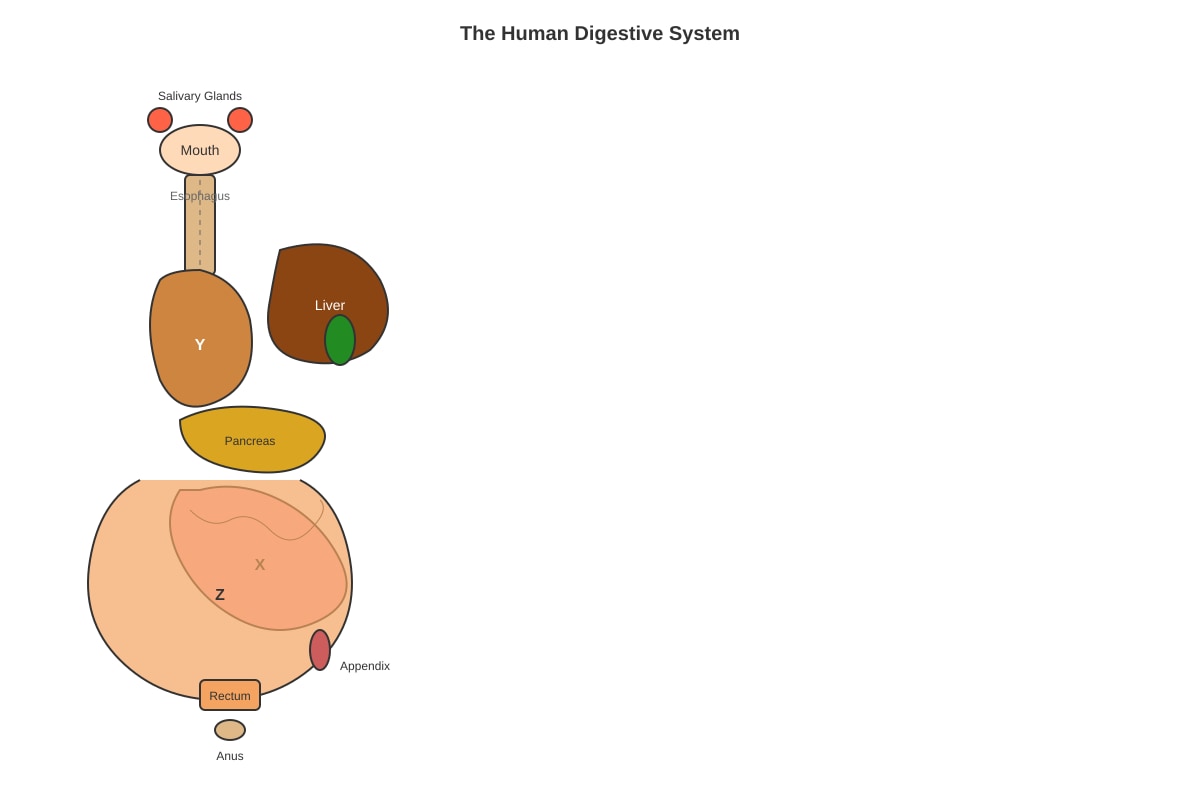
11. (a) Identify organs X, Y, and Z. [3] Answer: (Based on typical digestive system diagram)
- X: Stomach
- Y: Small intestine
- Z: Large intestine/colon Marking: 1 mark each for correct identification
(b) Describe the role of bile in fat digestion. [3] Answer:
- Bile emulsifies fats (1)
- Breaks large fat droplets into smaller droplets (1)
- Increases surface area for enzyme action/lipase digestion (1)
(c) Explain why the pH in organ X is different from the pH in organ Y. [4] Answer:
- Stomach (X) has acidic pH (1-2) due to hydrochloric acid production (1)
- Acid activates pepsin enzyme for protein digestion (1)
- Small intestine (Y) has alkaline pH (8-9) due to bile and pancreatic juice (1)
- Alkaline conditions needed for pancreatic enzymes to work optimally (1)
12. (a) Calculate the percentage change in mass. [2] Working: (2.2 - 2.0)/2.0 × 100 = 0.2/2.0 × 100 = 10% (1) Answer: 10% (1) Marking: Award 1 mark for correct working, 1 mark for correct answer
(b) Explain why the potato cylinder gained mass in distilled water. [3] Answer:
- Water potential of distilled water is higher than cell sap (1)
- Water moves into potato cells by osmosis (1)
- Through partially permeable cell membrane down water potential gradient (1)
(c) Conclusion about cell sap concentration. [3] Answer:
- Cell sap concentration is approximately 0.4 mol/dm³ (1)
- At this concentration, there is no net movement of water/no change in mass (1)
- This represents the point where water potential inside cells equals water potential outside (1)
Section C: Extended Response Questions [15 marks]
13. Blood glucose regulation [8]
Marking scheme: Organs involved (2 marks):
- Pancreas produces hormones (1)
- Liver stores/releases glucose (1)
Hormones (2 marks):
- Insulin released when glucose high (1)
- Glucagon released when glucose low (1)
Hormone effects (3 marks):
- Insulin increases glucose uptake by cells/converts glucose to glycogen (1)
- Glucagon stimulates glycogen breakdown to glucose in liver (1)
- Negative feedback mechanism maintains homeostasis (1)
Importance (1 mark):
- Prevents damage from high glucose/ensures adequate energy supply (1)
Sample answer: The pancreas detects blood glucose levels and releases appropriate hormones. When glucose is high, beta cells release insulin, which increases glucose uptake by muscle and fat cells and promotes glycogen synthesis in the liver. When glucose is low, alpha cells release glucagon, which stimulates glycogen breakdown in the liver to release glucose. This negative feedback system maintains glucose between 4-6 mmol/L, preventing cellular damage from high glucose and ensuring adequate energy supply for cellular respiration.
14. (a) Investigation of light intensity effect [5]
Marking scheme:
- Apparatus: Light source, aquatic plant (e.g., Elodea), test tube, ruler, stopwatch (1)
- Method: Place plant in test tube of water, vary distance from light source (1)
- Measurement: Count oxygen bubbles produced per minute (1)
- Control variables: Temperature, CO₂ concentration, pH, same plant species (1)
- Safety/reliability: Repeat readings, allow equilibration time (1)
(b) Explain leveling off at high light intensities. [2] Answer:
- Light is no longer the limiting factor (1)
- CO₂ concentration or temperature becomes limiting instead (1)
Total: 65 marks
Grade Boundaries (Suggested)
- A: 55-65 marks (85-100%)
- B: 48-54 marks (74-84%)
- C: 39-47 marks (60-73%)
- D: 32-38 marks (49-59%)
- E: 26-31 marks (40-48%)
- F: Below 26 marks (<40%)
Common Mistakes to Watch For:
- Section A: Students often confuse active transport with diffusion
- Question 9: Mixing up organelle functions
- Question 10: Not explaining enzyme denaturation properly
- Question 12: Calculation errors in percentage change
- Question 13: Incomplete description of negative feedback
- Question 14: Not identifying limiting factors correctly
Teaching Points:
- Emphasize the difference between correlation and causation in data interpretation
- Practice calculation methods for percentage change and rates
- Reinforce the concept of limiting factors in biological processes
- Ensure students understand negative feedback mechanisms
- Practice drawing and interpreting graphs from biological data