From Real Exams Exam Paper
Secondary 4 Combined Science Biology Preliminary Examination Paper 3
Free Sec 4 Comb Sci Bio Prelim Paper 3, DeepSeek Exam version, with questions, answers, and O Level-style practice for Singapore students.
These static practice materials are generated from the site's syllabus and paper-generation workflow, with source and model context shown so students and parents can evaluate the material before use.
Questions
Free quiz and exam paper access
Enter your details to view this paper
Your access is remembered on this device.
Answers
TuitionGoWhere Practice Paper - Combined Science Biology Secondary 4
PRELIMINARY EXAMINATION — ANSWER KEY AND MARKING SCHEME
TuitionGoWhere Secondary School (AI)
Subject: Combined Science Biology (5087/5088)
Level: Secondary 4
Paper: Biology Paper 2 (Structured and Free Response)
Version: 3 of 5
Total Marks: 65
SECTION A: STRUCTURED QUESTIONS (40 marks)
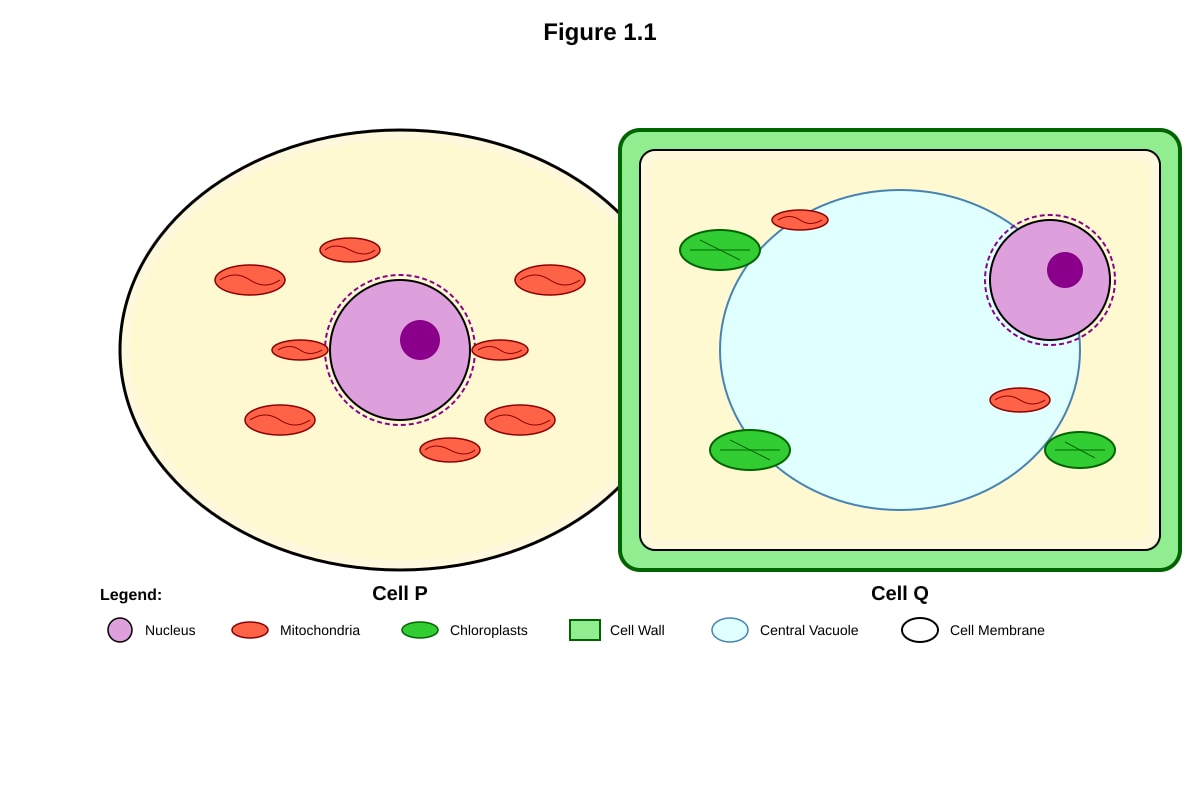
Question 1: Cell Structure and Function (6 marks)
(a) [2 marks]
- Cell P: Animal cell [1]
- Cell Q: Plant cell [1]
(b) [2 marks]
- Structural feature: Cell wall OR Large central vacuole OR Chloroplasts [1]
- Function (accept any one matching the feature stated):
- Cell wall: Provides structural support and protection / prevents cell from bursting
- Large central vacuole: Stores water and solutes / maintains turgor pressure
- Chloroplasts: Site of photosynthesis / contains chlorophyll for light absorption [1]
(c) [2 marks]
- Cell P (animal cell) requires more energy/ATP for metabolic activities [1]
- Mitochondria are the site of aerobic respiration where ATP is produced [1]
- (Accept: Animal cells are more metabolically active than plant cells which also obtain energy from chloroplasts)
Question 2: Movement of Substances (7 marks)
(a) [2 marks]
- Working: Percentage change = (Change in mass ÷ Initial mass) × 100 [1]
- = (0.2 ÷ 5.2) × 100 = 3.85% (accept 3.8% or 3.9%) [1]
- Award [1] for correct formula, [1] for correct answer with units
(b) [3 marks]
- 0.0 mol/dm³ sucrose solution is distilled water / has higher water potential than potato cells [1]
- Water moves from region of higher water potential (solution) to region of lower water potential (potato cells) [1]
- By osmosis / down the water potential gradient [1]
- Therefore, potato cells gain water and mass increases
(c) [2 marks]
- The potato strip would lose mass / decrease in mass [1]
- Because the 1.0 mol/dm³ sucrose solution has lower water potential than the potato cells, so water moves out of the potato cells by osmosis [1]
Question 3: Organelles and Cell Specialisation (5 marks)
(a) [2 marks]
- Different cell types have different numbers of mitochondria [1]
- Cardiac muscle cells have the most mitochondria (5000), followed by liver cells (1500), and skin cells have the fewest (200) [1]
- (Accept: Cells with higher energy demands have more mitochondria)
(b) [3 marks]
- Cardiac muscle cells contract continuously/rhythmically throughout life to pump blood [1]
- This requires a large amount of energy/ATP [1]
- Mitochondria are the site of aerobic respiration where ATP is produced, so more mitochondria are needed to meet the high energy demand [1]
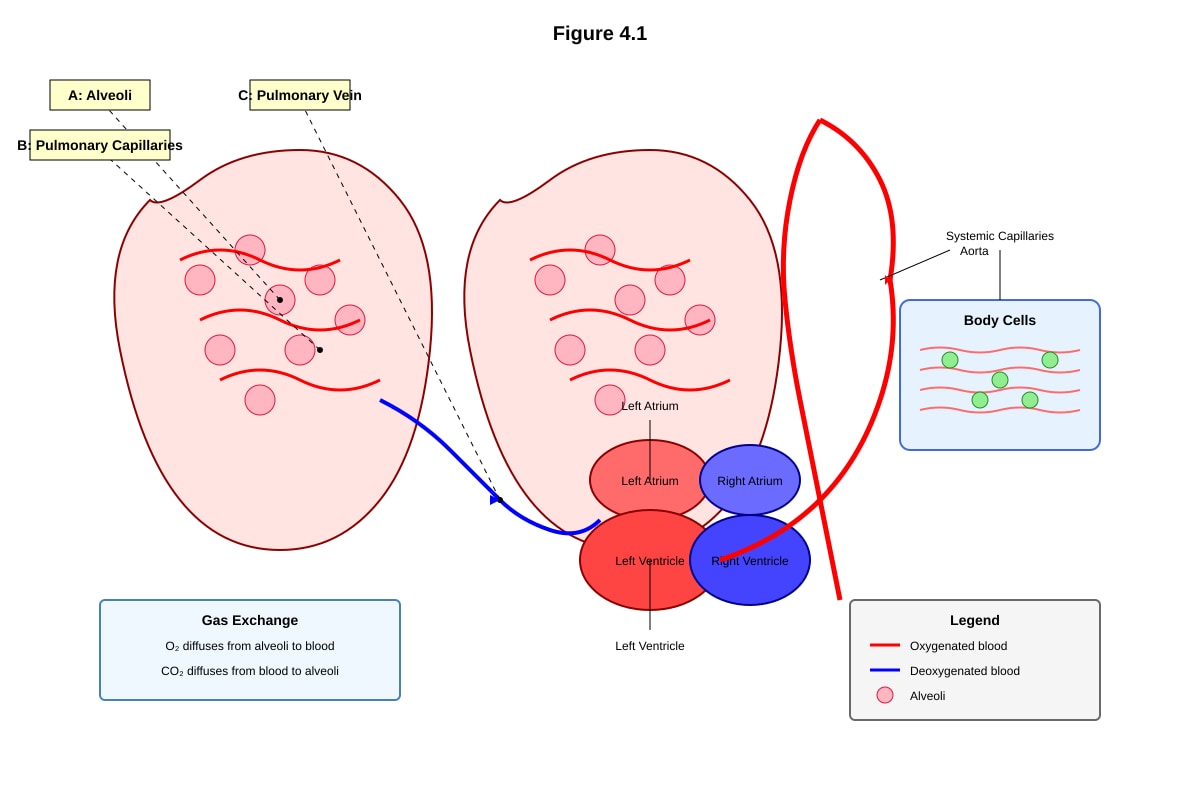
Question 4: Gas Exchange and Transport (8 marks)
(a) [3 marks]
- A: Alveolus / Alveoli [1]
- B: Pulmonary vein [1]
- C: Aorta [1]
(b) [1 mark]
- Diffusion [1]
(c) [4 marks] Award marks for correct sequence and named structures:
- Oxygen diffuses from alveolus into pulmonary capillary [1]
- Oxygen binds to haemoglobin in red blood cells [1]
- Blood travels via pulmonary vein → left atrium → left ventricle → aorta [1]
- Oxygen diffuses from systemic capillary into tissue fluid, then into muscle cell [1]
- (Accept any four correct steps with named structures)
- Deduct [1] if structures are not named
- Deduct [1] if diffusion is confused with active transport
Question 5: Enzymes and Digestion (6 marks)
(a) [3 marks]
- Bile salts emulsify fats / break large fat droplets into smaller fat droplets [1]
- This increases the surface area of fats [1]
- For more efficient digestion by lipase enzyme / increases rate of fat digestion [1]
(b) [2 marks]
- Without bile salts, fats would remain as large droplets with smaller surface area [1]
- Lipase would have less surface area to act on, so rate of fat digestion would be slower [1]
(c) [1 mark]
- Any one of: Deamination of excess amino acids / Detoxification of harmful substances / Regulation of blood glucose concentration / Storage of glycogen / Production of plasma proteins / Breakdown of haemoglobin
- Accept any valid function of the liver
Question 6: Active Transport (4 marks)
(a) [1 mark]
- Active transport [1]
(b) [3 marks]
- Active transport moves substances against the concentration gradient / from low to high concentration [1]
- This requires energy in the form of ATP [1]
- Carrier proteins in the cell membrane use ATP to change shape and move glucose molecules across the membrane [1]
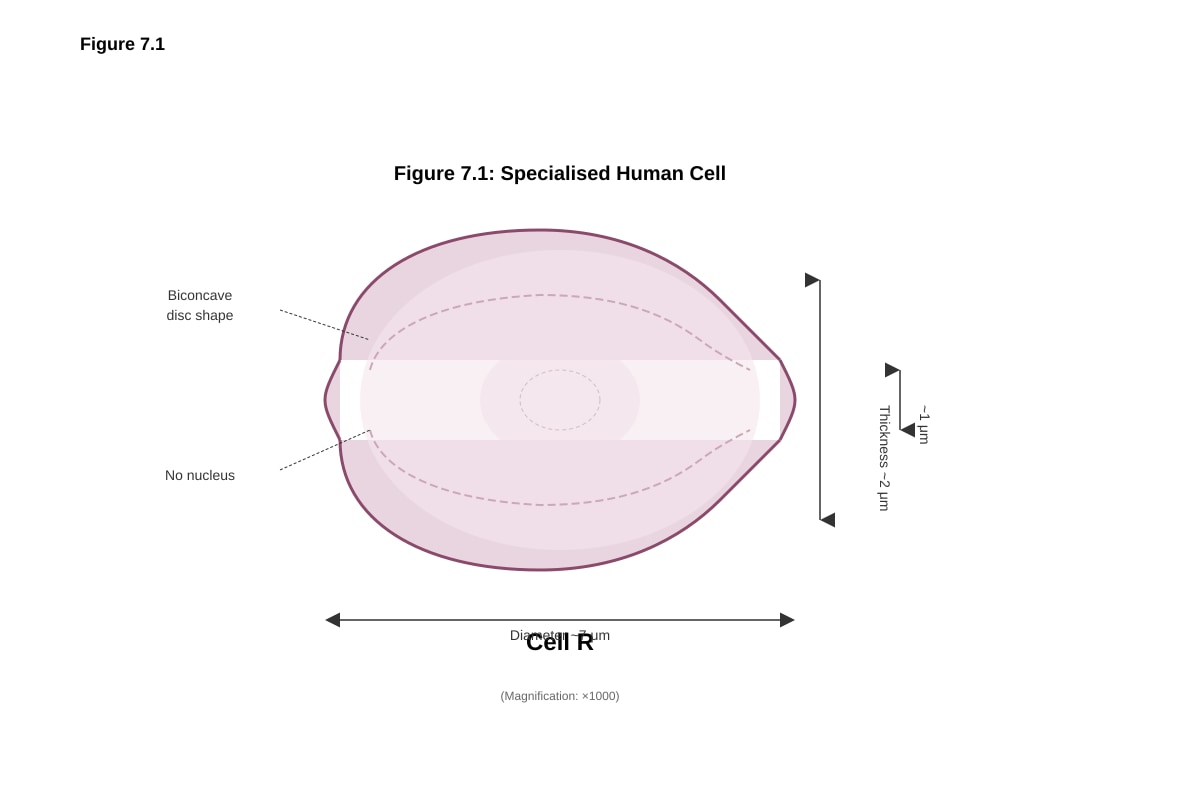
Question 7: Cell Identification and Function (4 marks)
(a) [1 mark]
- Red blood cell / Erythrocyte [1]
(b) [2 marks] Award [1] for each correct structural feature:
- Biconcave disc shape → increases surface area for faster diffusion of oxygen
- No nucleus → more space for haemoglobin to carry oxygen
- Flexible/elastic membrane → can squeeze through narrow capillaries
- Small size → allows close contact with capillary walls for efficient gas exchange (Accept any two with correct functional explanation)
(c) [1 mark]
- Red blood cells do not contain mitochondria because they transport oxygen rather than use it for aerobic respiration / they rely on anaerobic respiration to avoid using the oxygen they carry [1]
SECTION B: DATA-BASED QUESTIONS (15 marks)
Question 8: Osmosis Investigation (8 marks)
(a) [4 marks] Graph plotting marks:
- Correct axes with labels and units: y-axis "Change in mass (g)", x-axis "Salt concentration (%)" [1]
- Appropriate scales on both axes [1]
- All five points plotted correctly [1]
- Line of best fit drawn (should be a straight line or smooth curve passing through or near all points) [1]
(b) [1 mark]
- 4% salt concentration (where change in mass = 0 g) [1]
(c) [3 marks]
- The 8% salt solution has lower water potential than the carrot cells [1]
- Water moves out of the carrot cells into the salt solution by osmosis / down the water potential gradient [1]
- Therefore, the carrot cylinder loses mass [1]
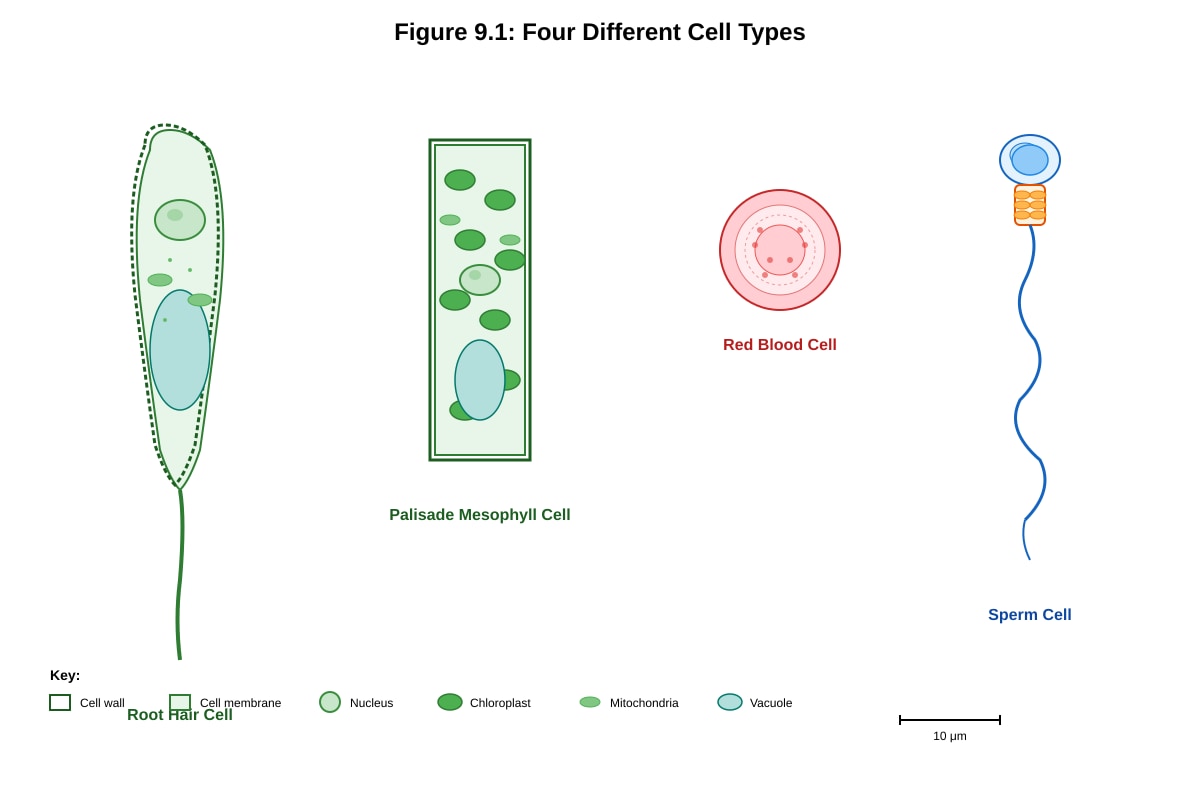
Question 9: Cell Structure Comparison (7 marks)
(a) [4 marks]
| Cell type | Function | Structural adaptation |
|---|---|---|
| Root hair cell | Absorption of water and mineral salts from soil [1] | Long, narrow extension/root hair → increases surface area for absorption [1] |
| Palisade mesophyll cell | Photosynthesis / absorption of light energy [1] | Contains many chloroplasts / tightly packed / located near upper leaf surface [1] |
(Accept any valid function and matching structural adaptation)
(b) [2 marks]
- Root hair cells are located underground in the soil [1]
- They do not receive light, so chloroplasts are not needed for photosynthesis [1]
(c) [1 mark]
- Mitochondria produce ATP through aerobic respiration to provide energy for the sperm's movement/swimming towards the egg [1]
SECTION C: FREE RESPONSE QUESTIONS (10 marks)
Question 10: Transport in Humans (10 marks)
(a) [4 marks] Award marks for structure-function links:
- Thick, muscular wall → withstands high blood pressure from heart pumping [1]
- Elastic fibres in wall → allow artery to stretch and recoil, maintaining blood pressure [1]
- Narrow lumen → maintains high pressure for efficient blood flow [1]
- Smooth endothelial lining → reduces friction for smooth blood flow [1] (Accept any four valid structure-function pairs)
(b) [3 marks]
- Capillary walls are one cell thick / composed of a single layer of endothelial cells → short diffusion distance [1]
- Capillaries have a narrow lumen → red blood cells pass in single file, maximising contact with capillary wall [1]
- Capillaries form extensive networks / are highly branched → large total surface area for exchange [1]
(c) [3 marks]
- Anaemia results in fewer red blood cells / less haemoglobin [1]
- Less oxygen can be transported from lungs to body cells [1]
- During exercise, muscle cells require more oxygen for aerobic respiration to produce ATP; insufficient oxygen leads to fatigue and breathlessness [1]
Question 11: Enzymes and Metabolism (10 marks)
(a) [4 marks]
- The lock-and-key hypothesis states that the active site of an enzyme has a specific shape [1]
- This shape is complementary to the shape of the substrate molecule [1]
- The substrate fits into the active site like a key fits into a lock, forming an enzyme-substrate complex [1]
- The reaction occurs at the active site, and products are released; the enzyme remains unchanged and can be reused [1]
(b) [3 marks]
- As temperature increases, the rate of enzyme-catalysed reaction initially increases [1]
- This is because enzyme and substrate molecules have more kinetic energy, increasing the frequency of effective collisions [1]
- However, above the optimum temperature, the enzyme is denatured: the active site loses its specific shape, and the substrate can no longer bind, so the reaction rate decreases sharply [1]
(c) [3 marks]
- At pH 7 (neutral), amylase is at its optimum pH, so the reaction occurs rapidly [1]
- At pH 2 (acidic), amylase is denatured because the pH is far from its optimum [1]
- The active site of amylase loses its specific shape, so starch can no longer bind, and no reaction occurs [1]
END OF ANSWER KEY
© TuitionGoWhere Secondary School (AI) 2024
PRELIMINARY EXAMINATION — Version 3 of 5