From Real Exams Exam Paper
Secondary 4 Combined Science Biology Preliminary Examination Paper 1
Free Sec 4 Comb Sci Bio Prelim Paper 1, DeepSeek Exam version, with questions, answers, and O Level-style practice for Singapore students.
These static practice materials are generated from the site's syllabus and paper-generation workflow, with source and model context shown so students and parents can evaluate the material before use.
Questions
Free quiz and exam paper access
Enter your details to view this paper
Your access is remembered on this device.
Answers
TuitionGoWhere Practice Paper - Combined Science Biology Secondary 4
PRELIMINARY EXAMINATION - ANSWER KEY AND MARKING SCHEME
TuitionGoWhere Secondary School (AI)
Subject: Combined Science Biology (5087/5088) Level: Secondary 4 Paper: Biology Paper 2 (Structured & Free Response) Version: 1 of 5
Section A: Structured Questions
[50 marks]
Question 1: Cell Structure and Function
[8 marks]
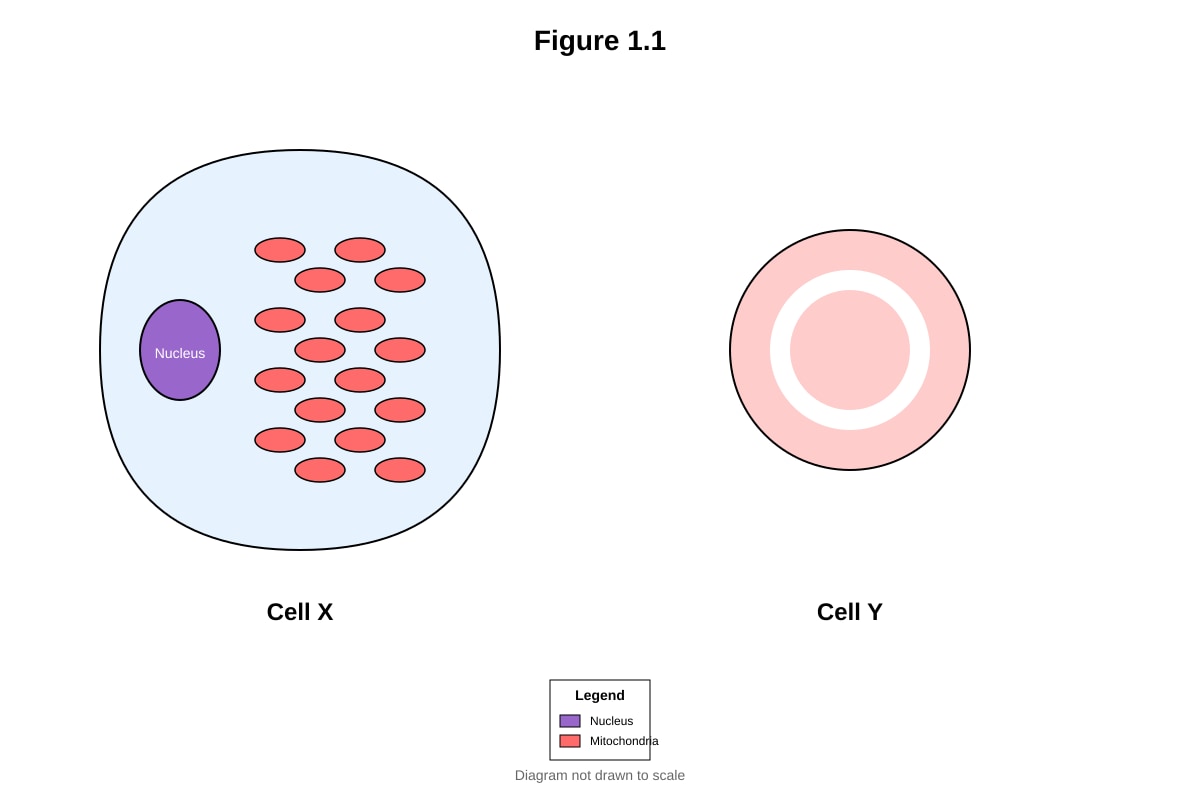
(a)(i) Identify cell X and cell Y. [2]
- Cell X: Sperm cell / spermatozoon [1 mark]
- Cell Y: Red blood cell / erythrocyte [1 mark]
(a)(ii) Cell X contains many mitochondria. Explain why this is necessary for its function. [2]
- Sperm cells require large amounts of energy/ATP [1 mark]
- Energy is needed for swimming/movement to reach the egg for fertilisation [1 mark]
- Mitochondria are the site of aerobic respiration where ATP is produced [accept as part of explanation]
(b)(i) Using the data in Table 1.1, explain why cardiac muscle cells have the highest number of mitochondria. [2]
- Cardiac muscle cells contract continuously/rhythmically throughout life without rest [1 mark]
- They require large amounts of energy/ATP for continuous contraction, hence they have the most mitochondria to carry out aerobic respiration [1 mark]
(b)(ii) Suggest why liver cells have more mitochondria than skin cells. [2]
- Liver cells carry out many metabolic processes (e.g., detoxification, protein synthesis, glucose regulation) [1 mark]
- These processes require more energy/ATP than skin cells, which have lower metabolic activity [1 mark]
Question 2: Movement of Substances
[10 marks]
(a) Define the term diffusion. [2]
- Diffusion is the net movement of particles/molecules [1 mark]
- From a region of higher concentration to a region of lower concentration, down a concentration gradient [1 mark]
- [Accept: passive process that does not require energy]
(b)(i) Explain why the contents of the Visking tubing turned blue-black. [2]
- Iodine molecules are small enough to diffuse through the Visking tubing membrane [1 mark]
- Iodine reacts with starch inside the tubing to form a blue-black complex [1 mark]
(b)(ii) Explain why the water outside the Visking tubing did not change colour. [2]
- Starch molecules are too large to pass through the Visking tubing membrane [1 mark]
- Therefore, starch cannot diffuse out of the tubing to react with iodine in the external solution [1 mark]
(c)(i) Name the process by which glucose is absorbed under these conditions. [1]
- Active transport [1 mark]
(c)(ii) Explain why this process requires energy. [3]
- Active transport moves substances against the concentration gradient (from low to high concentration) [1 mark]
- This requires energy in the form of ATP [1 mark]
- Carrier proteins in the cell membrane use ATP energy to transport glucose molecules across the membrane against the gradient [1 mark]
Question 3: Gas Transport and Respiration
[12 marks]
(a) State the process by which oxygen from the air in the alveoli enters the blood capillaries. [1]
- Diffusion [1 mark]
(b) Describe in detail how a molecule of oxygen present in the air breathed into the lungs reaches a muscle cell in the leg. Name the structures involved in the pathway. [6]
- Award marks for correct sequence and naming of structures:
- Oxygen enters alveoli during inhalation [1 mark]
- Oxygen diffuses across alveolar epithelium into blood capillaries [1 mark]
- Oxygen binds to haemoglobin in red blood cells [1 mark]
- Oxygenated blood travels via pulmonary vein → left atrium → left ventricle → aorta [1 mark]
- Aorta branches to femoral artery → arterioles → capillaries in leg muscle [1 mark]
- Oxygen diffuses from capillary into tissue fluid, then across muscle cell membrane into the cell/mitochondria [1 mark]
[Accept any 6 correct steps with named structures. Deduct marks for missing key structures like alveoli, pulmonary vein, aorta, or capillaries.]
(c)(i) Explain why the oxygen concentration decreases from the alveoli (80 units) to the muscle cell (5 units). [3]
- Oxygen is used by muscle cells for aerobic respiration [1 mark]
- Oxygen is consumed in mitochondria to produce ATP/energy [1 mark]
- Continuous consumption maintains a low oxygen concentration in muscle cells, creating a concentration gradient for continued diffusion from blood to cells [1 mark]
(c)(ii) Using the data, explain why oxygen moves from the blood leaving the lungs into the muscle tissue fluid. [2]
- Oxygen concentration in blood leaving lungs is 75 units, while in muscle tissue fluid it is 20 units [1 mark]
- Oxygen diffuses down the concentration gradient from a region of higher concentration (blood, 75 units) to a region of lower concentration (tissue fluid, 20 units) [1 mark]
Question 4: Enzymes and Biomolecules
[10 marks]
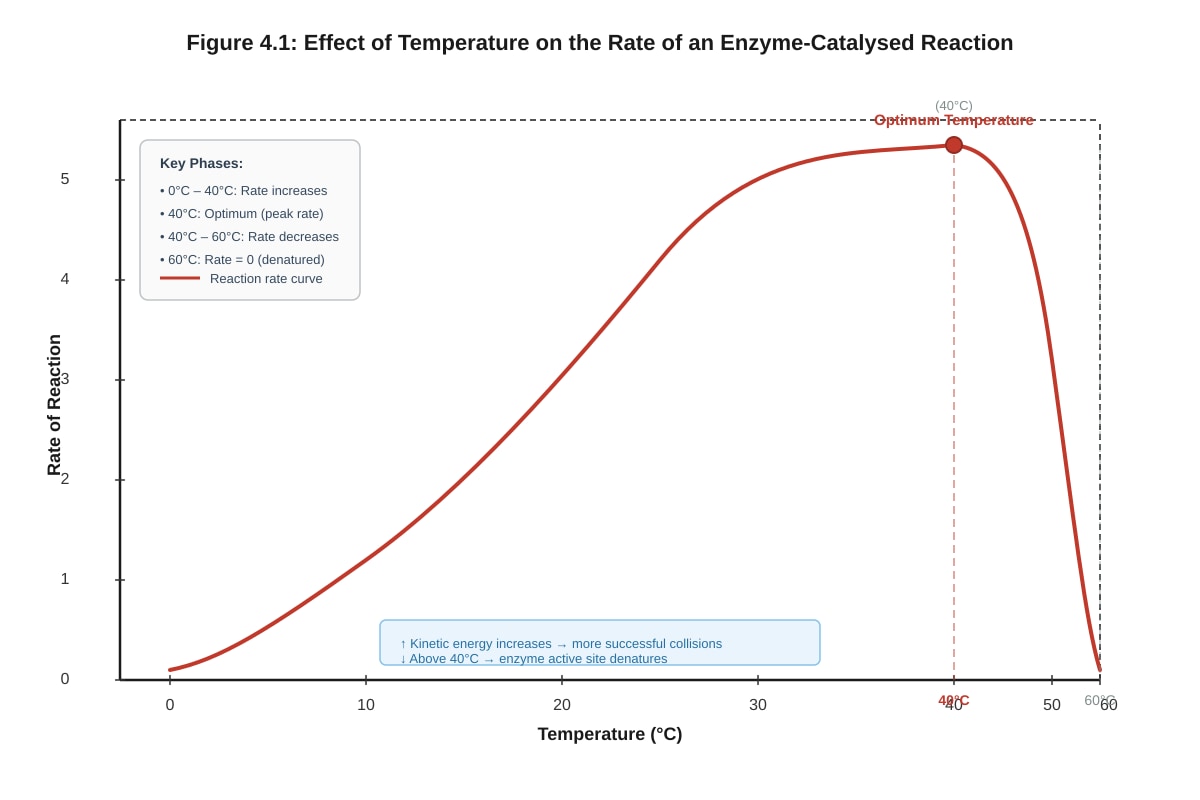
(a)(i) Explain why the rate of reaction increases from 0°C to 40°C. [3]
- As temperature increases, kinetic energy of enzyme and substrate molecules increases [1 mark]
- Molecules move faster and collide more frequently [1 mark]
- More successful enzyme-substrate complexes form per unit time, increasing the rate of reaction [1 mark]
(a)(ii) Explain why the rate of reaction decreases after 40°C and reaches zero at 60°C. [3]
- Above the optimum temperature (40°C), the enzyme begins to denature [1 mark]
- High temperatures break the hydrogen bonds and other bonds maintaining the enzyme's three-dimensional shape/active site [1 mark]
- The active site loses its specific shape and can no longer bind to the substrate; at 60°C, all enzyme molecules are denatured, so the rate is zero [1 mark]
(b)(i) Identify the optimum pH for amylase activity. [1]
- pH 7 [1 mark]
(b)(ii) Explain why the time taken to digest starch increases at pH 2 and pH 10. [3]
- Amylase has an optimum pH of 7; at pH 2 (acidic) and pH 10 (alkaline), the pH is far from the optimum [1 mark]
- Extreme pH values cause the enzyme to denature by disrupting the bonds maintaining the enzyme's three-dimensional shape [1 mark]
- The active site changes shape and can no longer bind to starch effectively, so the rate of digestion decreases and takes longer [1 mark]
Question 5: Plant Biology and Photosynthesis
[10 marks]
(a) Write the word equation for photosynthesis. [2]
- Carbon dioxide + water → glucose + oxygen [1 mark for correct reactants, 1 mark for correct products]
- [Must include "light energy" and "chlorophyll" written above/below the arrow for full marks, or accept if stated in words]
(b)(i) Describe the relationship between distance from light and the rate of photosynthesis. [2]
- As the distance from the light source increases, the rate of photosynthesis decreases [1 mark]
- The number of oxygen bubbles produced per minute decreases from 45 at 10 cm to 10 at 50 cm [1 mark for using data]
(b)(ii) Explain why the rate of photosynthesis decreases as the distance from the light source increases. [3]
- Light intensity decreases as distance from the light source increases (inverse square law) [1 mark]
- Light is a limiting factor for photosynthesis; less light energy is available for the light-dependent reactions [1 mark]
- With less light energy, less ATP and reduced NADP are produced, so the rate of the light-independent reactions (Calvin cycle) also decreases, reducing overall photosynthesis rate [1 mark]
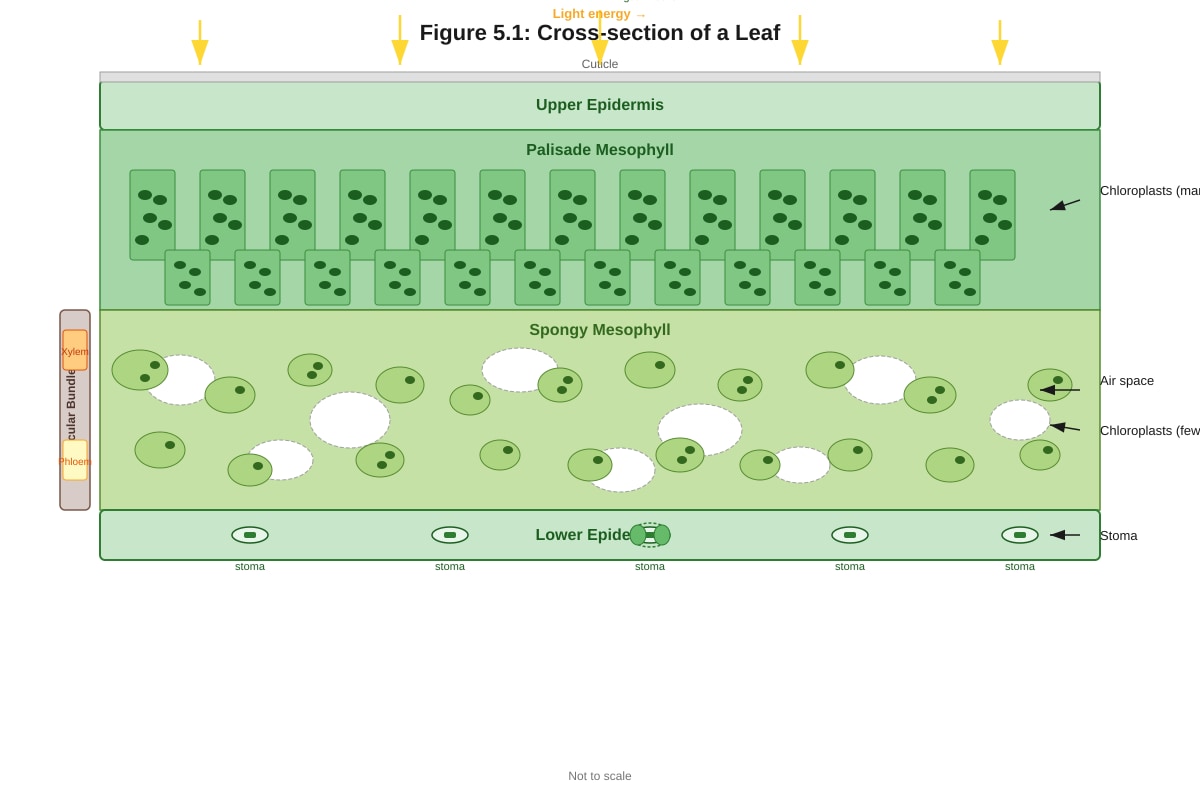
(c)(i) Describe and explain the distribution of chloroplasts in the palisade layer and the spongy layer. [3]
- Palisade mesophyll cells contain many more chloroplasts than spongy mesophyll cells [1 mark]
- Palisade cells are located near the upper epidermis and receive the most direct sunlight; more chloroplasts maximise light absorption for photosynthesis [1 mark]
- Spongy mesophyll cells receive less light (filtered through palisade layer); fewer chloroplasts are needed; the loose arrangement and air spaces facilitate gas exchange (CO₂ in, O₂ out) [1 mark]
Section B: Free Response Question
[15 marks]
Question 6: Transport in Humans and Plants
[15 marks]
(a) Describe the pathway taken by a glucose molecule from the small intestine to a muscle cell in the arm. Include the names of all blood vessels and organs involved in the transport pathway. [8]
Marking Scheme:
- Glucose absorbed from small intestine into blood capillaries of villi [1 mark]
- Travels via hepatic portal vein to the liver [1 mark]
- In the liver, excess glucose may be converted to glycogen for storage; remaining glucose enters hepatic vein [1 mark]
- Hepatic vein carries blood to inferior vena cava → right atrium of heart [1 mark]
- Right atrium → right ventricle → pulmonary artery → lungs (for oxygenation, though glucose is not involved in gas exchange) [1 mark]
- Pulmonary vein returns blood to left atrium → left ventricle → aorta [1 mark]
- Aorta branches to subclavian artery → brachial artery → arterioles → capillaries in arm muscle [1 mark]
- Glucose diffuses from capillaries into tissue fluid, then into muscle cells (or via facilitated diffusion/active transport) [1 mark]
[Accept any 8 correct sequential steps with named structures. Deduct marks for incorrect vessel names or sequence errors.]
(b) Explain how the structure of a red blood cell is adapted for its function in oxygen transport. [4]
- Biconcave disc shape increases surface area to volume ratio for faster diffusion of oxygen [1 mark]
- Contains haemoglobin, which binds to oxygen to form oxyhaemoglobin for efficient oxygen transport [1 mark]
- Lacks a nucleus, creating more space for haemoglobin molecules [1 mark]
- Small and flexible, allowing it to squeeze through narrow capillaries [1 mark]
(c) State three differences between the transport systems in plants (xylem and phloem) and the circulatory system in humans. [3]
- Any three of the following (1 mark each):
- Plants have two separate transport tissues (xylem and phloem); humans have a single circulatory system with blood vessels
- Plants do not have a pump/heart; humans have a heart that pumps blood
- Transport in xylem is unidirectional (upwards); transport in phloem is bidirectional; human blood circulates in a closed loop
- Xylem transports water and mineral ions; phloem transports sucrose and amino acids; human blood transports oxygen, nutrients, hormones, waste products
- Xylem vessels are dead cells with no cytoplasm; human blood vessels are lined with living endothelial cells
OR
Question 7: Homeostasis and Hormonal Control
[15 marks]
(a) Describe and explain the role of hormones in maintaining a relatively constant blood glucose concentration in humans. Include the names of the hormones, the glands that produce them, and their target organs. [8]
Marking Scheme:
- Blood glucose concentration is maintained by negative feedback [1 mark]
- When blood glucose rises (e.g., after a meal): [1 mark for context]
- Pancreas (islets of Langerhans, β cells) detects high glucose and releases insulin [1 mark]
- Insulin travels in blood to target organs: liver and muscles [1 mark]
- Insulin stimulates liver and muscle cells to increase glucose uptake and convert glucose to glycogen for storage [1 mark]
- Blood glucose concentration decreases back to normal [1 mark]
- When blood glucose falls (e.g., during fasting/exercise): [1 mark for context]
- Pancreas (α cells) detects low glucose and releases glucagon [1 mark]
- Glucagon stimulates liver to break down glycogen into glucose and release it into blood [1 mark]
- Blood glucose concentration increases back to normal [1 mark]
[Accept any 8 correct points covering both hormones, their sources, targets, and effects.]
(b) Explain why it is important for the body to maintain a constant internal temperature. [4]
- Enzymes in the body function optimally at around 37°C [1 mark]
- If temperature rises too high, enzymes denature; their active sites change shape and can no longer catalyse reactions [1 mark]
- If temperature falls too low, enzyme activity slows down due to reduced kinetic energy and fewer successful collisions [1 mark]
- Maintaining constant temperature ensures metabolic reactions proceed at an appropriate rate for normal body function [1 mark]
(c) A person with Type 1 diabetes does not produce enough insulin. Explain the effects this would have on blood glucose concentration after a meal and suggest how this condition can be managed. [3]
- After a meal, blood glucose concentration rises but remains high because without insulin, glucose cannot be taken up efficiently by liver and muscle cells [1 mark]
- Glucose is not converted to glycogen, so blood glucose remains elevated (hyperglycaemia) [1 mark]
- Management: Regular insulin injections (or insulin pump) to replace the missing hormone; monitoring blood glucose levels; controlling carbohydrate intake through diet [1 mark for any one management strategy]
END OF ANSWER KEY
Copyright © TuitionGoWhere Secondary School (AI) 2024. This is a practice paper answer key generated for educational purposes.