AI Generated Quiz
Secondary 4 Chinese Comprehension Quiz
Free Sec 4 Chinese Comprehension quiz, AI version, with questions, answers, and O Level-style practice for Singapore students.
These static practice materials are generated from the site's syllabus and paper-generation workflow, with source and model context shown so students and parents can evaluate the material before use.
Questions
Free quiz and exam paper access
Enter your details to view this paper
Your access is remembered on this device.
Answers
Answer Key: Secondary 4 Chinese Quiz - Comprehension
Total Marks: 100
Section A: 综合填空 (10 marks)
Passage Analysis: The passage discusses the impact of smartphone usage on modern life and social interactions. The correct answers are based on context, collocation, and meaning.
1. B (普通) 【2分】
- Explanation: The phrase "_______的一部分" requires an adjective meaning "ordinary" or "common". "普通" (pǔtōng) means ordinary/common in the sense of everyday life. "平常" (píngcháng) means usual, but it does not fit as well with "生活的一部分" here. "常见" (chángjiàn) means "commonly seen", which is not the best fit. "通常" (tōngcháng) is an adverb meaning "usually".
- Marking tip: Accept only B. [2m]
2. A (可能) 【2分】
- Explanation: The sentence expresses a possibility, not a certainty. "可能" (kěnéng) means "may" or "possibly". "必然" (bìrán) means "inevitably", which is too strong. "果然" (guǒrán) means "as expected", and "显然" (xiǎnrán) means "obviously", both of which do not fit the uncertain tone.
- Marking tip: Accept only A. [2m]
3. A (无意) 【2分】
- Explanation: The context describes an unintentional neglect of real-world interactions. "无意" (wúyì) means "unintentionally". "特意" (tèyì) and "故意" (gùyì) both mean "deliberately", which contradicts the meaning. "执意" (zhíyì) means "insistently", which is also wrong.
- Marking tip: Accept only A. [2m]
4. A (控制) 【2分】
- Explanation: The verb should mean "to control" or "to manage" the duration of phone use. "控制" (kòngzhì) fits perfectly. "掌握" (zhǎngwò) means "to master", "推广" (tuīguǎng) means "to promote", and "增加" (zēngjiā) means "to increase", all of which are opposite to the intended meaning of limiting usage.
- Marking tip: Accept only A. [2m]
5. A (保持) 【2分】
- Explanation: The phrase "_______良好的人际关系" means "to maintain good relationships". "保持" (bǎochí) means "to maintain". "制造" (zhìzào) means "to create", "改变" (gǎibiàn) means "to change", and "失去" (shīqù) means "to lose", which are not appropriate.
- Marking tip: Accept only A. [2m]
Section B: 阅读理解一 (20 marks)
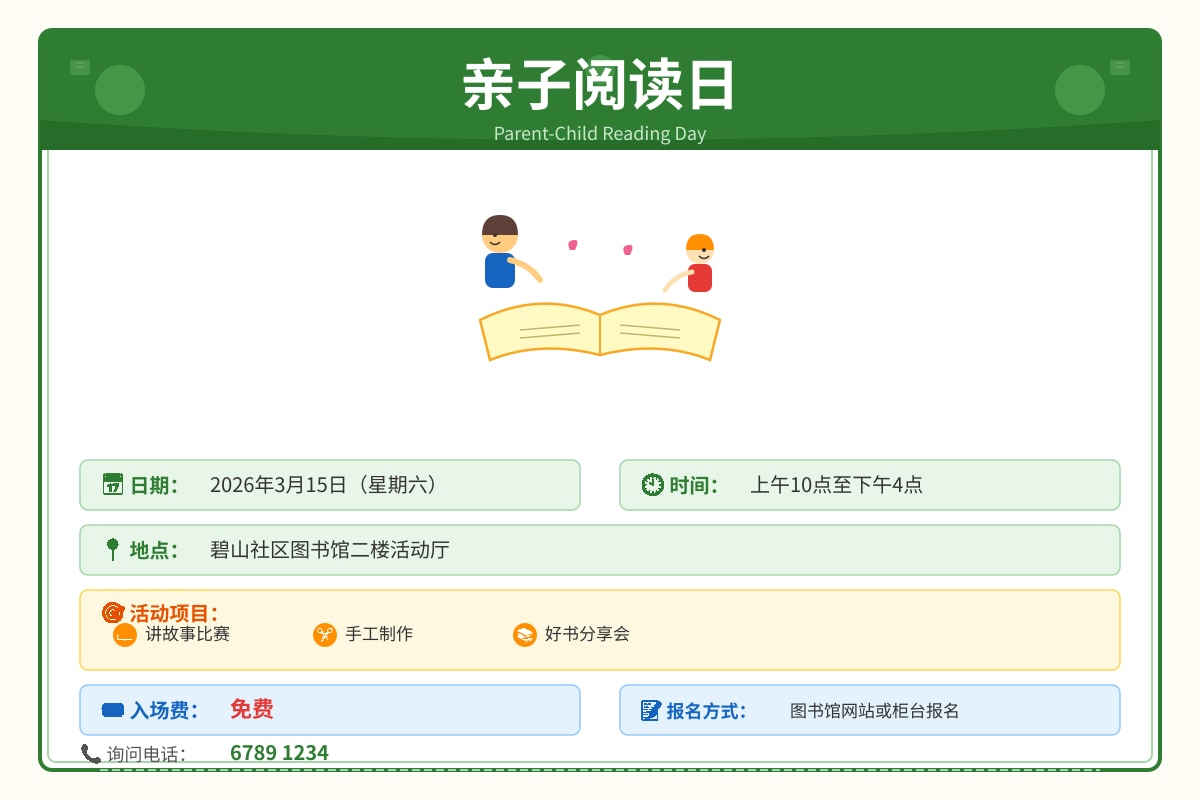
Text A Analysis: A poster for a community library Parent-Child Reading Day event.
Text B Analysis: A news article about a record high in book borrowing at community libraries.
6. A (从图书馆网站或柜台报名) 【4分】
- Explanation: The poster clearly states "Registration: 可通过图书馆网站或到柜台报名". Options B and C are not mentioned. Option D is incorrect as the event is "免费" (free).
- Marking tip: Accept only A. [4m]
7. B (好书分享会) 【4分】
- Explanation: The poster lists "Activities: 讲故事比赛、手工制作、好书分享会". Option A and C are from Text B, not Text A. Option D is not mentioned.
- Marking tip: Accept only B. [4m]
8. B (图书馆推出了新的数码服务和推广活动) 【4分】
- Explanation: The article states: "国家图书馆管理局指出,这一增长与图书馆推出的多项数码服务和推广活动有关。" Options A, C, and D are not mentioned.
- Marking tip: Accept only B. [4m]
9. C (讲故事比赛和好书分享会) 【4分】
- Explanation: Text A's Parent-Child Reading Day has events that directly engage children and parents as a team. While Text B mentions "儿童阅读工作坊", the question asks for what best attracts parents and children together, and Text A's activities specifically target this. Option A is a general benefit. Option B refers to Text B only. Option D is too vague.
- Marking tip: Accept C. Accept B if student justifies with Text B's children-focused events. [4m]
10. D (借阅量比去年同期增加了15%) 【4分】
- Explanation: The article states: "书籍借阅量达150万本,比去年同期增长了15%。" Option A is not mentioned. Option B is incorrect because the increase is attributed to multiple factors. Option C is the opposite.
- Marking tip: Accept only D. [4m]
Section C: 阅读理解二 (70 marks)
Passage 1: 《小雨伞的旅程》
11. 旅程指的是小云从被阿玲买下,到阿玲把它送给老奶奶,再到传给他人,这一系列过程中经历的事情。 (4 marks)
- Teaching point: Explain that "旅程" here is a metaphor for the journey or series of events a character experiences, not just a physical trip.
- Scoring: Students must mention both "被阿玲买下" and "被送给老奶奶" or the concept of a journey from one owner/place to another. [2m for mentioning the key events; 2m for explaining "旅程" meaning the sequence of events/experiences]
12. 因为阿玲的家很穷。文中提到“阿玲的家很穷,住在政府组屋的一个小单位里。她们家住在二十楼,上学要转两趟车。”这间接说明她家负担不起车。 (4 marks)
- Teaching point: Teach students to infer economic status from details about housing and commute.
- Scoring: [2m for stating the reason (poor family); 2m for quoting "家很穷" or "住在政府组屋" and explaining "转两趟车" implies they can't afford a car or more direct transport]
13. 心情变化: 犹豫 或 从犹豫到坚定 (2 marks) 文中依据: "阿玲犹豫了一下,然后毫不犹豫地走过去" (4 marks)
- Teaching point: Highlight that "犹豫了一下" shows a moment of doubt (maybe thinking about being late or getting wet), and "毫不犹豫地走过去" shows she resolved her hesitation and acted. Accept "矛盾" (conflicted) if explained well.
- Scoring: [2m for the word; 4m for the correct quote and explanation of what it shows]
14. "心里也撑着一把伞"意思是心里感到温暖、被保护、有安全感。这把伞代表了 善良 或 爱心。 (8 marks)
- Teaching point: This is a metaphor. "撑着一把伞" is a symbol of protection and goodness. The story ends with: "那把伞的名字叫'善良'。" Students must connect the metaphor to the literal meaning of the umbrella as a protector.
- Scoring:
- [4m for explaining the metaphorical meaning: feeling protected/warm/virtuous. Must not be a literal interpretation of raining inside.]
- [4m for identifying what the umbrella represents: 善良/爱心/乐于助人的精神]
15. 阿玲是一个善良/有爱心/懂得分享/不自私的人。 - 例子1: 她用自己仅有的零用钱买下小云,说明她珍视自己想要的物品。或者,她把心爱的伞借给陌生人,说明她善良。 (5 marks) - 例子2: 她把伞给了老奶奶,自己冒雨跑到学校,说明她宁愿自己淋湿也要帮助别人,不自私。 (5 marks)
- Teaching point: Require students to provide a specific action from the text as evidence and explain what character trait that action demonstrates.
- Scoring:
- [2m for giving the character trait]
- [4m for each example + explanation: 2m for quoting/referencing the action, 2m for explaining how it shows the trait]
- Accept other reasonable interpretations, e.g., she is determined (买下伞), appreciative (珍惜伞).
Passage 2: 《数码时代的专注力危机》
16. 超过七成的青少年在学习时无法持续集中注意力超过二十分钟。 (3 marks) 主要原因是手机上的通知和信息不断打断他们的学习状态。 (3 marks)
- Teaching point: Students must extract two separate pieces of information from the first paragraph.
- Scoring: [3m for the problem (cannot focus >20 mins); 3m for the reason (phone notifications/interruptions)]
17. 文章认为所谓的"多任务处理"其实是伪多任务,大脑是在不同任务之间快速切换,而不是真的同时进行。这样做反而会使完成每一件事花费更长时间,错误率也更高。 (6 marks)
- Teaching point: Emphasize "用自己的话说明" - students cannot just copy the phrase "伪多任务".
- Scoring:
- [2m for explaining that the brain switches tasks, not does them simultaneously]
- [2m for stating that this is less efficient (takes longer)]
- [2m for stating that it causes more errors]
18. (6 marks) ① 在学习时关闭手机通知,或者把手机放在另一个房间。 (2m) ② 尝试使用"番茄工作法":集中工作25分钟,休息5分钟。 (2m) ③ 每天进行适量运动,如散步或跑步。 (2m)
- Teaching point: Students must list three distinct methods from paragraph 3. Accept paraphrases as long as the core idea matches.
19. (8 marks) 理由1: 家长应该为孩子创造安静的学习环境,减少家中的干扰因素。 (4m) 理由2: 家长要以身作则,在与孩子相处时减少使用手机。如果家长自己都无法放下手机,就很难要求孩子专心致志。 (4m)
- Teaching point: The two reasons are in the fourth paragraph. One is environmental, one is behavioral/modeling.
- Scoring: [4m per reason, correctly linked to the article's text]
20. 【12分】
- Teaching point: This is an opinion question requiring personal experience. Use the following rubric for marking.
- Marking Descriptors:
- Content (6 marks):
- 4-6m: Clearly states opinion (agree/disagree/partially agree). Provides 1-2 specific personal examples or observations. Makes a connection to the article's ideas.
- 2-3m: Opinion stated but example is vague or not personal.
- 0-1m: No clear opinion; no example.
- Language and Organization (6 marks):
- 4-6m: Clear, coherent response with logical flow. Uses appropriate vocabulary. Minimal errors.
- 2-3m: Somewhat clear but with some errors or organizational issues.
- 0-1m: Unclear, very short, or many errors.
- Content (6 marks):
- Example Strong Answer: 我同意作者的看法。我自己在学习时也经常被手机上的通知干扰。有一次我为了完成一个科学报告,特意把手机放在客厅,自己一个人待在房间里。结果,我用了比平时少一半的时间就完成了,而且写得很好。现在我每天下午都会和爸爸一起去公园跑步。我发现运动之后,我晚上做作业时更能集中精神。所以,我认为作者提出的方法很有效,我会继续坚持。
- Scoring: Evaluate holistically within the rubric ranges. Do not give full marks for a generic answer with no personal element.