From Real Exams Quiz
Secondary 4 Additional Mathematics Statistics Probability Quiz
Free Sec 4 A Maths Statistics quiz, HY3 Exam version, with questions, answers, and O Level-style practice for Singapore students.
These static practice materials are generated from the site's syllabus and paper-generation workflow, with source and model context shown so students and parents can evaluate the material before use.
Questions
Secondary 4 Additional Mathematics Quiz - Statistics Probability
Name: ___________________________
Class: _________
Date: ____________
Score: _______ / 40
Duration: 60 minutes
Total Marks: 40
Instructions:
- Answer all 20 questions.
- Show your working clearly. Solutions by accurate drawing will not be accepted.
- Write your answers in the spaces provided.
- Calculators may be used.
Section A: Basic Probability (Questions 1–5) [10 marks]
1. A bag contains 5 red balls and 3 blue balls. A ball is drawn at random. Find the probability that it is red. [2]
2. Two fair dice are thrown. Find the probability that the sum of the numbers is 7. [2]
3. A letter is chosen at random from the word "ADDITION". Find the probability that the letter is a vowel. [2]
4. A box has 4 green, 6 yellow, and 2 white cards. One card is picked. What is the probability it is not yellow? [2]
5. The probability that it rains on a given day is 0.3. Find the probability that it does not rain. [2]
Section B: Combined and Conditional Probability (Questions 6–12) [16 marks]
6. Events A and B are such that P(A)=0.5, P(B)=0.4, and P(A∩B)=0.2. (a) Find P(A∪B). [2] (b) Find P(A∣B). [2]
(a) ____________________
(b) ____________________
7. In a class of 30 students, 18 take Physics, 12 take Chemistry, and 5 take both. Find the probability that a randomly chosen student takes Physics or Chemistry. [3]
8. A card is drawn from a standard deck of 52 cards. Find the probability that it is a king given that it is a face card. [3]
9. A bag contains 6 black and 4 white marbles. Two marbles are drawn without replacement. Find the probability that both are black. [3]
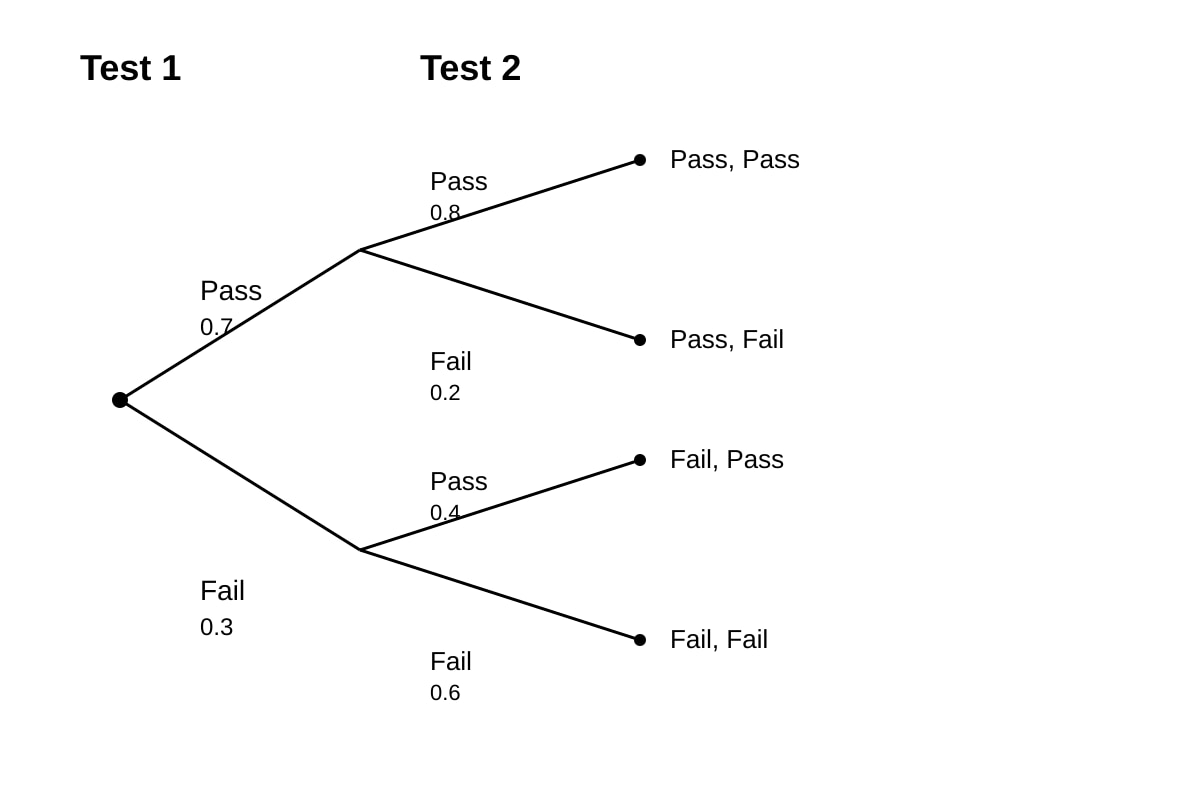
10. The tree diagram below shows the probabilities of a student passing two tests.

Generated diagram for Q10.
Find the probability that the student passes both tests. [2]
11. Events X and Y are independent with P(X)=0.6 and P(Y)=0.5. Find P(X∩Y). [2]
12. A survey of 100 people found 40 like tea, 30 like coffee, and 10 like both. Find the probability that a person likes tea given they like coffee. [3]
Section C: Data and Distributions (Questions 13–20) [14 marks]
13. The table shows the marks of 20 students in a quiz.
| Marks | 2 | 4 | 6 | 8 | 10 |
|---|---|---|---|---|---|
| Frequency | 3 | 5 | 7 | 3 | 2 |
Find the mean mark. [3]
14. Using the table in Q13, find the median mark. [2]
15. A random variable X has a binomial distribution B(10,0.3). Find P(X=2). [3]
16. In a binomial distribution B(n,p), the mean is 6 and variance is 2.4. Find n and p. [3]
17. The probability of a defective item is 0.05. In a sample of 20 items, find the probability that exactly 1 is defective. Use B(20,0.05). [3]
18. A set of numbers: 3, 7, 7, 9, 11, 13. Find the mode and range. [2]
19. The table below shows the number of goals scored by a team in 10 matches.
| Goals | 0 | 1 | 2 | 3 |
|---|---|---|---|---|
| Frequency | 2 | 4 | 3 | 1 |
Find the probability that in a randomly selected match, the team scored fewer than 2 goals. [2]
20. Events A and B are mutually exclusive with P(A)=0.35 and P(B)=0.25. Find P(A∪B). [1]
Answers
Secondary 4 Additional Mathematics Quiz - Statistics Probability (Answers)
Total Marks: 40
Section A: Basic Probability
Q1. [2 marks]
Total balls = 5 + 3 = 8. Red balls = 5.
P(red)=85.
Teaching note: Probability = number of favourable outcomes / total outcomes.
Common mistake: Using 5/3 or forgetting total.
Q2. [2 marks]
Total outcomes = 6 × 6 = 36.
Pairs summing to 7: (1,6),(2,5),(3,4),(4,3),(5,2),(6,1) → 6 ways.
P(sum 7)=366=61.
Teaching note: List favourable pairs systematically.
Q3. [2 marks]
"ADDITION" has 8 letters. Vowels: A, I, I, O → 4 vowels.
P(vowel)=84=21.
Teaching note: Count repeated letters as separate outcomes.
Q4. [2 marks]
Total = 4 + 6 + 2 = 12. Not yellow = green + white = 4 + 2 = 6.
P(not yellow)=126=21.
Alternative: 1 − 6/12 = 1/2.
Q5. [2 marks]
P(no rain)=1−0.3=0.7.
Teaching note: Complement rule P(A′)=1−P(A).
Section B: Combined and Conditional Probability
Q6. [4 marks total: (a) 2, (b) 2]
(a) P(A∪B)=P(A)+P(B)−P(A∩B)=0.5+0.4−0.2=0.7.
(b) P(A∣B)=P(B)P(A∩B)=0.40.2=0.5.
Teaching note: Union uses addition minus overlap; conditional is overlap over given event.
Q7. [3 marks]
n(P∪C)=18+12−5=25.
P=3025=65.
Marking: 1 for correct union count, 2 for fraction.
Q8. [3 marks]
Face cards = 3 × 4 = 12. Kings = 4.
P(King∣Face)=124=31.
Teaching note: Condition reduces sample space to face cards.
Q9. [3 marks]
First black: 106. Second black: 95.
P(both)=106×95=9030=31.
Teaching note: Without replacement reduces denominator and numerator.
Q10. [2 marks]
From tree: Pass1 then Pass2 = 0.7 × 0.8 = 0.56.
Expected visual: branches with given probabilities; multiply along path.
Q11. [2 marks]
Independent → P(X∩Y)=P(X)×P(Y)=0.6×0.5=0.3.
Q12. [3 marks]
P(tea∣coffee)=P(coffee)P(tea∩coffee)=3010=31.
Note: 30 like coffee out of 100.
Section C: Data and Distributions
Q13. [3 marks]
Mean = 202×3+4×5+6×7+8×3+10×2=206+20+42+24+20=20112=5.6.
Q14. [2 marks]
Cumulative: 3 (2), 8 (4), 15 (6), 18 (8), 20 (10). 10th & 11th values in 6 group → median = 6.
Q15. [3 marks]
P(X=2)=(210)(0.3)2(0.7)8=45×0.09×0.0576≈0.233.
Teaching note: Binomial formula nCrpr(1−p)n−r.
Q16. [3 marks]
Mean = np=6, Variance = np(1−p)=2.4.
6(1−p)=2.4⇒1−p=0.4⇒p=0.6.
n=6/0.6=10.
Answer: n=10,p=0.6.
Q17. [3 marks]
P(X=1)=(120)(0.05)1(0.95)19=20×0.05×0.377≈0.377.
Q18. [2 marks]
Mode = 7 (appears twice). Range = 13 − 3 = 10.
Q19. [2 marks]
Fewer than 2 goals = 0 or 1 goal: freq = 2 + 4 = 6 out of 10.
P=106=0.6.
Q20. [1 mark]
Mutually exclusive → P(A∪B)=P(A)+P(B)=0.35+0.25=0.6.
Free quiz and exam paper access
Enter your details to view this paper
Your access is remembered on this device.