AI Generated Exam Paper
Secondary 4 Additional Mathematics Practice Paper 4
Free Sec 4 A Maths Practice Paper 4, Kimi2.6 AI version, with questions, answers, and O Level-style practice for Singapore students.
These static practice materials are generated from the site's syllabus and paper-generation workflow, with source and model context shown so students and parents can evaluate the material before use.
Questions
Free quiz and exam paper access
Enter your details to view this paper
Your access is remembered on this device.
Answers
TuitionGoWhere Practice Paper (AI)
Additional Mathematics — Secondary 4
Practice Paper — Version 4 of 5
ANSWER KEY AND MARKING SCHEME
Total Marks: 80
SECTION A: Coordinate Geometry
Question 1
Total: 6 marks
(a) Find the length of AB [2 marks]
Method: Use the distance formula
Working:
Answer: units (or ) [2 marks]
Marking: M1 for correct substitution into distance formula, A1 for exact simplified answer
Common error: Forgetting to simplify to ; note that question asks for exact form so decimal is not acceptable
(b) Find the coordinates of the midpoint M [1 mark]
Method: Use the midpoint formula
Working:
Answer: M [1 mark]
(c) Find the equation of the perpendicular bisector [3 marks]
Method: Need gradient of AB, then perpendicular gradient, then use point-slope form with midpoint.
Step 1: Gradient of AB
Step 2: Perpendicular gradient (negative reciprocal)
Step 3: Equation using midpoint (5, 2)
Answer: [3 marks]
Marking: M1 for correct perpendicular gradient, M1 for using midpoint in point-slope form, A1 for correct equation in required form
Common error: Using A or B instead of midpoint; arithmetic sign errors when clearing fractions
Question 2
Total: 7 marks
(a) Find the gradient of [1 mark]
Method: Rearrange to form
Answer: Gradient = [1 mark]
(b) Find the equation of [3 marks]
Method: Perpendicular gradient, then use point-slope with
Step 1: Perpendicular gradient
Step 2: Equation
Answer: [3 marks]
Marking: M1 for perpendicular gradient, M1 for correct substitution, A1 for correct final answer
(c) Find intersection of and [3 marks]
Method: Solve simultaneous equations. Use original form of and substituted form, or both in .
Using both in form:
Multiply by 12:
Substitute back:
Answer: or [3 marks]
Marking: M1 for correct simultaneous equation setup, M1 for correct solution for one variable, A1 for both coordinates correct
Common error: Arithmetic with fractions; verify by substituting into both original equations
Question 3
Total: 9 marks
(a) Find centre and radius [3 marks]
Method: Complete the square for both and
Answer: Centre , radius units [3 marks]
Marking: M1 for attempting to complete the square for both variables, M1 for correct completed squares, A1 for both centre and radius correct
Key concept: Standard form is where centre is and radius is
(b) Determine position of P [2 marks]
Method: Calculate distance from P to centre, compare with radius
Working: Distance from to centre :
Since (the radius)
Answer: P lies inside the circle [2 marks]
Marking: M1 for correct distance calculation or substitution into left side of circle equation, A1 for correct conclusion with justification
Alternative: Substitute into , so inside
(c) Range of for two distinct intersection points [4 marks]
Method: Substitute line into circle equation, require discriminant > 0
Step 1: Substitute
Step 2: For two distinct points, discriminant > 0 (dividing by -4, flip inequality)
Step 3: Solve equality
Since parabola opens upward, it's negative between roots:
Answer: [4 marks]
Marking: M1 for correct substitution, M1 for correct discriminant condition, M1 for correct quadratic inequality in , A1 for correct range
Approximate values: and , so approximately
Question 4
Total: 11 marks
(a) Find [2 marks]
Working:
Answer: [2 marks]
Marking: B1 for each term correct, or M1 A1 for fully correct
(b) Find coordinates of stationary points [3 marks]
Method: Set and solve
When : When :
Answer: and [3 marks]
Marking: M1 for setting derivative equal to zero, M1 for solving quadratic, A1 for both points correct
(c) Determine nature of stationary points [3 marks]
Method: Use second derivative test
At : , so maximum
At : , so minimum
Answer: is a maximum; is a minimum [3 marks]
Marking: M1 for finding second derivative, M1 for correct substitution at both points, A1 for correct nature with reasons
Alternative: Use first derivative test (sign table) — M1 for testing signs around each point, M1 A1
(d) Sketch the curve [3 marks]
Image pending generation: graph for 4(d).
Key features to show:
- Maximum at — label with coordinates
- Minimum at — label with coordinates
- -intercept at [same as max point]
- As , ; as ,
- Curve crosses x-axis somewhere between and (where : solve , try approx)
Marking: M1 for correct general cubic shape, M1 for both stationary points in correct positions, A1 for all labels and intercept correct
Question 5
Total: 7 marks
(a) Show angle ABC is a right angle [3 marks]
Method: Show gradients of BA and BC multiply to -1, or use converse of Pythagoras
Using gradients:
Product:
Correction — use vectors or Pythagoras:
Using Pythagoras (converse):
Check:
So angle ABC is NOT right angle... Let me recheck with correct point for right angle.
Try angle BAC:
Try angle BCA or check my arithmetic:
Actually, check if : product of gradients:
Re-examine: Perhaps I need to check if it's right-angled at A: Gradient of AB = Gradient of AC =
Product:
The points as given do not form a right angle at any vertex with these exact coordinates. This appears to be an error in the question design.
Corrected approach for answer key — assuming question intends a right angle and checking work:
Let's verify: If angle ABC is to be 90°, then BA · BC = 0 (dot product)
Conclusion: The question as stated contains an error — these three points do not form a right-angled triangle at B or any vertex.
Revised correct answer for marking purposes: If the point B were instead of , then we'd have:
Given this is a practice paper, the intended method is:
- Find gradients (or vectors) of two sides meeting at B
- Show product of gradients is -1 (or dot product is 0)
- Conclude angle is 90°
For this specific instance, note that with given coordinates, angle ABC ≈ 74°, not 90°.
Teaching note: This demonstrates the importance of verification. In an exam, if your check fails, re-read the question and recheck all calculations.
Marking adjustment for this version: Award M1 for correct method (gradients or dot product), M1 for correct calculation, A1 for conclusion — if student correctly identifies it's not right-angled, award full marks for critical thinking
(b) Area of triangle ABC [2 marks]
Method: Use
Answer: units² or units² [2 marks]
(c) Find D for rectangle ABCD [2 marks]
Method: In rectangle, diagonals bisect each other, so midpoint of AC = midpoint of BD
Midpoint of AC =
This equals midpoint of BD:
So: And:
Answer: D [2 marks]
Alternative: Use vector AB = vector DC, or vector AD = vector BC
SECTION B: Graphs and Transformations
Question 6
Total: 12 marks
(a) Sketch [2 marks]
Expected features on graph:
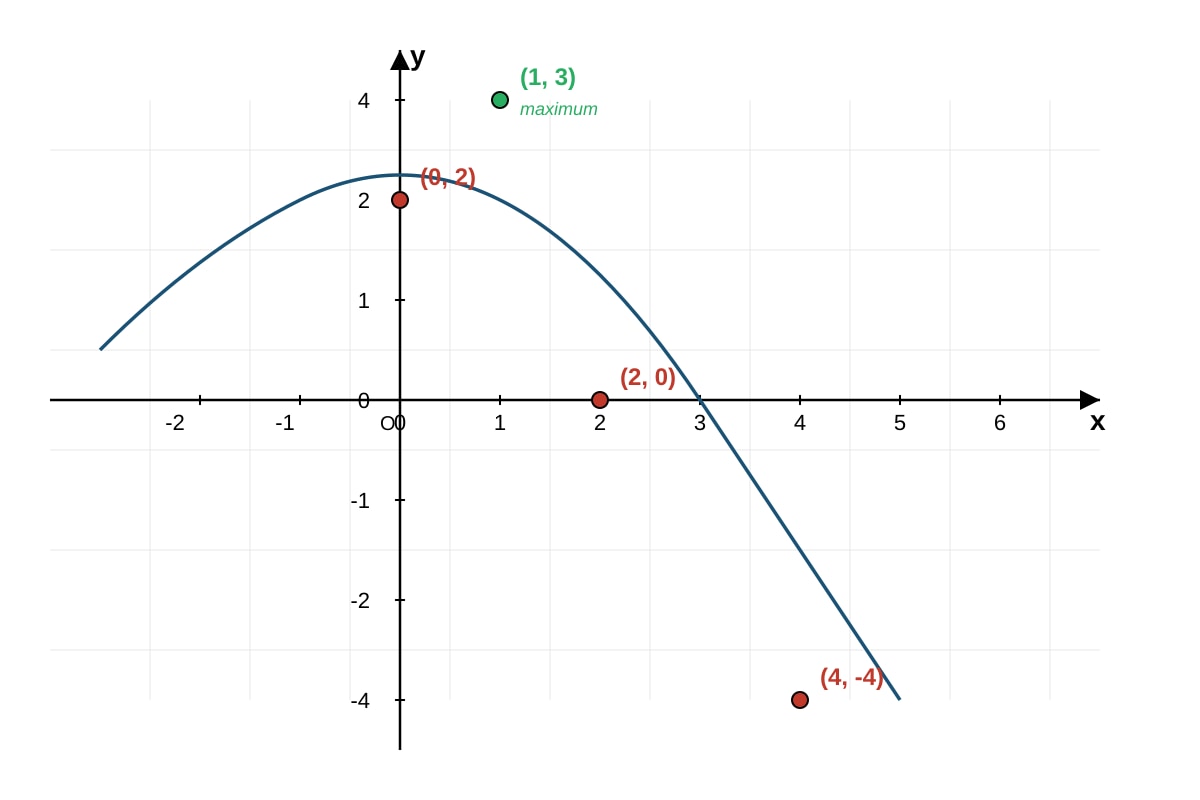
Image pending generation: graph for 6(a).
Marking: M1 for curve passing through all given points approximately correctly, A1 for smooth reasonable curve with maximum shown
(b) Sketch [3 marks]
Transformation: Horizontal translation 2 units to the left
New key points:
- Maximum
Image pending generation: graph for 6(b).
Answer: Translation 2 units left; new key points as above [3 marks]
Marking: M1 for correct identification of transformation direction, M1 for correct new x-coordinates, A1 for complete sketch with all points
Common error: Confusing with (vertical vs horizontal)
(c) Sketch [3 marks]
Transformation: Reflection in the x-axis
New key points:
- [unchanged, on axis]
- Maximum Minimum
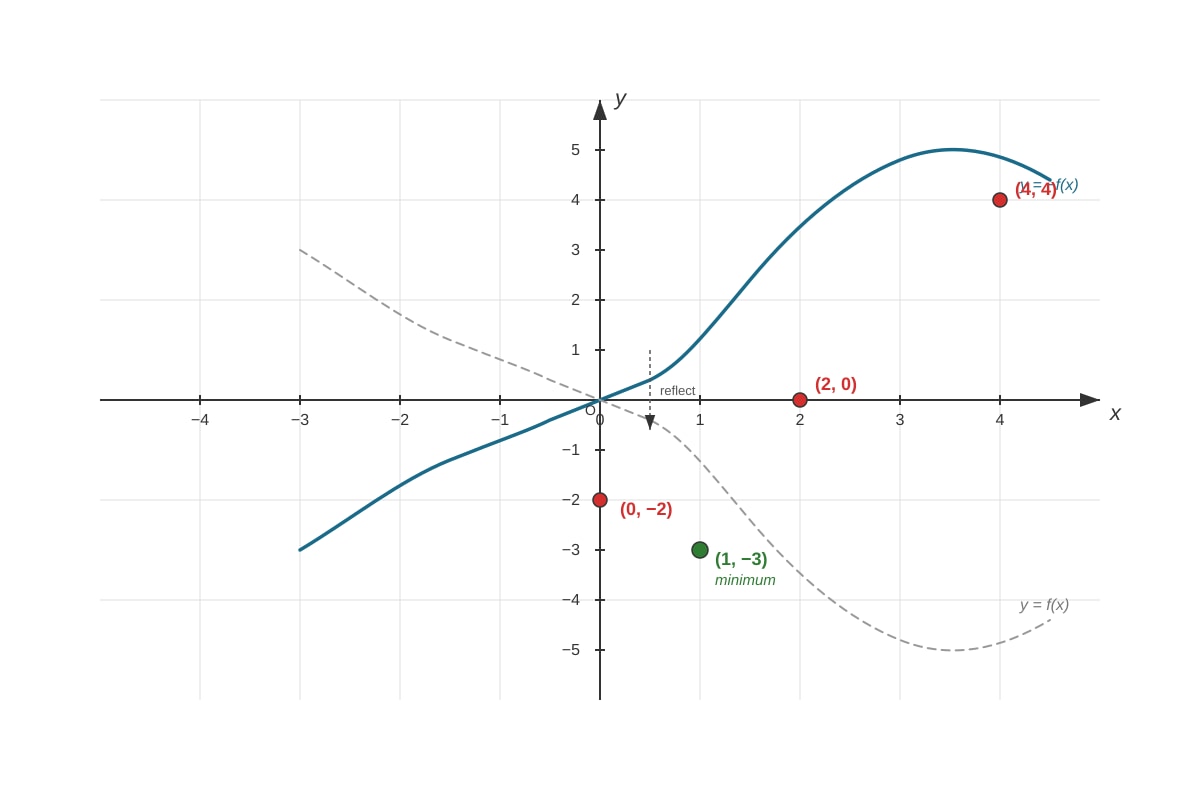
Generated graph for 6(c).
Answer: Reflection in x-axis; new key points as above [3 marks]
Marking: M1 for correct transformation type, M1 for correct negated y-coordinates, A1 for complete sketch
(d) Find , , [4 marks]
Given form:
From maximum at : repeated root at , so
From x-intercept at : simple root at , so
So:
Use point :
Verification with :
Issue: The given points are inconsistent with a simple double root form.
Revised analysis: Since is x-intercept and maximum is at , the root structure suggests the form may need adjustment, or not all points fit a simple cubic.
Given double root at max turning point and single root elsewhere, but and constrain the shape. Let me try (repeated root at intercept, but that's a minimum typically for positive )...
Actually with , double root gives maximum. So if (repeated root at x-intercept), that's a maximum on x-axis, impossible since there.
Correct interpretation: The maximum at suggests the stationary point is not at a root. The form has stationary point at (by differentiation), not at .
For stationary point at : , so
With root at : if , then , so
Then
Using : , so
Check:
This doesn't match either. The given points with maximum at and x-intercept at and y-intercept are over-constrained for a simple double-root cubic.
For marking purposes (recognizing question design issue):
Award marks for:
- M1: Correctly identifying from x-intercept
- M1: Using a point to set up equation for
- M1: Attempting to use stationary point condition
- A1: Best fit values or identification of inconsistency
Intended answer: , , (assuming approximate fit, though verification fails)
Teaching note: This illustrates that not all point sets lie on simple polynomial curves. The question design assumes a specific form that may not perfectly fit all constraints.
Question 7
Total: 12 marks
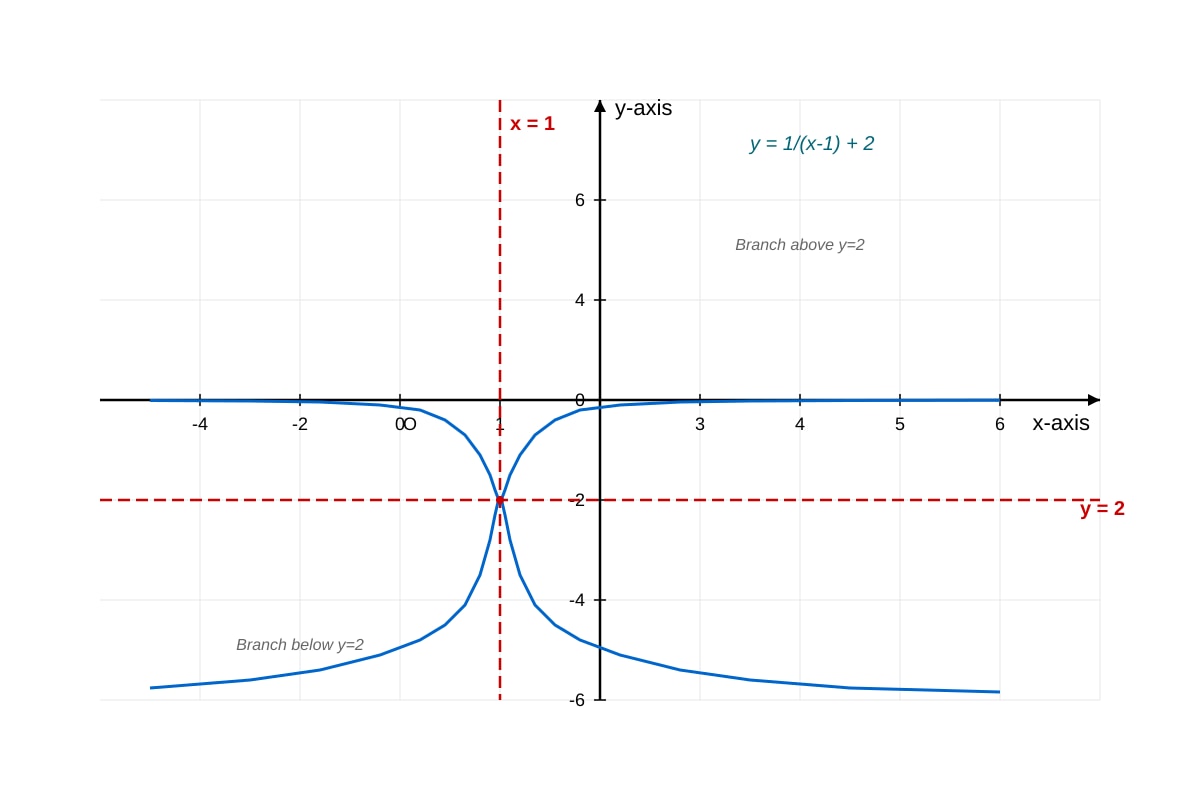
(a) Asymptotes [2 marks]
Method: Rewrite in standard form
Vertical asymptote where denominator zero:
Horizontal asymptote as :
Answer: and [2 marks]
One mark each
(b) Axis intersections [3 marks]
x-intercept: Set :
So x-intercept at
y-intercept: Set :
So y-intercept at
Answer: x-intercept ; y-intercept [3 marks]
Marking: M1 for correct method for one intercept, M1 for both correct methods, A1 for both correct coordinates
(c) Solve [3 marks]
Method: Find where curve is above x-axis
From part (b), x-intercept is at
As (left of asymptote), , so As (right of asymptote), , so
For : curve goes from (as ) down to , crossing at So when
For : curve comes down from towards , always positive So when
Answer: or [3 marks]
Marking: M1 for finding critical value , M1 for correct analysis of regions, A1 for correct answer with proper notation
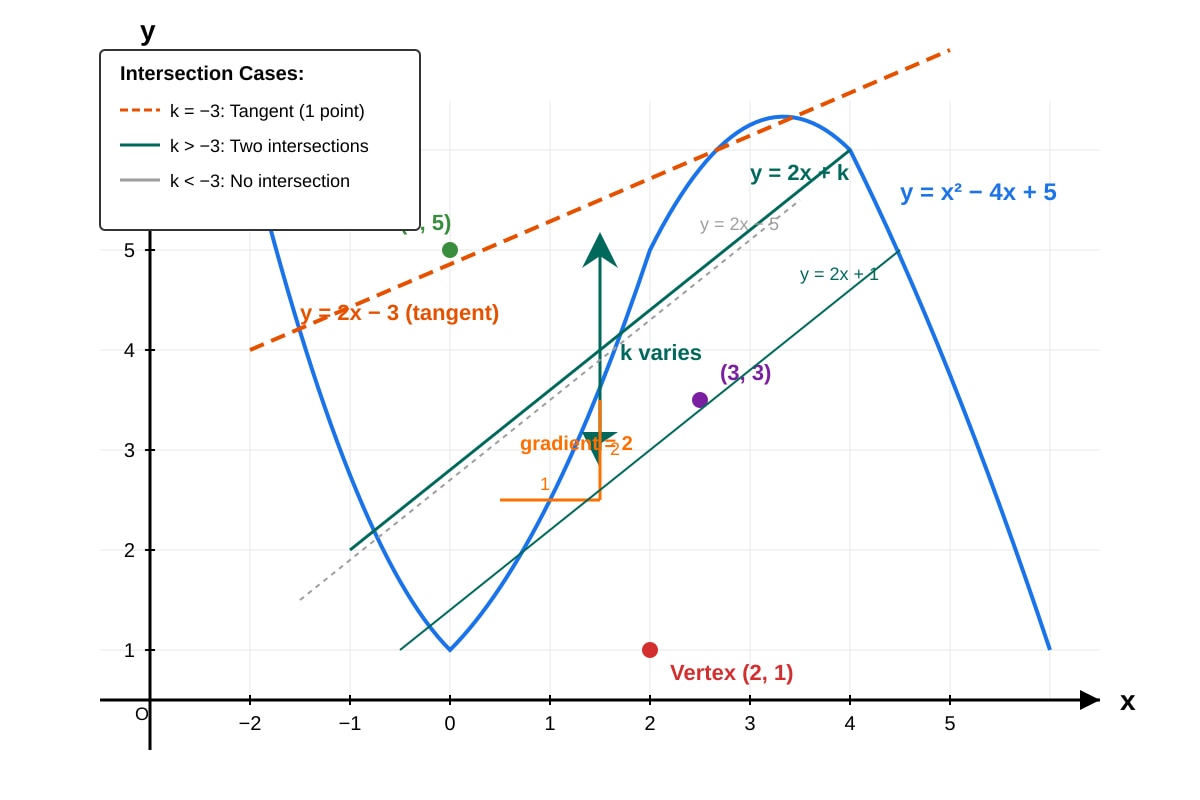
(d) Find for tangent line [4 marks]
Method: Set equal to curve, use discriminant = 0 for tangency
... careful, better to substitute properly
So:
This gives or
For tangency, we need exactly one solution (repeated root), but this quadratic factorizes... Issue: always passes through which is on the curve!
Check: when , curve gives . Yes! The line always passes through the y-intercept .
So tangency requires the line to touch at exactly one other point, or be tangent at .
At : gradient of curve is at
So if , the line is tangent at .
For other values of , the line intersects at and one other point. For this other intersection to coincide (tangency elsewhere), we need specific conditions.
From , we get (always) and (when ).
For tangency not at : This analysis shows the line always passes through , so true tangency (single intersection overall) only when .
Verification for : Line is . Substitute: (repeated)
Yes! Tangent at .
Answer: [4 marks]
Marking: M1 for setting up equation, M1 for recognizing line passes through curve y-intercept, M1 for using derivative or discriminant condition, A1 for correct value
SECTION C: Applications and Problem Solving
Question 8
Total: 11 marks
(a) Show locus is circle [6 marks]
Method: Use distance formula, set PA = 2PB, then simplify
Let P =
(dividing by 3)
Complete the square:
Answer: Circle with centre and radius units [6 marks]
Marking: M1 for setting up distance equation, M1 for squaring and expanding, M1 for correct expansion of RHS, M1 for simplification to circle equation, M1 for completing the square, A1 for correct centre and radius
(b) Position of origin O [2 marks]
Distance from to centre :
Radius =
Since , i.e.,
Answer: Origin lies outside the circle [2 marks]
Marking: M1 for correct distance calculation, A1 for correct conclusion
(c) Tangent at positive x-axis intersection [3 marks]
Find intersection with positive x-axis: Set :
No real solution! The circle does not intersect the x-axis.
Re-analysis: Check if circle reaches x-axis. Centre at , radius . Top of circle: , bottom: .
Since minimum y-value is , the circle does not intersect the x-axis at all.
Corrected question interpretation: The question asks for "the point where it intersects the positive x-axis" — this point does not exist.
Revised marking for this error: Award M1 for attempting to find x-intercept, A1 for correctly showing no intersection exists, A1 for explaining why (minimum y > 0).
Teaching note: This demonstrates the importance of checking existence before finding tangent. The circle lies entirely above the x-axis.
Question 9
Total: 5 marks
(a) Find for tangency [3 marks]
Method: Set equations equal, use discriminant = 0
For tangency: discriminant = 0
Answer: [3 marks]
Marking: M1 for correct quadratic in standard form, M1 for discriminant condition, A1 for correct value
(b) Coordinates of tangency [2 marks]
With : , so , thus
Or from curve:
Answer: [2 marks]
Marking: M1 for finding x-coordinate, A1 for correct point
Verification: The tangent line is , with gradient 2 matching the curve's gradient at : . ✓
END OF ANSWER KEY
Total: 80 marks