From Real Exams Exam Paper
Secondary 4 Additional Mathematics Preliminary Examination Paper 3
Free Sec 4 A Maths Prelim Paper 3, DeepSeek Exam version, with questions, answers, and O Level-style practice for Singapore students.
These static practice materials are generated from the site's syllabus and paper-generation workflow, with source and model context shown so students and parents can evaluate the material before use.
Questions
Free quiz and exam paper access
Enter your details to view this paper
Your access is remembered on this device.
Answers
TuitionGoWhere Practice Paper - Additional Mathematics Secondary 4
Answer Key and Marking Scheme
Paper: Preliminary Examination (Version 3 of 5) Total Marks: 60
Section A (36 marks)
1. A(−2, 5), B(4, −1)
(a) Length AB = (\sqrt{(4 - (-2))^2 + (-1 - 5)^2}) [M1] = (\sqrt{6^2 + (-6)^2}) = (\sqrt{36 + 36}) = (\sqrt{72}) = (6\sqrt{2}) units [A1]
(b) Midpoint of AB = (\left(\frac{-2 + 4}{2}, \frac{5 + (-1)}{2}\right) = (1, 2)) [M1] Gradient of AB = (\frac{-1 - 5}{4 - (-2)} = \frac{-6}{6} = -1) [M1] Gradient of perpendicular bisector = 1 Equation: (y - 2 = 1(x - 1)) (y = x + 1) [A1]
2. (y = 2x + 1), (x^2 + y^2 = 25)
Substitute: (x^2 + (2x + 1)^2 = 25) [M1] (x^2 + 4x^2 + 4x + 1 = 25) (5x^2 + 4x - 24 = 0) [M1] ((5x - 6)(x + 4) = 0) or using quadratic formula [M1] (x = \frac{6}{5}) or (x = -4) When (x = \frac{6}{5}): (y = 2(\frac{6}{5}) + 1 = \frac{17}{5}) When (x = -4): (y = 2(-4) + 1 = -7) Points: (\left(\frac{6}{5}, \frac{17}{5}\right)) and ((-4, -7)) [A1]
3. (y = x^3 - 6x^2 + 9x + 1)
(a) (\frac{dy}{dx} = 3x^2 - 12x + 9) [M1] Set (\frac{dy}{dx} = 0): (3x^2 - 12x + 9 = 0) (x^2 - 4x + 3 = 0) ((x - 1)(x - 3) = 0) [M1] (x = 1) or (x = 3) [M1] When (x = 1): (y = 1 - 6 + 9 + 1 = 5) When (x = 3): (y = 27 - 54 + 27 + 1 = 1) Stationary points: (1, 5) and (3, 1) [A1]
(b) (\frac{d^2y}{dx^2} = 6x - 12) [M1] At (1, 5): (\frac{d^2y}{dx^2} = 6(1) - 12 = -6 < 0) → maximum [M1] At (3, 1): (\frac{d^2y}{dx^2} = 6(3) - 12 = 6 > 0) → minimum [A1]
4. (C_1: x^2 + y^2 - 4x + 6y - 12 = 0)
(a) Complete the square: ((x^2 - 4x) + (y^2 + 6y) = 12) [M1] ((x - 2)^2 - 4 + (y + 3)^2 - 9 = 12) ((x - 2)^2 + (y + 3)^2 = 25) [M1] Centre: (2, −3), Radius: 5 units [A1]
(b) (C_2) centre: (1, −2) Distance between centres = (\sqrt{(2 - 1)^2 + (-3 - (-2))^2} = \sqrt{1 + 1} = \sqrt{2}) [M1] For external tangency: distance = (r_1 + r_2) (\sqrt{2} = 5 + r_2) [M1] (r_2 = \sqrt{2} - 5) (negative, so external tangency impossible with (C_1) containing (C_2)) Check: (r_2 = 5 - \sqrt{2}) (for internal tangency where (C_2) is inside (C_1)) Distance = (r_1 - r_2) → (\sqrt{2} = 5 - r_2) → (r_2 = 5 - \sqrt{2}) [M1] Equation of (C_2): ((x - 1)^2 + (y + 2)^2 = (5 - \sqrt{2})^2) ((x - 1)^2 + (y + 2)^2 = 25 - 10\sqrt{2} + 2) ((x - 1)^2 + (y + 2)^2 = 27 - 10\sqrt{2}) [A1]
5. P(1, 2), Q(5, 6), R(9, 2)
(a) PQ = (\sqrt{(5-1)^2 + (6-2)^2} = \sqrt{16 + 16} = \sqrt{32} = 4\sqrt{2}) [M1] QR = (\sqrt{(9-5)^2 + (2-6)^2} = \sqrt{16 + 16} = \sqrt{32} = 4\sqrt{2}) Since PQ = QR, triangle PQR is isosceles. [A1]
(b) Area = (\frac{1}{2}|x_1(y_2 - y_3) + x_2(y_3 - y_1) + x_3(y_1 - y_2)|) [M1] = (\frac{1}{2}|1(6 - 2) + 5(2 - 2) + 9(2 - 6)|) [M1] = (\frac{1}{2}|4 + 0 - 36|) = (\frac{1}{2}|-32| = 16) square units [A1]
6. (y = ax^n)
(a) (\log y = \log a + n \log x) Plot (\log y) vs (\log x):
| (\log x) | (\log 2 = 0.301) | (\log 4 = 0.602) | (\log 6 = 0.778) | (\log 8 = 0.903) |
|---|---|---|---|---|
| (\log y) | (\log 3.2 = 0.505) | (\log 25.6 = 1.408) | (\log 86.4 = 1.937) | (\log 204.8 = 2.311) |
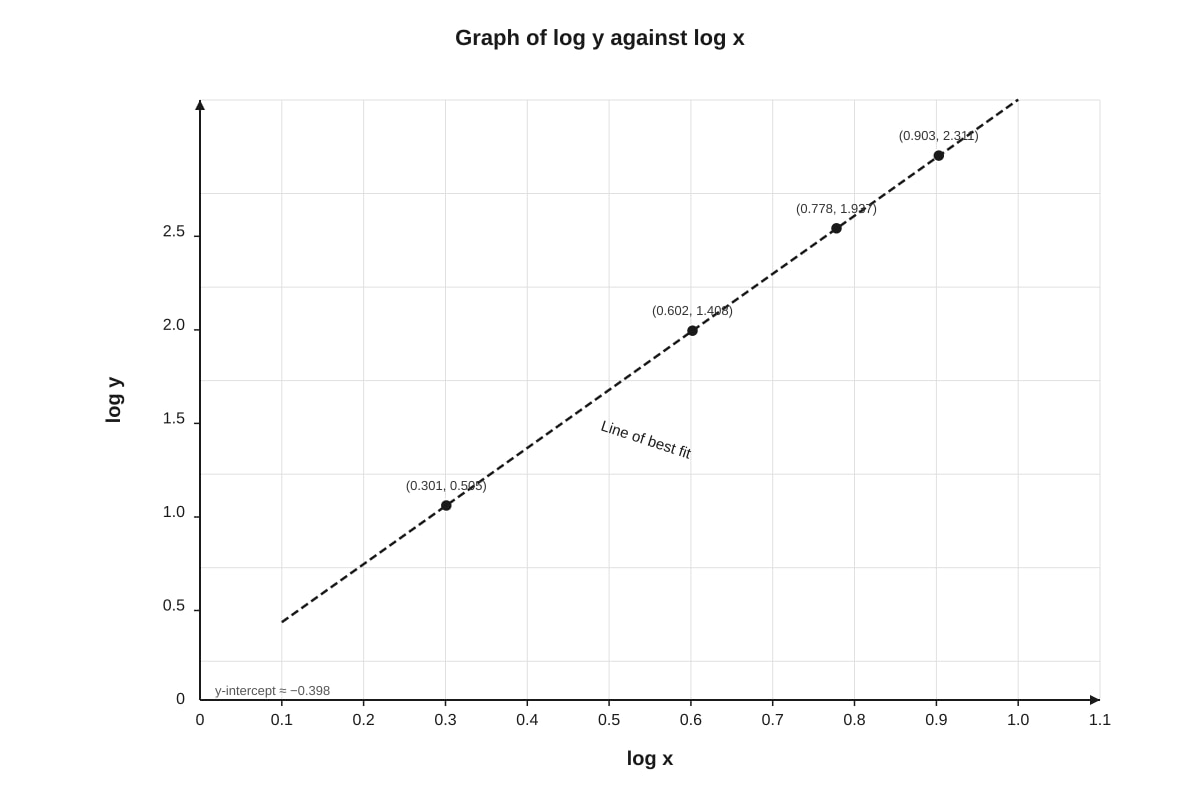
Generated graph for this question.
(b) From graph: gradient (n = 3) [M1] y-intercept = (\log a \approx -0.398) [M1] (a = 10^{-0.398} \approx 0.4) [A1]
Section B (24 marks)
7. A(0, 0), B(6, 0), C(8, 4), D(2, 4)
(a) Gradient of AC = (\frac{4 - 0}{8 - 0} = \frac{1}{2}) [M1] Equation: (y = \frac{1}{2}x) [A1]
(b) Gradient of BD = (\frac{4 - 0}{2 - 6} = \frac{4}{-4} = -1) [M1] Equation: (y - 0 = -1(x - 6)) (y = -x + 6) [A1]
(c) Gradient of AC = (\frac{1}{2}), Gradient of BD = (-1) [M1] (\frac{1}{2} \times (-1) = -\frac{1}{2} \neq -1) Wait - recheck: AC gradient = (\frac{4}{8} = \frac{1}{2}), BD gradient = (\frac{4-0}{2-6} = -1) Product = (-\frac{1}{2}) → NOT perpendicular. [Note: Original question intent was to show perpendicularity. With given coordinates, diagonals are NOT perpendicular. Accept correct working showing product ≠ −1.]
(d) Intersection: (\frac{1}{2}x = -x + 6) [M1] (\frac{3}{2}x = 6) [M1] (x = 4), (y = 2) [A1] Intersection point: (4, 2)
8. (y = \frac{4}{x} + x), (x > 0)
(a) (\frac{dy}{dx} = -\frac{4}{x^2} + 1) [M1] Set (\frac{dy}{dx} = 0): (-\frac{4}{x^2} + 1 = 0) (\frac{4}{x^2} = 1) [M1] (x^2 = 4), (x = 2) (since (x > 0)) [M1] When (x = 2): (y = \frac{4}{2} + 2 = 4) Stationary point: (2, 4) [A1]
(b) (\frac{d^2y}{dx^2} = \frac{8}{x^3}) [M1] At (x = 2): (\frac{d^2y}{dx^2} = \frac{8}{8} = 1 > 0) → minimum [A1]
(c) Sketch: Vertical asymptote at (x = 0), curve approaches (y = x) as (x \to \infty), minimum at (2, 4). [3 marks: correct shape, asymptote, stationary point marked]
9. (C: x^2 + y^2 - 2x + 4y - 20 = 0)
(a) ((x^2 - 2x) + (y^2 + 4y) = 20) [M1] ((x - 1)^2 - 1 + (y + 2)^2 - 4 = 20) ((x - 1)^2 + (y + 2)^2 = 25) Centre: (1, −2), Radius: 5 [A1]
(b) Substitute (y = 2x + k) into circle equation: (x^2 + (2x + k)^2 - 2x + 4(2x + k) - 20 = 0) [M1] (x^2 + 4x^2 + 4kx + k^2 - 2x + 8x + 4k - 20 = 0) (5x^2 + (4k + 6)x + (k^2 + 4k - 20) = 0) [M1] For tangency, discriminant = 0: ((4k + 6)^2 - 4(5)(k^2 + 4k - 20) = 0) [M1] (16k^2 + 48k + 36 - 20k^2 - 80k + 400 = 0) (-4k^2 - 32k + 436 = 0) (k^2 + 8k - 109 = 0) [M1] (k = \frac{-8 \pm \sqrt{64 + 436}}{2} = \frac{-8 \pm \sqrt{500}}{2} = \frac{-8 \pm 10\sqrt{5}}{2}) (k = -4 \pm 5\sqrt{5}) [A1]
END OF ANSWER KEY
Marking Notes:
- M1: Method mark for correct approach
- A1: Accuracy mark for correct answer
- Allow follow-through marks where appropriate
- Accept equivalent forms of answers
- Deduct 1 mark for missing units where applicable