AI Generated Quiz
Secondary 3 Social Studies Source Based Skills Quiz
Free Sec 3 Social Studies Source Based Skills quiz, HY3 AI version, with questions, answers, and O Level-style practice for Singapore students.
These static practice materials are generated from the site's syllabus and paper-generation workflow, with source and model context shown so students and parents can evaluate the material before use.
Questions
Secondary 3 Social Studies Quiz - Source Based Skills
Name: ___________________________
Class: ___________________________
Date: ___________________________
Score: ___________ / 40
Duration: 60 minutes
Total Marks: 40
Instructions:
- This quiz tests your source-based skills using the Upper Secondary Social Studies syllabus (Issue 1: Citizenship and Governance; Issue 2: Living in a Diverse Society; Issue 3: Being Part of a Globalised World).
- Answer all 20 questions.
- Section A: 10 short source questions (2 marks each). Section B: 6 source analysis questions (2 marks each). Section C: 4 extended source questions (5 marks each).
- Read sources carefully. Use evidence from sources and your own knowledge.
Caveat: No past-year exam templates were available. This quiz is syllabus-first practice generated from inferred patterns. It is not exam-derived.
Section A: Source Comprehension (Questions 1–10, 2 marks each)
Source A (for Q1–3):
"A good citizen obeys the law and votes during elections. In Singapore, citizens also serve National Service and keep public spaces clean. The government builds HDB flats and provides healthcare so families can live well." — Adapted from a civic education pamphlet, 2023.
1. Based on Source A, give one right and one obligation of a citizen in Singapore. [2]
2. According to Source A, state one function of the government mentioned. [2]
3. Source A suggests citizenship is only a legal status. Do you agree? Explain using the source. [2]
Source B (for Q4–6):
"My school has students from Chinese, Malay, Indian and Eurasian backgrounds. We celebrate Racial Harmony Day by sharing food. Sometimes, friends argue about which group is better at sports." — Student diary, 2024.
4. From Source B, identify two racial groups mentioned. [2]
5. What activity in Source B shows cultural exchange? [2]
6. Give one challenge of diversity shown in Source B. [2]
Source C (for Q7–10):
"Globalisation means our phones are made in Vietnam, apps coded in India, and sold here. Cheap imports help consumers but local factories close." — News report, 2023.
7. According to Source C, name one driving force of globalisation. [2]
8. State one benefit of globalisation from Source C. [2]
9. State one negative effect on locals from Source C. [2]
10. Source C shows globalisation only helps rich countries. True or false? Give a reason. [2]
Section B: Source Analysis (Questions 11–16, 2 marks each)
Source D (for Q11–13):
"Government uses meritocracy so the best students get scholarships. But some say poor families cannot afford tuition, so it is unfair." — Forum letter, 2024.
11. What principle of governance is described in Source D? [2]
12. What challenge to the principle is raised? [2]
13. Is Source D for or against meritocracy? Give evidence. [2]
Source E (for Q14–16):
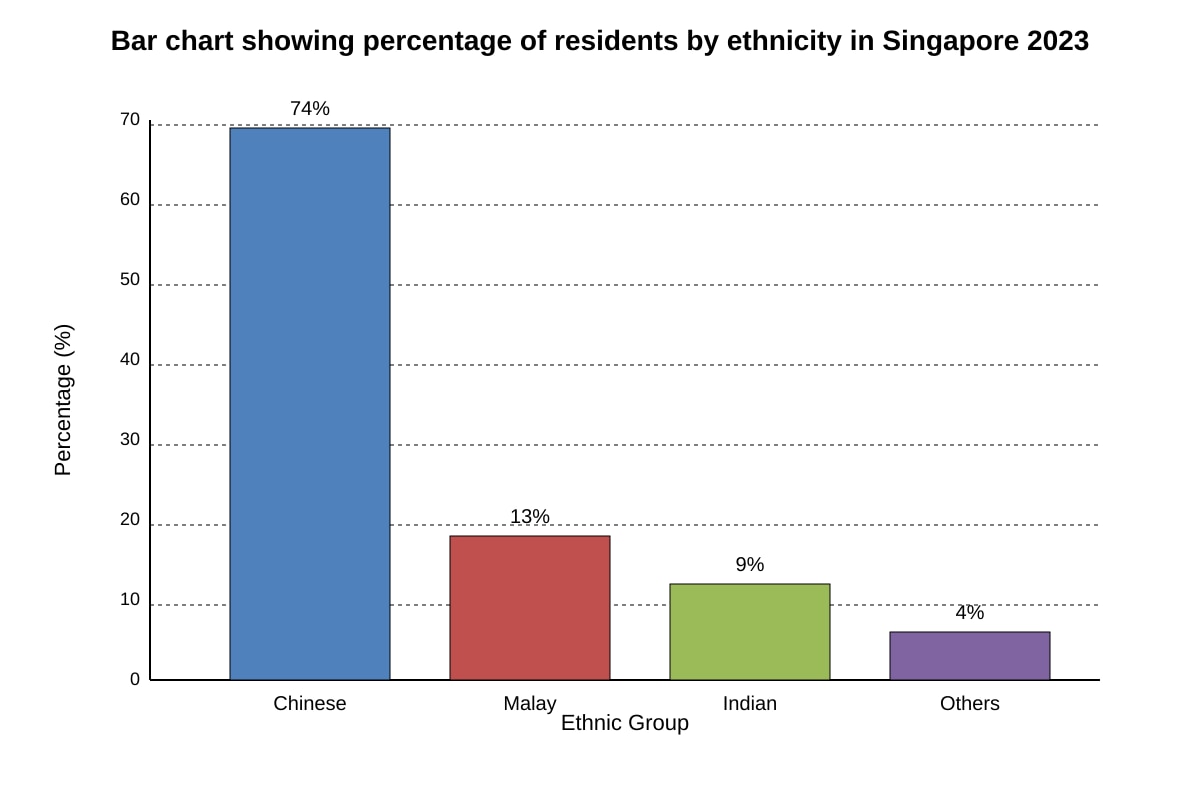
Image pending generation: chart for Q14.
14. Using the chart, what is the largest ethnic group? [2]
15. Based on Source E and your knowledge, why might harmony be challenging? [2]
16. Give one government policy that responds to such diversity. [2]
Section C: Extended Source Response (Questions 17–20, 5 marks each)
Source F (for Q17–18):
"Citizens should help the government by volunteering in elderly homes. The government cannot do everything. When we clean the park, we show belonging." — MP speech, 2023.
17. Explain how citizens and government can work together for the good of society, using Source F and Issue 1. [5]
18. Suggest one trade-off the government faces when relying on volunteers. [5]
Source G (for Q19–20):
"Climate change is global. Singapore imports food but rising seas threaten us. We must work with other countries and reduce waste locally." — Environment report, 2024.
19. How does Source G show globalisation requires response at different levels? [5]
20. Using Source G and Issue 3, explain one way individuals can respond to globalisation. [5]
Answers
Secondary 3 Social Studies Quiz - Source Based Skills (Answer Key)
Caveat: Syllabus-first answers; no past-year exam templates used.
Section A (Q1–10, 2 marks each)
Q1 [2]
- Right: vote during elections (or live in HDB/healthcare as provided).
- Obligation: obey law, National Service, keep public spaces clean.
Teaching: Citizenship has legal status (rights) and active duties. Source A shows both.
Q2 [2]
- Builds HDB flats / provides healthcare / makes laws (any one function).
Teaching: Government role is ensuring social well-being.
Q3 [2]
- Disagree. Source says citizens "serve NS" and "keep spaces clean" = active, not just legal.
Teaching: Citizenship = legal + active participation.
Q4 [2]
- Chinese, Malay, Indian, Eurasian (any two).
Teaching: Diversity from race/ethnicity.
Q5 [2]
- Racial Harmony Day food sharing.
Teaching: Cultural exchange builds appreciation.
Q6 [2]
- Arguments about which group better at sports = stereotype/competition.
Teaching: Diversity can cause tension.
Q7 [2]
- Production in Vietnam, coding in India, trade (any one).
Teaching: Division of labour across borders is a force.
Q8 [2]
- Cheap imports help consumers.
Teaching: Consumers benefit from lower prices.
Q9 [2]
- Local factories close.
Teaching: Negative impact on local jobs.
Q10 [2]
- False. Source says consumers here benefit, not only rich countries.
Teaching: Globalisation has mixed local effects.
Section B (Q11–16, 2 marks each)
Q11 [2]
- Meritocracy.
Teaching: Principle = opportunities for best regardless of background.
Q12 [2]
- Poor families cannot afford tuition, so unfair.
Teaching: Unequal starting point challenges meritocracy.
Q13 [2]
- Mixed; says "best get scholarships" (support) but "unfair" (critique). Evidence: "some say poor… unfair".
Teaching: Source shows tension, not one-sided.
Q14 [2]
- Chinese (74%).
Teaching: Chart shows majority group.
Q15 [2]
- Different sizes may cause minority feeling sidelined; need effort for harmony.
Teaching: Diversity needs policy to avoid conflict.
Q16 [2]
- Ethnic Integration Policy / Racial Harmony Day / HDB quota (any one).
Teaching: Government uses integration not assimilation.
Section C (Q17–20, 5 marks each)
Q17 [5]
Marking: 1 mark Source F volunteer/clean park; 2 marks explain government cannot do all; 2 marks link Issue 1 mutual responsibility.
Answer: Source F shows citizens volunteering in homes and cleaning parks. Government provides framework but not all help. Issue 1 says citizens + government share responsibility for good society. Together they meet needs.
Q18 [5]
Marking: 2 marks trade-off identified (e.g. cost vs quality); 3 marks explain.
Answer: If government relies on volunteers, it saves money but may get uneven care. Trade-off: lower cost vs consistent service.
Q19 [5]
Marking: 2 marks global level (work with countries); 3 marks local level (reduce waste).
Answer: Source G says sea rise is global so cooperate; local waste reduction is individual action. Shows response needed at both levels.
Q20 [5]
Marking: 2 marks individual action from source; 3 marks Issue 3 link.
Answer: Individuals can reduce waste locally (Source G). Issue 3 says people respond by changing habits to global challenges.
Free quiz and exam paper access
Enter your details to view this paper
Your access is remembered on this device.