AI Generated Quiz
Secondary 3 Social Studies Singapore Society Quiz
Free Sec 3 Social Studies Singapore Society quiz, Kimi2.6 AI version, with questions, answers, and O Level-style practice for Singapore students.
These static practice materials are generated from the site's syllabus and paper-generation workflow, with source and model context shown so students and parents can evaluate the material before use.
Questions
Free quiz and exam paper access
Enter your details to view this paper
Your access is remembered on this device.
Answers
Secondary 3 Social Studies Quiz - Singapore Society: Answer Key
Total Marks: 40
Section A: Multiple Choice (10 marks)
| Question | Answer | Explanation |
|---|---|---|
| 1 | B – Meritocracy | Meritocracy emphasises rewarding individuals based on ability and effort, which involves long-term investment in education and talent rather than short-term popularity. Common mistake: Pragmatism (C) is about practical solutions, not specifically long-term planning; accountability (A) focuses on answerability for actions. |
| 2 | B – A sense of belonging and shared values among people who live in Singapore | Singaporean identity is broader than legal citizenship (A) or CMIO categories (C); it encompasses shared values, experiences, and commitment to the nation. Key concept: Identity involves both emotional attachment and active participation. |
| 3 | B – The Baby Bonus Scheme | Introduced in 2001 and enhanced over time, this provides financial incentives and leave provisions to encourage childbirth. Context: Part of broader pro-natalist policies addressing fertility rate of approximately 1.1 in recent years. |
| 4 | B – Collaboration between government, community organisations, and individuals to help those in need | This approach recognises that government alone cannot address all social needs; it leverages civil society, businesses, and volunteers. Concept: Partnership model in social welfare, distinct from welfare states where government provides directly. |
| 5 | C – Participating in the Singapore Kindness Movement or volunteering in community projects | Active citizenship goes beyond passive acts like voting (A) or attendance (B); it involves tangible contribution to community wellbeing. Key distinction: Active vs. passive participation. |
| 6 | B – Multiculturalism with managed integration through policies like the Ethnic Integration Policy in housing | The Ethnic Integration Policy (EIP) limits ethnic concentration in public housing to ensure mixed neighbourhoods. Concept: Managed multiculturalism, not assimilation (A) or separation (C). |
| 7 | B – Rule of law | The three principles are: pragmatism (practical, evidence-based solutions), meritocracy (reward based on ability), and rule of law (governance through clear, fair legal frameworks). Memorisation note: These form the foundational framework in the syllabus. |
| 8 | B – An ageing population and increasing healthcare costs | Singapore's old-age support ratio fell from 13.5 workers per elderly in 1970 to approximately 4 in 2020, straining healthcare and pension systems. Elimination: Other options are factually incorrect (A, C, D). |
| 9 | C – Foster community bonding and administer local social programmes | Established in 1997, CDCs operate at district level to coordinate grassroots activities and social assistance. Note: They complement, not replace, MPs (A). |
| 10 | B – Programmes that identify and direct vulnerable individuals to appropriate help agencies | "Feeder services" is social work terminology for early identification and referral systems, connecting at-risk individuals to welfare resources. Common confusion: Literally misread as transport or food services. |
Section B: Structured Response (10 marks)
11. Explain two ways in which the Singapore government promotes social cohesion among different ethnic groups. [2]
| Mark | Awarded for |
|---|---|
| 1 | Any valid way identified and briefly explained |
Sample answers (any two):
-
Shared housing through the Ethnic Integration Policy (EIP): The EIP sets quotas for ethnic groups in public housing estates, ensuring no single group dominates a neighbourhood. This creates daily interaction across ethnic lines and prevents racial enclaves. (Key: policy name + mechanism promoting interaction)
-
National education and common curriculum: Schools teach a common history and civics curriculum, including Social Studies, to build shared understanding of Singapore's journey and values. Racial Harmony Day commemorations also foster mutual appreciation. (Key: education as nation-building tool)
-
Mandarin, Malay, Tamil, and English as official languages: English serves as lingua franca while mother tongues preserve cultural roots. This linguistic arrangement enables inter-ethnic communication while respecting diversity. (Key: language policy function)
Common mistake: Merely listing policies without explaining how they promote cohesion; or confusing social cohesion with economic policies.
12. Identify one trade-off the Singapore government faces when deciding how much foreign talent to allow into the country. [2]
| Mark | Awarded for |
|---|---|
| 1 | Identification of valid trade-off |
| 1 | Explanation of both sides of the trade-off |
Sample answer:
The government must balance economic growth (needing foreign professionals to fill skills gaps and boost competitiveness) against social integration and local employment concerns (Singaporeans may feel displaced or that opportunities are limited). [1]
Explanation: More foreign talent can increase GDP and innovation, but if perceived as excessive, it may strain infrastructure, raise living costs, and create political discontent among citizens who feel competition for jobs and housing. The trade-off requires calibrating immigration to sustain growth without undermining social cohesion or citizens' sense of fairness. [1]
Alternative valid trade-off: Diversity and dynamism vs. preserving local culture/identity; or immediate economic needs vs. long-term population planning.
13. Describe how the principle of meritocracy is demonstrated in Singapore's education system. [2]
| Mark | Awarded for |
|---|---|
| 1 | Identification of a meritocratic feature |
| 1 | Explanation showing how ability/effort determines outcome |
Sample answer:
Students are placed into secondary school streams (Express, Normal Academic, Normal Technical) based on Primary School Leaving Examination (PSLE) results [1], which are intended to reflect academic ability and effort regardless of family background [1]. This theoretically allows any student to advance through performance rather than social connections or wealth. (Note: recent 2024 reforms replacing streams with subject-based banding also operate on assessed aptitude; answers referencing this reform are acceptable if correctly described.)
Key concept: Meritocracy = rewards based on demonstrated ability + effort, not ascriptive characteristics like race or family status.
14. Explain why citizen participation is important in a democratic society like Singapore. [2]
| Mark | Awarded for |
|---|---|
| 1 | Valid reason identified |
| 1 | Explanation linking participation to democratic functioning |
Sample answer:
Citizen participation informs government decision-making with ground-level concerns [1]. Through feedback channels like REACH (Reaching Everyone for Active Citizenry @ Home), town hall sessions, and the Singapore Government's e-engagement platforms, policies can be adjusted to reflect actual needs rather than assumptions, strengthening legitimacy and effectiveness of governance [1].
Alternative: Participation cultivates a sense of ownership and responsibility, making citizens more likely to comply with and support policies; or it serves as accountability mechanism, checking government power.
15. State two reasons why Singapore needs to plan carefully for an ageing population. [2]
| Mark | Awarded for |
|---|---|
| 1 each | Any two distinct, valid reasons |
Sample answers:
-
Shrinking workforce and tax base: Fewer working-age citizens supporting more elderly means reduced economic productivity and potentially insufficient contributions to fund public services.
-
Increased healthcare and long-term care costs: Elderly typically require more medical intervention; without planning, costs could overwhelm the system or require severe tax increases.
-
Inter-generational equity concerns: Without sustainable financing, younger generations may bear disproportionate burden through higher taxes or reduced public services.
-
Need for aged-friendly infrastructure: Housing, transport, and public spaces require modification to maintain elderly independence and quality of life.
Section C: Source-Based and Extended Response (20 marks)
16(a). According to Source A, identify two areas where the government plans to do more to support Singaporeans. [1]
| Mark | Awarded for |
|---|---|
| 1 | Any two correct areas from source |
Answer: Healthcare and housing [1]
Note: Must be extracted directly from source text. "Help one another" is not an area of government support but a citizen expectation.
16(b). Explain what is meant by "moving beyond a transactional relationship" in Source A. [2]
| Mark | Awarded for |
|---|---|
| 1 | Understanding of "transactional" (quid pro quo, immediate exchange) |
| 1 | Explanation of the new reciprocal, trust-based relationship described |
Sample answer:
A "transactional relationship" implies citizens pay taxes and vote, while government delivers services—a direct, immediate exchange with limited mutual obligation beyond this [1]. "Moving beyond" suggests building deeper mutual commitment: citizens actively contribute (skill upgrading, helping others) while government provides more substantial, proactive support, creating a partnership based on trust and shared responsibility for societal wellbeing [1].
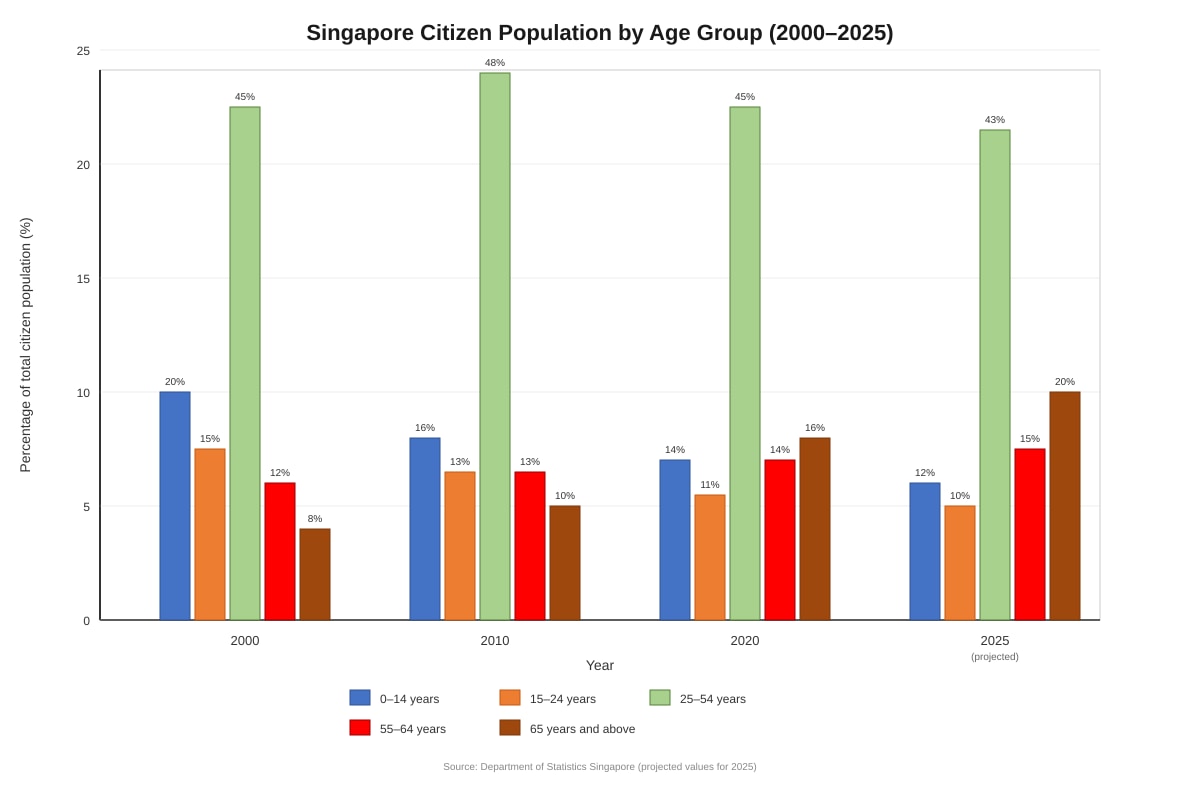
17. Using Source B, describe two trends in Singapore's population structure. [2]
| Mark | Awarded for |
|---|---|
| 1 each | Any two valid trends with reference to data in Source B |
Expected visual features for answer verification: Bar chart shows percentage of citizen population across five age groups from 2000 to 2025 (projected).
Sample answers:
-
The proportion of elderly (65 years and above) is increasing significantly, from approximately 8% in 2000 to a projected 20% in 2025—more than doubling over 25 years [1].
-
The youth population (0-14 years and 15-24 years) is declining, with 0-14 years falling from 20% to 12% and 15-24 years from 15% to 10% over the same period [1].
Alternative valid trends: Working-age population (25-54) declining slightly from 45% to 43%; 55-64 years group gradually increasing; overall population ageing with top-heavy structure emerging.
18. Study Source B. Suggest one reason for the trend in the 65 years and above category, and explain one challenge this trend creates for Singapore society. [3]
| Mark | Awarded for |
|---|---|
| 1 | Valid reason for increasing elderly proportion |
| 2 | Valid challenge identified (1) and explained with societal impact (1) |
Sample answer:
Reason: Rising life expectancy combined with declining birth rates [1]. Singaporeans now live longer (average life expectancy around 83-84 years) while total fertility rate has fallen below replacement level (approximately 1.1), meaning proportionally fewer young people to balance the elderly [1].
Challenge: Increased fiscal pressure on healthcare and pension systems [1] explained by: with fewer working-age contributors relative to elderly beneficiaries, either taxes/CPF contributions must rise, benefits must be constrained, or government must draw on reserves more heavily—creating difficult political and inter-generational choices about sustainable financing [1].
Alternative challenges: Labour shortages requiring foreign worker influx (with integration challenges); demand for eldercare workers exceeding supply; need for housing and transport redesign; "sandwich generation" stress on middle-aged caregivers.
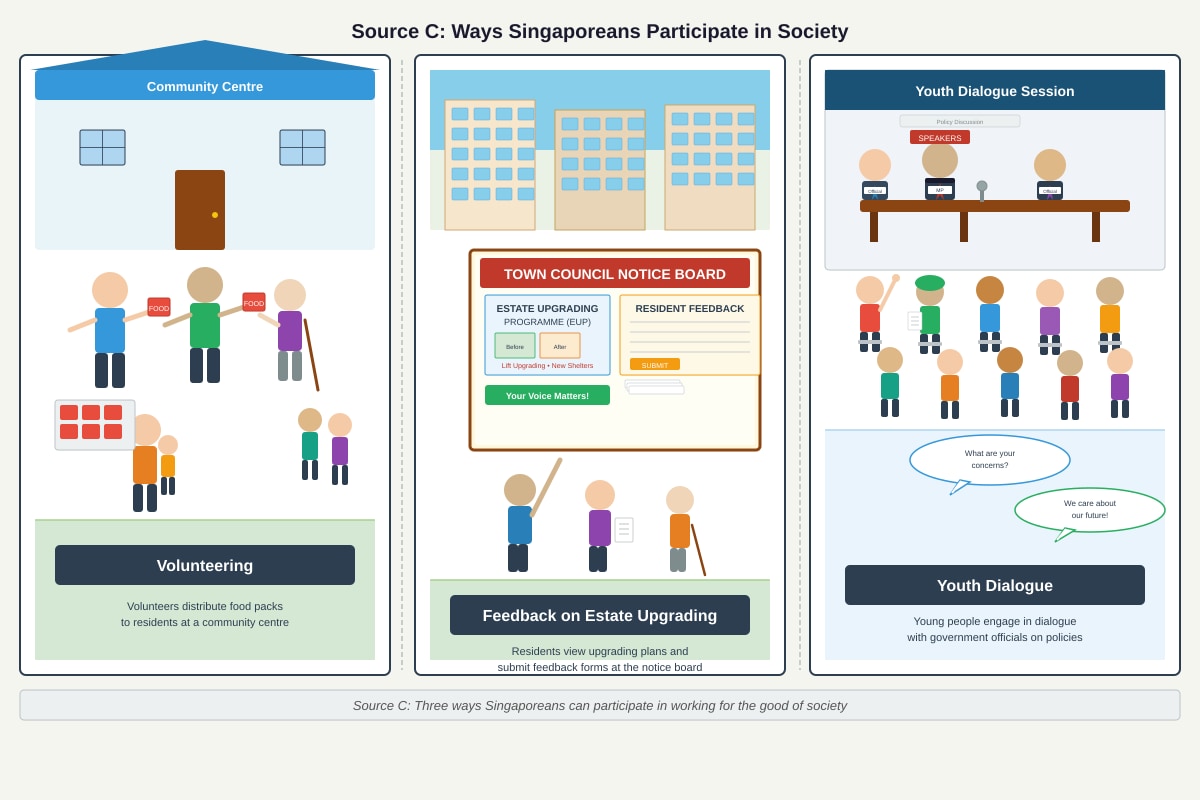
19. Using Source C and your own knowledge, explain three ways Singaporeans can participate in working for the good of society. [3]
| Mark | Awarded for |
|---|---|
| 1 each | Three distinct ways, each with explanation of how it contributes to societal good; at least two should connect to Source C |
Source C analysis: Left image = volunteering/community service; centre = giving feedback on local improvements; right = youth dialogue/engagement with policy.
Sample answers:
-
Volunteering and community service (left image): Citizens contribute time and skills to help vulnerable groups—distributing food, mentoring youth, or assisting elderly. This directly addresses needs government programmes may not reach, strengthening informal safety net and community bonds [1].
-
Participating in feedback and consultation (centre image): Residents engage with estate upgrading plans, town council matters, or national policy consultations. This ensures public resources align with actual community needs and builds democratic legitimacy [1].
-
Engaging in policy dialogue (right image, own knowledge): Youth and citizens participate in platforms like Youth Corps Singapore, REACH dialogues, or parliamentary committees. This brings diverse perspectives into policy formulation and develops civic capacity among participants [1].
Important: Answers referencing only own knowledge (without Source C) are acceptable but weaker; best responses integrate visual evidence.
20. "Singapore society has achieved harmony, but this requires constant effort from both the government and citizens." To what extent do you agree with this statement? Explain your answer with reference to at least two policies or practices in Singapore. [4]
| Mark | Awarded for |
|---|---|
| 1 | Clear position stated (agree/disagree/partially agree with justification) |
| 1 | First policy/practice explained with evaluation of its contribution |
| 1 | Second policy/practice explained with evaluation |
| 1 | Balanced conclusion recognising achievements while acknowledging ongoing challenges or effort needed |
Marking descriptors and sample structure:
Position: Agree substantially—Singapore has made significant progress in managing diversity, but harmony is dynamic and requires sustained attention [1].
Evidence 1 – Government policy: Ethnic Integration Policy in public housing prevents racial enclaves by setting maximum proportions for each ethnic group in H blocks. This has successfully created mixed neighbourhoods where daily interaction occurs. However: Occasional tensions still arise (e.g., cultural misunderstandings, online racism during COVID-19), requiring ongoing reinforcement through education and community programmes [1].
Evidence 2 – Citizen practice: Inter-racial and religious confidence circles (IRCCs) and grassroots leaders proactively build trust across communities, organising joint celebrations and responding to incidents. Complication: Citizens must actively participate—if apathy sets in, or if new immigrants don't integrate, social fabric weakens. The 2019 Pulau Ubin burial site issue showed how community dialogue was needed to resolve sensitivities [1].
Conclusion: Singapore's harmony is institutionalised but not automatic. Government must update policies (e.g., addressing discrimination in employment, managing new immigration), while citizens must move beyond tolerance to genuine appreciation. The "constant effort" is evidenced by continuous education campaigns, policy adjustments, and the reality that harmony, once taken for granted, can erode quickly as seen in other multi-ethnic societies [1].
Alternative valid policies: Maintenance of Religious Harmony Act; racial harmony education in schools; Community Mediation Centres; National Integration Council for new immigrants; anti-discrimination guidelines.
Common mistake: Describing policies without evaluating whether they represent "constant effort"; or asserting harmony is complete without acknowledging vulnerabilities.
END OF ANSWER KEY