AI Generated Quiz
Secondary 3 Social Studies Issue Analysis Quiz
Free Sec 3 Social Studies Issue Analysis quiz, Kimi2.6 AI version, with questions, answers, and O Level-style practice for Singapore students.
These static practice materials are generated from the site's syllabus and paper-generation workflow, with source and model context shown so students and parents can evaluate the material before use.
Questions
Free quiz and exam paper access
Enter your details to view this paper
Your access is remembered on this device.
Answers
Secondary 3 Social Studies Quiz - Issue Analysis: Answer Key
Total Marks: 40
Section A: Multiple-Choice Questions [8 marks]
| Question | Answer | Explanation |
|---|---|---|
| 1 | B | An issue in Social Studies is defined as an important matter requiring attention that involves different viewpoints or perspectives. It is not merely a personal opinion (D) or something affecting only officials (A). Issues have current relevance and societal implications. |
| 2 | C | "Think" involves explaining observations and making interpretations—moving beyond description to analysis. "See" (A) is observation, while making assumptions without evidence (B) or skipping to conclusions (D) represent flawed reasoning. |
| 3 | D | ICE stands for Interests, Concerns, Expectations—used to analyse stakeholder perspectives. "Identify, Compare, Evaluate" (A) describes a generic analysis process, not the specific ICE framework for stakeholder analysis. |
| 4 | C | Business associations prioritise economic growth and would support industrial development. Environmental NGOs (A) and local residents (B) prioritise environmental/health concerns. Healthcare workers (D) see health impacts. |
| 5 | B | Source evaluation requires examining reliability through authorship, date, and purpose. Website colour (A), agreement with personal views (C), and document length (D) are irrelevant to reliability assessment. |
| 6 | C | Wicked problems are complex, interconnected issues (like climate change, inequality) resistant to simple solutions. They are not solved (A), simple (B), or exclusively international (D). |
| 7 | B | "Anticipate change and stay relevant" guides balancing adaptation with stability. During COVID-19, this principle justified temporary restrictions on freedoms for collective safety. "Leadership is key" (A) emphasises direction-setting; "A stake for everyone" (C) focuses on inclusion; "Reward for work" (D) on economic incentives. |
| 8 | A | Vested interest means having a personal stake in an outcome, which may bias perspective. It does not imply evidence-based neutrality (B, C) or universal agreement (D). |
Section B: Short-Answer Questions [14 marks]
9. [2 marks]
Sample answer: Understanding multiple perspectives is important because societal issues affect different groups differently [1], and decisions made without considering diverse views may create unintended harm or fail to address the needs of vulnerable populations [1]. It also promotes more inclusive policies that have broader legitimacy.
Marking notes:
- 1 mark: identifies that different groups experience issues differently / promotes inclusivity
- 1 mark: explains consequence of ignoring perspectives (unintended harm / reduced legitimacy / poorer outcomes)
10. [2 marks]
Sample answers (any two):
- Private vehicle owners/drivers [1]
- Public transport operators (e.g., SMRT, SBS Transit) [1]
- Businesses in the Central Business District [1]
- Delivery and logistics companies [1]
- Commuters who use alternative routes [1]
- Environmental groups [1]
- Low-income workers who rely on driving for employment [1]
Marking notes:
- 1 mark per valid stakeholder, maximum 2 marks
- Must be clearly distinct groups affected by the policy
- "Government" alone is insufficient without specifying which agency and its interest
11. [2 marks]
Sample answer:
| Aspect | Explanation | Example |
|---|---|---|
| Fact [1] | A statement that can be verified with evidence | "Over 80% of Singapore residents live in HDB flats" |
| Opinion [1] | A judgment or belief that may not be universally accepted | "The HDB flat ownership scheme is the best public housing policy in the world" |
Marking notes:
- 1 mark: correct distinction with valid Singapore housing example for fact
- 1 mark: correct distinction with valid Singapore housing example for opinion
- Example must specifically relate to housing policy, not generic Singapore facts
12. [2 marks]
Sample answer: Singapore's ageing population is transboundary because [1] neighbouring countries also face demographic transitions and compete for healthcare workers and talent [1], and [1] solutions require international cooperation on research, caregiver policies, and regional economic integration to sustain growth with fewer workers [1].
Marking notes:
- 1 mark: recognises transboundary nature (crosses borders/affects/becomes relevant beyond Singapore)
- 1 mark: explains mechanism (labour mobility, regional competition for resources, shared challenges, or need for international cooperation)
- Accept reference to Singapore's reliance on foreign workforce in healthcare/ eldercare sectors
13. [2 marks]
Sample answer: "Staying relevant" means anticipating and responding to changing circumstances [1]. The government addresses digital transformation by updating education curricula for digital skills, investing in 5G infrastructure, and reskilling programmes for workers displaced by automation, ensuring citizens remain employable and Singapore competitive [1].
Marking notes:
- 1 mark: explains principle of staying relevant (adaptation to change)
- 1 mark: applies to digital transformation with specific policy examples
- Generic mention of "using technology" without government action is insufficient
14. [2 marks]
Sample answer: One limitation is sampling bias—surveys may over-represent certain demographics (e.g., younger, more educated internet users) and under-represent older or less digitally literate citizens [1], leading to distorted conclusions about "public" opinion that do not reflect diverse viewpoints [1]. Another valid limitation: social desirability bias (respondents give socially acceptable answers), timing effects, or question wording influence.
Marking notes:
- 1 mark: identifies specific limitation (sampling bias, response bias, timing, question design, etc.)
- 1 mark: explains how this limitation affects validity of conclusions about public opinion
- "People might lie" without elaboration = 0 marks; needs mechanism explained
15. [2 marks]
Sample answer: Trade-offs involve giving up one benefit to gain another due to limited resources [1]. In Singapore, using scarce land for housing means less land for industry, defence, or recreation; choosing more green space reduces commercial development potential [1]. Every land use decision involves comparing opportunity costs.
Marking notes:
- 1 mark: defines trade-offs (sacrificing one option for another due to scarcity/limited resources)
- 1 mark: applies to Singapore land use with specific example
- Definition without application = 1 mark; example without definition = 1 mark
Section C: Source-Based and Structured Questions [18 marks]
16. [3 marks]
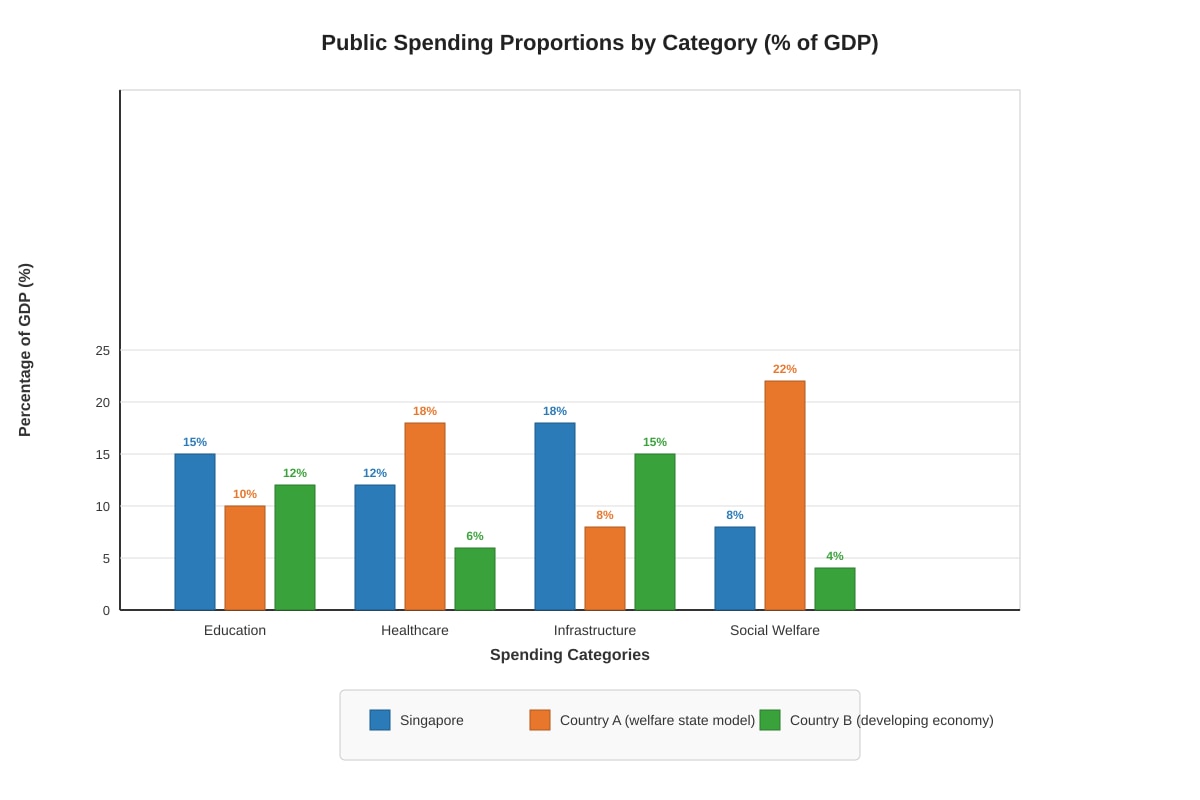
Sample answer: Difference 1: Singapore spends a higher percentage of GDP on infrastructure (18%) compared to Country A (8%) [1], suggesting Singapore prioritises hardware and connectivity for economic function [1/2 mark for development].
Difference 2: Country A spends a much higher proportion on social welfare (22% vs. Singapore's 8%) [1], while Singapore allocates more to education (15% vs. 10%) [alternative valid difference] [1].
Marking notes:
- 1 mark: identifies first difference with data from Figure 1
- 1 mark: identifies second difference with data from Figure 1
- 1 mark: explains significance of one difference (what this reveals about priorities/approach)
- Maximum 2 marks for identification without explanation; 3 marks requires some interpretation
17. [3 marks]
Sample answer: Source B suggests citizenship is evolving from survival-driven, self-reliant individualism toward collective responsibility for well-being [1]. Evidence: the leader states "the question is not whether government should help, but how"—implying citizens now expect proactive government support [1]. The reference to "preserving dignity while building resilience" shows a shift from mere survival to quality of life concerns [1].
Marking notes:
- 1 mark: identifies how citizenship is changing (from self-reliance to expectation of support / from survival to well-being)
- 2 marks: two pieces of evidence from Source B with interpretation
- Must use "Source B states..." or paraphrased evidence with clear connection to argument
18. [4 marks]
Evidence 1: Home ownership rate. Singapore has one of the highest home ownership rates globally (approximately 90% of residents own HDB flats) [1], showing low welfare spending does not mean deprivation when asset-building policies create wealth [1].
Evidence 2: Central Provident Fund (CPF) system with compulsory savings [1]. This pre-funds retirement, healthcare, and housing needs, reducing need for later-life welfare transfers while promoting self-reliance [1].
Alternative valid evidence:
- Life expectancy (among world's highest, ~84 years) indicating health outcomes despite moderate healthcare spending
- Low unemployment rates through active labour market policies
- Education outcomes (PISA rankings) showing efficient education spending
Marking notes:
- 2 marks per evidence: 1 for identifying relevant evidence, 1 for explaining how it supports the government's argument about success despite/through lower welfare spending
- Evidence must be factually accurate and clearly linked to the claim
19. [4 marks]
Sample answer:
Both sources agree that adaptation is necessary, but differ in emphasis and direction [1].
Agreement: Source A notes critics argue the current approach "may leave vulnerable populations without adequate protection during economic disruptions," implying some adjustment may be needed [1]. Source B explicitly calls for "updating" the mindset and asks "how help can be designed" [1]. Both recognise that existing approaches face pressure for change.
Disagreement: Source A frames the core tension as economic competitiveness versus welfare dependency, suggesting change is risky [1]. Source B frames it as preserving dignity while building resilience, suggesting change is essential and overdue. Source A defends the status quo with caveats; Source B advocates more fundamental rethinking.
Marking notes:
- L1 (1-2 marks): identifies surface agreement or disagreement only
- L2 (3-4 marks): nuanced analysis of both agreement and divergence with source evidence
- Must reference both sources; single source analysis capped at 2 marks
- "To what extent" requires evaluative judgment, not mere description
20. [4 marks]
Evaluation:
Economic data alone is insufficient [1], though valuable as one component [1].
Limitations: GDP comparisons mask inequality distribution—the same spending proportion may reach wealthy or poor populations differently. Figure 1 shows what is spent, not outcomes achieved or access experienced [1]. Economic data excludes subjective well-being, social cohesion, environmental sustainability, and unpaid care work that contribute to citizens' quality of life [1].
Uses: Spending data enables cross-national comparison and identifies policy priorities (e.g., Singapore's infrastructure emphasis reveals developmental focus) [1].
Conclusion: Effective issue analysis requires combining quantitative data with qualitative evidence—surveys, case studies, stakeholder interviews, and outcome indicators—to capture lived experiences [1].
Marking notes:
- 1 mark: clear evaluative judgment (extent of sufficiency/insufficiency)
- 2 marks: two developed reasons why economic data is limited (with reference to Figure 1)
- 1 mark: recognition of what economic data can contribute (balanced evaluation)
- Maximum 3 marks without explicit reference to well-being; question specifically asks about well-bring understanding
Total marks: 40