AI Generated Quiz
Secondary 3 Social Studies Governance Citizenship Quiz
Free Sec 3 Social Studies Governance Citizenship quiz, Kimi2.6 AI version, with questions, answers, and O Level-style practice for Singapore students.
These static practice materials are generated from the site's syllabus and paper-generation workflow, with source and model context shown so students and parents can evaluate the material before use.
Questions
Free quiz and exam paper access
Enter your details to view this paper
Your access is remembered on this device.
Answers
Secondary 3 Social Studies Quiz - Governance Citizenship — Answer Key
Total Marks: 50
Section A: Multiple Choice (10 marks)
1. (b) Legal status with both rights and responsibilities ✓ [1]
Teaching note: Citizenship in Singapore is not merely about entitlements. It involves a legal relationship with the state that includes rights (e.g., voting, passport access) balanced with responsibilities (e.g., national service, obeying laws, paying taxes). This reflects the syllabus understanding that citizenship involves both dimensions working together for societal good.
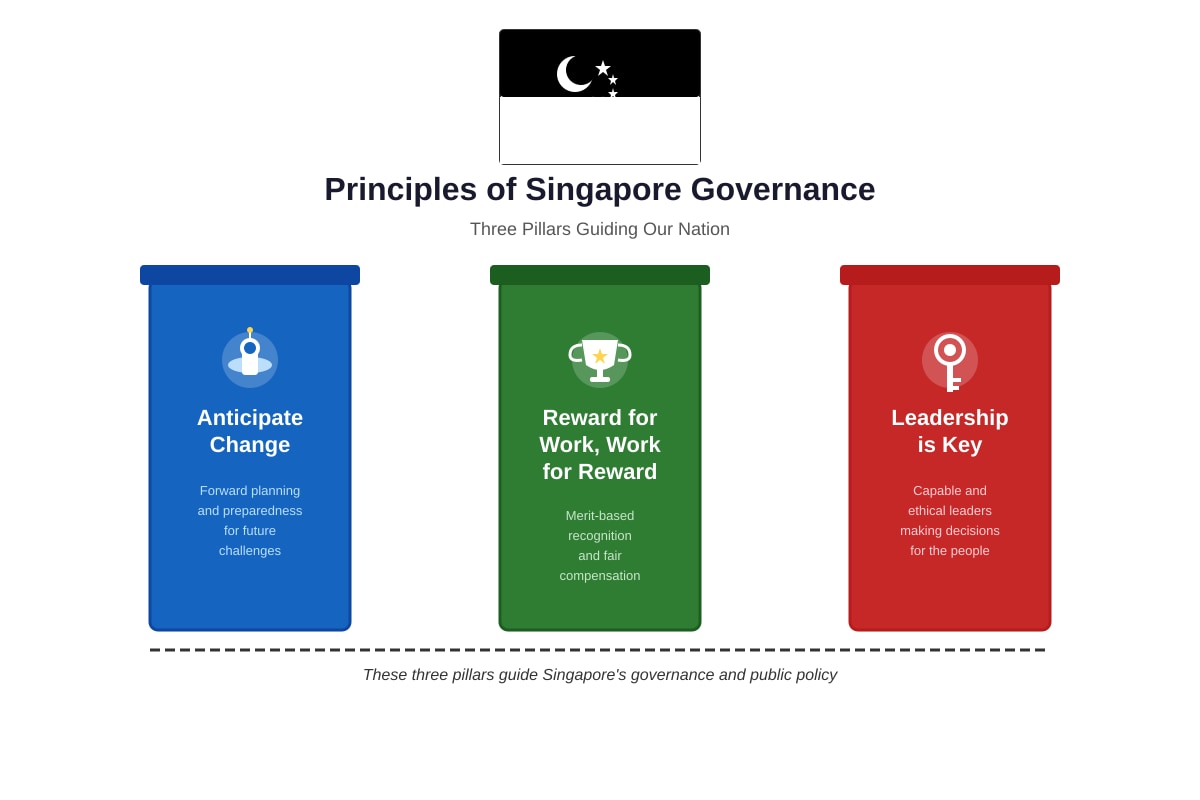
2. (b) Planning ahead and adapting policies to future challenges ✓ [1]
Teaching note: This is one of Singapore's core governance principles. "Anticipating change and staying relevant" means proactive policy-making rather than reactive crisis management. Examples include water management planning (NEWater development begun before critical shortage) and continuous education upgrading to prepare workers for economic shifts.
3. (b) Volunteering at a community food bank ✓ [1]
Teaching note: Responsibilities go beyond legal obligations to include active contribution to community wellbeing. Volunteering demonstrates civic virtue and participative citizenship. Options (a), (c), and (d) represent either legal violations or harmful behaviours that undermine social cohesion.
4. (b) Government decisions often require balancing competing needs ✓ [1]
Teaching note: Trade-offs are fundamental to governance because resources are finite and stakeholder interests differ. For example, spending on healthcare versus defence, or development versus conservation, requires weighing costs and benefits to different groups. No policy satisfies everyone completely.
5. (b) Active government intervention in social cohesion ✓ [1]
Teaching note: The Maintenance of Religious Harmony Act and related policies demonstrate the government's active role in managing potentially divisive issues. This is not laissez-faire (letting things resolve naturally) but intentional state action to preserve multicultural stability, recognising that left unmanaged, racial or religious tensions could fragment society.
6. (b) Building consensus and engaging stakeholders ✓ [1]
Teaching note: REACH represents the government's mechanism for citizen engagement and feedback collection. This illustrates governance that seeks informed consensus rather than top-down imposition alone. It recognises that legitimacy and effectiveness improve when citizens feel heard, even when final decisions rest with elected leaders.
7. (b) Any person or group affected by or with an interest in a policy decision ✓ [1]
Teaching note: Stakeholder analysis is crucial in governance. Stakeholders include citizens, businesses, civil society, affected communities, and even future generations. Understanding who is affected by and who can influence decisions ensures more comprehensive policy design and identifies potential opposition or support.
8. (a) Pragmatism — using practical solutions to real problems ✓ [1]
Teaching note: Singapore's water strategy exemplifies pragmatism: water agreements with Malaysia, local catchment expansion, NEWater recycling, and desalination provide multiple practical solutions rather than depending on any single ideal approach. Pragmatism prioritises what works over ideological purity.
9. (b) A debate between building more roads versus expanding public transport ✓ [1]
Teaching note: This illustrates genuine societal disagreement about "the good." Roads favour car owners and certain business logistics; public transport serves environmental goals and broader accessibility. Reasonable people disagree, and government must mediate such conflicts using evidence and consultation, not simply impose a solution.
10. (c) Honest and capable leadership is essential for good governance ✓ [1]
Teaching note: This principle emphasises integrity and competence, not autocracy. Singapore's governance model holds that corruption-free, technically skilled leadership builds trust and enables effective long-term planning. Leadership quality affects all other governance dimensions.
Section B: Short Answer (10 marks)
11. Right: The right to vote in elections (or: right to live in Singapore, right to passport, right to education/subsidies) [1]
Responsibility: National service (or: paying taxes, obeying laws, participating in community, respecting racial/religious harmony) [1]
Teaching note: Citizenship involves this reciprocal relationship. The right to vote enables democratic participation; national service exemplifies the citizen's contribution to collective security. Other valid examples exist, but each must show the two-way nature of citizenship status. Common error: Listing two rights or two responsibilities — the question explicitly asks for one of each.
12. Any two of: [2]
- Providing national defence and security
- Maintaining law and order
- Ensuring economic growth and employment
- Providing public goods and services (education, healthcare, housing, infrastructure)
- Managing external relations/foreign policy
- Safeguarding social cohesion and harmony
Teaching note: These functions derive from the social contract between citizens and state. The government holds legitimate authority in exchange for delivering these collective goods that individuals cannot effectively provide alone. Full marks require two distinct functions, not two aspects of the same function (e.g., "police" and "courts" both fall under law and order).
13. Any two of: [2]
- Government has expertise and resources but needs citizen feedback to understand ground concerns and ensure policies are relevant
- Citizens have local knowledge and diverse perspectives that improve policy design
- Collaboration builds trust and legitimacy, making policies more likely to succeed
- Complex societal problems require collective effort (e.g., environmental conservation, social volunteering) that government alone cannot achieve
- Democratic governance requires citizen participation to be truly representative
Teaching note: This reflects the syllabus theme of partnership between state and citizens. Neither can achieve societal good alone. Government brings scale and coordination; citizens bring legitimacy, information, and implementation energy. This mutual dependence is central to modern conceptions of governance.
14. This principle means that effort and contribution are recognised and rewarded, creating incentive for productive work while ensuring those who contribute more gain proportionally. [1] In Singapore, this appears in merit-based education and employment systems, performance-based wages, and subsidies targeted at working families rather than unconditional handouts. [1]
Teaching note: This principle aims to balance equity (fairness) with efficiency (productivity). It rejects both pure egalitarianism (equal outcomes regardless of effort) and extreme inequality (unearned privilege). Singapore's Workfare scheme exemplifies this: topping up wages of low-income workers who remain employed, thus rewarding work effort.
15. Example: Development of NEWater and desalination capabilities before water shortages became critical [1]
Importance: This prevented a crisis that could have damaged public health, economic activity, and social stability; it demonstrates how anticipation allows gradual, cost-effective adaptation rather than emergency responses that are more expensive and disruptive [1]
Teaching note: Other valid examples include SkillsFuture (preparing workers for industry disruption), early COVID-19 preparations, or land reclamation planning. The importance must connect to concrete outcomes — anticipation reduces costs, maintains options, and demonstrates competent stewardship that maintains public trust.
Section C: Structured Response (30 marks)
16. (a) Meritocracy / Reward for work, work for reward ✓ [1]
Teaching note: This pillar represents the principle that social and economic rewards should correspond to effort, ability, and contribution. The label directly states this reciprocity.
16. (b) This principle maintains social stability by: [3]
| Mark point | Explanation |
|---|---|
| 1 mark | Providing legitimate pathways to success: When people believe hard work leads to reward, they are motivated to participate productively rather than resent the system or seek illegal gains. |
| 1 mark | Reducing class resentment: Meritocracy promises that circumstances of birth do not permanently determine life outcomes, reducing potential for inter-class conflict. |
| 1 mark | Encouraging talent development: By rewarding education and skill development, society maximises available human capital, creating overall prosperity that benefits all through public goods. |
Teaching note: Full marks require explanation, not mere repetition. Connect to social stability specifically — how does this principle prevent disorder? The key mechanism is perceived fairness combined with incentive structure. Common error: Describing meritocracy without explaining the stability link.
17. (a)
- Residents: Concerned about construction noise and loss of green spaces [1]
- Business owners: Worried about reduced customer access during construction [1]
Teaching note: Both groups must be correctly identified with matched concerns from the extract. No marks for invented stakeholders not in the text.
17. (b) This illustrates trade-offs because: [2]
| Mark point | Explanation |
|---|---|
| 1 mark | Competing interests requiring balance: The government wanted improved transport infrastructure (long-term benefit) but had to weigh this against immediate resident quality-of-life and business viability concerns. |
| 1 mark | Mitigation through adjustment: The trade-off was managed, not eliminated, through modified construction schedules and temporary parks — showing trade-offs require creative compromise, not zero-sum choices. |
Teaching note: Trade-offs exist even when solutions are found; the point is that choices have costs and multiple legitimate claims must be balanced. The extract shows active management of trade-offs, not absence of trade-offs.
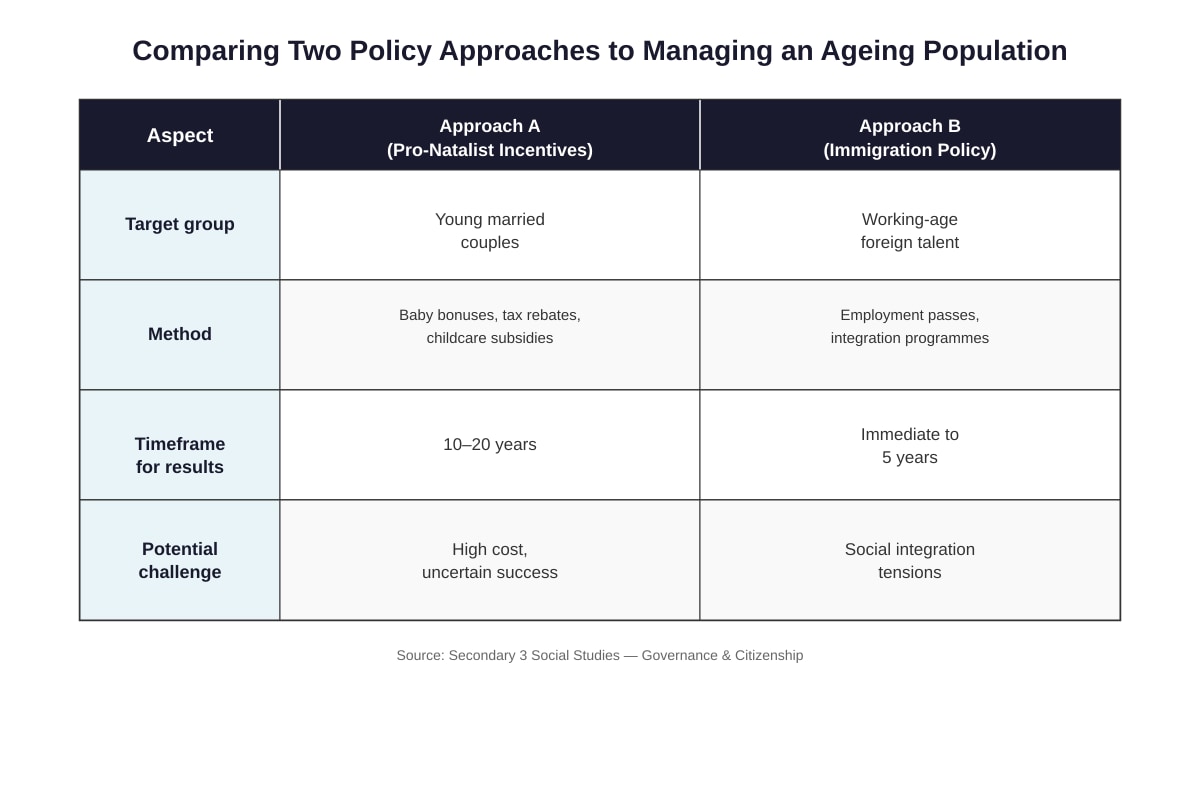
18. (a) Approach A (Pro-Natalist Incentives) ✓ [1]
Teaching note: "Pro-natalist" means encouraging births within the existing population. Approach B explicitly brings in external labour.
18. (b) A government might use both because: [3]
| Mark point | Explanation |
|---|---|
| 1 mark | Different timeframes complement each other: Pro-natalist measures (A) take 10–20 years to yield working-age adults, while immigration (B) addresses immediate labour shortages. Using only A leaves a decade-long gap; using only B creates perpetual dependence. |
| 1 mark | Risk diversification: Table shows A has "uncertain success" — birth rates may not rise regardless of incentives. B provides a more reliable though politically sensitive alternative. Combining approaches hedges against either failing. |
| 1 mark | Balancing quantitative and qualitative needs: B brings immediate workforce numbers but carries "social integration tensions." A preserves cultural continuity and social cohesion. Together, they balance economic needs with social stability. |
Teaching note: Evidence must be explicitly drawn from the table (timeframes, challenges). Generic discussion without table reference receives only 1 mark maximum.
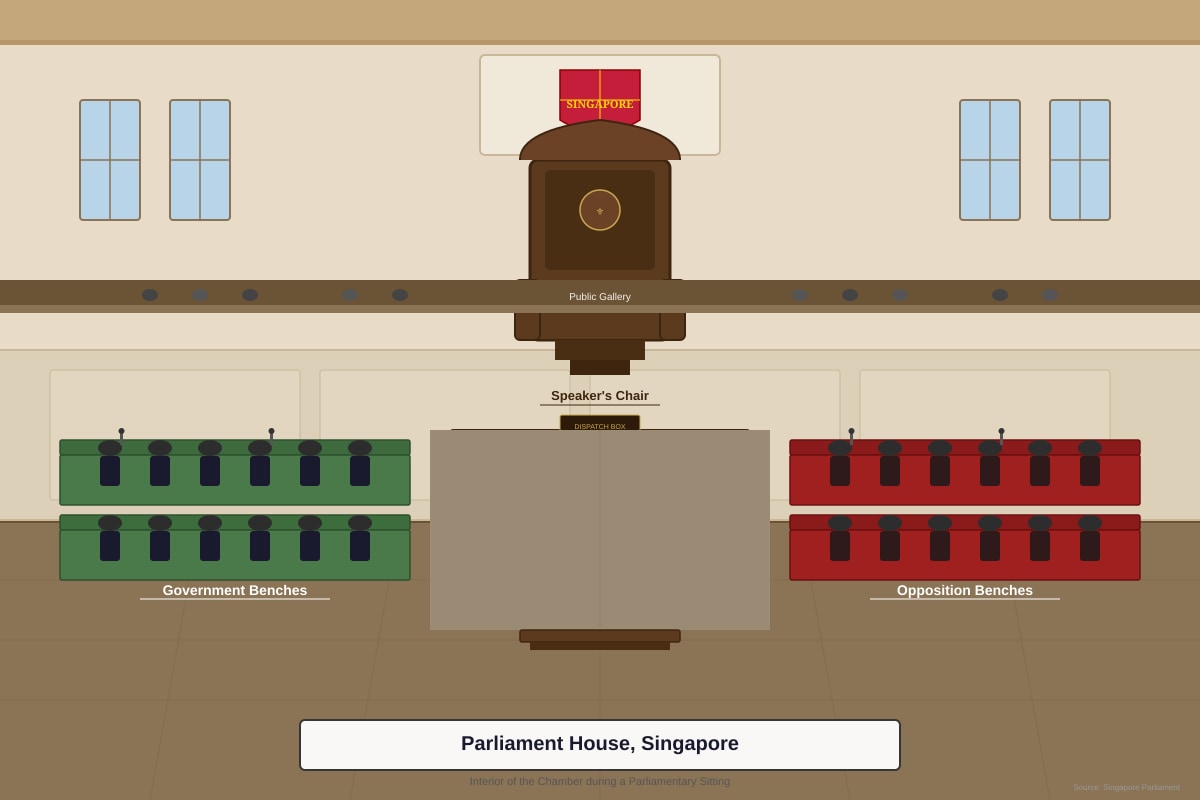
19. (a) Contacting their Member of Parliament (MP) with concerns / Attending parliamentary sessions as gallery observers / Participating in public hearings on legislation ✓ [1]
Teaching note: The image of Parliament sitting indicates the legislative forum. Citizens engage through elected representatives, not directly in most decisions.
19. (b) Participative citizenship matters because: [3]
| Mark point | Explanation |
|---|---|
| 1 mark | Democratic legitimacy: Government decisions gain moral authority when citizens have opportunities to influence them, even when outcomes differ from individual preferences. |
| 1 mark | Improved policy quality: Diverse citizen input surfaces issues experts might miss, enables testing of proposals against lived experience, and reveals unintended consequences before implementation. |
| 1 mark | Citizen ownership and compliance: People more readily accept and cooperate with policies they helped shape, reducing enforcement costs and social friction. |
Teaching note: Connect to "democratic governance" specifically. Democracy is not merely voting periodically but ongoing citizen engagement with power. The Parliament image symbolises this structured channel for participation.
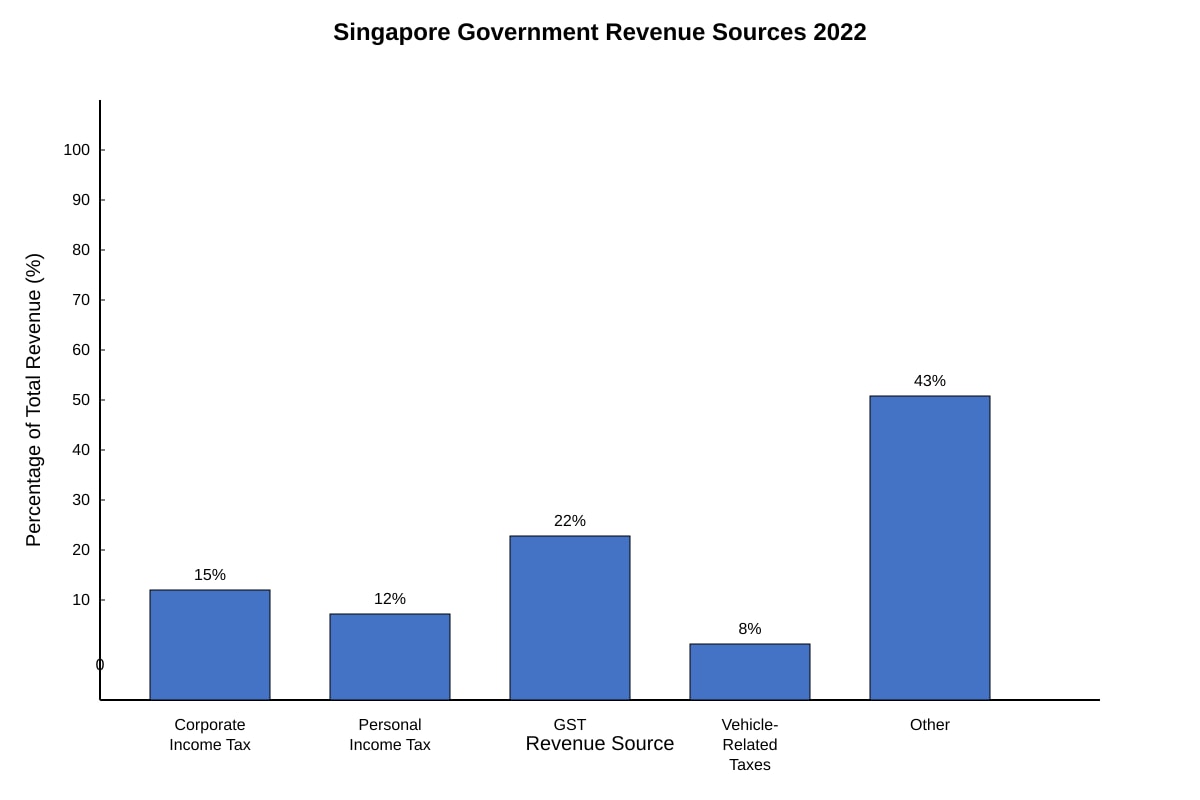
20. (a) Other (43%) — or if "Other" is considered composite, then GST (22%) as largest named single source ✓ [1]
Teaching note: Accept "Other" or "GST" with valid reasoning. "Other" at 43% is factually largest but non-specific. This ambiguity tests careful reading — students should note whether precision about named categories is required.
20. (b) This knowledge helps citizens: [2]
| Mark point | Explanation |
|---|---|
| 1 mark | Understand policy constraints: Revenue limits expenditure options. Knowing GST is significant explains why governments are cautious about GST adjustments and what services this revenue funds. |
| 1 mark | Evaluate budget debates critically: Citizens can assess whether proposed spending (e.g., healthcare expansion, defence procurement) aligns with available revenue or requires tax changes, making them informed voters and commentators. |
Teaching note: Informed citizenship requires understanding how government is financed, not merely what it spends. This fiscal literacy enables meaningful participation beyond slogans.
20. (c) Discussion of the statement: [4]
| Mark descriptor | Guidance |
|---|---|
| Level 3 (4 marks) | Nuanced evaluation: Recognises taxation creates legitimate claim to accountability AND acknowledges governance principles that limit direct demands. Shows balance. |
| Level 2 (2–3 marks) | Partial analysis: Explains one side well (taxpayer rights OR governance complexity) with some recognition of the other, OR describes both without integrating them. |
| Level 1 (1 mark) | Simple assertion: Agrees or disagrees without reasoning, or restates statement. |
| Level 0 (0 marks) | Irrelevant or no response. |
Sample Level 3 response framework:
Taxpayers have legitimate grounds to expect accountability — this is fundamental to democratic governance. Paying taxes creates a stakeholder relationship where citizens deserve transparency and responsive government. [1 mark for acknowledging valid claim]
However, the claim to "exactly the policies they want" oversimplifies governance. The principle of "trade-offs" means different citizens want incompatible things; government must mediate, not simply implement majority demands at each moment. [1 mark for governance complexity]
Furthermore, "leadership is key" implies elected leaders must sometimes make unpopular long-term decisions (e.g., CPF adjustments, GST changes) that citizens might resist but serve societal good. Immediate taxpayer preferences may conflict with intergenerational equity. [1 mark for leadership principle]
Finally, "reward for work, work for reward" suggests not all demands have equal merit — policies should reward contribution and maintain incentive structures, not merely reflect raw demand. Citizenship involves accepting these governance principles, not just asserting consumer-like preferences. [1 mark for synthesis]
Conclusion: Taxation creates legitimate expectations of accountability and consultation, but governance principles require balancing competing claims, long-term thinking, and maintaining systemic fairness beyond aggregating individual demands.
Teaching note: This is the most demanding question, requiring students to hold multiple syllabus concepts simultaneously and resist simplistic agreement/disagreement. Strong responses show the tension between democratic participation and principled governance, using syllabus concepts as analytical tools.
Total marks audit: Section A (10) + Section B (10) + Section C (30) = 50 marks ✓
Duration audit: Section A approximately 10 minutes, Section B approximately 12 minutes, Section C approximately 20 minutes, review 3 minutes = 45 minutes ✓