AI Generated Quiz
Secondary 3 Social Studies Governance Citizenship Quiz
Free Sec 3 Social Studies Governance Citizenship quiz, HY3 AI version, with questions, answers, and O Level-style practice for Singapore students.
These static practice materials are generated from the site's syllabus and paper-generation workflow, with source and model context shown so students and parents can evaluate the material before use.
Questions
Secondary 3 Social Studies Quiz - Governance Citizenship
Name: ___________________________
Class: _____________
Date: _____________
Score: _______ / 40
Duration: 50 minutes
Total Marks: 40
Instructions:
- This quiz has 20 questions across three sections.
- Section A: 10 multiple-choice questions (1 mark each).
- Section B: 6 short-answer questions (2 marks each).
- Section C: 4 structured source-based questions with subparts (total 10 marks).
- Answer all questions in the spaces provided.
- This is syllabus-first practice content generated from inferred templates; it is not derived from past-year papers.
Section A: Multiple-Choice (1 mark each, Q1–Q10)
1. Which of the following best describes citizenship in Singapore?
A. Only a legal status with no responsibilities
B. A legal status that includes rights and obligations
C. The right to vote only
D. A title given to government workers
____ (1)
2. Which is NOT a function of the government?
A. Makes and passes laws
B. Implements and enforces laws
C. Interprets and applies laws
D. Decides which citizens can leave the country freely
____ (1)
3. The principle of meritocracy in governance means that:
A. Everyone gets the same reward
B. Positions and opportunities are based on ability and effort
C. Only the rich can lead
D. Random selection for public roles
____ (1)
4. A trade-off in policy making refers to:
A. A free exchange of goods
B. Balancing competing interests when making decisions
C. A type of tax
D. A legal contract
____ (1)
5. Which role shows the government promoting national interests?
A. Building a new MRT line
B. Signing a trade agreement with another country
C. Collecting rubbish
D. Running schools
____ (1)
6. Active citizenship includes:
A. Only paying taxes
B. Taking part in community projects
C. Ignoring public issues
D. Waiting for the government to act alone
____ (1)
7. One challenge in deciding what is good for society is:
A. Too few laws
B. Differing needs and interests
C. Too much money
D. Lack of leaders
____ (1)
8. "A stake for everyone, opportunities for all" is a:
A. Command word
B. Principle of governance
C. Type of law
D. Citizen duty
____ (1)
9. Citizens and government can work together by:
A. Engaging in public affairs
B. Avoiding contact
C. Only voting every 10 years
D. Protesting violently
____ (1)
10. Good leadership as a governance principle requires leaders to:
A. Stay in power at all costs
B. Anticipate change and stay relevant
C. Ignore new problems
D. Follow other countries blindly
____ (1)
Section B: Short Answer (2 marks each, Q11–Q16)
11. State two rights of a Singapore citizen. (2)
12. Explain one role of government in ensuring economic well-being. (2)
13. Why is managing trade-offs important in governance? (2)
14. Give one example of civic participation by a community group. (2)
15. What does "practicing meritocracy" mean in the Singapore context? (2)
16. How can citizens strengthen their sense of belonging? (2)
Section C: Source-Based (Q17–Q20, 10 marks total)
Source A: A newspaper article (2024) states: "The town council worked with residents to build a community garden. Residents suggested plants and helped maintain it. The MP said this shows citizens and government working together."
17. (a) What is one way citizens participated in Source A? (1)
(b) What is one role of the government shown? (1)
18. Explain how the example in Source A shows active citizenship. (2)
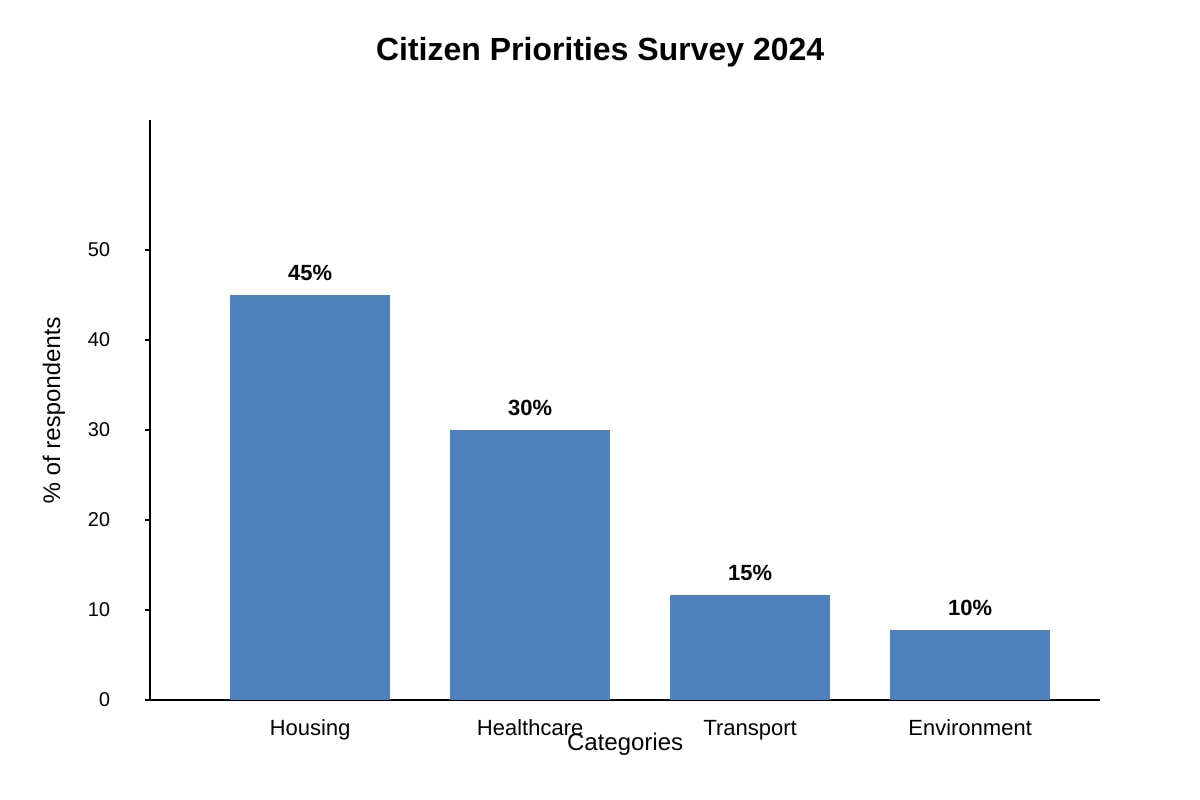
Image pending generation: chart for Q19.
19. Using the chart, identify the top priority and explain one trade-off the government may face. (3)
20. "Good governance needs both leaders and citizens." Do you agree? Use the source and your knowledge. (2)
Answers
Answer Key: Secondary 3 Social Studies Quiz - Governance Citizenship
Total Marks: 40
Level: Secondary 3 | Topic: Governance Citizenship
Syllabus-first content; not from past-year papers.
Section A (1 mark each)
1. B – Citizenship is a legal status that includes both rights (e.g., vote) and obligations (e.g., obey laws). A is wrong as it ignores duties; C and D are too narrow.
2. D – The three functions are make/pass, implement/enforce, interpret/apply laws. Free movement is a right, not a government function of law-making.
3. B – Meritocracy: opportunities based on ability and effort, not wealth or birth.
4. B – Trade-off: balancing competing interests (e.g., cost vs. benefit) in decisions.
5. B – Promoting national interests includes external relations like trade agreements.
6. B – Active citizenship = participation such as community projects, not passive.
7. B – Differing needs/interests make "good for society" hard to define.
8. B – It is a stated principle of governance in syllabus.
9. A – Working together = engaging in public affairs (e.g., feedback).
10. B – Good leadership anticipates change and stays relevant.
Section B (2 marks each)
11. [2 marks] Any two: right to vote, right to freedom of speech (within law), right to education, right to housing (HDB).
Marking: 1 mark per correct right.
12. [2 marks] E.g., "Government ensures economic well-being by creating jobs through policies." Role = maintains economy / provides infrastructure.
Marking: 1 for role named, 1 for brief explanation.
13. [2 marks] Trade-offs prevent one group from dominating; balances limited resources.
Marking: 1 for definition, 1 for importance.
14. [2 marks] E.g., "RC organises recycling drive." Community group civic participation.
Marking: 1 example, 1 that it is group-based.
15. [2 marks] Meritocracy = people advance by merit (exam results, skills), not status.
Marking: 1 definition, 1 local context.
16. [2 marks] E.g., joining neighbourhood events, volunteering; builds bond with country.
Marking: 1 action, 1 effect on belonging.
Section C (10 marks)
17. (a) [1] Residents suggested plants / helped maintain garden.
(b) [1] Government (town council/MP) provided platform/support.
18. [2] Active citizenship = citizens take initiative in public matters. In source, residents gave ideas and maintained garden, not just received.
Marking: 1 concept, 1 link to source.
19. [3] Top priority: Housing (45%). Trade-off: spending more on housing may reduce environment funds (10%).
Marking: 1 identify, 2 explain trade-off using chart.
20. [2] Agree: source shows MP+residents; knowledge says government needs citizen input for relevance.
Marking: 1 stance, 1 reason with evidence.
Free quiz and exam paper access
Enter your details to view this paper
Your access is remembered on this device.