AI Generated Exam Paper
Secondary 3 Social Studies Practice Paper 5
Free Sec 3 Social Studies Practice Paper 5, Kimi2.6 AI version, with questions, answers, and O Level-style practice for Singapore students.
These static practice materials are generated from the site's syllabus and paper-generation workflow, with source and model context shown so students and parents can evaluate the material before use.
Questions
Free quiz and exam paper access
Enter your details to view this paper
Your access is remembered on this device.
Answers
TuitionGoWhere Practice Paper Answers — Social Studies Secondary 3
Version 5 of 5
SECTION A: SOURCE-BASED CASE STUDY [35 marks]
Question 1 [2 marks]
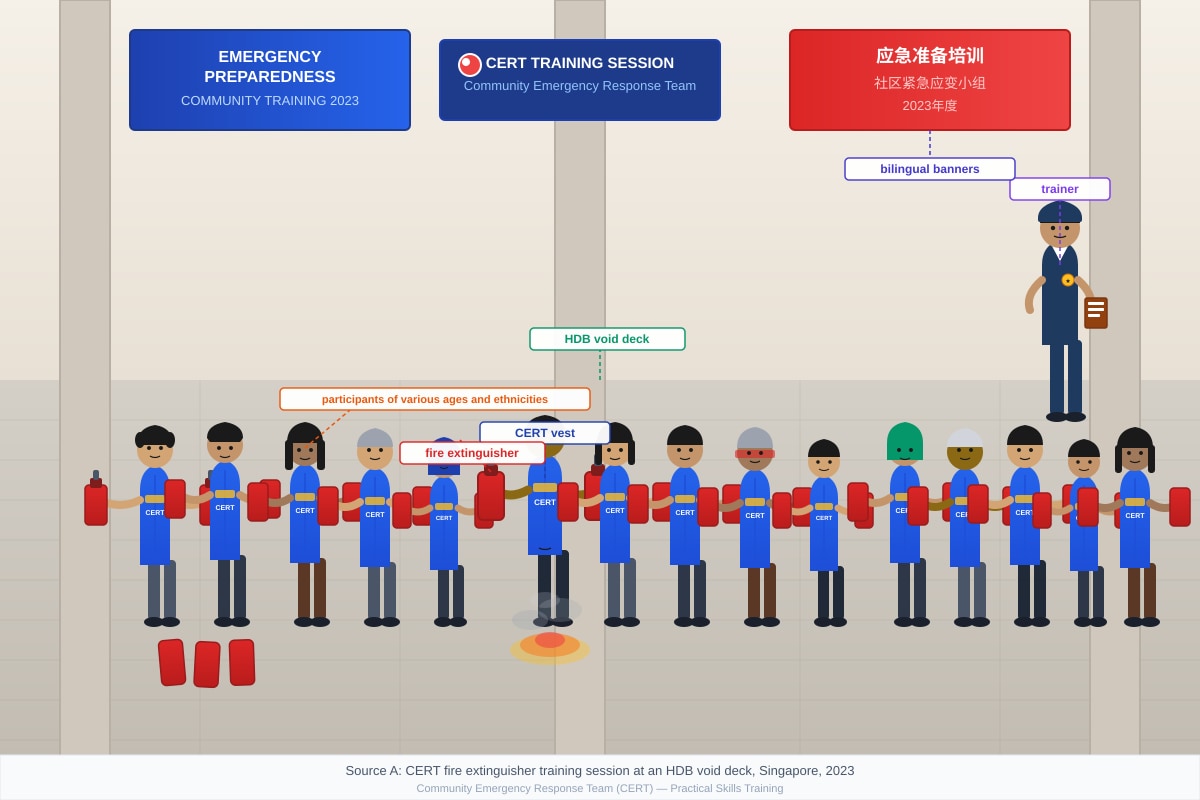
Question: Study Source A. Identify two ways the photograph shows citizens actively participating in working for the good of society.
Answer:
| Point | Explanation |
|---|---|
| Point 1 (1 mark): Residents are training in emergency response skills (fire extinguisher use) through CERT. | This shows citizens acquiring practical skills to help their community during emergencies, rather than waiting for professional services. |
| Point 2 (1 mark): The participants are of diverse ages and ethnicities, indicating broad community involvement. | This demonstrates inclusive citizenship where different community members contribute collectively to neighbourhood safety. |
Alternative acceptable points:
- Participants wearing CERT vests indicate formal organised volunteer structure (1 mark)
- Bilingual banners show efforts to reach all language groups in the community (1 mark)
- Training occurs in public HDB space, making preparedness accessible to ordinary residents (1 mark)
Marking note: Award 1 mark per valid, distinct point with brief explanation. Max 2 marks. Do not award marks for purely describing the image without linking to "working for the good of society."
Question 2 [3 marks]
Question: With reference to Source B, explain why the Member of Parliament describes the 'Meals-on-Wheels' programme as an example of "the partnership we need."
Answer:
Step 1 — Identify what citizens contributed (1 mark): The residents themselves "identified the need, recruited volunteers, and managed the logistics" — they took initiative and ownership of the community problem.
Step 2 — Identify what government contributed (1 mark): The government provided "seed funding and regulatory guidance" — it enabled the project through resources and framework-setting without taking it over.
Step 3 — Explain why this combination represents ideal partnership (1 mark): This is "the partnership we need" because it combines citizen energy and local knowledge with government capacity and legitimacy. The MP explicitly contrasts this with passive citizenship ("what the government should do for us") and presents it as a model where empowerment replaces dependency.
Marking descriptor:
- Level 1 (1 mark): Identifies one element (citizen action OR government role)
- Level 2 (2 marks): Identifies both elements but does not explain the partnership concept
- Level 3 (3 marks): Explains how citizen initiative + government support = mutual partnership, with explicit reference to source vocabulary
Common mistake: Students may describe the Meals-on-Wheels programme without explaining why it illustrates partnership specifically. The phrase "the partnership we need" is evaluative and requires interpretation of the MP's argumentative intent.
Question 3 [4 marks]
Question: Study Source C. What conclusion can you draw from the survey data about Singaporeans' views on responsibility for elderly care? Support your answer with evidence from the source.
Answer:
Main conclusion (1 mark): The majority of Singaporeans believe that responsibility for elderly care should be shared between citizens and government rather than falling to either party alone.
Supporting evidence with interpretation (3 marks):
| Evidence Point | Interpretation |
|---|---|
| Evidence 1: 58% agree that "Citizens and government should share responsibility for elderly care." | This is by far the largest response category, representing a clear majority view that rejects both government-only and citizen-only responsibility. |
| Evidence 2: Only 22% believe "The government alone should be responsible." | This minority view shows limited support for pure state paternalism; Singaporeans do not expect passive receipt of government services. |
| Evidence 3: Combined, only 20% assign primary responsibility to citizens/volunteers (17%) or regard it as purely a family matter (3%). | This reinforces that Singaporeans see a legitimate and necessary government role; they do not advocate for minimal state involvement. |
Additional validity note: The large sample size (1,500) and small margin of error (±3%) increase confidence that this 58% figure represents genuine population sentiment rather than sampling variation.
Marking descriptor:
- Level 1 (1–2 marks): States a conclusion with minimal evidence, or lists statistics without interpretation
- Level 2 (3 marks): Clear conclusion with evidence but limited synthesis across categories
- Level 3 (4 marks): Developed conclusion that interprets the distribution of views as a coherent pattern, using comparative evidence (majority vs. minorities) and noting survey reliability
Question 4 [6 marks]
Question: Study Sources B and D. How far does Source D support the view of governance in Source B? Explain your answer with reference to both sources.
Answer:
Step 1 — Identify Source B's view of governance (2 marks):
Source B presents an active partnership model of governance:
- The MP criticises passive citizenship and "what the government should do for us" thinking
- Citizens should identify needs, initiate action, and manage implementation
- Government role is supportive: "seed funding and regulatory guidance," enabling rather than controlling
- The desired relationship is described as "citizens who care enough to act, and a government that empowers them"
Step 2 — Identify Source D's representations (2 marks):
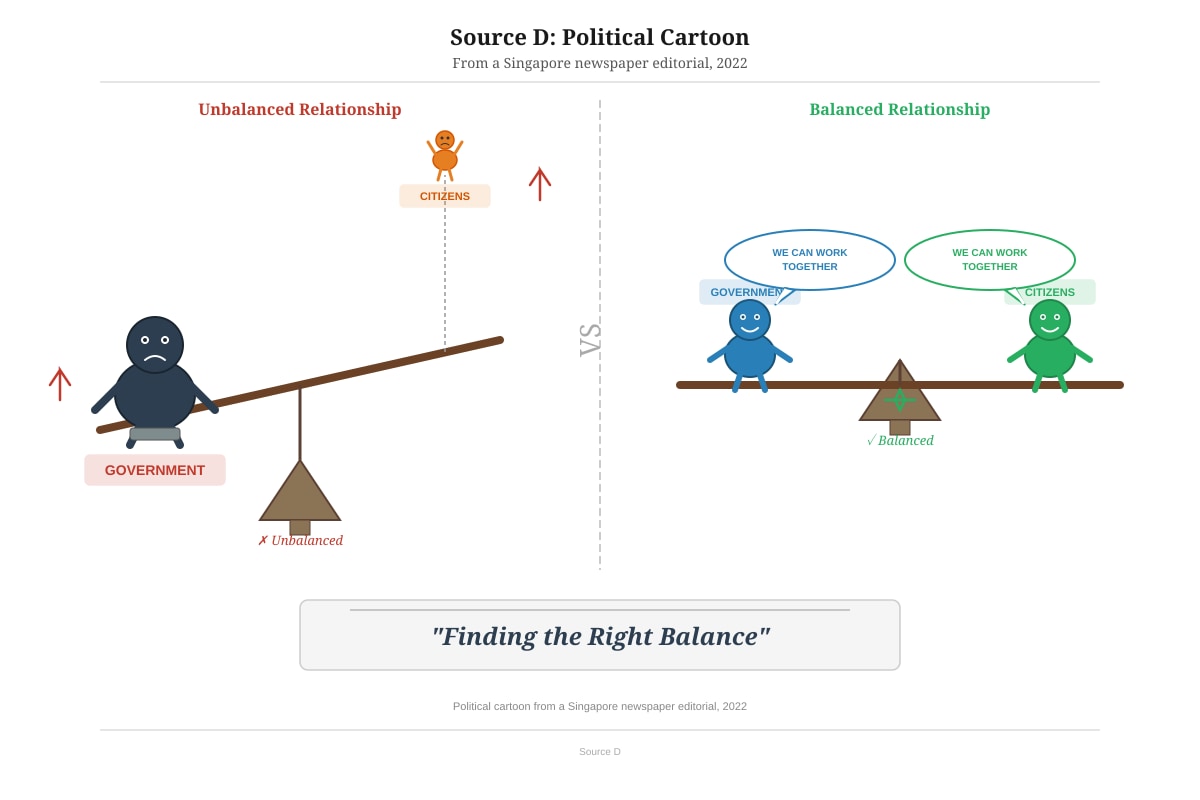
Source D is a political cartoon with two contrasting images:
| Left seesaw | Right seesaw |
|---|---|
| Unbalanced: oversized "GOVERNMENT" vs. tiny "CITIZENS" | Balanced: equal-sized "GOVERNMENT" and "CITIZENS" |
| Citizens are helpless/elevated but powerless | Both parties actively cooperating with "WE CAN WORK TOGETHER" |
| Represents dysfunctional governance-citizen relationship | Represents desired equilibrium |
The cartoon's caption "Finding the Right Balance" explicitly endorses the balanced model.
Step 3 — Evaluate how far Source D supports Source B (2 marks):
| Aspect of support | Explanation |
|---|---|
| Strong support for partnership concept | Both sources reject government dominance in favour of mutual responsibility. The right seesaw visually embodies the MP's verbal description of citizen-government collaboration. |
| Slight divergence in emphasis | Source B emphasises citizen initiative (citizens start projects, government follows with support); Source D presents equal partnership visually without showing who initiates. The cartoon is slightly more symmetrical than Source B's account, where citizens appear more proactive. |
Overall judgment: Source D substantially supports Source B's partnership model, though Source B's narrative of citizen-led initiative with government enablement goes slightly beyond Source D's balanced-but-neutral visual representation.
Marking descriptor:
- Level 1 (1–2 marks): Describes one source or makes simple comparison without evaluating "how far"
- Level 2 (3–4 marks): Identifies both sources' views with some comparison; limited evaluation
- Level 3 (5–6 marks): Balanced analysis recognising both support and any limits; clear evaluative judgment on "how far"
Question 5 [5 marks]
Question: Study Sources C and E. Does Source E support or challenge the majority view expressed in Source C? Explain your answer.
Answer:
Step 1 — Identify the majority view in Source C (1 mark):
The majority view (58%) in Source C is that citizens and government should share responsibility for social provision — specifically elderly care in the survey context.
Step 2 — Identify Source E's argument (1 mark):
Source E, from the White Paper on Women's Development, argues that for gender equality in caregiving:
- Government will expand infrastructure ("infant care places," "paternity leave provisions")
- But "workplace culture change requires more than policy"
- Employers must voluntarily implement flexible arrangements
- Colleagues must challenge assumptions
- Individual citizens must have "honest conversations at home"
- Concludes: "Government sets the framework; society fills it with practice. Neither can achieve gender equality in caregiving alone."
Step 3 — Initial comparison: Direct support (1 mark):
Source E supports the majority view. Both sources endorse:
- Joint rather than exclusive government responsibility
- Active citizen participation beyond passive receipt of services
- Recognition that government alone cannot achieve social outcomes
Step 4 — Nuanced evaluation: Extension beyond Source C (2 marks):
| Supporting element | Extension/challenge element |
|---|---|
| Core support for shared responsibility | Source E adds multiple non-state actors — employers, colleagues, workplace culture — not just "citizens vs. government" |
| Both reject government-only solutions | Source E is more explicit about limits of government power: even with policy framework, "society fills it with practice" implies government cannot compel cultural change |
Conclusion: Source E supports the majority view in Source C but extends it to a more complex multi-actor model where "citizens" is unpacked into employers, colleagues, and family members, and where government's role is deliberately circumscribed to "framework"-setting rather than direct social change.
Marking descriptor:
- Level 1 (1–2 marks): Simple "support" or "challenge" judgment with minimal evidence
- Level 2 (3 marks): Correct judgment with evidence from both sources; limited development
- Level 3 (4–5 marks): Nuanced evaluation recognising support but identifying meaningful extension or qualification; understands that "citizens" in Source E is more differentiated than in Source C
Question 6 [15 marks]
Question: Evaluate the claim that government-citizen partnership is the most effective way to achieve the good of society. In your answer, you must refer to all five sources and your own knowledge about citizenship and governance in Singapore.
Answer structure and content points:
This requires a balanced evaluation using evidence from all sources and own knowledge. The following represents a strong response structure with indicative content.
Introduction (1–2 marks)
- Define "government-citizen partnership" and "good of society"
- Acknowledge that partnership appears widely endorsed but may not be "most effective" in all circumstances
- Outline scope of evaluation: effectiveness depends on type of social good, urgency, and capacity of each party
Arguments that partnership IS most effective (up to 6 marks)
From sources:
- Source A: CERT training shows practical, localised preparedness that government agencies cannot sustain alone; citizen volunteers extend state capacity
- Source B: Meals-on-Wheels succeeded precisely because citizens identified genuine need and managed logistics; government funding without citizen leadership would lack local knowledge
- Source C: Majority public opinion endorses shared responsibility, suggesting partnership aligns with democratic legitimacy
- Source D: Visual representation of balanced partnership as desirable outcome
- Source E: Explicit statement "Neither can achieve gender equality in caregiving alone" — direct endorsement of necessity of partnership
From own knowledge:
- Singapore's Community Development Councils and Resident Committees institutionalise government-citizen partnership in local governance
- The Sars crisis (2003) demonstrated effectiveness of TRACE system plus citizen compliance; Covid-19 similarly required SG Clean ambassadors and public cooperation with vaccination and tracing
- Smart Nation initiatives require citizen digital literacy and uptake, not just government provision
Arguments that partnership may NOT always be most effective / limitations (up to 6 marks)
From sources:
- Source C: 22% still favour government-only responsibility, suggesting some contexts (complex elderly care?) may need state leadership
- Source E: "Government sets the framework" — when rapid, uniform action needed (pandemic lockdowns), deliberative partnership may slow response
From own knowledge:
- External crises (financial crises, security threats) may require decisive government action with limited citizen consultation
- Market failures (housing speculation, environmental externalities) may need regulatory coercion beyond voluntary partnership
- Inequality of citizen capacity: wealthier constituencies partner more effectively, risking unequal social outcomes (digital divide in Smart Nation)
- Historical own knowledge: Elected Presidency and GIC/TH foiem holdings show areas where government expertise is legitimately shielded from direct citizen input
Synthesis and evaluation (2–3 marks)
Strong responses should move beyond "on the one hand/on the other hand" to evaluate:
| Criterion | When partnership is most effective | When partnership is less effective |
|---|---|---|
| Nature of problem | Complex, localised, requiring ongoing commitment (community care, environmental maintenance) | Urgent, technical, requiring uniformity (pandemic response, monetary policy) |
| Citizen capacity | Educated, resourced, organised communities | Marginalised, time-poor, disengaged populations |
| Government role | Enabler, capacity-builder, funder | Direct provider where market/non-state failure |
Conclusion (1–2 marks)
Most effective responses argue that government-citizen partnership is generally effective for the type of social goods described in the Social Studies syllabus — citizenship-building, community resilience, democratic legitimacy — but is not universally "most effective" for all societal goods. The claim should be qualified: partnership is most effective when (a) citizens have capacity and information, (b) problems require sustained local adaptation, and (c) government plays a clear enabling role without abdicating accountability.
Marking descriptor (Issue-Based Case Study standard):
| Level | Marks | Characteristics |
|---|---|---|
| Level 1 | 1–4 | Describes sources; little evaluation; minimal own knowledge; assertion without argument |
| Level 2 | 5–8 | Some evaluation; limited own knowledge; one-sided argument or uncritical acceptance of claim |
| Level 3 | 9–11 | Balanced evaluation with explicit weighing; good use of sources and some own knowledge; beginning of criteria for judgment |
| Level 4 | 12–15 | Sophisticated evaluation with clear criteria; all five sources used meaningfully; substantial, relevant own knowledge; nuanced conclusion recognising limits of claim |
Common mistakes:
- Treating sources as equal evidence rather than evaluating their perspectives
- Describing all five sources without forming an argument about "most effective"
- Using own knowledge only as description rather than as evidence for/against the claim
- Ignoring the evaluative command word "evaluate" and writing purely descriptive account
SECTION B: STRUCTURED ESSAY RESPONSE [25 marks]
Answer ONE question. The following provides guidance for both questions.
Question 7 [25 marks]
"Citizens in Singapore have become too dependent on the government to solve society's problems." Discuss this statement with reference to examples from citizenship and governance.
Analysis of proposition:
This is a classic tension statement requiring evaluation of citizen dependency vs. active citizenship in Singapore's context.
Arguments supporting "too dependent" (agreement):
| Evidence | Explanation |
|---|---|
| High government provision of public housing (85% live in HDB), healthcare, education, CPF | Reduces incentive for informal social support; citizens may lack experience in self-organisation |
| Paternalistic governance tradition; "Singapore Inc." discourse | Citizens socialised to expect technocratic solutions; political culture of waiting for government initiative |
| Low voter turnout in certain contexts; limited civil society growth historically | Indicators of passive rather than active citizenship |
Arguments against "too dependent" (rejection or qualification):
| Evidence | Explanation |
|---|---|
| Rising civil society activism: AWARE, HOME, transient worker NGOs | Citizens address problems government neglects or where government cannot operate due to diplomatic sensitivity |
| Online citizen journalism, crowdfunding for social causes (Ray of Hope, Giving.sg) | Digital-era citizen initiative not captured by "dependency" narrative |
| Neighbourhood initiatives: ground-up groups, heritage conservation efforts, environmental volunteering | Substantial civic engagement at local level |
| 2011 and 2020 General Election campaigns | Increased political engagement, questioning of government entitlement psychology |
Sophisticated evaluation:
Dependency is partially evident but changing. Older generations socialised into developmental-state citizenship may exhibit dependency; younger Singaporeans increasingly combine state expectations with critical engagement. The NE programme and Issues Investigation in Social Studies explicitly aim to reduce dependency. Dependency is also recursive: government's very competence creates expectations that then become self-fulfilling.
Conclusion: The statement is partially true as description but diminishing as trend; it should not be accepted without qualification about generational change, sectoral variation (more dependency in housing/healthcare, less in cultural/identity policy), and government's deliberate efforts to cultivate active citizenship.
Question 8 [25 marks]
"The greatest challenge in working for the good of society is overcoming self-interest." How far do you agree with this statement? Explain your answer with reference to citizenship and governance in Singapore.
Analysis of proposition:
Requires evaluation of self-interest as challenge relative to other obstacles (disagreement, apathy, structural inequality, information deficits, etc.).
Arguments supporting self-interest as greatest challenge:
| Evidence | Explanation |
|---|---|
| Rational choice theory; free-rider problem in public goods | Classic collective action problem: individuals benefit from others' contribution without contributing |
| NIMBYism in Singapore: opposition to shelters, halfway houses, eldercare facilities | Even progressive citizens may support social goods abstractly but resist local costs |
| Consumption vs. conservation: plastic use, car ownership despite COE costs | Individual convenience often overrides collective environmental good |
| Competitive education system, meritocratic values | System incentivises individual advancement; "every school a good school" attempts to reduce zero-sum competition |
Arguments that self-interest is NOT the greatest challenge / other challenges are greater:
| Evidence | Explanation |
|---|---|
| High survey responses showing willingness to contribute (Source C's 58%) | Singaporeans may be prepared to contribute but lack opportunity or information |
| Structural barriers: long working hours, dual-income necessity, housing costs | "Self-interest" may actually be survival imperitives; framing as "self-interest" misidentifies structural constraints |
| Government trust deficit in some domains (pre-2011) | Citizens may avoid engagement due to perceived futility, not selfishness |
| Complexity and technicality of modern governance | Information asymmetry, not self-interest, prevents meaningful participation |
Sophisticated evaluation:
| Challenge | When self-interest dominates | When other factors dominate |
|---|---|---|
| Local, immediate, tangible costs (NIMBY, taxation) | High | Low |
| Abstract, deferred, complex benefits (climate change, pension adequacy) | Low — cognitive limits, not selfishness | High — requires expertise, not sacrifice |
| Issues with clear free-rider potential | High | Low |
Conclusion: Self-interest is a persistent and fundamental challenge due to its universality and invisibility (often disguised as "practical constraints"). However, it is not always "greatest" — structural inequality and information complexity can be more tractable but equally disabling. Most accurate judgment: self-interest is the most pervasive challenge but not always the most decisive; its dominance varies by issue type, transparency of costs/benefits, and institutional design that can redirect self-interest toward public good (e.g. CPF, carbon pricing).
Paper total: 60 marks
- Section A: 35 marks
- Section B: 25 marks
Duration check: 1 hour 30 minutes
- Recommended: 55–60 minutes on Section A (including reading time)
- Recommended: 30–35 minutes on Section B
- Buffer: 5–10 minutes review
End of Answer Key