AI Generated Exam Paper
Secondary 3 Social Studies Practice Paper 5
Free Sec 3 Social Studies Practice Paper 5, HY3 AI version, with questions, answers, and O Level-style practice for Singapore students.
These static practice materials are generated from the site's syllabus and paper-generation workflow, with source and model context shown so students and parents can evaluate the material before use.
Questions
TuitionGoWhere Practice Paper - Social Studies Secondary 3
TuitionGoWhere Practice Paper (AI) — Version 5
Subject: Social Studies
Level: Secondary 3
Paper: Practice Paper (Topic: Source Based Skills)
Duration: 1 hour 15 minutes
Total Marks: 40
Name: ___________________________
Class: ____________
Date: ____________
Instructions:
- This practice paper contains 20 questions across three sections.
- Answer all questions in the spaces provided.
- Read each source carefully before answering source-based questions.
- Section marks and question marks add up to 40.
- This paper is syllabus-first generated content. It is NOT derived from past-year exam papers.
Section A: Understanding Sources (Questions 1–5)
Total: 10 marks
1. [2 marks] Study Source A below.
Source A: A poster from a community club in Singapore reads, "Join our Racial Harmony Day booth to learn about different cultures through food and games!"
What type of source is Source A?
2. [2 marks] Source B is a speech by a Minister: "The government must balance the needs of the elderly and the youth when planning housing." State one reason why this is a useful source for understanding governance.
3. [2 marks] Source C is a photograph of a crowded MRT train during peak hour. What can you infer about daily life in Singapore from this source?
4. [2 marks] Source D is a statistical table showing rising income inequality from 2010 to 2020. Is Source D a primary or secondary source? Give a reason.
5. [2 marks] Source E is a personal blog post by a student complaining about school homework. Why might this source be limited for studying national policy?
Section B: Using Sources (Questions 6–15)
Total: 20 marks
6. [2 marks] Source F (government report): "Citizens are encouraged to give feedback via Reach sessions." Source G (citizen letter): "We feel ignored by town council decisions." Compare what these two sources show about citizen-government engagement.
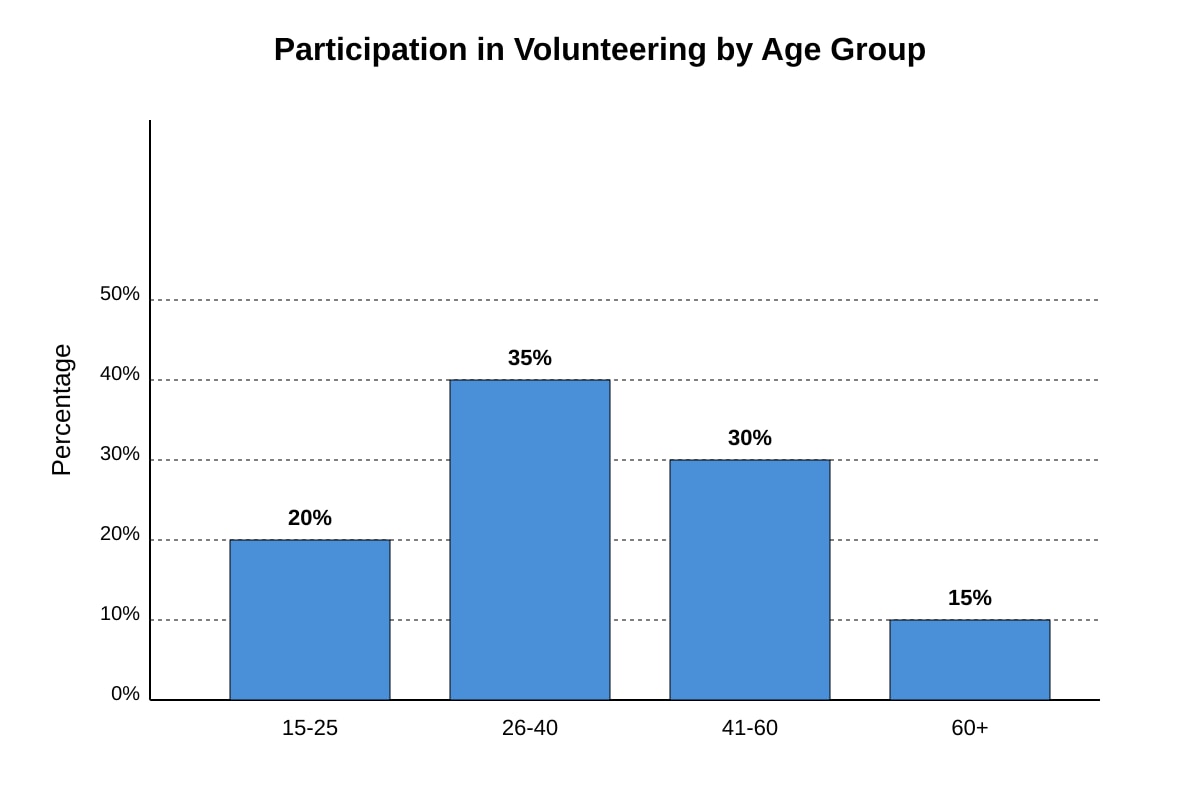
7. [2 marks] Source H: A bar chart titled "Participation in Volunteering by Age Group" showing 15–25 year olds at 20%, 26–40 at 35%, 41–60 at 30%, 60+ at 15%.
Image pending generation: chart for Q7.
Which age group volunteers most? What does this suggest?
8. [2 marks] Source I (news article): "New integration policy helps foreign spouses learn local customs." Explain how this source relates to the concept of integration.
9. [2 marks] Source J (historical document): "In 1965, Singapore faced separation from Malaysia." Why is provenance important when using Source J?
10. [2 marks] Source K (survey): 70% of residents want more parks. Source L (official plan): "We will build 2 new parks in 2025." Does Source L respond to Source K? Explain.
11. [2 marks] Source M is a cartoon showing a large figure labelled "Government" and small figures labelled "Citizens" pulling a rope. What viewpoint does the cartoon suggest about power balance?
12. [2 marks] Source N (speech): "Trade-offs mean some groups pay more for the common good." Define trade-off using this source.
13. [2 marks] Source O (photo): A mixed-race family at a hawker centre. How could this support the idea of harmony in diversity?
14. [2 marks] Source P (data): Crime rate fell from 300 to 200 per 100k from 2015–2022. What trend does Source P show? Why is this relevant to governance?
15. [2 marks] Source Q (diary): "I felt left out because I was new to the school." How might this source help understand diversity challenges?
Section C: Evaluating Sources (Questions 16–20)
Total: 10 marks
16. [2 marks] Source R (official stats) and Source S (social media rumour) both discuss cost of living. Which is more reliable? State one criterion.
17. [2 marks] Source T: A 2023 survey of 1000 students on climate change. Give one way to check if Source T is representative.
18. [2 marks] Source U (policy paper): "Meritocracy ensures fair opportunities." What is a possible bias in Source U?
19. [2 marks] Source V (photo of rally) lacks date and location. Why is this a limitation for source evaluation?
20. [2 marks] Using Sources W (NGO report) and X (government reply), explain one step to judge if they contradict.
Answers
TuitionGoWhere Practice Paper Answer Key — Social Studies Secondary 3 (Version 5)
Subject: Social Studies
Level: Secondary 3
Paper: Practice Paper (Source Based Skills)
Total Marks: 40
Section A: Understanding Sources (Q1–5)
1. [2 marks] Source A is a poster / visual propaganda source from a community club.
- Teaching note: A poster is a created artifact for public information; it is a primary source of a local event. 1 mark for type, 1 mark for identifying community origin.
2. [2 marks] Useful because it is a direct statement from a government leader showing policy intent.
- Teaching note: Minister speech = primary source showing official governance view. 1 mark reason, 1 mark link to governance.
3. [2 marks] Inference: High density / crowded living / reliance on public transport.
- Teaching note: Photo shows real condition; infer daily commute stress. 1 mark inference, 1 mark explanation.
4. [2 marks] Secondary source because it compiles existing data.
- Teaching note: Tables summarising stats are secondary. 1 mark type, 1 mark reason.
5. [2 marks] Limited because it is personal, not representative of national policy.
- Teaching note: Blog = subjective. 1 mark limitation, 1 mark reason.
Section B: Using Sources (Q6–15)
6. [2 marks] Source F shows formal feedback channels; G shows citizens feel unheard → gap between policy and perception.
- Marking: 1 mark compare, 1 mark insight.
7. [2 marks] 26–40 age group (35%) volunteers most; suggests mid-career adults engage more.
- Image note: Chart must show bars 20/35/30/15%. Answer uses labelled values.
8. [2 marks] Integration = minorities and majority adapt mutually; source shows foreign spouses learning customs = integration not assimilation.
- 1 mark concept, 1 mark application.
9. [2 marks] Provenance (1965 context) affects meaning; separation shaped policies.
- 1 mark provenance, 1 mark relevance.
10. [2 marks] Yes, plan builds parks matching survey want.
- 1 mark yes, 1 mark link.
11. [2 marks] Cartoon suggests government has more power / citizens smaller role.
- 1 mark view, 1 mark symbol explanation.
12. [2 marks] Trade-off = sacrificing some interests for greater good (per source).
- 1 mark definition, 1 mark use of source.
13. [2 marks] Shows real mixed-race harmony at common space (hawker).
- 1 mark evidence, 1 mark link to harmony.
14. [2 marks] Trend: crime fell; relevant as governance success.
- 1 mark trend, 1 mark relevance.
15. [2 marks] Shows personal experience of exclusion; helps understand diversity cost.
- 1 mark use, 1 mark link.
Section C: Evaluating Sources (Q16–20)
16. [2 marks] Official stats more reliable; criterion: verifiable / authored.
- 1 mark choice, 1 mark criterion.
17. [2 marks] Check sample size (1000) and method (random?).
- 1 mark method, 1 mark representativeness.
18. [2 marks] Bias: presents meritocracy positively, may ignore inequality.
- 1 mark bias identified.
19. [2 marks] No date/location = cannot verify context.
- 1 mark limitation.
20. [2 marks] Step: compare claims line by line for conflicting facts.
- 1 mark step.
All 20 questions answered; total 40 marks verified.
Free quiz and exam paper access
Enter your details to view this paper
Your access is remembered on this device.