AI Generated Exam Paper
Secondary 3 Social Studies Practice Paper 4
Free Sec 3 Social Studies Practice Paper 4, DeepSeek AI version, with questions, answers, and O Level-style practice for Singapore students.
These static practice materials are generated from the site's syllabus and paper-generation workflow, with source and model context shown so students and parents can evaluate the material before use.
Questions
Free quiz and exam paper access
Enter your details to view this paper
Your access is remembered on this device.
Answers
TuitionGoWhere Practice Paper - Social Studies Secondary 3
Answer Key and Marking Scheme (Version 4)
Topic: Source Based Skills Total Marks: 25
Question 1: Inference (Source A) [5 marks]
Award 1 mark for a basic inference of the message. Award 2-3 marks for a developed inference with some support. Award 4-5 marks for a well-developed inference that captures the deeper meaning, supported by detailed evidence.
Model Answer:
The message of Source A is that preserving one's cultural heritage is essential for building a strong personal identity, which in turn allows one to confidently and successfully engage with globalisation. The source argues that tradition and global culture are not opposites, but that a strong foundation in one's own culture is a prerequisite for meaningful global participation.
Evidence and Explanation:
- The source uses the metaphor of a tree: "Our traditions are the roots that keep us grounded." This implies that cultural heritage provides stability and a sense of self ("a strong sense of self").
- It states that knowing one's heritage means "we have something unique to offer" when engaging with the world. This suggests that local culture is not a barrier but a valuable asset in a globalised context.
- The final line, "A tree without strong roots will be blown over by the first strong wind of globalisation," reinforces the message. The "strong wind" represents the potentially overwhelming force of global culture. The message is a warning: without a secure cultural identity, a person (or society) is vulnerable and will be unable to withstand the pressures of globalisation. The deeper message is that cultural grounding is a form of strength, not weakness, in a modern world.
Question 2: Comparison (Sources B and C) [7 marks]
Award 1 mark for a simple point of similarity or difference. Award 2-3 marks for identifying a difference/similarity with some evidence from one source. Award 4-5 marks for a clear comparison explaining one side with evidence from both sources. Award 6-7 marks for a well-developed comparison that analyses both similarity and difference in attitude, supported by detailed evidence from both sources.
Model Answer:
Sources B and C are fundamentally different in their attitudes towards traditional culture.
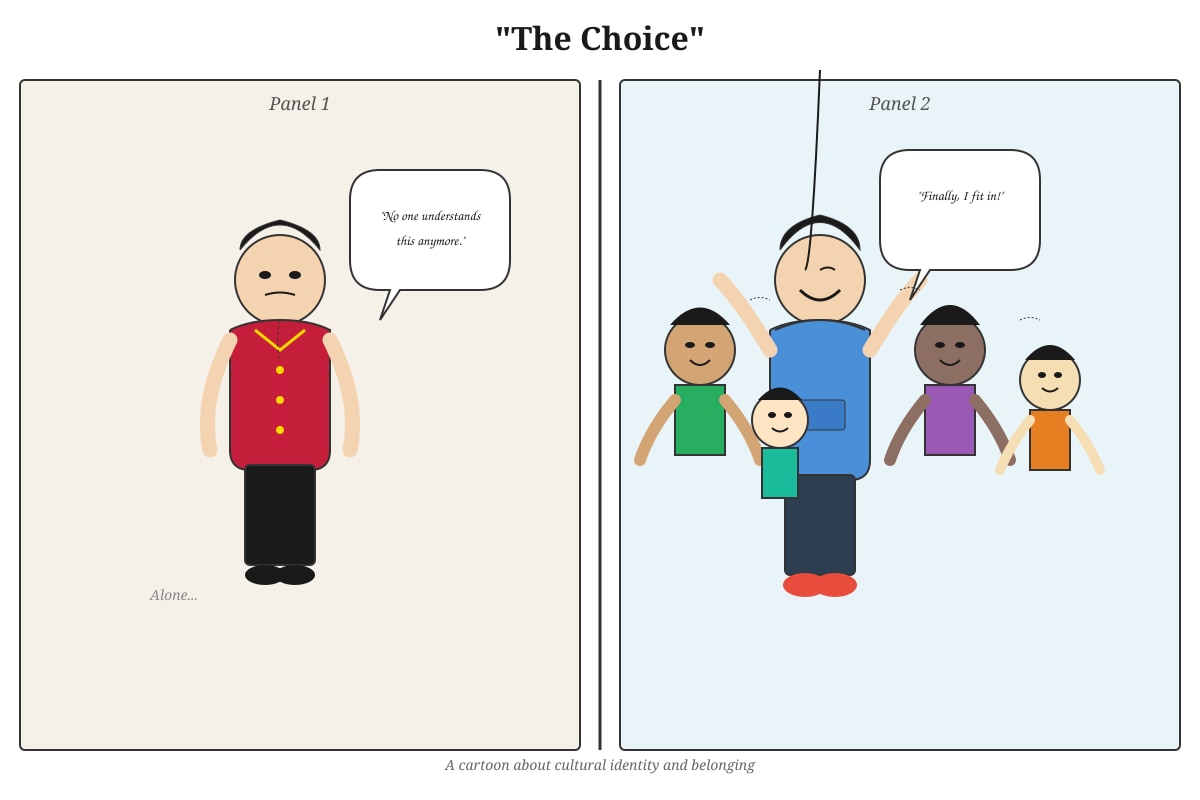
Difference in Attitude: Source B presents a conflicted and somewhat negative view of traditional culture's social function. The left panel shows a teenager in traditional costume feeling isolated ("No one understands this anymore"), suggesting that holding onto tradition leads to social exclusion. The right panel shows the same teenager happy and integrated when adopting global culture ("Finally, I fit in"). The title "The Choice" frames this as a binary decision where social belonging is achieved by abandoning traditional culture. The source's attitude is that traditional culture is a barrier to social acceptance for young people.
In contrast, Source C's attitude is openly dismissive and hostile. The user calls the preservation of tradition an "obsession" that is "holding us back," and dismisses customs as having "no relevance to our lives today." The tone is one of active rejection, viewing cultural loss not as a problem but as "progress." While Source B depicts a sad, reluctant choice, Source C celebrates the abandonment of tradition as a rational and forward-thinking decision.
Similarity in Outcome: Despite their different tones, both sources share a similarity in their perceived outcome: that traditional culture is incompatible with a modern, globalised identity. Source B implies that to "fit in" one must choose global culture. Source C explicitly states that being a "global citizen means embracing a global culture," leaving no room for traditional culture. Both sources, therefore, present a worldview where young people must move away from tradition to succeed or belong in a globalised world, even if Source B does so with regret and Source C with enthusiasm.
Question 3: Purpose (Source D) [6 marks]
Award 1 mark for a simple statement of purpose. Award 2-3 marks for identifying a purpose with some reference to the source's content or provenance. Award 4-5 marks for a developed explanation of purpose, linking content to intended outcome. Award 6 marks for a well-developed analysis of purpose that considers the source's message, intended audience, and desired outcome, with reference to provenance.
Model Answer:
The purpose of Source D, a press release by the Ministry of Culture, Community and Youth (MCCY), is to promote and justify the government's new "OurSG Heritage 2.0" grant scheme to the public, particularly to community groups and potential applicants.
Explanation:
- Message and Outcome: The source delivers a clear message that preserving heritage is a crucial and forward-looking national project. It directly counters the view that heritage is about "looking backwards" by stating it is about "carrying forward the values, stories, and practices that bind us together." The desired outcome is to encourage applications for the grant ("We encourage innovative projects...") and to shape public perception so that heritage preservation is seen as a modern, relevant, and unifying activity.
- Audience and Context: As a government press release, it is aimed at the general public, media, and specifically at the "community groups and individuals" who might apply. The provenance (MCCY) is key. The government has an interest in fostering social cohesion. By linking heritage to "national identity" and "social cohesion" in an "era of rapid globalisation," the source aims to build consensus that this government initiative is necessary and beneficial for the nation's well-being.
- Tone and Language: The positive and proactive language ("empower," "revitalise," "innovative," "accessible and exciting") serves to make the scheme attractive and to associate heritage with dynamism, not stagnation. The purpose is therefore not just to inform, but to persuade the audience to support and participate in this government-led vision of heritage management.
Question 4: Evaluation of Statement Using All Sources [7 marks]
Award 1-2 marks for a simple answer that agrees or disagrees with the statement, using one source. Award 3-4 marks for an answer that uses at least two sources to support and/or challenge the statement. Award 5-6 marks for a balanced evaluation using evidence from most sources to both support and challenge the statement. Award 7 marks for a well-reasoned, balanced conclusion that evaluates the statement's validity by weighing evidence from all sources, showing how far they prove the statement.
Model Answer:
The statement "The sources prove that young Singaporeans see no value in traditional culture in a globalised world" is not fully supported. While some sources show a clear rejection of tradition, others strongly refute this, and the overall picture is more complex than the statement suggests. The sources do not "prove" the statement; they provide evidence for a range of views.
Sources that support the statement:
- Source C is the strongest supporter. The user "GlobalCitizenSG" explicitly states that preserving tradition is an "obsession... holding us back" and that cultural loss is "progress." This directly shows a young person (implied by the platform and language) who sees zero value in traditional culture, viewing it as an obstacle to a global future.
- Source B partially supports the statement. The cartoon depicts a teenager who feels social pressure to abandon traditional culture to "fit in." The source implies that for this young person, global culture holds the value of social belonging, while traditional culture offers only isolation. However, the teenager in the left panel looks sad, not contemptuous, suggesting the choice is painful, not a reflection of seeing "no value."
Sources that challenge the statement:
- Source A directly challenges the statement. The cultural leader is speaking to young people at a youth forum, and the entire message is that traditional culture has immense value as "roots" that provide a "strong sense of self" and a "unique" offering to the world. The source argues that young people should see value in it to survive globalisation.
- Source D also challenges the statement. As a government body, MCCY is launching a grant because it believes heritage is "more crucial than ever" for "national identity and social cohesion." The source explicitly aims to make heritage "exciting for the next generation," which implies a belief that young people can and should see value in it, even if they currently need innovative ways to connect with it.
Conclusion: The sources do not prove the statement. They show a spectrum of attitudes. Source C represents one end (active rejection), while Source A represents the other (active promotion of value). Source B shows a young person caught in a difficult social trade-off, not a simple dismissal of value. Source D shows an institutional belief in heritage's value and an attempt to cultivate it among the young. Therefore, the sources suggest that while some young people may reject traditional culture, it is inaccurate to claim this is a universal or proven truth. The reality is a contested space with competing pressures and perspectives.