AI Generated Exam Paper
Secondary 3 Social Studies Practice Paper 3
Free Sec 3 Social Studies Practice Paper 3, Kimi2.6 AI version, with questions, answers, and O Level-style practice for Singapore students.
These static practice materials are generated from the site's syllabus and paper-generation workflow, with source and model context shown so students and parents can evaluate the material before use.
Questions
Free quiz and exam paper access
Enter your details to view this paper
Your access is remembered on this device.
Answers
Answer Key: TuitionGoWhere Practice Paper - Social Studies Secondary 3
Version 3 of 5
SECTION A: Source Interpretation and Inference [30 marks]
1. What is the main message of Source A? Use evidence from the source to support your answer. [3 marks]
Answer:
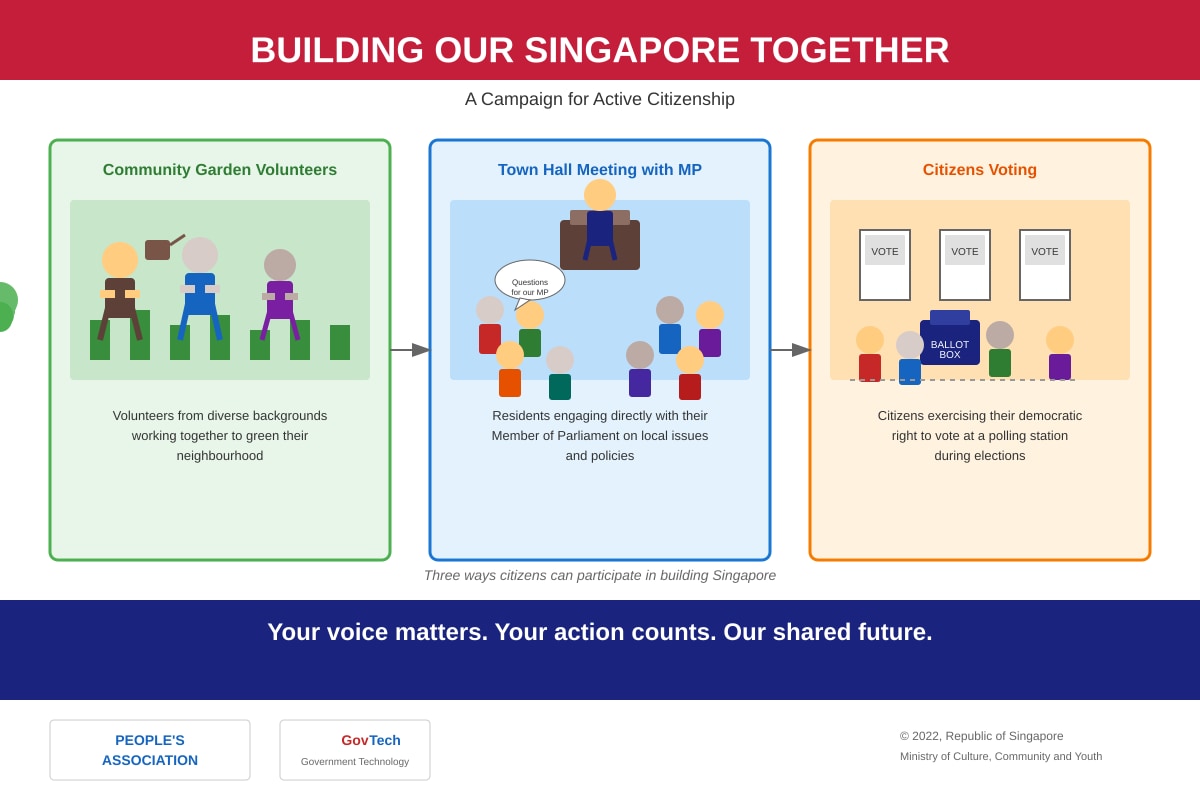
The main message is that active citizenship in Singapore involves multiple forms of participation—voluntary community service, political engagement, and democratic participation—and that both individual citizens and government agencies share responsibility for building the nation's future.
Evidence from source:
- The three panels show diverse forms of participation: community volunteering (community garden), political engagement (town hall meeting with MP), and electoral participation (voting)
- The unified title "Building Our Singapore Together" and the closing statement "Our shared future" emphasise collective responsibility
- The inclusion of PA and GovTech logos indicates government-citizen partnership rather than purely bottom-up or top-down initiative [1 mark per point, max 3]
Teaching note: The "main message" requires identifying the overarching purpose, not just describing individual elements. Look for connecting language ("Together," "shared") that unifies disparate visual elements into a coherent argument.
2. Identify the purpose of Source A. Explain your answer using details from the source. [3 marks]
Answer:
The purpose is to encourage and mobilise Singapore citizens to participate actively in civic life, while simultaneously legitimising the government's role in facilitating such participation.
Explanation:
- The imperative mood of "Your voice matters. Your action counts" directly exhorts citizens to act [1 mark]
- The visual representation of ethnically diverse participants across age groups models inclusive, desirable behaviour that viewers can identify with [1 mark]
- The government agency logos frame participation as structured and validated by state institutions, reinforcing trust in official channels rather than purely spontaneous activism [1 mark]
Common mistake: Do not state the purpose is merely "to inform"—posters are persuasive instruments. The active verbs and direct address ("Your") signal mobilisation.
3. Using Source C, identify two trends in public engagement with government in Singapore between 2019 and 2023. [4 marks]
Answer:
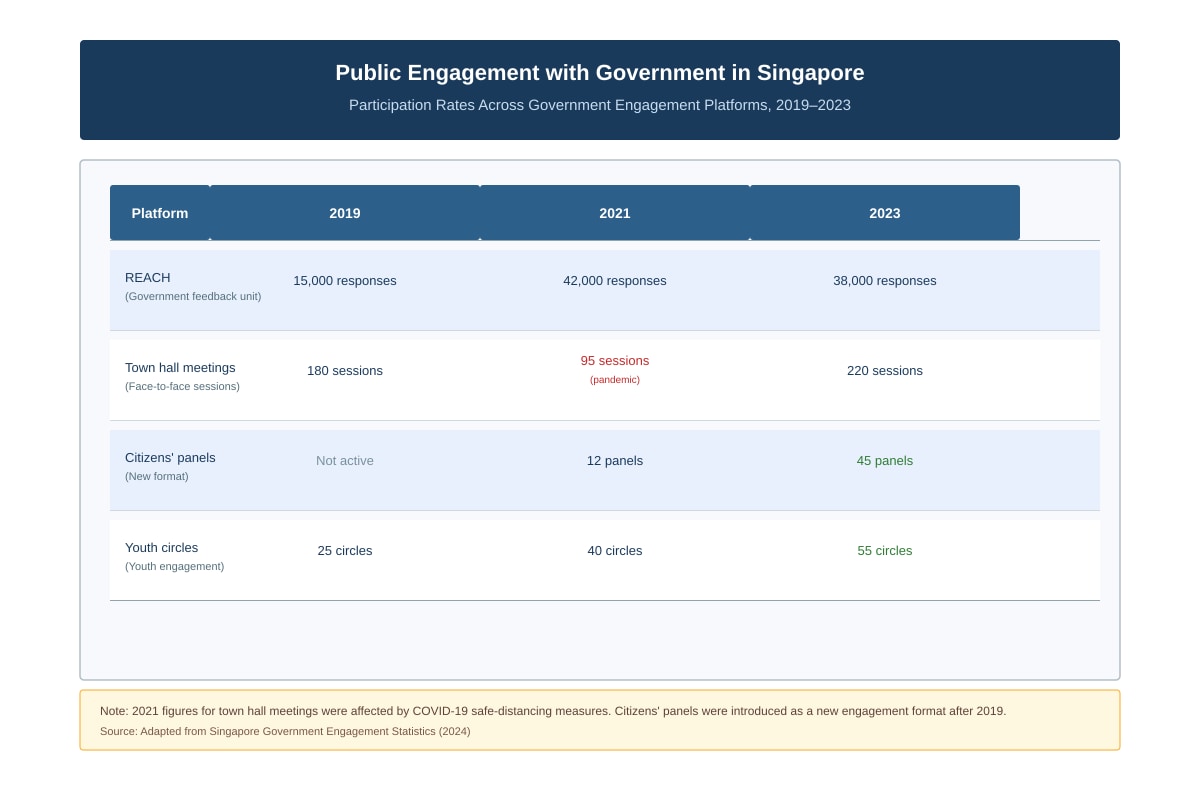
Trend 1: The pandemic disrupted traditional forms of engagement but accelerated new formats. Town hall meetings dropped from 180 (2019) to 95 (2021) due to safe management measures, while citizens' panels were introduced (12 in 2021, growing to 45 in 2023). [2 marks]
Trend 2: Youth engagement has grown consistently regardless of pandemic conditions. Youth circles increased steadily from 25 (2019) to 40 (2021) to 55 (2023), suggesting sustained investment in younger cohorts. [2 marks]
Alternative Trend 3 (accepted): REACH feedback peaked during the pandemic (42,000 in 2021) but moderated slightly to 38,000 in 2023, possibly indicating either resolution of urgent concerns or "feedback fatigue." [2 marks if chosen as one of two]
Teaching note: A "trend" requires describing change over time, not just stating figures. Always connect data points with causal or correlational language.
4. How far does Source C show that citizens are becoming more active in governance? Explain your answer. [5 marks]
Answer:
Source C partially supports this view but with significant limitations.
Evidence supporting "more active":
- Overall participation platforms expanded from three to four (citizens' panels introduced), and total engagement volume generally increased [1 mark]
- Youth circles nearly doubled (25 to 55), suggesting generational deepening of engagement habits [1 mark]
- Recovery of town hall meetings to 220 in 2023 (exceeding 2019 levels) indicates pent-up demand for direct engagement [1 mark]
Evidence qualifying or limiting:
- The 2023 REACH figure (38,000) fell below 2021's pandemic peak, suggesting some forms of engagement are situational rather than sustained [1 mark]
- "Activity" measured here is institutionally channelled through government-designed platforms; the data does not capture informal, dissent-based, or spontaneous civic action [1 mark]
Conclusion: The source shows citizens are becoming more active within official frameworks, but "governance" remains government-led; the source cannot show whether citizens are becoming more active in shaping governance autonomously. [L2/3 boundary]
Marking descriptor: L1 (1-2): Describes data without evaluative framing. L2 (3-4): Evaluates with some balance but limited source reference or conflation of "more platforms" with "more active citizens." L3 (5): Discriminates between institutional participation and autonomous civic engagement, with explicit source reference.
5. What does Source B suggest about the relationship between citizens and government in Singapore? [3 marks]
Answer:
Source B suggests a reciprocal but asymmetrical relationship where both parties need each other, but government sets the framework and citizens operate within it.
Evidence:
- The phrase "we cannot succeed without active citizens" acknowledges interdependence—government depends on citizen cooperation [1 mark]
- The COVID-19 examples position citizens primarily as compliers, volunteers, and helpers rather than co-decision-makers, suggesting a supportive but not equal role [1 mark]
- The final question—"does this mean citizens should simply follow...or should they also question"—and the answer "our governance system creates space for this" implies government confers the legitimacy and mechanisms for engagement, which citizens "must use wisely" [1 mark]
Teaching note: Note the nuanced tension in the source: the MP both praises citizen action and questions whether it goes far enough. This "suggest" question requires reading between the lines, not just literal extraction.
6. Comparing Sources A and B, how far do they agree about what "active citizenship" means? [5 marks]
Answer:
They agree on the core principle but differ in emphasis and complexity.
Agreement:
- Both include community/voluntary action (Source A's community garden; Source B's volunteers at vaccination centres) [1 mark]
- Both feature political participation (Source A's voting and town hall; Source B's "constructive engagement" and "question policies") [1 mark]
- Both position government as enabling or facilitating citizen action [1 mark]
Divergence:
- Source A presents simplified, celebratory participation across three clear domains without tension or conflict
- Source B introduces critical interrogation: citizens should "question policies when needed," and the MP explicitly problematises whether following directives constitutes true citizenship [1 mark]
- Source A's "active citizenship" is largely performance (doing things); Source B's includes discursive and evaluative dimensions (thinking, questioning, judging) [1 mark]
Conclusion: The sources agree on visible, cooperative behaviours but Source B advances a more intellectually demanding and potentially oppositional conception of active citizenship than Source A's harmonious portrayal.
7. How useful is Source D for understanding how citizens should evaluate government performance in Singapore? Explain your answer. [4 marks]
Answer:
The source is substantially useful but not sufficient alone.
Usefulness:
- It directly addresses the evaluative criteria citizens might use: pragmatism/flexibility versus ideological consistency [1 mark]
- It provides concrete policy examples (population policy U-turns, welfare evolution, sustainability emphasis) that citizens can verify or recall, grounding abstract debate in evidence [1 mark]
- It presents balanced perspectives (critic and supporter), modelling how citizens should weigh multiple viewpoints [1 mark]
Limitations:
- It is a secondary academic commentary, not a primary source of government position or citizen experience; it tells citizens what to debate but not how to resolve evaluations
- It lacks contemporary data on whether citizens actually value flexibility or consistency, which would be needed to understand how citizens do evaluate government versus how they should [1 mark]
8. "Singapore's approach to governance makes it easy for citizens to be actively involved." How far do Sources A to D support this statement? Use evidence from all four sources and your own knowledge. [3 marks]
Answer:
The sources offer mixed support with significant qualifications.
Supporting evidence:
- Source A shows multiple accessible channels (community, political, electoral) visually presented as welcoming and inclusive
- Source C demonstrates institutional expansion of engagement platforms, particularly for youth
Qualifying evidence:
- Source B suggests active citizenship requires more than ease—it requires judgement about when to comply and when to question; the MP's rhetorical question implies this tension is not easily navigated
- Source D notes that pragmatic flexibility without ideological anchors may actually make it harder for citizens to hold government accountable, implying structural difficulty in meaningful involvement
Own knowledge: The Grassroots Adviser system and Citizens' Consultative Committees provide structured participation, but critics note these are government-initiated and may not accommodate adversarial voices easily.
Conclusion (L3): The sources show Singapore creates structured opportunities for involvement, but "easy" active citizenship—implying low-cost, high-impact participation—is not fully supported; the sources reveal cognitive and structural demands that complicate simple involvement.
SECTION B: Source Evaluation and Application [40 marks]
9. Using Source F, explain two ways the Singapore government supports citizens with different needs. [4 marks]
Answer:
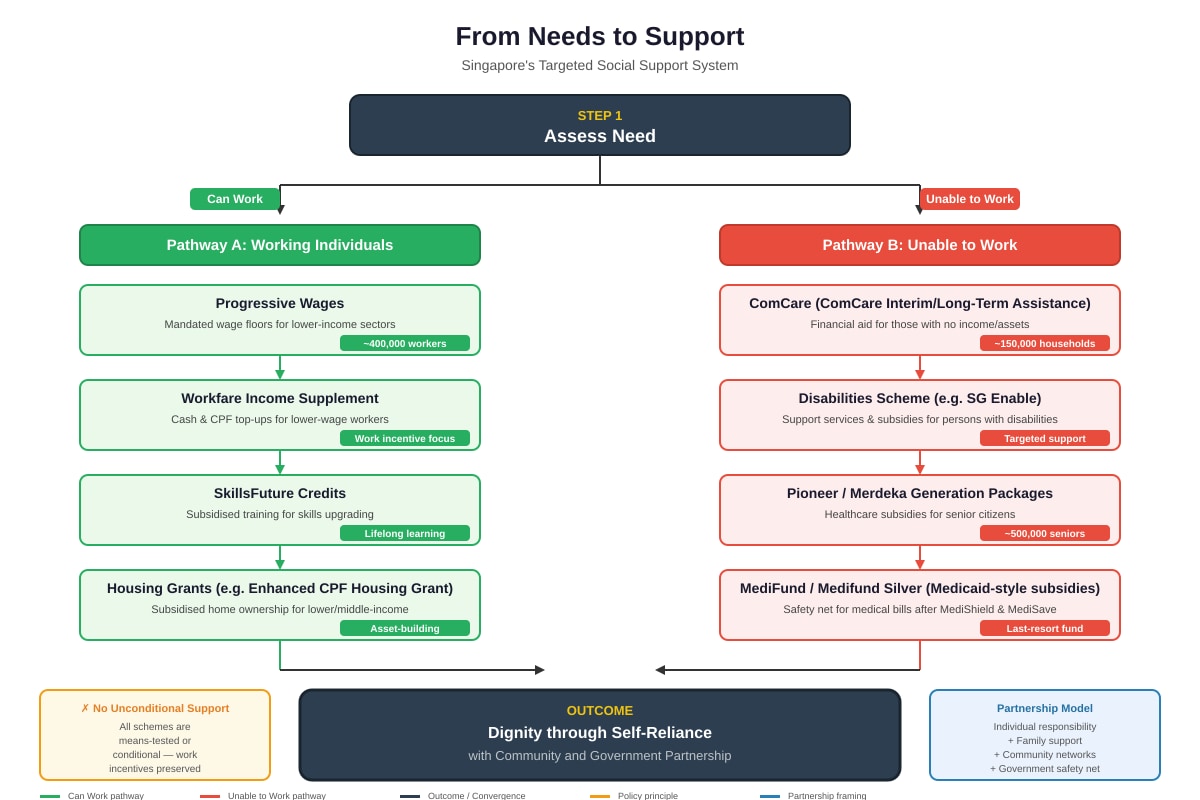
Way 1: Conditional support based on work capability [1 mark]: The infographic shows a branching system where those who "Can work" receive employment-linked support—Progressive Wages, Workfare, SkillsFuture Credits, and housing grants—designed to make work pay and enhance employability [1 mark for development]
Way 2: Direct assistance for those unable to work [1 mark]: Those "Unable to work" access ComCare, disability schemes, generation-specific packages, and medical subsidies—providing essential needs without work requirements, recognising that self-reliance is not universally achievable [1 mark for development]
Teaching note: The key insight from Source F is the conditional architecture: support is not uniform but stratified by perceived capacity. Students must identify both pathways and explain the differing logic (work-enablement vs. direct provision).
10. What does Source E reveal about the Singapore government's attitude toward social inequality? Explain your answer. [4 marks]
Answer:
Source E reveals a pragmatic, interventionist but non-egalitarian attitude.
Evidence and explanation:
- The government acknowledges market-generated inequality (Gini 0.435) as real and problematic enough to require response, rejecting pure laissez-faire [1 mark]
- It actively redistributes through layered interventions (Progressive Wage Model, Workfare, housing subsidies), demonstrating belief in state responsibility to modify market outcomes [1 mark]
- The significant Gini reduction (0.435 to 0.378) is publicly cited as achievement, suggesting the government measures and communicates its redistributive performance [1 mark]
- However, the rejection of "universal welfare" and emphasis on "work is rewarded" reveals prioritisation of efficiency and incentive preservation over equality of outcome; the attitude is that inequality is mitigated, not eliminated, and targeted intervention preserves desired behaviours [1 mark]
11. How far does Source H challenge the view presented in Source F? [5 marks]
Answer:
Source H substantially challenges Source F's framing, though partially convergent.
Direct challenges:
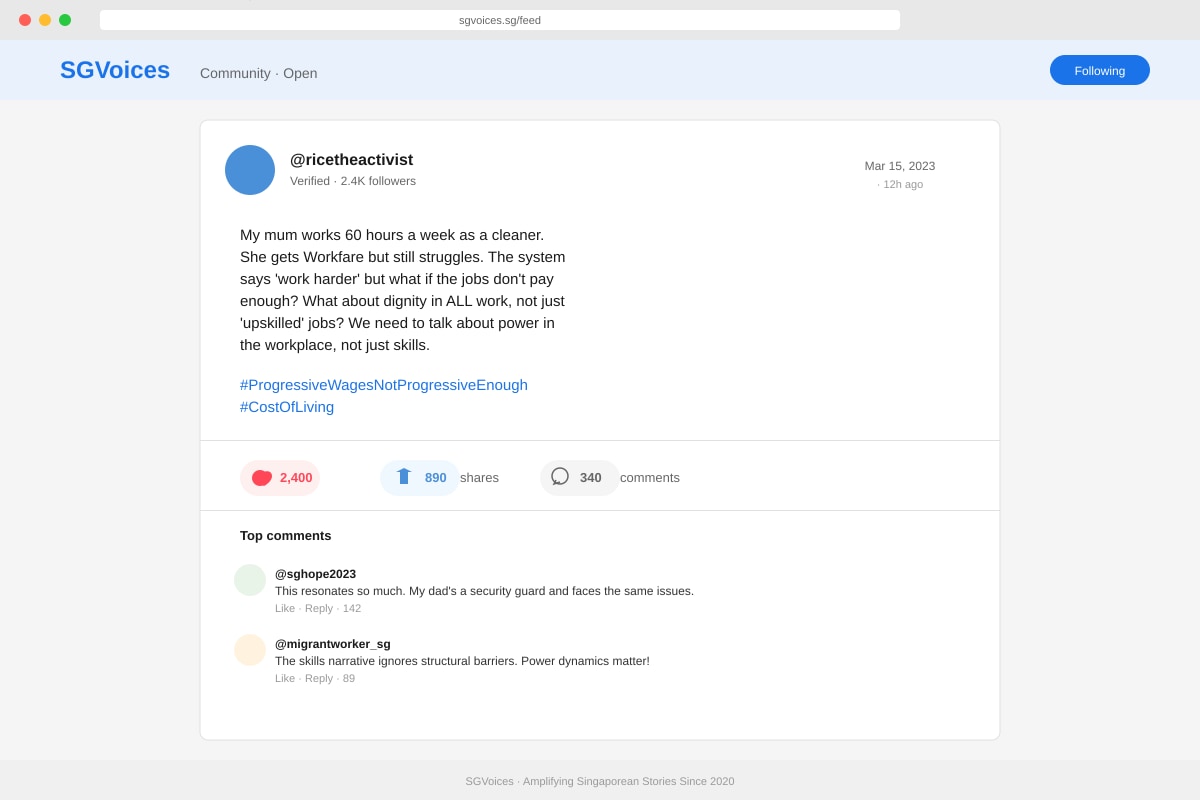
- Source F presents a skills-upgrading pathway ("Can work → Progressive Wages → SkillsFuture") implying advancement through individual capability development; Source H's mother's 60-hour cleaning work with persistent struggle undermines the narrative that current pathways sufficiently reward existing work [1 mark]
- Source H explicitly questions "What about dignity in ALL work, not just 'upskilled' jobs," directly attacking the hierarchical valuation of labour embedded in Source F's conditional structure [1 mark]
- The hashtag "#ProgressiveWagesNotProgressiveEnough" indicts the adequacy of the very scheme Source F features prominently [1 mark]
Partial convergence:
- Both acknowledge government provision exists (Workfare in Source H; entire system in Source F); the challenge is to scale and conception, not existence [1 mark]
- Both implicitly agree that work should be supported, but disagree whether current support matches need
Evaluation: Source H challenges Source F most fundamentally on whose voice defines "success." Source F is an institutional, top-down representation of system logic; Source H is experiential, bottom-up testimony of system failure for specific cases. The challenge is potent precisely because it uses the system's own terms (Workfare, Progressive Wages) to show insufficiency. [1 mark for evalative comparison]
12. Evaluate the reliability of Source H for understanding public attitudes toward social policy in Singapore. [5 marks]
Answer:
Reliability is moderate—valuable for specific insights but limited in representativeness.
Strengths supporting reliability:
- Authentic lived experience: First-person testimony from someone directly connected to policy impact (mother as cleaner) carries empirical weight that official statistics lack [1 mark]
- Engagement metrics (2,400 likes, 890 shares) provide proxy evidence of resonance with at least a social media-active segment, suggesting the view is not isolated [1 mark]
- Specific policy references (Workfare, Progressive Wages, skills narrative) demonstrate informed engagement with actual policy discourse, not ignorant complaint [1 mark]
Limitations undermining reliability:
- Single case: Anecdotal evidence from one family cannot represent all "public attitudes"; we lack data on whether this experience is typical or exceptional
- Platform bias: SGVoices likely attracts already-critical or politically engaged users; the engagement metrics may reflect algorithmic amplification or activist network effects rather than broad public sentiment
- Unknown author verification: @ricetheactivist's identity and claims are unverified; astroturfing or oversimplification is possible
- Temporal specificity: March 2023 data captures a specific cost-of-living moment; attitudes may shift with policy adjustments [2 marks for any two limitations with development]
Conclusion: Reliable for understanding experiential critique and activist framing, but should be triangulated with representative surveys (e.g., Ministry of Social and Family Development quality-of-life surveys) for comprehensive public attitude assessment.
13. "Singapore's social policies successfully balance efficiency and compassion." How far do Sources E, F, and G support this view? [8 marks]
Answer:
The sources offer qualified support, with significant tensions exposed.
Support for "successful balance":
Efficiency:
- Source E: Low fiscal cost (3% GDP vs. 15-25%) with substantial Gini reduction (0.435 to 0.378) demonstrates cost-effective poverty reduction [1 mark]
- Source F: The conditional architecture targets resources precisely, avoiding leakage to those who could self-provide [1 mark]
- Source G confirms "impressive poverty reduction with relatively low fiscal cost" [1 mark]
Compassion:
- Source F's "Outcome: Dignity through self-reliance" and extensive provision for "Unable to work" recognising varying circumstances shows humanitarian concern [1 mark]
- Source E's Minister's statement about "robust safety net for those unable to work" acknowledges limits of self-reliance ideology [1 mark]
Challenges to balance:
Efficiency may compromise compassion:
- Source G identifies exclusion errors from administrative complexity—some eligible families miss support, undermining compassionate intent [1 mark]
- Gig economy gaps: Those in non-standard employment fall "between schemes," revealing efficiency-driven categorisation excludes emerging vulnerable groups [1 mark]
- Source H (usable as own knowledge context): The cleaning mother's 60-hour work with persistent struggle suggests compassion is procedural but not always material
Compassion framed to serve efficiency:
- Source G notes the "heavy emphasis on work attachment" may reflect efficiency concerns (incentive preservation) overriding unconditional compassion [1 mark]
- "Stigma attached to means-testing" from Source G indicates compassion is conditional and potentially humiliating, not generous [1 mark]
Synthesis: The sources support that Singapore achieves market efficiency metrics successfully and has structured compassion programmes, but the "balance" is contested. Compassion is operationalised through efficiency logics (targeting, conditionality), which Source G and the implied experience of Source H suggest creates systematic blind spots. Whether this constitutes "successful" balance depends on evaluative priority: material outcomes (strong) versus dignified process (questioned) versus universal security (limited). [L3: 7-8 marks for evaluation with explicit source integration and conceptual framing]
14. Using your own knowledge, explain one other way the Singapore government has addressed social inequality since 2015. [4 marks]
Answer:
Merdeka Generation Package (announced 2019, building on Pioneer Generation):
Description: Provided MediSave top-ups, outpatient care subsidies, and MediShield Life premium subsidies for Singaporeans born in the 1950s, a cohort who contributed to nation-building but may have limited retirement savings due to lower historical wages.
How it addresses inequality:
- Intergenerational equity: Recognises that current elderly faced different economic conditions (less compulsory education, lower CPF contributions in early years) through no fault of their own [1 mark]
- Health cost mitigation: Subsidies target major predictable expense for elderly, preventing health shocks from becoming poverty triggers [1 mark]
- Symbolic recognition: The "Generation" framing, like Pioneer before it, legitimises support through contribution narrative rather than pure need, maintaining political palatability while redistributing [1 mark]
- Complements work-based systems: Those who worked but in low-wage sectors benefit without requiring ongoing employment, filling gaps that Workfare (which requires current work) cannot address [1 mark]
Alternative acceptable answers: Silver Support Scheme enhancements, COVID-19 Solidarity Payments, Assurance Package for GST increase mitigation, or significant childcare subsidy expansions (e.g., Partner Operator Scheme, Anchor Operator Scheme allowing broader subsidy access).
15. "Social media posts like Source H are more useful than official sources for understanding the true impact of government policies." How far do you agree? [6 marks]
Answer:
This claim has merit but is ultimately overstated; optimal understanding requires both source types.
Arguments supporting greater usefulness of social media sources:
- Experiential authenticity: Source H captures affective and material dimensions of policy impact (struggle, hours worked, dignity concerns) that official sources like Source E and F, which present aggregated or schematic data, cannot convey [1 mark]
- Lag identification: Official sources may report programme existence; social media reveals implementation gaps and time lags between policy announcement and lived improvement [1 mark]
- Critical perspectives: Official sources rarely problematise their own frameworks; Source H's questioning of "upskilling" narrative provides counter-hegemonic viewpoint essential for balanced evaluation [1 mark]
- Issue identification for further investigation: viral posts (2,400 likes, 890 shares) can signal emerging problems before they appear in formal statistics
Arguments for continued necessity of official sources:
- Representativeness: Source H is one unverified case; official sources like Source C's REACH data or Source E's Gini statistics provide systematic, generalisable patterns [1 mark]
- Structural context: Official sources explain why policies are designed as they are (fiscal constraints, incentive effects, trade-offs) that experiential sources typically ignore; Source G's efficiency/compassion framework helps evaluate whether shortcomings are design failures or necessary compromises [1 mark]
- Verification and scale: Official figures allow cross-checking of anecdotal claims; without Source E's Gini data, we cannot assess whether Source H's experience is typical or exceptional [1 mark]
- Democratic accountability: Official sources, through parliamentary debate and ministerial statements, represent institutional deliberation that social media outrage cannot replace
Synthesis: Social media posts like Source H are indispensable for surfacing subaltern experiences and testing policy narratives against reality, but "more useful" requires they supplant rather than supplement official sources. For comprehensive understanding—particularly for citizens making voting or advocacy decisions—integration is essential: social media identifies whom to ask about, official sources establish how widespread the issue is, and critical academic sources (like Source D and G) provide frameworks for evaluation. The "true impact" encompasses both material conditions (where experiential sources excel) and systemic effects (where official sources are necessary). [L3: 5-6 marks for nuanced integration]
16. Explain how studying sources on social inequality helps you become a more informed and participative citizen in Singapore. [4 marks]
Answer:
Cognitive development for informed citizenship:
- Source analysis develops evidential reasoning: learning to distinguish between official claims (Source E), institutional logic (Source F), critical evaluation (Source G), and experiential testimony (Source H) prepares citizens to evaluate policy debates multi-dimensionally rather than accepting single authoritative accounts [1 mark]
- Understanding concepts like Gini coefficient, conditional welfare, and exclusion errors provides vocabulary and frameworks to engage public discourse precisely
Dispositional development for participative citizenship:
- Exposure to sources like Source H's activist voice models how personal experience can be connected to structural critique, empowering students to articulate their own concerns effectively [1 mark]
- Recognising tensions in Sources E-G (efficiency vs. compassion, flexibility vs. accountability) develops tolerance for ambiguity and constructive disagreement essential for democratic participation [1 mark]
Behavioural application:
- With these skills, citizens can use feedback channels like REACH more effectively (linking to Source C), participate in citizens' panels with substantive contributions, or engage in community advocacy with evidence-based arguments [1 mark]
Syllabus connection: This directly supports Issue 1's learning outcome of citizens and government working together for society's good by developing inquiry skills and civic literacy.
END OF ANSWER KEY
Total mark cross-check: Section A (3+3+4+5+3+5+4+3 = 30) ✓ | Section B (4+4+5+5+8+4+6+4 = 40) ✓ | Grand Total: 70 ✓
Estimated time allocation (for internal verification, not student-facing):
- Section A reading + Q1-4: 22 min
- Section A Q5-8: 18 min
- Section B reading + Q9-12: 25 min
- Section B Q13-16: 22 min
- Review buffer: 3 min