AI Generated Exam Paper
Secondary 3 Social Studies Practice Paper 2
Free Sec 3 Social Studies Practice Paper 2, DeepSeek AI version, with questions, answers, and O Level-style practice for Singapore students.
These static practice materials are generated from the site's syllabus and paper-generation workflow, with source and model context shown so students and parents can evaluate the material before use.
Questions
Free quiz and exam paper access
Enter your details to view this paper
Your access is remembered on this device.
Answers
TuitionGoWhere Practice Paper - Social Studies Secondary 3
Answer Key and Marking Scheme (Version 2)
Paper: Practice Paper (Version 2 of 5) Total Marks: 50
Section A: Source-Based Questions (25 marks)
Question 1 (5 marks)
Answer: Source A tells me that achieving harmony is challenging because underlying societal fault lines and negative stereotypes persist despite outward appearances of peace.
- The source states that "fault lines of race, religion, and socioeconomic status still exist beneath the surface." This shows that the challenges are not always visible but are deeply embedded in society, making them difficult to address directly. [Award 1 mark for inference, 1 mark for evidence]
- It also mentions that "a significant minority of Singaporeans still hold negative stereotypes about other groups." This tells me that prejudice is an ongoing challenge that undermines trust and mutual respect between different communities. [Award 1 mark for inference, 1 mark for evidence]
- The source concludes that "true harmony... requires active effort from every citizen," implying that a major challenge is moving beyond passive tolerance to active understanding, which is a difficult and continuous process. [Award 1 mark for inference]
Marking Notes:
- Award 1 mark for each valid inference supported by evidence from the source, up to a maximum of 5 marks.
- Accept any other valid inferences that are well-explained and supported by the source.
- Do not award marks for lifting text without explanation.
Question 2 (6 marks)
Answer: Sources A and B are different in their views on the role of government policy in fostering social harmony.
- Source A presents a view that government policy creates a necessary "framework" for harmony. The MP acknowledges the government's role in building a "harmonious society" but argues that this is insufficient on its own, as the "heart of harmony" lies in citizen interactions. The view is that policy is a foundation, not a complete solution. [Award 1 mark for comparison, 1 mark for evidence from A]
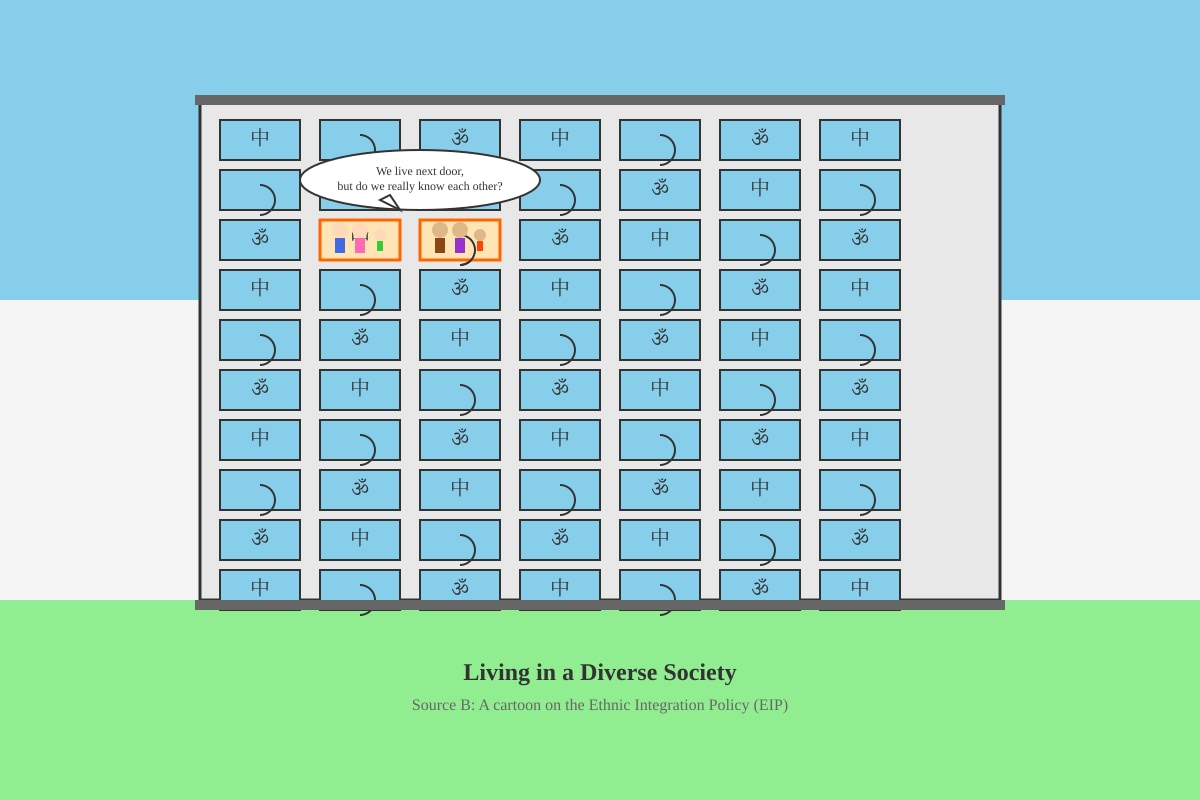
- Source B, through the cartoon, is more critical of government policy. The strict, alternating pattern of ethnic symbols enforced by the EIP is depicted as creating a superficial, almost mechanical form of diversity. The family's question, "do we really know each other?", suggests the policy places people side-by-side physically but fails to create genuine social bonds. The view is that policy can be artificial and may not lead to true understanding. [Award 1 mark for comparison, 1 mark for evidence from B]
- The key difference is that Source A sees government policy as a positive but incomplete starting point, while Source B implies that such policies might create a false sense of harmony without addressing deeper social connections. Source A is cautiously optimistic about the framework, whereas Source B is skeptical about its depth. [Award 2 marks for a clear explanation of the difference, synthesizing both sources]
Marking Notes:
- L1 (1-2 marks): Describes the sources without making a comparison, or makes a simple unsupported comparison.
- L2 (3-4 marks): Identifies a similarity or difference with evidence from one or both sources.
- L3 (5-6 marks): Clearly explains the difference in views, supported by well-explained evidence from both sources. A higher L3 answer will show a nuanced understanding of the difference (e.g., framework vs. superficiality).
Question 3 (7 marks)
Answer: The purpose of Source C is to express frustration and persuade readers that the "shared responsibility" approach to managing socio-economic diversity is unfair and an abdication of government duty.
- The author, "ConcernedCitizenSG," uses personal experience ("I work two jobs just to pay the bills") to build credibility and evoke sympathy from readers who may feel similarly overburdened. [Award 1 mark for purpose, 1 mark for evidence]
- The source uses accusatory language, such as "an excuse for the government to do less" and "the rich get richer," to frame the policy as a failure that benefits the wealthy at the expense of the struggling middle and lower classes. This aims to shape public opinion against the current approach. [Award 1 mark for purpose, 1 mark for evidence]
Reliability: The source is reliable as evidence of one citizen's genuine perception of the shared responsibility approach, reflecting a sentiment of disillusionment and economic pressure that exists within society. As a personal account, it provides an authentic, ground-level view of how policies are experienced. [Award 1 mark for reliability]
However, its reliability as a complete and balanced assessment of the policy is limited. The source is an opinion piece from an anonymous online forum, lacking the accountability of a named author or verified facts. It presents a highly subjective and emotional argument without acknowledging any benefits of the shared responsibility approach, such as community empowerment or the extensive government subsidies that do exist. Its purpose is to persuade, not to inform objectively. [Award 2 marks for evaluating limitations of reliability]
Marking Notes:
- L1 (1-2 marks): Identifies a simple purpose or makes a generic statement about reliability without explanation.
- L2 (3-4 marks): Explains purpose with some evidence, or makes a simple evaluation of reliability based on provenance.
- L3 (5-7 marks): Clearly explains the purpose with well-supported evidence, and provides a balanced evaluation of reliability, considering both what the source is useful for and its limitations. A top L3 answer will cross-reference the source's content and tone with its purpose to assess reliability.
Question 4 (7 marks)
Answer: Source D partially supports the view in Source C, but also challenges it.
- Source C argues that the government uses "shared responsibility" as "an excuse... to do less." Source D provides some support for this by showing that government programmes have significant gaps. For example, the uptake rate for SkillsFuture Credits is only 45%, with key challenges being "low motivation" and "perceived irrelevance." This suggests the government provides opportunities, but does not ensure they are effective or accessible, lending some weight to the idea that the government's role is incomplete. [Award 1 mark for support, 1 mark for evidence from D, 1 mark for linking to C]
- However, Source D also challenges Source C's view. The table shows the government is actively involved in providing a wide range of support programmes (ComCare, SkillsFuture, CHAS), which contradicts the claim that it is "doing less." The high uptake rate for CHAS (85%) and ComCare (78%) shows that many government initiatives are reaching and helping their target groups. This demonstrates a substantial government role, not an abdication of duty. [Award 1 mark for challenge, 1 mark for evidence from D, 1 mark for linking to C]
- Overall, Source D supports the idea that the government's approach has limitations and implementation challenges, as Source C implies. But it does not support the more extreme claim that the government is using this as an excuse to do less. Instead, it shows a government that is actively, if imperfectly, trying to fulfil its role. [Award 1 mark for a balanced conclusion]
Marking Notes:
- L1 (1-2 marks): Describes the sources without making a link, or makes a simple claim of support/challenge without evidence.
- L2 (3-4 marks): Identifies ways in which Source D supports or challenges Source C, with evidence from one source.
- L3 (5-7 marks): Explains both how Source D supports and challenges Source C, using well-explained evidence from both sources to reach a balanced conclusion on the extent of support.
Section B: Structured Response Questions (25 marks)
Question 5 (8 marks)
Answer: The principle of "A Stake for Everyone, Opportunities for All" means creating a society where every citizen has a tangible interest in the nation's success and is given fair chances to advance, regardless of their background. The Singapore government applies this to manage socio-economic diversity in several ways.
- Home Ownership: The government enables widespread home ownership through the Housing and Development Board (HDB). By selling flats on 99-year leases at subsidised prices and providing housing grants, a vast majority of Singaporeans own their homes. This gives every family a physical and financial stake in the country. When property values appreciate, owners benefit directly, reducing the sense of a divide between the wealthy and the rest. It fosters a sense of rootedness and shared destiny, as everyone has an asset to protect and a reason to care about the nation's long-term stability. [Award 3-4 marks for a well-explained example]
- Education and Lifelong Learning: The government provides heavily subsidised education from primary to tertiary levels, ensuring that no child is denied a good education due to their family's financial situation. Schemes like the Edusave Awards and the MOE Financial Assistance Scheme help level the playing field. For adults, the SkillsFuture initiative provides credits and subsidised courses to help workers continually upgrade their skills. This creates "opportunities for all" by allowing individuals from lower-income backgrounds to improve their employment prospects and social mobility through their own effort, managing socio-economic diversity by making the system meritocratic and accessible. [Award 3-4 marks for a second well-explained example]
Marking Notes:
- L1 (1-3 marks): States the meaning of the principle or gives a simple, unexplained example.
- L2 (4-6 marks): Explains one or two ways the principle is applied, with some development of examples.
- L3 (7-8 marks): Provides a clear explanation of the principle and explains in detail how it is applied through at least two well-developed, relevant examples. The explanation should clearly link the policy to the principle and the management of socio-economic diversity.
Question 6 (8 marks)
Answer: Individuals and community groups play a vital role in responding to the challenges of socio-cultural diversity in Singapore.
- Promoting Intercultural Understanding through Ground-Up Initiatives: Individuals and community groups can organise activities that bring people of different races and religions together to foster mutual understanding. For example, a Residents' Committee (RC) might organise a "Heritage Food Trail" where families from different ethnic backgrounds teach neighbours how to cook their traditional dishes. This creates a casual, enjoyable setting for interaction, breaking down stereotypes and building personal bonds. Such initiatives address the challenge of ignorance and prejudice by replacing abstract stereotypes with real, positive personal experiences. [Award 3-4 marks for a well-explained example]
- Providing Targeted Support through Self-Help Groups: Community groups like the Chinese Development Assistance Council (CDAC), Yayasan Mendaki, and the Singapore Indian Development Association (SINDA) provide targeted educational and social support to their respective communities. They offer tuition programmes, financial assistance, and mentorship. This helps manage socio-cultural diversity by addressing the specific needs of different communities, which may arise from cultural or historical factors, without relying solely on a one-size-fits-all government approach. This strengthens community resilience from within and demonstrates that diversity is managed not just by the state, but by empowered communities themselves. [Award 3-4 marks for a second well-explained example]
Marking Notes:
- L1 (1-3 marks): Identifies one or two simple ways without detailed explanation or examples.
- L2 (4-6 marks): Explains one or two ways with some development and/or examples, but the link to managing socio-cultural diversity may be implicit.
- L3 (7-8 marks): Clearly explains two distinct ways with well-developed, relevant examples. The explanation explicitly links the actions of individuals/community groups to addressing specific challenges of socio-cultural diversity (e.g., stereotypes, prejudice, specific community needs).
Question 7 (9 marks)
Answer: I agree that government policies are a very important factor, but they are not the most important on their own. Ensuring harmony requires a strong partnership between government and citizens.
- Importance of Government Policies: The government creates the essential structural conditions for harmony. Policies like the Ethnic Integration Policy (EIP) in public housing prevent the formation of racial enclaves, ensuring daily interaction among different groups. This builds common spaces and shared experiences, which are the bedrock of a national identity. Furthermore, laws against hate speech and the maintenance of racial and religious harmony through the Presidential Council for Minority Rights provide a legal framework that deters discrimination and protects minorities. Without these top-down measures, the foundation for harmony would be weak and vulnerable to segregation and conflict. [Award 3-4 marks for a well-explained argument on the role of government]
- Importance of Citizens' Role: However, policies can only create the opportunity for harmony; they cannot force genuine understanding or friendship. True harmony is built from the bottom up through the daily choices of citizens. This includes individuals making an effort to interact with neighbours of different races, being sensitive to the cultural and religious practices of others, and speaking out against racist or xenophobic remarks in their social circles. Community groups and ground-up initiatives, such as interfaith dialogues organised by volunteers, foster the trust and personal relationships that laws alone cannot create. If citizens are prejudiced or indifferent, even the best policies will result in a superficial, fragile peace, as suggested by Source B. [Award 3-4 marks for a well-explained argument on the role of citizens]
- Conclusion: Therefore, government policies are a crucial starting point, providing the necessary framework and incentives for harmony. But the "heart of harmony," as Source A notes, lies in the active, daily effort of citizens to understand and appreciate one another. The most important factor is not one or the other, but the synergy between a facilitative government and an engaged citizenry. A government framework without citizen buy-in is hollow; citizen goodwill without a supportive structure is easily undermined. [Award 1-2 marks for a balanced, well-reasoned conclusion that synthesises both roles]
Marking Notes:
- L1 (1-3 marks): States a position with little or no explanation. May only describe one factor.
- L2 (4-6 marks): Explains the role of either the government or citizens with examples, but the answer is one-sided. Or, mentions both but without a clear, reasoned judgment.
- L3 (7-9 marks): Provides a balanced argument, explaining the importance of both government policies and the role of citizens with well-developed examples. Reaches a clear, well-reasoned conclusion that weighs the relative importance of both factors and explains their interdependence. A top L3 answer will show a nuanced understanding that "most important" is about the interplay between the two.
END OF ANSWER KEY