AI Generated Exam Paper
Secondary 3 Social Studies Practice Paper 1
Free Sec 3 Social Studies Practice Paper 1, Kimi2.6 AI version, with questions, answers, and O Level-style practice for Singapore students.
These static practice materials are generated from the site's syllabus and paper-generation workflow, with source and model context shown so students and parents can evaluate the material before use.
Questions

Free quiz and exam paper access
Enter your details to view this paper
Your access is remembered on this device.
Answers
TuitionGoWhere Practice Paper - Social Studies Secondary 3
ANSWER KEY AND MARKING SCHEME
Version 1 of 5
SECTION A: Interpreting Visual Sources (Cartoon and Infographic) [20 marks]
Question 1 [3 marks]
Expected answer: The cartoonist suggests that the Singapore government's claim to deliver justice/equality (shown by the scales) is undermined by unequal treatment favouring the wealthy [1]. The larger, better-dressed figures appear to receive more favourable positioning on the scales, while smaller figures look concerned [1]. This implies that despite official rhetoric about fairness, economic status influences how citizens experience governance [1].
Marking guidance:
- 1 mark: Identify basic message about inequality/unequal treatment
- 1 mark: Reference specific visual evidence (size of figures, scale positioning, expressions)
- 1 mark: Explain the implied criticism of government claims versus reality
Teaching note: Political cartoons use exaggeration and symbolism. The scales represent justice/equality; uneven positioning despite equal appearance shows criticism. The contrast between government rhetoric and citizen experience is a common cartoon theme.
Question 2 [4 marks]
Expected answer: Source A does show government favouring the wealthy to a significant extent [1]. The wealthy figures are depicted as larger and better-dressed, giving them visual dominance; they appear positioned higher on the scales [1]. However, the source has limitations: it is a single cartoonist's perspective, may exaggerate for effect, and does not show actual policy details [1]. The cartoon captures a perception of inequality rather than proving intentional government bias [1].
Marking guidance:
- 1 mark: Clear judgment on "how far" (not absolute agreement/disagreement)
- 1 mark: Evidence supporting the "favouring wealthy" interpretation
- 1 mark: Evidence limiting that interpretation (nature of source, exaggeration)
- 1 mark: Balanced conclusion about perception vs. provable government preference
Teaching note: "How far" questions require balance. Students must avoid saying "completely" or "not at all." The nature of a political cartoon (satire, single perspective, emotional appeal) provides natural limitations.
Question 3 [4 marks]
Expected answer: Source A has limited usefulness for today [1]. It reflects 2019 perceptions before policy changes like GST vouchers enhancement, Progressive Wage Model expansion, and Majulah Package announcements [1]. However, it remains somewhat useful for showing historical attitudes toward inequality and as a benchmark for measuring subsequent policy responses [1]. A historian should compare it with post-2019 sources showing government measures to address inequality, and with sources showing whether citizen perceptions changed [1].
Marking guidance:
- 1 mark: Clear judgment on usefulness
- 1 mark: Specific policy changes since 2019 that limit relevance (own knowledge)
- 1 mark: Remaining value (historical snapshot, basis for comparison)
- 1 mark: What additional sources would be needed for fuller understanding
Teaching note: "How useful" questions test source evaluation skills. Currency matters for contemporary history. Students should connect to specific post-2019 policies: GST enhancement, Workfare enhancements, ComCare updates.
Question 4 [2 marks]
Expected answer: Any two from:
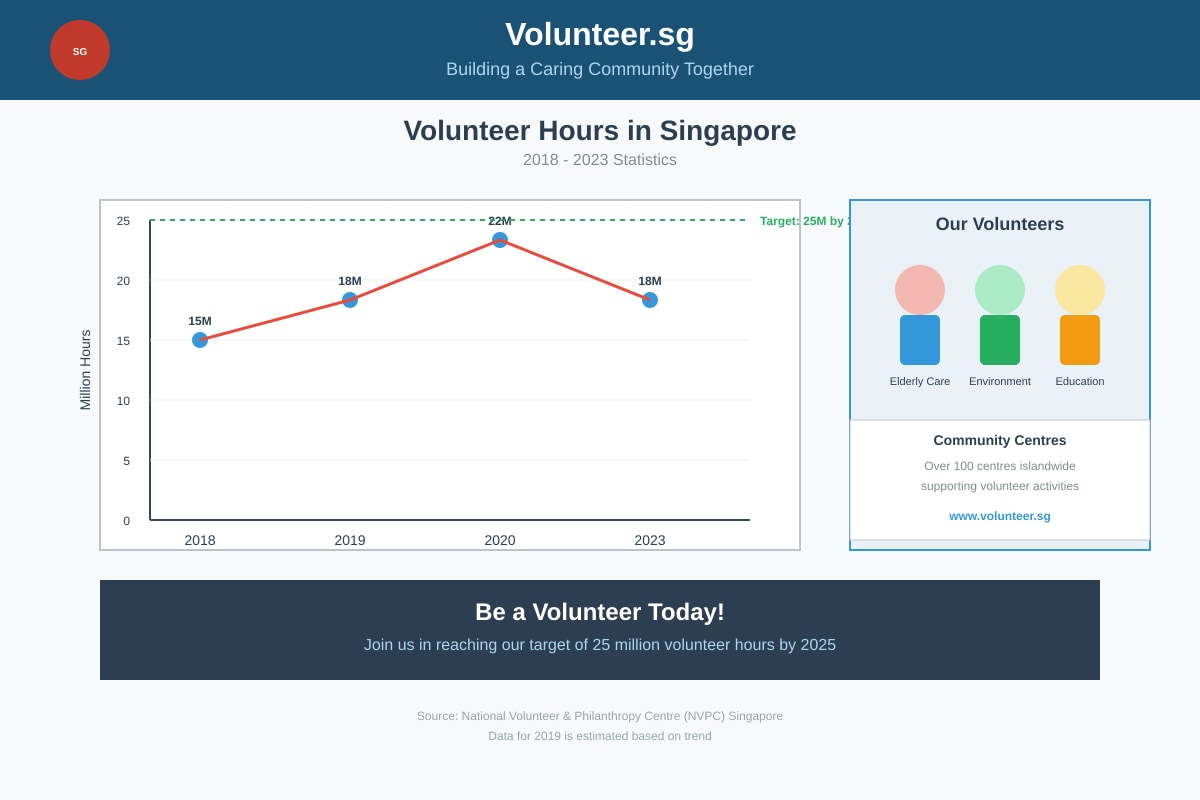
- Overall increase then decrease in volunteer hours (15m → 22m → 18m) [1]
- Peak during COVID-19 pandemic period (2020) [1]
- Current levels remain above 2018 baseline despite post-pandemic decline [1]
- Gap between actual hours and 2025 target (18m vs 25m) suggests challenge ahead [1]
Marking guidance:
- 1 mark per valid trend, max 2 marks
- Must be supported by data from source
Teaching note: "Identify trends" requires describing patterns over time, not just stating numbers. Students should look for direction (increase/decrease), turning points, and comparisons to benchmarks.
Question 5 [2 marks]
Expected answer: Possible reasons:
- COVID-19 pandemic created urgent needs (frontline support, mask distribution, contact tracing assistance) [1+1]
- Heightened community solidarity during crisis period / "circuit breaker" brought people together [1+1]
- Government mobilisation of volunteers through national campaigns [1+1]
- More free time during work-from-home arrangements [1+1]
Marking guidance:
- 1 mark: Identify plausible reason
- 1 mark: Explain mechanism linking to data increase
Teaching note: Contextual knowledge: Singapore saw significant volunteer mobilisation during COVID-19, including SG Clean ambassadors, mask distribution volunteers, and community care efforts. The spike is anomalous compared to long-term trend.
Question 6 [3 marks]
Expected answer: The government views citizen participation as important but requiring encouragement/targets [1]. The infographic shows ambitious targets (25 million hours by 2025), suggesting government sets direction for volunteerism rather than leaving it purely spontaneous [1]. The official branding (Volunteer.sg logo, government styling) and inclusion in national statistics shows institutionalisation of volunteerism as policy tool [1].
Marking guidance:
- 1 mark: Basic inference about positive attitude to participation
- 1 mark: Evidence of active government direction (targets, institutionalisation)
- 1 mark: Nuanced inference about government seeing volunteerism as instrument for social cohesion/policy goals
Teaching note: Inference goes beyond literal reading. The infographic format itself is evidence—government production of promotional material shows active encouragement, not passive acceptance.
Question 7 [4 marks]
Expected answer: The sources show both agreement and disagreement about government-citizen relations [1].
Agreement: Both show government-citizen interaction around societal needs—Source A citizens seek justice, Source B citizens contribute to community; both involve government response to citizen situations [1].
Disagreement: Source A is critical, showing government failing citizens (unequal scales); Source B is promotional, showing successful partnership in volunteerism. The tone differs: accusatory vs. celebratory [1].
Overall: The sources represent different moments and purposes—Source A critiques governance outcomes, Source B promotes civic participation. They agree that government-citizen relations matter but disagree on how well they function [1].
Marking guidance:
- 1 mark: Clear overall judgment (not absolute agreement/disagreement)
- 1 mark: Point of agreement with evidence
- 1 mark: Point of disagreement with evidence
- 1 mark: Synthesis explaining why both can coexist (different purposes/contexts)
Teaching note: Comparison questions require explicit cross-referencing. "How far" demands nuance. Students often miss that sources can agree on importance of topic while disagreeing on assessment.
SECTION B: Evaluating Written Sources (Newspaper Editorial) [18 marks]
Question 8 [2 marks]
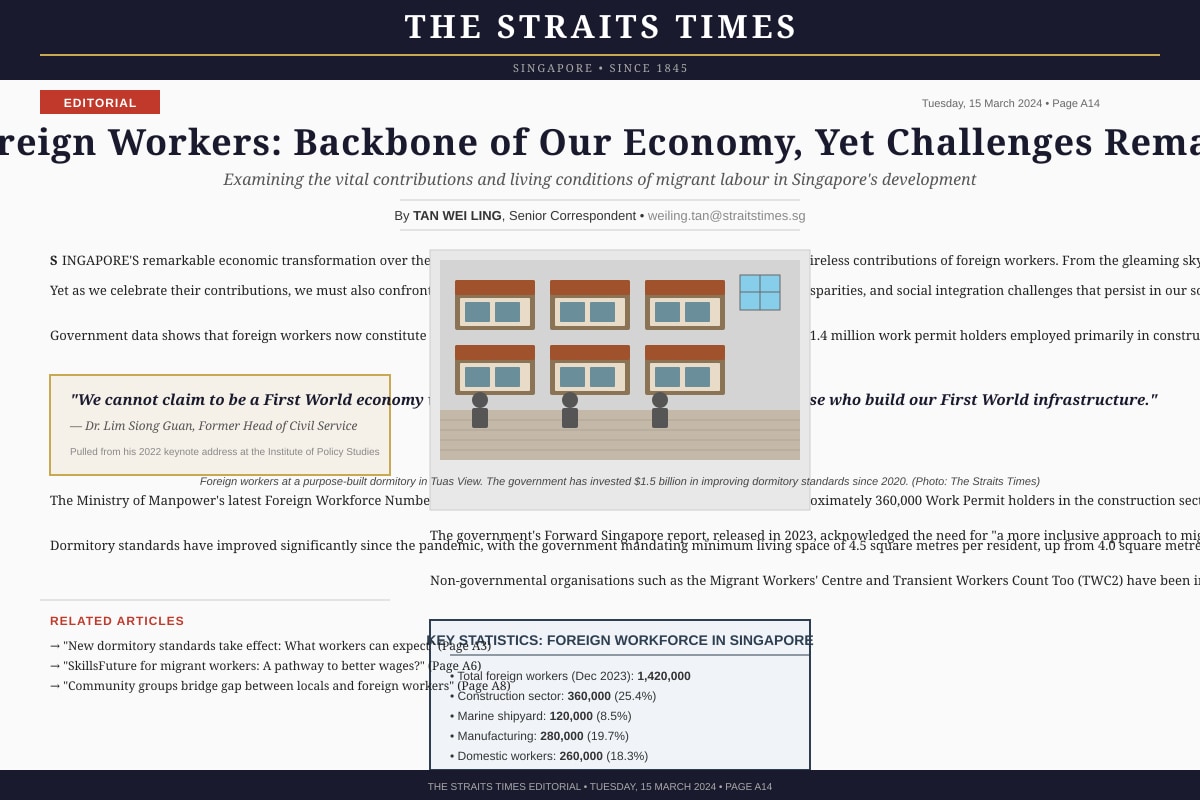
Expected answer: The pandemic made dormitory conditions impossible to ignore because public health was at stake [1]; outbreaks in cramped quarters threatened to overwhelm the healthcare system, forcing immediate government response [1].
Marking guidance:
- 1 mark: Link between pandemic and visibility of conditions
- 1 mark: Specific consequence (health system threat / forced confrontation)
Teaching note: This tests direct comprehension. The editorial's argument is that crisis revealed pre-existing problems. Students should not simply say "COVID was bad" but explain the causal mechanism in the source.
Question 9 [2 marks]
Expected answer: "Pillars" suggests foreign workers are foundational/structurally essential to Singapore's success [1]; "Invisible" suggests their contributions are unnoticed, unacknowledged, or deliberately hidden from public view [1]. The phrase criticises the gap between their importance and their recognition.
Marking guidance:
- 1 mark: Explain "pillars" (structural importance, foundational support)
- 1 mark: Explain "invisible" (lack of recognition, hidden from view)
Teaching note: Metaphor analysis requires unpacking both terms. "Pillars" = load-bearing, essential architecture; "invisible" = unseen, unacknowledged. The tension between the two creates the critical meaning.
Question 10 [2 marks]
Expected answer: Any two from:
- Dormitory locations physically separate workers from community [1]
- Work permit restrictions limit movement and interaction [1]
- Public discomfort with cultural/social difference [1]
- Limited recreation options (though this is being improved) [1]
Marking guidance:
- 1 mark per valid reason, max 2 marks
- Must be explicitly stated or clearly inferable from source
Teaching note: "Identify" requires extracting explicit information. Students should scan for "segregated" and surrounding explanatory phrases.
Question 11 [5 marks]
Expected answer: Source C is reasonably reliable but with limitations [1].
As a national newspaper editorial, it reflects informed institutional perspective with research resources and editorial standards [1]. The specific details (300,000 workers, pandemic timeline, policy changes) suggest factual basis [1].
However: It represents elite Singaporean perspective, not foreign worker voice; the emotional language ("uncomfortable questions," "moral character") signals advocacy rather than neutral analysis [1]. It was written during post-pandemic reform period, which may colour assessment of earlier periods [1].
For fuller reliability, a historian would need foreign worker testimonies, government documents on dormitory policy, and comparative sources from different time periods [1].
Marking guidance:
- 1 mark: Overall reliability judgment
- 2 marks: Nature of source strengths (authority, research, institutional backing)
- 2 marks: Nature of source limitations (bias, perspective, timing)
- 1 mark: What would strengthen reliability assessment (cross-checking sources)
(Max 5: distribute based on depth)
Teaching note: "How reliable" requires balanced source evaluation. Students must weigh format (newspaper editorial = researched but opinionated) against content. The source's Singaporean perspective is a significant limitation for understanding foreign worker experiences.
Question 12 [7 marks]
Expected answer:
Agreement (up to 3 marks): The treatment of foreign workers does test Singapore's governance balance [1]. The editorial highlights tension between economic efficiency (cheap labour, cost savings) and social stability/welfare (decent conditions, integration) [1]. Historical own knowledge supports this: 2013 Little India riot exposed governance gaps; 2020 dormitory crisis showed health system vulnerability from poor conditions [1].
Disagreement/limitation (up to 3 marks): However, the statement may overstate the novelty of this "test." Singapore has long managed this balance through Work Permit system, levies, and quotas that deliberately calibrate foreign worker presence [1]. Post-2020 improvements (Purpose-Built Dormitories, recreation centre expansion, healthcare access) show government response to correct imbalance [1]. The "test" framing implies a moment of reckoning; arguably, Singapore's governance has always involved iterative calibration rather than binary pass/fail [1].
Overall judgment (1 mark): The statement captures genuine tension but oversimplifies Singapore's governance approach, which has historically involved managing trade-offs through policy adjustment rather than facing existential tests.
Marking guidance:
- L3 (5-7 marks): Balanced argument with source evidence and detailed own knowledge; clear judgment
- L2 (3-4 marks): Some balance but limited own knowledge or uneven development
- L1 (1-2 marks): Simple agreement/disagreement with minimal support
Teaching note: "How far do you agree" is the classic Social Studies evaluative structure. Students need both sides, source evidence, own knowledge, and decisive conclusion. Key own knowledge: 2013 Little India riot, Progressive Wage Model extension to sectors with foreign workers, 2020 dormitory reforms, S Pass/Work Permit tiering.
SECTION C: Comparing and Evaluating Multiple Sources [22 marks]
Question 13 [4 marks]
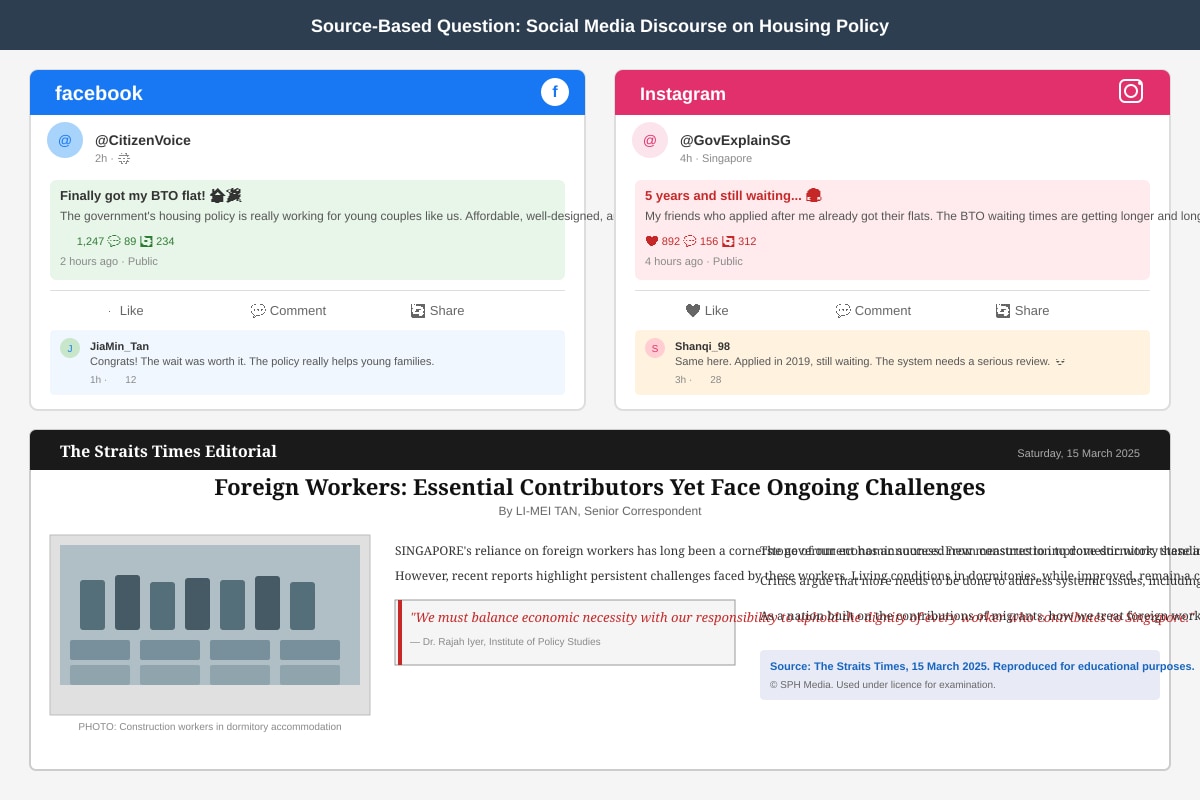
Expected answer: Source D reflects Source E's concerns to a significant but incomplete extent [1]. Both identify housing accessibility for young families as a key issue—Post 1's 5-year BTO wait and Post 3's complaint about 3-year waits match Source E's acknowledgment of "concerns, particularly for young families" [1]. Both Sources D and E mention first-time buyers [1]. However, Source D includes additional voices (singles, critics of affordability) not directly addressed in Source E, which focuses on families with children and multi-generational households [1]. Source D's tone is more critical/urgent; Source E is more measured/policy-focused [1].
Marking guidance:
- 1 mark: Overall judgment on reflection
- 2 marks: Specific points of correspondence with evidence
- 1 mark: Significant difference between sources
Teaching note: "How far" requires explicit matching and mismatching. Students should create a two-column mental comparison: what matches, what doesn't, and how significantly.
Question 14 [5 marks]
Expected answer:
Post 1 reliability:
- Strength: Citizen advocacy groups aggregate real experiences; 2,400 likes suggest resonance with genuine concerns [1]
- Limitation: Single anonymous anecdote ("my BTO"); no verification; emotional hashtag "#HousingCrisis" signals advocacy framing; possible selection of extreme case [1]
Post 2 reliability:
- Strength: Government feedback unit has access to official statistics; 85% and 23,000 figures are verifiable; represents actual policy [1]
- Limitation: Selective statistics (85% within 3 years implies 15% wait longer); "selected within" vs "completed" may obscure timeline; promotional purpose; lower engagement suggests less public resonance [1]
Comparative judgment: Post 2 is more factually reliable for objective data; Post 1 captures experiential reality that official statistics may smooth over. Best understanding requires both: Post 2 for policy facts, Post 1 for lived experience gaps [1].
Marking guidance:
- 2 marks: Post 1 evaluation (strength + limitation)
- 2 marks: Post 2 evaluation (strength + limitation)
- 1 mark: Comparative synthesis
Teaching note: Reliability evaluation must consider purpose and audience. Government accounts have institutional authority but promotional intent; citizen posts have authenticity but anecdotal vulnerability. The engagement metrics (likes, shares) are themselves evidence of resonance.
Question 15 [7 marks]
Expected answer:
Agreement (government has succeeded, up to 3 marks): Singapore has largely maintained social objectives [1]. HDB builds at subsidised rates below market prices; 80%+ of resident population lives in public housing [1]. Priority schemes genuinely favour those with greater needs—first-timers, families with children, elderly near children [1]. Source E shows continued policy commitment; Post 2's statistics show improvement in waiting times [1].
Disagreement/limitation (government has not fully succeeded, up to 3 marks): Market forces increasingly intrude: BTO prices rose significantly (4-room flat from ~400k+ in mature estates); resale prices hit record highs [1]. Source D shows persistent affordability concerns; singles face 35-year minimum age and limited supply; private market spillover affects public housing expectations [1]. "Social objective" of integration is challenged by income segregation (Pinnacle@Duxton prices vs. standard BTO) and estate renewal patterns [1].
Overall judgment (1 mark): The government has partially succeeded—public housing remains far more accessible than in comparable global cities, and social objectives are structurally embedded. However, market pressures are intensifying, and the gap between policy intent and citizen experience (especially for singles, young couples in mature estates) shows erosion that requires renewed policy attention.
Marking guidance:
- L3 (5-7 marks): Detailed own knowledge with specific policies/prices; balanced; clear judgment addressing "how far"
- L2 (3-4 marks): Some own knowledge but general; partially developed
- L1 (1-2 marks): Simple assertion with minimal support
Teaching note: Key own knowledge: HDB as statutory board mission, historical price trajectories, priority schemes ( Parenthood Priority, Multi-Generation Priority), income ceilings, CPF usage, Lease Buyback/Enhancement for CPF for older flats, recent cooling measures. The "how far" requires acknowledging genuine success while identifying pressure points.
Question 16 [6 marks]
Expected answer:
Value of social media sources:
- Immediate, unfiltered citizen voice; captures lived experience that official sources may miss [1]
- Engagement metrics (likes, shares, comments) indicate scale of concern and allow issue prioritisation [1]
- Multiple perspectives emerge quickly (Post 3 comment thread shows debate, qualification of positions) [1]
- Useful for studying government communication effectiveness (Post 2's lower engagement vs. Post 1's suggests message reception issues) [1]
Limitations:
- Selection bias: algorithms amplify extreme views; moderate positions less visible [1]
- Verification problems: anonymous accounts; astroturfing; misinformation risks [1]
- Ephemeral nature: posts deleted, accounts suspended; hard to establish reliable archive [1]
- Demographic skew: younger, more educated, urban users overrepresented; excludes elderly, low-income, non-English speakers [1]
Overall judgment: Social media sources are valuable for understanding sentiment, identifying emerging issues, and gauging government-citizen communication gaps. However, they require triangulation with official statistics, survey data, and traditional media for balanced assessment of government effectiveness.
Marking guidance:
- 3 marks: Value points with development
- 3 marks: Limitation points with development
- No separate mark for conclusion but stronger answers will synthesise
Teaching note: This evaluates source literacy for new media. Students should connect format characteristics to historical/evidentiary value. The engagement metrics are data, not just decoration—they show which messages gain traction.
MARK SUMMARY
| Question | Marks | Topic |
|---|---|---|
| 1 | 3 | Cartoon interpretation |
| 2 | 4 | Cartoon evaluation |
| 3 | 4 | Source usefulness |
| 4 | 2 | Data extraction |
| 5 | 2 | Contextual inference |
| 6 | 3 | Attitude inference |
| 7 | 4 | Cross-source comparison |
| 8 | 2 | Comprehension |
| 9 | 2 | Language analysis |
| 10 | 2 | Information extraction |
| 11 | 5 | Source reliability |
| 12 | 7 | Evaluative essay |
| 13 | 4 | Cross-source reflection |
| 14 | 5 | Reliability comparison |
| 15 | 7 | Synthesis evaluation |
| 16 | 6 | Source type evaluation |
| TOTAL | 60 |
Caveat: This is curriculum-aligned practice content generated from LLM-inferred templates. No past-year papers or extracted exam templates were available for this topic group. The content follows the 2023 Upper Secondary Social Studies syllabus structure (Issue 1: Citizenship and Governance; Issue 2: Living in a Diverse Society concepts applied) and Singapore assessment conventions, but does not claim to reproduce actual examination material.