AI Generated Quiz
Secondary 3 Physics Waves Sound Light Quiz
Free Sec 3 Physics Waves Sound Light quiz, Nemo3 AI version, with questions, answers, and O Level-style practice for Singapore students.
These static practice materials are generated from the site's syllabus and paper-generation workflow, with source and model context shown so students and parents can evaluate the material before use.
Questions
Secondary 3 Physics Quiz - Waves Sound Light
Name: ___________________________
Class: ___________________________
Date: ___________________________
Score: ________ / 40
Duration: 45 minutes
Total Marks: 40
Instructions:
- Answer all questions.
- Write your answers in the spaces provided.
- Show all working for calculation questions.
- Use where needed.
- The speed of sound in air is unless otherwise stated.
- The speed of light in vacuum/air is .
Section A: Multiple Choice Questions (10 marks)
Questions 1 to 10 carry 1 mark each. Choose the correct answer and write the letter (A, B, C, or D) in the box provided.
1. A transverse wave travels along a rope. The distance between two adjacent crests is 0.4 m and the wave frequency is 5 Hz. What is the speed of the wave?
☐ A. 0.08 m/s
☐ B. 0.8 m/s
☐ C. 2.0 m/s
☐ D. 20 m/s
2. Which of the following statements about sound waves is correct?
☐ A. Sound waves are transverse waves.
☐ B. Sound travels faster in vacuum than in air.
☐ C. Sound waves require a medium to propagate.
☐ D. The speed of sound is independent of temperature.
3. A student stands 170 m from a cliff and shouts. She hears the echo after 1.0 s. What is the speed of sound in air based on this measurement?
☐ A. 170 m/s
☐ B. 340 m/s
☐ C. 510 m/s
☐ D. 680 m/s
4. Light passes from air into a glass block with refractive index 1.5. The angle of incidence in air is 30°. What is the angle of refraction in the glass?
☐ A. 19.5°
☐ B. 20.0°
☐ C. 30.0°
☐ D. 48.6°
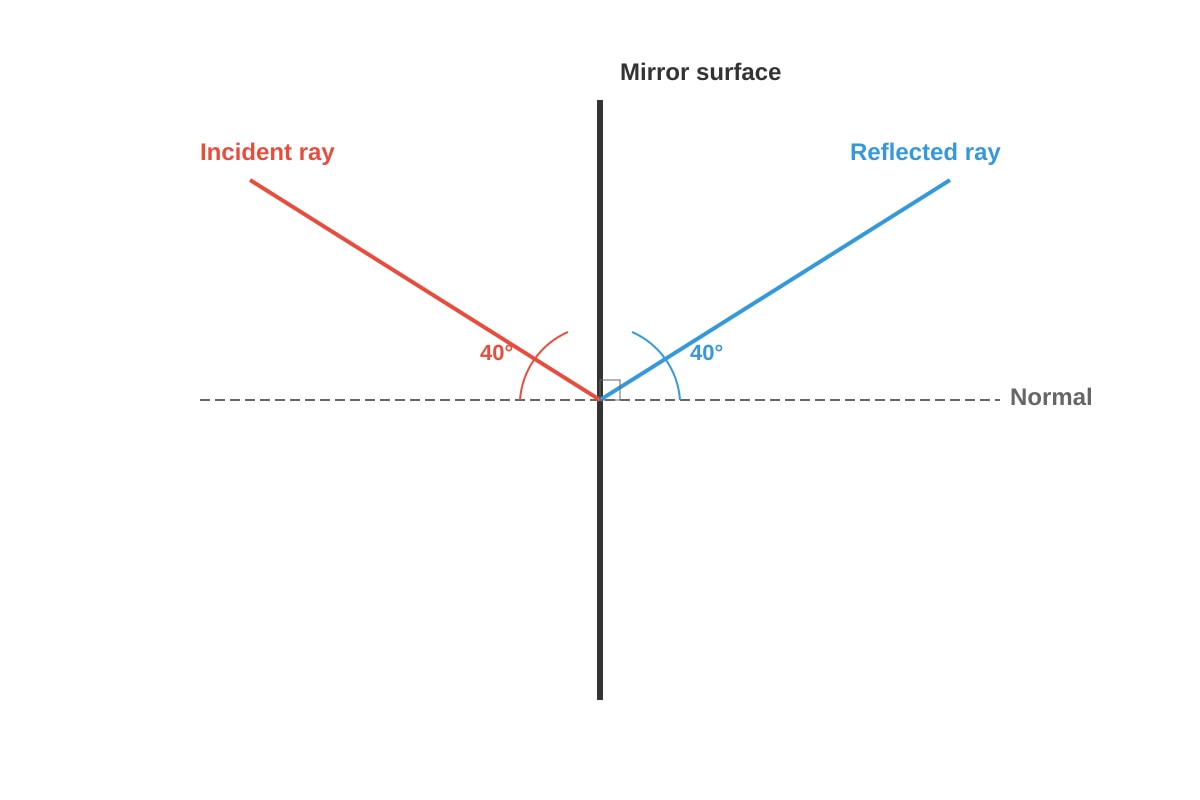
5. The diagram shows a ray of light incident on a plane mirror at an angle of 40° to the normal. What is the angle between the incident ray and the reflected ray?
<image_placeholder> id: Q5-fig1 type: diagram linked_question: Q5 description: A plane mirror drawn vertically with a normal line. An incident ray approaches the mirror at 40° to the normal on the left side. A reflected ray leaves the mirror on the right side. The angle between incident ray and normal is labelled 40°. The angle between reflected ray and normal is also 40°. labels: Normal, Incident ray, Reflected ray, Mirror surface, 40° angle (incident), 40° angle (reflected) values: Angle of incidence = 40°, Angle of reflection = 40° must_show: Normal line perpendicular to mirror, incident and reflected rays on opposite sides of normal, equal angles marked </image_placeholder>
☐ A. 40°
☐ B. 50°
☐ C. 80°
☐ D. 100°
6. Which of the following electromagnetic waves has the shortest wavelength?
☐ A. Radio waves
☐ B. Infrared
☐ C. Ultraviolet
☐ D. Gamma rays
7. A wave has a period of 0.02 s. What is its frequency?
☐ A. 0.02 Hz
☐ B. 20 Hz
☐ C. 50 Hz
☐ D. 500 Hz
8. When light passes from water (refractive index 1.33) into air, total internal reflection occurs if the angle of incidence exceeds the critical angle. What is the critical angle for the water-air boundary?
☐ A. 37°
☐ B. 41°
☐ C. 49°
☐ D. 53°
9. The amplitude of a sound wave is doubled while its frequency remains unchanged. How does this affect the loudness and pitch of the sound?
☐ A. Loudness increases, pitch increases
☐ B. Loudness increases, pitch unchanged
☐ C. Loudness unchanged, pitch increases
☐ D. Loudness unchanged, pitch unchanged
10. A convex lens forms a real, inverted image of an object. The object distance is 30 cm and the image distance is 15 cm. What is the focal length of the lens?
☐ A. 5 cm
☐ B. 10 cm
☐ C. 15 cm
☐ D. 20 cm
Section B: Structured Questions (18 marks)
Answer all questions in the spaces provided.
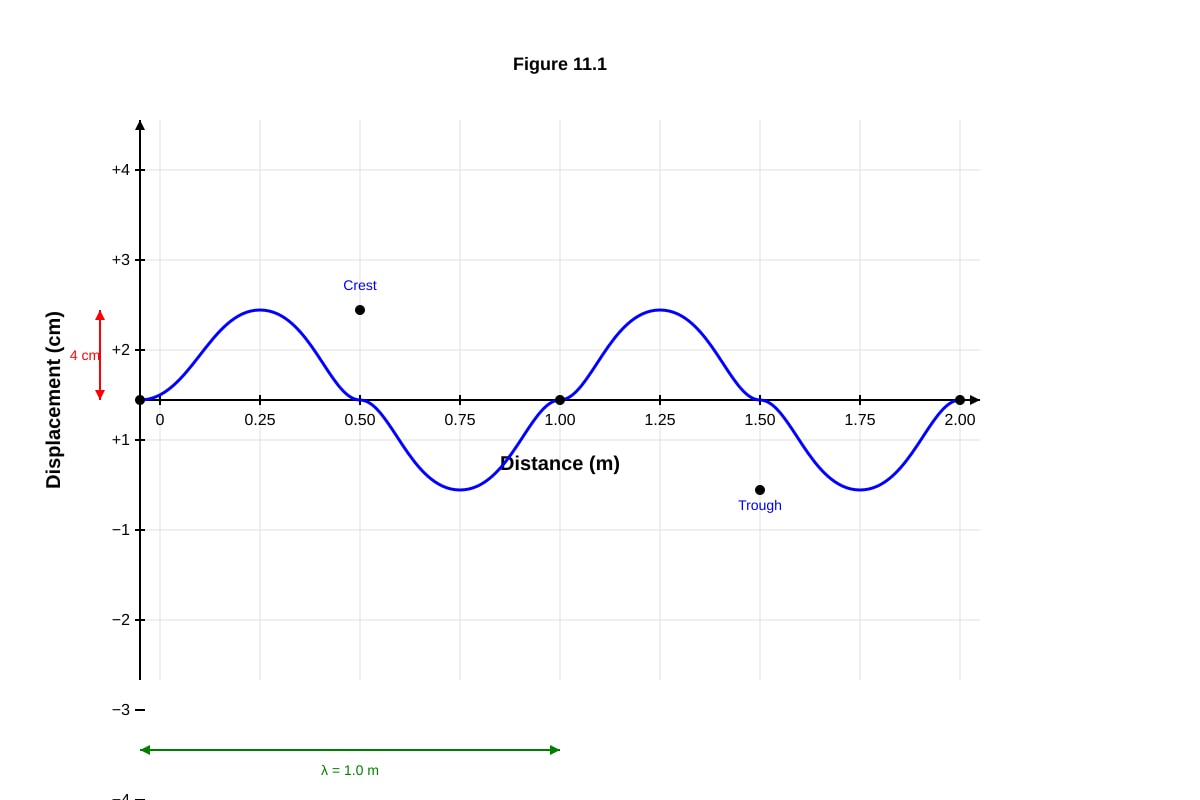
11. Figure 11.1 shows a displacement-distance graph for a transverse wave on a string at time .
<image_placeholder> id: Q11-fig1 type: graph linked_question: Q11 description: Displacement-distance graph for a transverse wave. Horizontal axis: distance (m) from 0 to 2.0 m. Vertical axis: displacement (cm) from -4 to +4. The wave shows two complete wavelengths between 0 and 2.0 m. At x=0, displacement = 0 and increasing. At x=0.5 m, displacement = +4 cm (crest). At x=1.0 m, displacement = 0. At x=1.5 m, displacement = -4 cm (trough). At x=2.0 m, displacement = 0. labels: Distance (m) on x-axis, Displacement (cm) on y-axis values: Wavelength = 1.0 m, Amplitude = 4 cm, Two complete waves shown from 0 to 2.0 m must_show: Sinusoidal wave shape, clear amplitude and wavelength markings, axes labelled with units </image_placeholder>
(a) State the amplitude of the wave.
Amplitude = _______________ [1]
(b) Determine the wavelength of the wave.
Wavelength = _______________ [1]
(c) The frequency of the wave is 2.5 Hz. Calculate the speed of the wave.
Speed = _______________ [2]
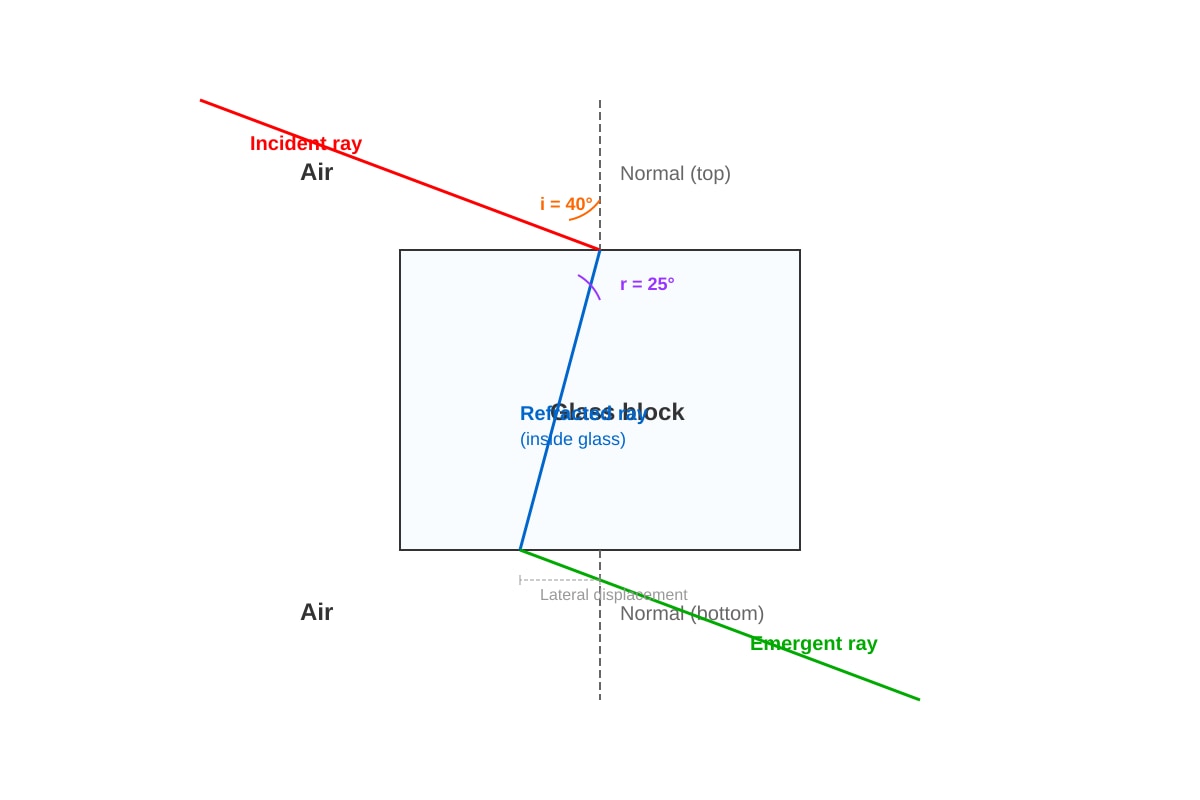
12. A student investigates the refraction of light through a rectangular glass block. Figure 12.1 shows the path of a light ray entering the block.
<image_placeholder> id: Q12-fig1 type: diagram linked_question: Q12 description: Rectangular glass block with a ray entering from air at top left. The incident ray hits the top surface at an angle of incidence i = 40° to the normal. The ray refracts into the glass at angle r = 25° to the normal. The ray travels straight through the block and exits the bottom surface parallel to the incident ray but laterally displaced. The normal lines at top and bottom surfaces are shown as dashed lines. labels: Air, Glass block, Normal (top), Normal (bottom), Incident ray, Refracted ray (inside glass), Emergent ray, Angle i = 40°, Angle r = 25° values: Angle of incidence i = 40°, Angle of refraction r = 25° must_show: Rectangular block, two parallel normals, incident ray, refracted ray bending towards normal, emergent ray parallel to incident ray, lateral displacement visible </image_placeholder>
(a) Calculate the refractive index of the glass.
Refractive index = _______________ [2]
(b) The speed of light in air is . Calculate the speed of light in the glass.
Speed in glass = _______________ [2]
(c) Explain why the emergent ray is parallel to the incident ray.
______________________________________________________________________________ [1]
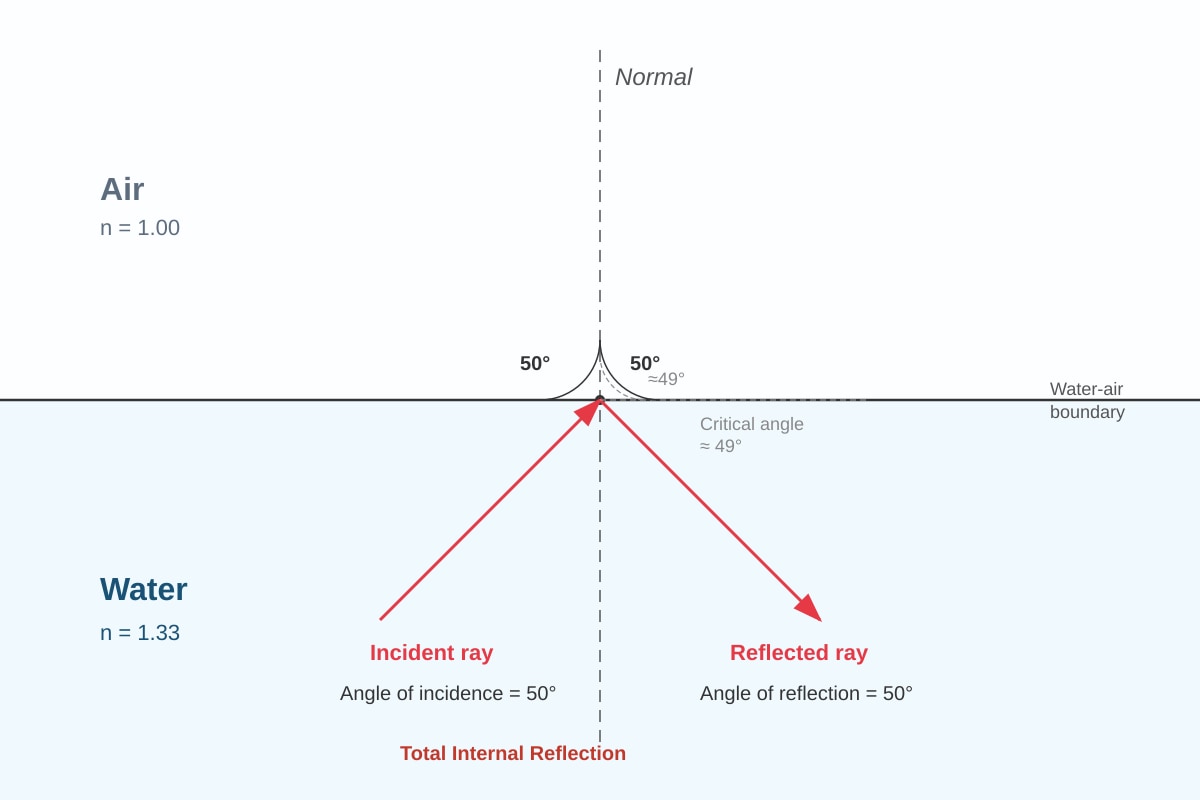
13. Figure 13.1 shows a ray of light travelling from water (refractive index 1.33) into air. The angle of incidence in water is 50°.
<image_placeholder> id: Q13-fig1 type: diagram linked_question: Q13 description: Water-air boundary shown as a horizontal line. Water below, air above. A ray in water approaches the boundary from below at an angle of incidence of 50° to the normal (vertical dashed line). The critical angle for water-air is approximately 49°. The ray undergoes total internal reflection, reflecting back into water at 50° to the normal on the other side. labels: Water, Air, Normal, Incident ray, Reflected ray, Angle of incidence = 50°, Critical angle ≈ 49° values: Refractive index of water = 1.33, Angle of incidence = 50°, Critical angle ≈ 49° must_show: Water below boundary, air above, normal vertical, incident ray at 50° in water, total internal reflection back into water at 50°, critical angle indicated </image_placeholder>
(a) State what happens to the light ray at the boundary.
______________________________________________________________________________ [1]
(b) Calculate the critical angle for the water-air boundary.
Critical angle = _______________ [2]
(c) State one application of total internal reflection in everyday life.
______________________________________________________________________________ [1]
14. A convex lens of focal length 10 cm is used to form an image of an object placed 25 cm from the lens.
(a) Using the lens formula , calculate the image distance.
Image distance = _______________ [2]
(b) State two characteristics of the image formed.
-
- ___________________________________________________________________________ [2]
(c) Calculate the magnification of the image.
Magnification = _______________ [1]
15. A police car siren emits a sound of frequency 800 Hz. The car moves towards a stationary observer at 30 m/s. The speed of sound in air is 340 m/s.
(a) Calculate the frequency heard by the observer.
Observed frequency = _______________ [2]
(b) Explain why the observed frequency is different from the emitted frequency.
______________________________________________________________________________ [1]
Section C: Longer Structured Questions (12 marks)
Answer all questions in the spaces provided.
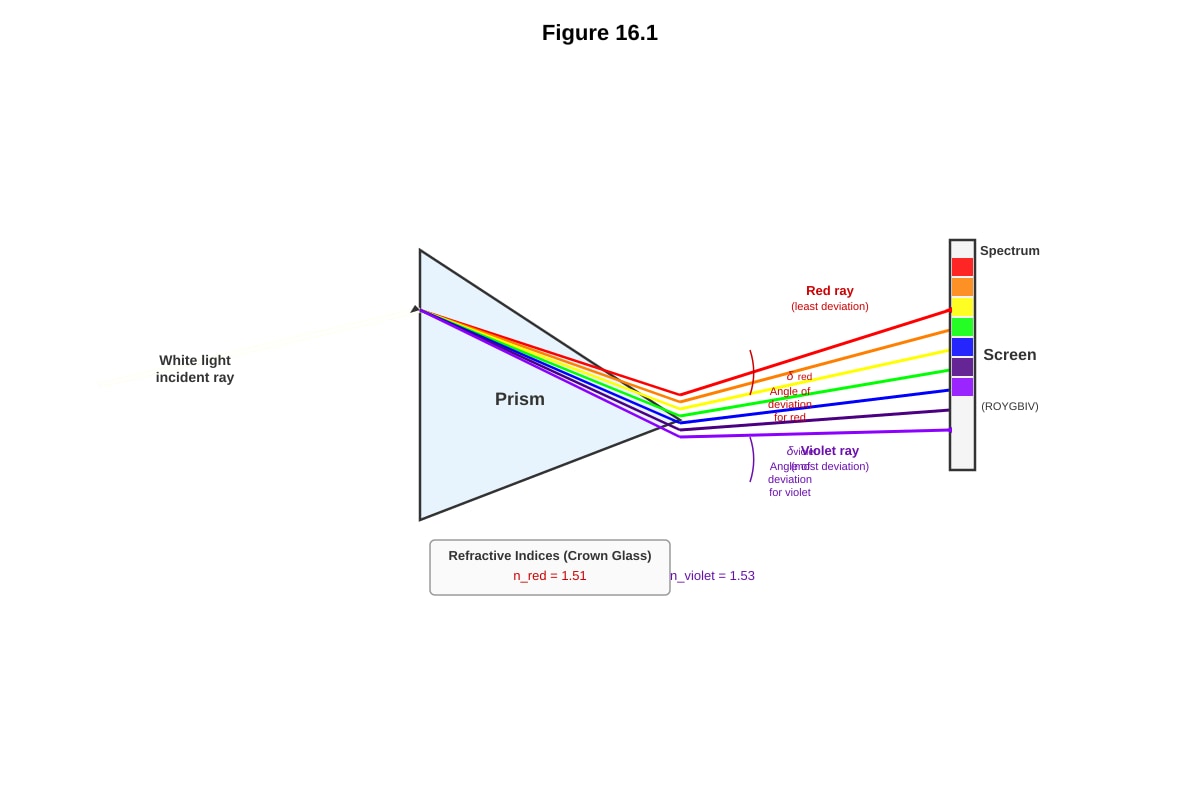
16. Figure 16.1 shows a ray of white light incident on a triangular glass prism. The light disperses into a spectrum.
<image_placeholder> id: Q16-fig1 type: diagram linked_question: Q16 description: Triangular prism with apex at top, base horizontal. A ray of white light enters the left face of the prism. Inside the prism, the ray splits into a spectrum (red, orange, yellow, green, blue, indigo, violet) with red deviated least and violet deviated most. The spectrum emerges from the right face of the prism and spreads out on a screen placed to the right. The angle of deviation for red and violet rays are marked. labels: White light incident ray, Prism, Spectrum (ROYGBIV), Red ray (least deviation), Violet ray (most deviation), Screen, Angle of deviation for red, Angle of deviation for violet values: Refractive index for red light = 1.51, Refractive index for violet light = 1.53 (typical for crown glass) must_show: Triangular prism, white light entering, dispersion inside prism, spectrum emerging, red least deviated, violet most deviated, screen showing spread spectrum </image_placeholder>
(a) Name the phenomenon shown in Figure 16.1.
______________________________________________________________________________ [1]
(b) Explain why white light splits into different colours when it passes through the prism.
______________________________________________________________________________ [2]
(c) The refractive index of the glass for red light is 1.51 and for violet light is 1.53. The angle of incidence at the first face is 45°. Calculate the angle of refraction for red light at the first face.
Angle of refraction (red) = _______________ [2]
(d) State which colour, red or violet, has the greater angle of deviation. Explain your answer.
______________________________________________________________________________ [2]
17. A student sets up a ripple tank to study wave properties. Plane waves are generated with a frequency of 10 Hz. The student measures the distance between 5 consecutive bright bands on the screen below the tank as 12 cm.
(a) Explain why bright and dark bands are observed on the screen.
______________________________________________________________________________ [1]
(b) Calculate the wavelength of the water waves.
Wavelength = _______________ [2]
(c) Calculate the speed of the water waves.
Speed = _______________ [1]
(d) The depth of water in the tank is reduced. State and explain what happens to the wavelength and speed of the waves.
______________________________________________________________________________ [2]
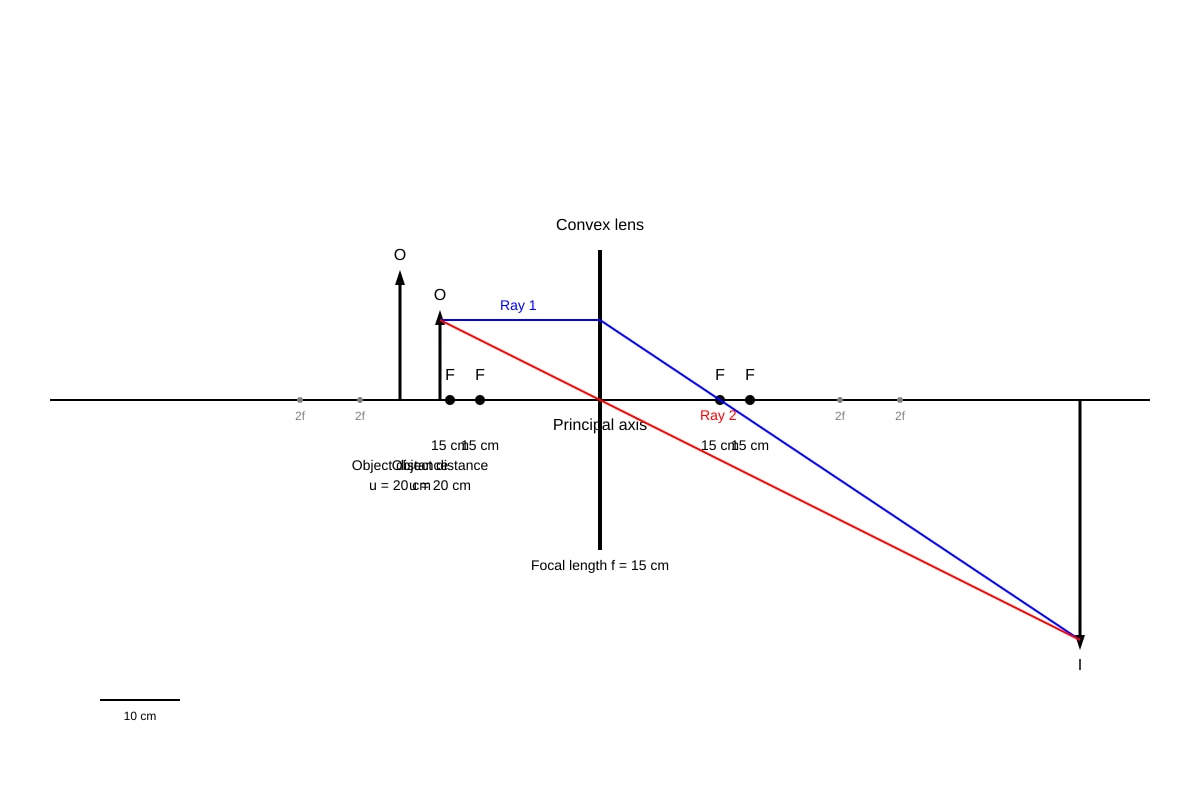
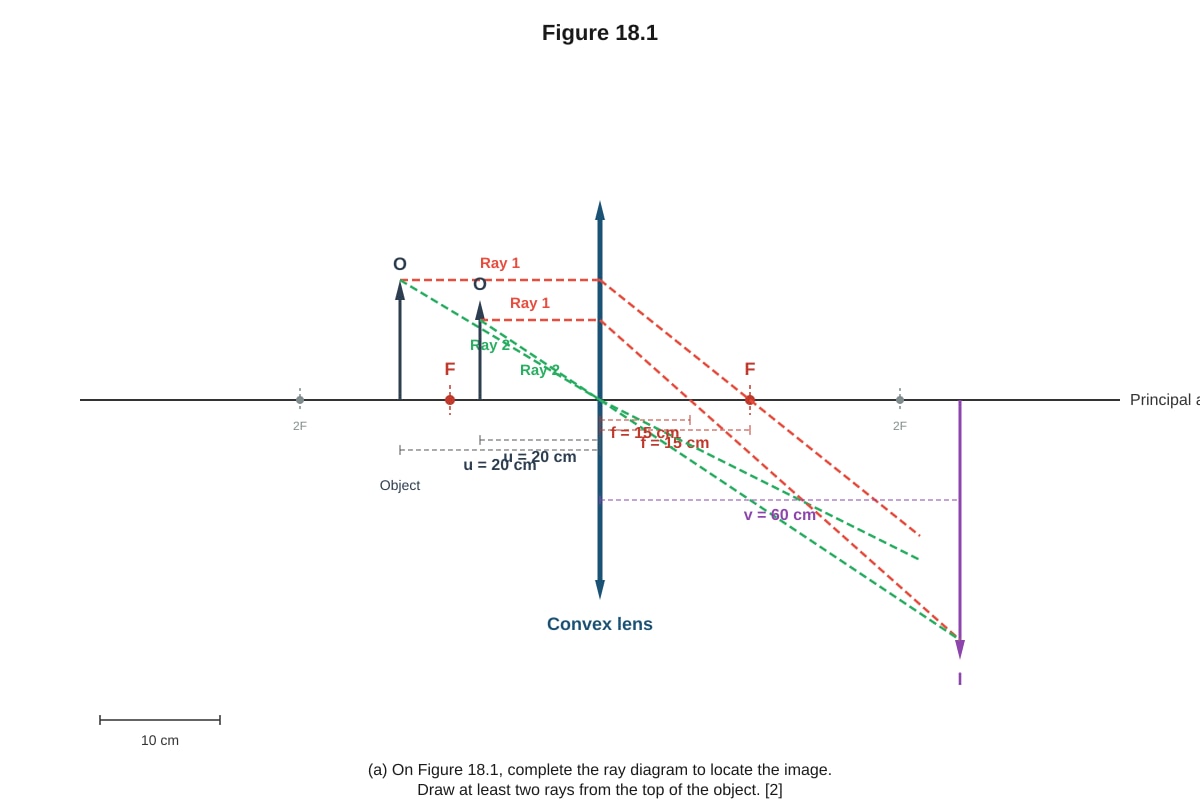
18. Figure 18.1 shows an object O placed in front of a convex lens. The focal length of the lens is 15 cm. The object distance is 20 cm.
<image_placeholder> id: Q18-fig1 type: diagram linked_question: Q18 description: Principal axis horizontal. Convex lens at centre with focal points F marked 15 cm on each side. Object O (arrow pointing up) placed 20 cm to the left of lens. Two construction rays drawn from top of object: Ray 1 parallel to principal axis, refracts through F on right side. Ray 2 passes through optical centre undeviated. The rays converge on right side to form a real, inverted, magnified image I. labels: Principal axis, Convex lens, F (focal points), O (object), I (image), Ray 1, Ray 2, Object distance u = 20 cm, Focal length f = 15 cm values: f = 15 cm, u = 20 cm must_show: Convex lens, principal axis, focal points marked, object at 20 cm left of (between f and 2f), two construction rays, real inverted magnified image formed beyond 2f on right </image_placeholder>
(a) On Figure 18.1, complete the ray diagram to locate the image. Draw at least two rays from the top of the object.
[Diagram completion - 2 marks]
(b) Using the lens formula, calculate the image distance.
Image distance = _______________ [2]
(c) State three characteristics of the image formed.
-
-
- ___________________________________________________________________________ [3]
19. The electromagnetic spectrum is shown in Figure 19.1 in order of increasing frequency.
<image_placeholder> id: Q19-fig1 type: diagram linked_question: Q19 description: Electromagnetic spectrum diagram showing waves in order of increasing frequency (decreasing wavelength). From left to right: Radio waves, Microwaves, Infrared, Visible light, Ultraviolet, X-rays, Gamma rays. Arrows showing increasing frequency → and decreasing wavelength ←. Typical wavelengths/frequencies marked for each region. labels: Radio waves, Microwaves, Infrared, Visible light, Ultraviolet, X-rays, Gamma rays, Increasing frequency arrow, Decreasing wavelength arrow values: Radio: >1 m, Micro: 1 mm - 1 m, IR: 700 nm - 1 mm, Visible: 400-700 nm, UV: 10-400 nm, X-ray: 0.01-10 nm, Gamma: <0.01 nm must_show: Full EM spectrum in correct order, frequency/wavelength arrows, region labels, approximate wavelength ranges </image_placeholder>
(a) State the speed of all electromagnetic waves in vacuum.
______________________________________________________________________________ [1]
(b) Name the region of the spectrum that has a wavelength of approximately 500 nm.
______________________________________________________________________________ [1]
(c) State one use and one potential hazard of ultraviolet radiation.
Use: __________________________________________________________________________
Hazard: _______________________________________________________________________ [2]
(d) Microwaves are used in satellite communication. Explain why microwaves are suitable for this purpose.
______________________________________________________________________________ [2]
20. A student investigates the reflection of sound waves. She sets up a loudspeaker facing a large flat wall, with a microphone connected to a data logger placed next to the loudspeaker. The loudspeaker emits a short pulse of sound. The data logger records the time interval between the emitted pulse and the reflected pulse (echo) as 0.04 s. The distance between the loudspeaker and the wall is 6.8 m.
(a) Calculate the speed of sound in air based on this experiment.
Speed of sound = _______________ [2]
(b) The accepted value for the speed of sound in air at room temperature is 340 m/s. Suggest one reason why the experimental value might differ from the accepted value.
______________________________________________________________________________ [1]
(c) The student repeats the experiment with a higher frequency sound. State whether the speed of sound changes. Explain your answer.
______________________________________________________________________________ [1]
(d) Describe how the student could modify the experiment to measure the speed of sound in water.
______________________________________________________________________________ [2]
End of Quiz
Answers
Secondary 3 Physics Quiz - Waves Sound Light (Answer Key)
Total Marks: 40
Section A: Multiple Choice Questions (10 marks)
1. Answer: C
Working:
Wave speed
Given: (distance between adjacent crests = wavelength),
Key concept: For any wave, . Distance between adjacent crests is the wavelength.
2. Answer: C
Explanation:
- A is incorrect: Sound waves are longitudinal waves (particles vibrate parallel to wave direction).
- B is incorrect: Sound cannot travel in vacuum; it requires a medium.
- C is correct: Sound waves are mechanical waves that require a medium (solid, liquid, or gas) to propagate.
- D is incorrect: Speed of sound increases with temperature in gases.
3. Answer: B
Working:
Echo travels to cliff and back: total distance =
Time = 1.0 s
Speed =
Common mistake: Forgetting to double the distance (using 170 m instead of 340 m gives 170 m/s, option A).
4. Answer: A
Working:
Snell's Law:
, ,
Key concept: Light bends towards the normal when entering a denser medium (), so .
5. Answer: C
Explanation:
Angle of incidence = 40°, so angle of reflection = 40° (Law of Reflection).
Angle between incident ray and reflected ray = .
Visual check: The two rays are on opposite sides of the normal, each at 40° to it.
6. Answer: D
Explanation:
Order of EM spectrum by increasing frequency (decreasing wavelength):
Radio → Microwave → Infrared → Visible → Ultraviolet → X-rays → Gamma rays
Gamma rays have the highest frequency and shortest wavelength.
7. Answer: C
Working:
Frequency
Period
Key concept: Period and frequency are reciprocals.
8. Answer: C
Working:
Critical angle : (from water to air)
Key concept: Total internal reflection occurs when light travels from denser to rarer medium and .
9. Answer: B
Explanation:
- Loudness depends on amplitude. Doubling amplitude increases loudness.
- Pitch depends on frequency. Frequency unchanged → pitch unchanged.
Key concept: Amplitude → loudness/energy; Frequency → pitch.
10. Answer: B
Working:
Lens formula:
, (real image, so positive)
Section B: Structured Questions (18 marks)
11. (a) Amplitude = 4 cm [1]
Explanation: Amplitude is the maximum displacement from equilibrium. From graph, peak displacement = 4 cm.
(b) Wavelength = 1.0 m [1]
Explanation: Two complete waves in 2.0 m → one wavelength = 1.0 m. Or distance between adjacent crests (0.5 m to 1.5 m) = 1.0 m.
(c) Speed = 2.5 m/s [2]
Working:
Mark breakdown: 1 mark for formula/substitution, 1 mark for correct answer with unit.
12. (a) Refractive index = 1.59 (or 1.6) [2]
Working:
Accept 1.5–1.6 depending on rounding.
Mark breakdown: 1 mark for correct formula/substitution, 1 mark for answer.
(b) Speed in glass = [2]
Working:
(Using gives ; using gives )
Mark breakdown: 1 mark for formula, 1 mark for calculation with unit.
(c) The two surfaces of the rectangular block are parallel. The ray bends towards the normal on entry and away from the normal on exit by the same amount, so the emergent ray is parallel to the incident ray. [1]
Key concept: Parallel-sided block → emergent ray parallel to incident ray but laterally displaced.
13. (a) Total internal reflection occurs. [1]
Explanation: Angle of incidence (50°) > critical angle (~49°), and light travels from denser (water) to rarer (air) medium.
(b) Critical angle = 48.8° (≈ 49°) [2]
Working:
Mark breakdown: 1 mark for , 1 mark for calculation.
(c) Optical fibres / fibre optics in telecommunications / endoscopes / binoculars / periscopes. [1]
Any one valid application accepted.
14. (a) Image distance = 16.7 cm [2]
Working:
Mark breakdown: 1 mark for correct substitution, 1 mark for answer with unit.
Note: Positive → real image on opposite side of lens from object.
(b) Characteristics (any two): [2]
- Real (formed on opposite side of lens)
- Inverted
- Magnified (since )
- Formed beyond 2f on the other side
(c) Magnification = 0.67 (or -0.67) [1]
Working:
Sign convention: negative for inverted real image, but magnitude often accepted.
Key concept: → diminished; → magnified. Here object at 25 cm (between f and 2f) → magnified, but calculation gives 0.67? Wait: , , . Object at 25 cm is beyond 2f, so image should be diminished (between f and 2f). cm is between f and 2f. Magnification = 16.7/25 = 0.67 < 1 → diminished. Correct.
15. (a) Observed frequency = 880 Hz [2]
Working:
Doppler effect (source moving towards stationary observer):
Mark breakdown: 1 mark for correct formula, 1 mark for calculation.
(b) The source is moving towards the observer, causing wavefronts to compress (wavelength decreases). Since wave speed is constant in the medium, frequency increases (). [1]
Key concept: Motion of source changes wavelength; observer receives more wavefronts per second.
Section C: Longer Structured Questions (12 marks)
16. (a) Dispersion (of light) [1]
(b) Different colours of light have different wavelengths. In glass, refractive index is higher for shorter wavelengths (violet) and lower for longer wavelengths (red). Since , different colours refract by different amounts (violet bends most, red least), causing white light to split into a spectrum. [2]
Mark breakdown: 1 mark for different wavelengths/refractive indices, 1 mark for different deviation/bending.
(c) Angle of refraction (red) = 27.7° [2]
Working:
,
(≈ 28°)
Mark breakdown: 1 mark for Snell's law substitution, 1 mark for answer.
(d) Violet has the greater angle of deviation.
Explanation: Violet light has a shorter wavelength and higher refractive index in glass (). It bends more at both surfaces of the prism, resulting in a larger total deviation. [2]
Mark breakdown: 1 mark for identifying violet, 1 mark for explanation linking higher to greater bending.
17. (a) Bright bands correspond to crests (converging light) and dark bands to troughs (diverging light) of the water waves acting as lenses. [1]
Explanation: Water surface acts like a series of convex (crests) and concave (troughs) lenses focusing/defocusing light onto the screen.
(b) Wavelength = 3.0 cm [2]
Working:
Distance between 5 consecutive bright bands = 4 wavelengths = 12 cm
Mark breakdown: 1 mark for recognizing 5 bands = 4, 1 mark for calculation.
(c) Speed = 0.3 m/s [1]
Working:
(d) Wavelength decreases and speed decreases.
Explanation: In shallower water, wave speed decreases ( for shallow water waves). Frequency remains constant (determined by source). Since , wavelength must also decrease. [2]
Mark breakdown: 1 mark for both decrease, 1 mark for explanation linking , , .
18. (a) Ray diagram completion [2]
Expected rays:
- Ray 1: From top of object, parallel to principal axis → refracts through F through F through focal point on right side.
- Ray 2: From top of object, through optical centre → continues undeviated.
- Image formed where rays intersect: real, inverted, magnified, beyond 2F on right.
Mark breakdown: 1 mark for each correct ray, or 2 marks for correct image location with two rays.
(b) Image distance = 60 cm [2]
Working:
Mark breakdown: 1 mark for substitution, 1 mark for answer.
(c) Three characteristics: [3]
- Real (formed on opposite side, positive)
- Inverted
- Magnified (since , or )
Also acceptable: formed beyond 2F on the other side.
19. (a) [1]
(b) Visible light (green region) [1]
Explanation: Visible spectrum ≈ 400–700 nm. 500 nm is in the green region.
(c) Use: Sterilisation / disinfection / vitamin D synthesis / fluorescent lamps / security marking
Hazard: Skin cancer / sunburn / premature aging / eye damage (cataracts) / DNA damage
[2] — 1 mark each.
(d) Microwaves can pass through the atmosphere (ionosphere) with little absorption, travel in straight lines (line-of-sight), and can be directed in narrow beams using dish antennas, allowing high-bandwidth communication with satellites. [2]
Key points: Penetrate atmosphere, line-of-sight, directional beams, high frequency → high data capacity.
20. (a) Speed of sound = 340 m/s [2]
Working:
Total distance travelled by sound =
Time = 0.04 s
Mark breakdown: 1 mark for doubling distance, 1 mark for calculation with unit.
(b) Any one valid reason: [1]
- Temperature different from standard conditions (speed varies with )
- Wind affecting sound propagation
- Reaction time / measurement error in data logger
- Humidity effects
- Wall not perfectly reflecting (some absorption)
(c) No, the speed of sound does not change.
Explanation: Speed of sound in a medium depends only on the properties of the medium (temperature, density, elasticity), not on the frequency of the sound wave. [1]
(d) Modifications for water: [2]
- Submerge the loudspeaker and microphone/hydrophone in water
- Use a waterproof sound source (e.g., underwater speaker/pinger) and hydrophone
- Place a large flat reflector (e.g., metal plate) underwater at known distance
- Measure time for echo return and calculate
- Ensure temperature of water is noted/controlled
Mark breakdown: 1 mark for submerged setup with appropriate transducers, 1 mark for measurement method.
End of Answer Key