AI Generated Quiz
Secondary 3 Physics Waves Sound Light Quiz
Free Sec 3 Physics Waves Sound Light quiz, Kimi2.6 AI version, with questions, answers, and O Level-style practice for Singapore students.
These static practice materials are generated from the site's syllabus and paper-generation workflow, with source and model context shown so students and parents can evaluate the material before use.
Questions
Free quiz and exam paper access
Enter your details to view this paper
Your access is remembered on this device.
Answers
Secondary 3 Physics Quiz - Waves Sound Light: Answer Key
Total Marks: 40 marks
Section A: Multiple Choice
1. B — water wave travelling across the surface of a pond [1 mark]
- Water waves are transverse: particles vibrate perpendicular to wave direction.
- Sound waves (A, C, D) are longitudinal: particles vibrate parallel to wave direction.
- Common mistake: Confusing all waves with being transverse. Remember sound needs a medium and particles compress/rarefy in the direction of travel.
2. C — [1 mark]
- Using , so
- Note: This is red light (visible range ~400–700 nm). The answer is approximately 667 nm.
3. C — frequency [1 mark]
- Pitch corresponds to frequency: higher frequency = higher pitch.
- Amplitude (A) determines loudness, not pitch.
- Key concept: Frequency is the number of complete vibrations per second, measured in hertz (Hz).
4. C — frequency [1 mark]
- When light enters a denser medium (air to glass): speed decreases, wavelength decreases ( with constant), direction changes (refraction).
- Frequency stays constant because it is determined by the source, not the medium.
- Underlying principle: The wave equation ; if changes and changes proportionally, remains unchanged.
5. B — they spread out in circular arcs [1 mark]
- This is diffraction: waves spread out after passing through a gap comparable to their wavelength.
- Condition for noticeable diffraction: Gap size ≈ wavelength or smaller. Straight wavefronts become circular when the gap is small.
Section B: Short Answer and Structured Questions
6. [2 marks]
(a) Amplitude: The maximum displacement of a particle from its equilibrium position. [1 mark]
- For transverse waves: maximum height of crest or depth of trough from rest position.
- For longitudinal waves: maximum compression or rarefaction density change.
(b) Period: The time taken for one complete wave cycle (or oscillation) to pass a point. [1 mark]
- Related to frequency by . Unit: seconds (s).
7. [2 marks]
Using :
[1 mark for formula, 1 mark for answer with unit]
- Step-by-step:
- Identify: frequency , wavelength
- Apply wave equation:
- Substitute:
- State unit:
This is the typical speed of sound in air at room temperature.
8. [3 marks]
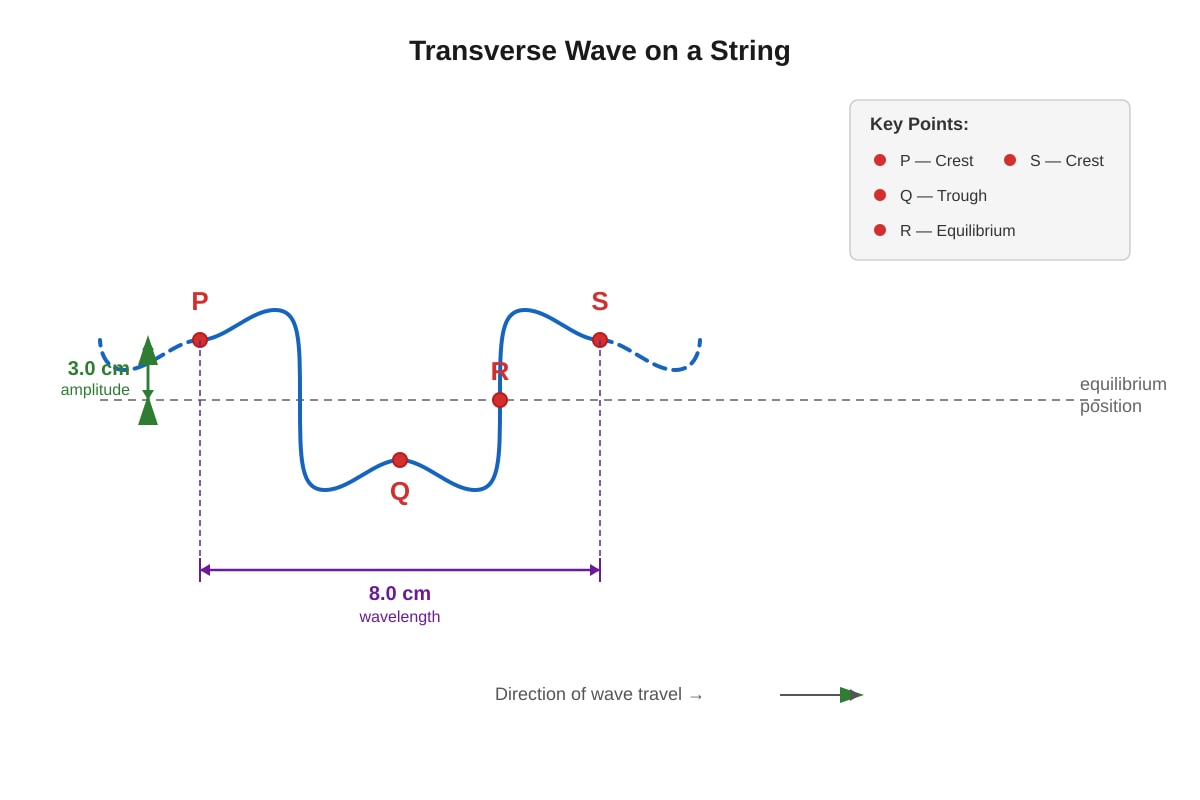
(a) Amplitude = 3.0 cm (or ) [1 mark]
- Read directly from diagram: vertical distance from equilibrium to crest.
(b) Frequency calculation: [2 marks]
First convert amplitude-related values to metres: amplitude given as 3.0 cm, but we need wavelength:
Using :
[1 mark for conversion and substitution, 1 mark for final answer]
- Critical step: Convert cm to m before calculation. Wavelength = 8.0 cm = 0.08 m.
- Speed was given as 0.48 m/s, so consistent units are essential.
9. [2 marks]
Sound waves require a medium to travel because they are longitudinal mechanical waves. [1 mark]
Sound travels by particles vibrating and transferring energy through collisions. [0.5 mark]
In a vacuum there are no particles, so there is no mechanism for the vibrations to be transmitted. [0.5 mark]
- Key distinction: Electromagnetic waves can travel through vacuum; mechanical waves (including sound) cannot.
- Exam tip: Always mention "medium" and "particles" in explanations about sound requiring matter.
10. [4 marks]
(a) Speed of sound: [2 marks]
For an echo, sound travels to the wall AND back: total distance =
[1 mark for doubling distance, 1 mark for calculation]
- Common error: Using 85 m instead of 170 m gives 170 m/s — wrong because the sound makes a round trip.
(b) Two distinct sounds: [2 marks]
As the student walks towards the wall, the time for the echo to return decreases. [1 mark]
When very close to the wall, the direct sound and echo arrive with very short time separation, becoming distinguishable or merging; while farther apart, the time gap between direct sound and echo is longer. [1 mark]
Alternatively accepted: Standing at 85 m gives clear echo; moving closer reduces echo time delay. At some positions the student may hear the original clap (from hands) and the reflected echo as separate sounds if time gap > 0.1 s (persistence of hearing).
11. [2 marks]
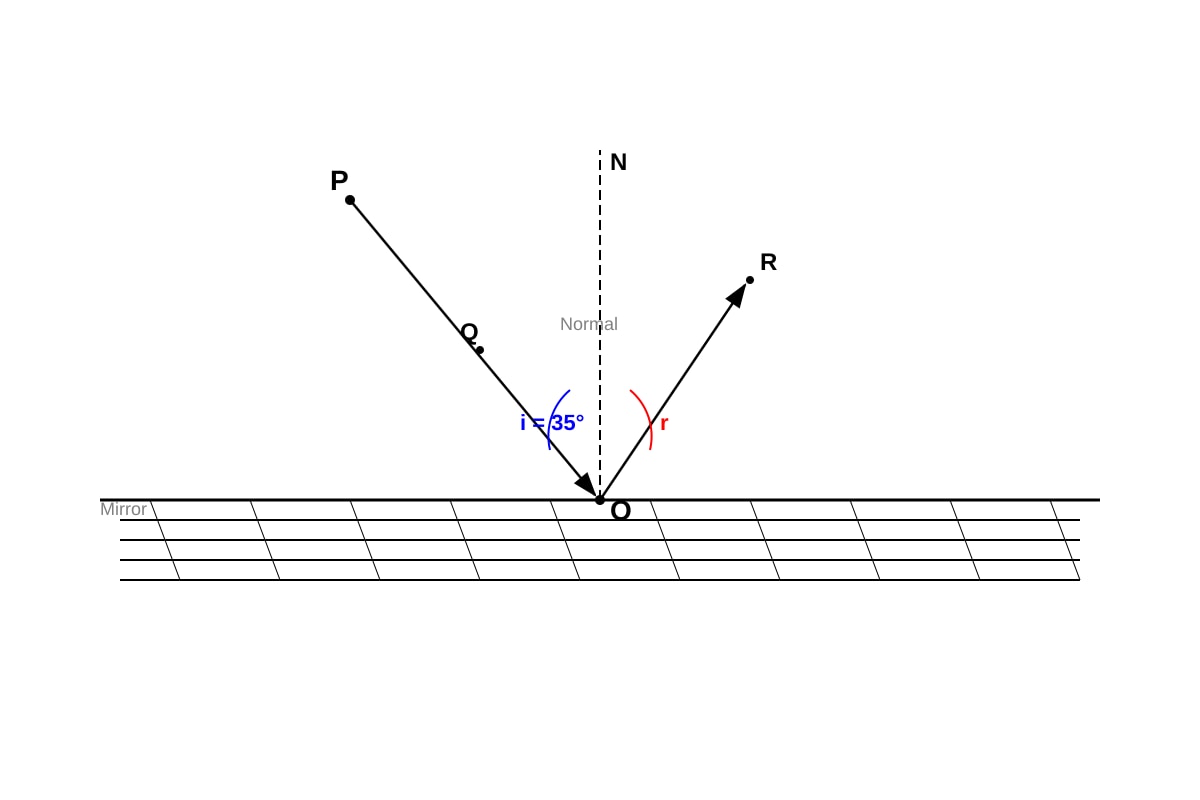
(a) Law of reflection: The angle of incidence equals the angle of reflection (). [1 mark]
- Both angles are measured between the ray and the normal, not between ray and mirror surface.
(b) Angle and reflected ray drawn symmetrically about normal. [1 mark]
- Using . The reflected ray should be drawn in the upper right quadrant, making 35° with normal ON.
- Marking note: Ray must have correct direction (away from mirror), correct angle, and arrowhead.
12. [3 marks]
(a) Common property: (Any one of) [1 mark]
- All travel at the same speed in a vacuum ()
- All are transverse waves
- All can travel through a vacuum
- All transfer energy without transferring matter
- All obey the wave equation
(b) Uses: [2 marks]
| Radiation | Use |
|---|---|
| Ultraviolet: [1 mark] | Sterilisation of medical equipment; detecting forged bank notes (fluorescence); sun tanning; vitamin D production |
| X-rays: [1 mark] | Medical imaging of bones; airport security scanning; crystallography; detecting defects in materials |
13. [4 marks]
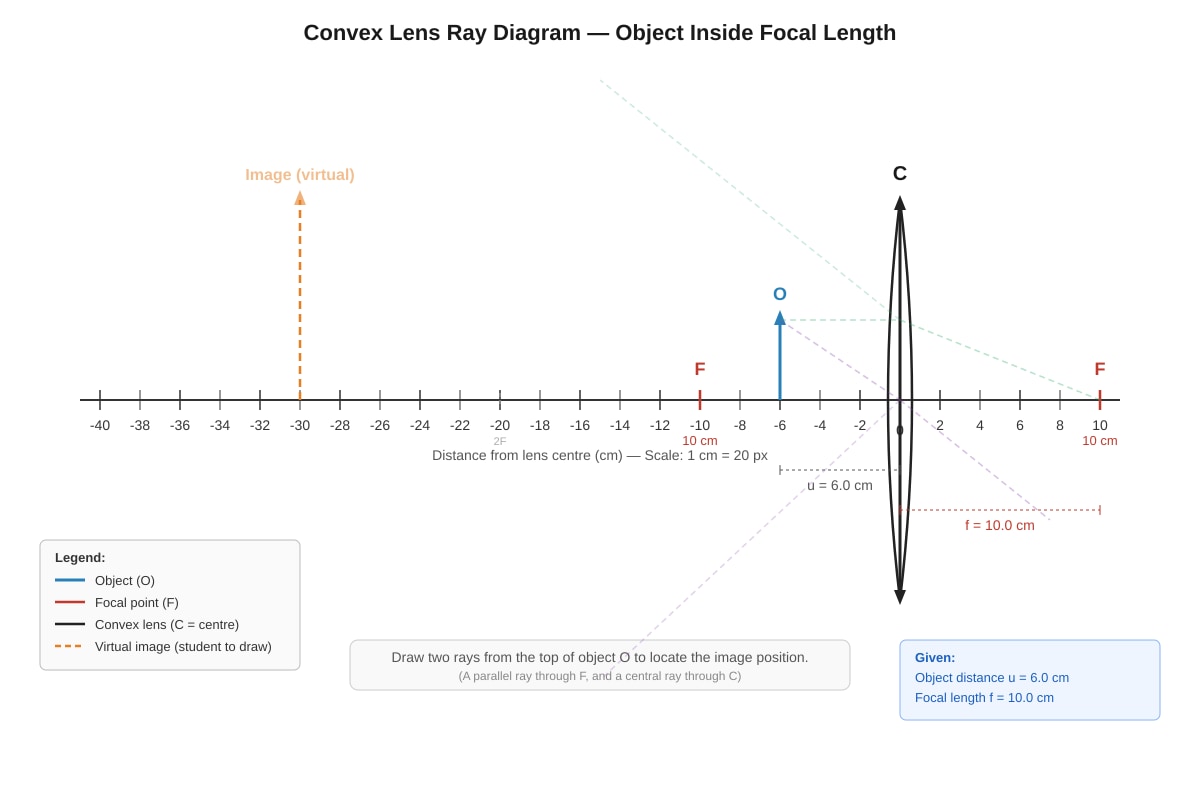
(a) Ray diagram: [2 marks]
Two standard rays from top of object:
- Ray 1: Parallel to principal axis → refracts through focal point F on far side [1 mark]
- Ray 2: Through centre of lens C → continues undeviated [0.5 mark]
Image formed where backward extensions of diverging rays meet (virtual image on same side as object). [0.5 mark for locating image correctly]
Image pending generation: diagram for Q13.
(b) Image characteristics: (Any two of) [2 marks]
- Virtual (cannot be projected on screen)
- Upright (same orientation as object)
- Magnified (larger than object)
- Located on same side of lens as object
14. [3 marks]
(a) Why wavelength changes: [2 marks]
The wave slows down in shallow water because the water depth restricts particle motion. [1 mark]
Since frequency stays constant (determined by source), and , a decrease in causes a proportional decrease in . [1 mark]
- Key reasoning chain: depth decrease → speed decrease → wavelength decrease (frequency unchanged).
(b) Frequency stays the same. [1 mark]
- Frequency is determined by the wave source (e.g., vibration frequency of dipper in ripple tank), not by the medium.
15. [4 marks]
(a) P-wave time: [2 marks]
[1 mark for formula, 1 mark for answer with unit]
- Straightforward substitution. Distance in km, speed in km/s, so time in s.
(b) Time difference: [2 marks]
First find S-wave time: [1 mark]
Time difference: [1 mark]
- Physical significance: P-waves arrive first. Seismologists use this time difference to locate earthquake epicentres.
Section C: Extended Response
16. [3 marks]
Experiment to measure speed of sound using echo method:
Apparatus: [1 mark]
- Stopwatch or time interval recorder
- Measuring tape or trundle wheel
- Large vertical wall or building (flat, hard surface) with clear space in front
- Wooden blocks or两块木板 (to clap together, or use starting pistol/electronic sound source)
Measurements: [1 mark]
- Measure the perpendicular distance from student to wall using measuring tape (e.g., 50–100 m for clear time measurement)
- Produce a sharp sound (clap blocks) and start timer simultaneously
- Stop timer when echo is heard
- Repeat several times and calculate average time
Calculation: [1 mark]
- Total distance travelled by sound = (to wall and back)
- Speed of sound:
Improvements/accuracy notes:
- Distance should be large enough ( m) for time measurement >0.3 s
- Use two observers with synchronized stopwatches, or electronic timing
- Take multiple readings and average
- Avoid background noise and wind
17. [6 marks]
(a) (wave speed = frequency × wavelength) [1 mark]
(b) Wavelength in air: [2 marks]
(or 77.3 cm, or ~0.77 m to 2 s.f.) [1 mark for formula, 1 mark for calculation]
(c) New wavelength and explanation: [3 marks]
[1 mark for calculation]
Explanation why frequency is constant: [2 marks]
-
Frequency is determined by the source of the wave (the vibrating object producing the sound). [1 mark]
-
When sound enters a different medium, the speed changes because the new medium has different elastic properties and density, but the source vibration rate stays the same. [0.5 mark]
-
Since and is fixed, the wavelength must change proportionally with to maintain the equality. [0.5 mark]
-
Numerical check: Water speed (1480) is about 4.35× air speed (340), so wavelength increases by same factor: 0.773 × 4.35 ≈ 3.36 m. ✓
18. [4 marks]
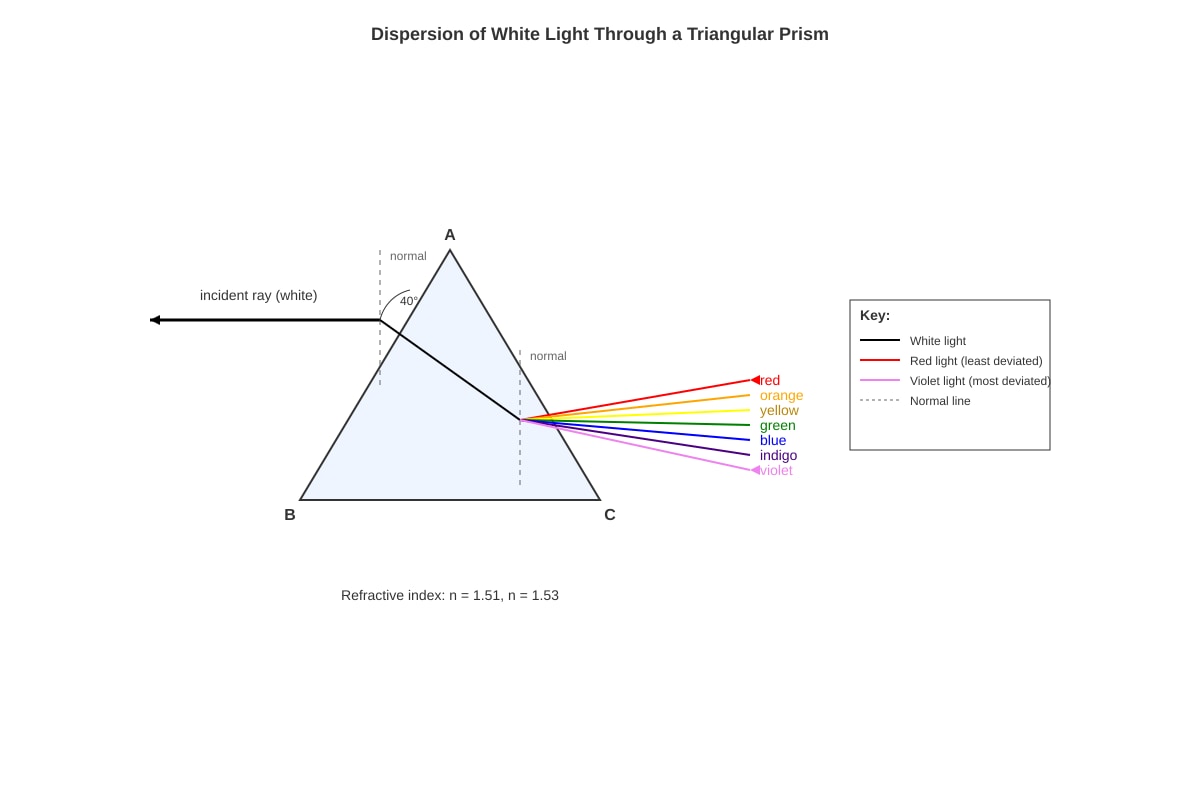
(a) Why white light separates into colours: [2 marks]
White light consists of many different frequencies (colours), each with a different wavelength. [1 mark]
The refractive index of glass depends on wavelength (dispersion): shorter wavelengths (violet) are slowed more than longer wavelengths (red), causing different angles of refraction for each colour. [1 mark]
- Key term: "Dispersion" — the separation of white light into its component colours.
(b) Why violet is deviated more: [2 marks]
Violet light has a shorter wavelength and higher frequency than red light. [1 mark]
The refractive index of glass for violet () is greater than for red (). Using Snell's law, a higher refractive index means light bends more toward the normal at each refraction, resulting in greater overall deviation through the prism. [1 mark]
- Calculation check: For incident angle 40°, using :
- Red: , so
- Violet: , so
- Violet bends more at first surface; similar at second surface, cumulative effect gives greater deviation.
19. [4 marks]
(a) Longitudinal nature: [2 marks]
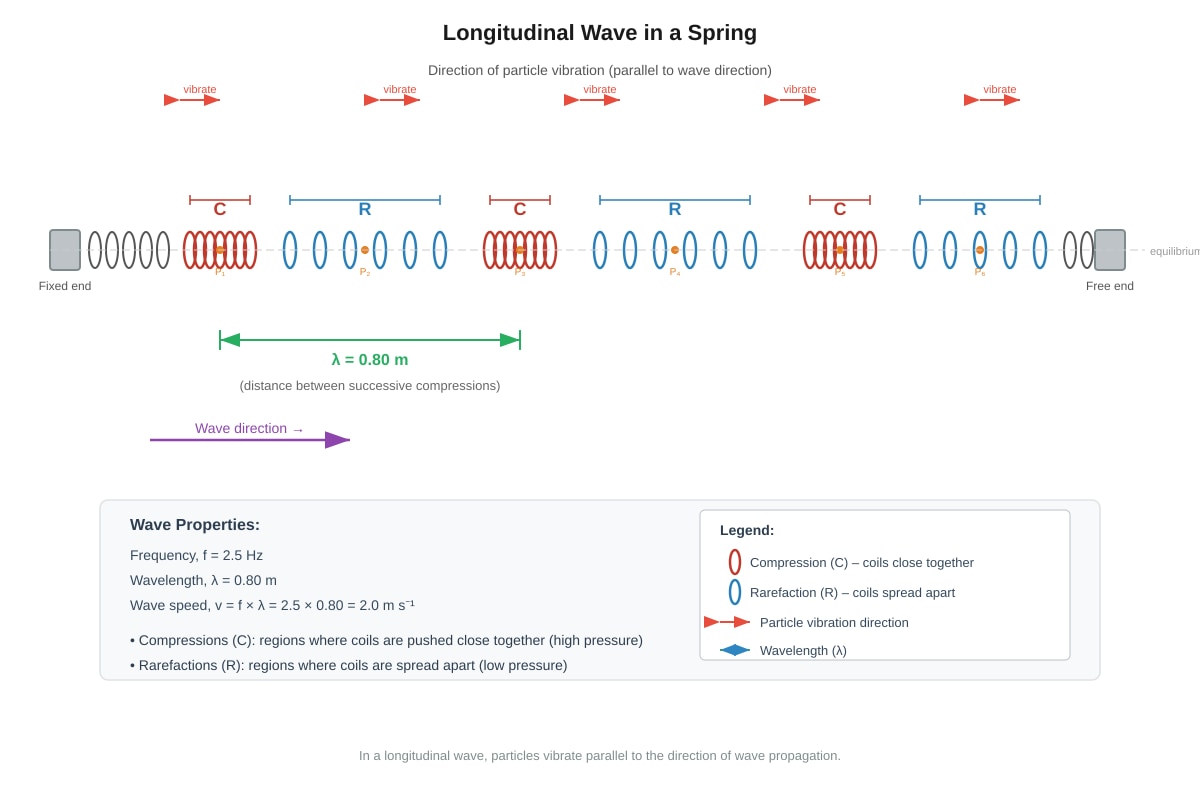
In this wave, the particles of the spring vibrate parallel to the direction of wave travel. [1 mark]
The diagram shows compressions (C) where coils are close together and rarefactions (R) where coils are spread out — the displacement arrows point along the spring's length, not perpendicular to it. [1 mark]
- Contrast with transverse: In a transverse wave, particle displacement would be perpendicular to wave direction (e.g., string waved up and down).
(b) Wave speed: [2 marks]
[1 mark for formula, 1 mark for answer with unit]
20. [4 marks]
(a) Intensity is inversely proportional to the square of the distance: [1 mark]
or where is constant, or " = constant"
(b) Completed table and analysis: [3 marks]
| Distance / m | / | / W |
|---|---|---|
| 1.0 | 1.0 | 80 |
| 2.0 | 4.0 | 80 |
| 3.0 | 9.0 | 80.1 ≈ 80 |
| 4.0 | 16.0 | 80 |
| 5.0 | 25.0 | 80 |
[1 mark for correct column, 1 mark for correct column]
Analysis: [1 mark]
The product is approximately constant (≈ 80 W in each case), confirming that . This is the inverse square law for intensity from a point source.
- Small variation (80.1) due to rounding in given data; students should note consistency.
- Physical basis: Sound energy spreads over spherical area , so intensity (power/area) decreases as .
Total: 40 marks