AI Generated Quiz
Secondary 3 Physics Waves Sound Light Quiz
Free Sec 3 Physics Waves Sound Light quiz, HY3 AI version, with questions, answers, and O Level-style practice for Singapore students.
These static practice materials are generated from the site's syllabus and paper-generation workflow, with source and model context shown so students and parents can evaluate the material before use.
Questions
Secondary 3 Physics Quiz - Waves Sound Light
Name: ___________________________
Class: ___________________________
Date: ___________________________
Score: _______ / 40
Duration: 50 minutes
Total Marks: 40
Instructions: Answer all 20 questions. Show your working where calculation is required. Section A is multiple-choice (1 mark each), Section B is structured short answers (2 marks each), Section C is extended structured questions (3–4 marks each). Use g=10 m s−2 where needed.
Section A: Multiple Choice (Questions 1–5, 1 mark each)
-
Which of the following best describes a transverse wave?
A. Particles vibrate parallel to the direction of energy transfer
B. Particles vibrate perpendicular to the direction of energy transfer
C. The wave does not transfer energy
D. The wave requires no medium
_____ (1 mark) -
Sound waves are classified as:
A. Transverse and require a medium
B. Longitudinal and require a medium
C. Transverse and can travel in vacuum
D. Longitudinal and can travel in vacuum
_____ (1 mark) -
The speed of light in air is approximately:
A. 3.0×10⁸ m s−1
B. 340 m s−1
C. 1500 m s−1
D. 3.0×10⁶ m s−1
_____ (1 mark) -
When light travels from air into glass, it bends towards the normal because:
A. Its speed increases in glass
B. Its speed decreases in glass
C. Its frequency changes
D. Its amplitude increases
_____ (1 mark) -
Echoes are produced by the phenomenon of:
A. Refraction
B. Diffraction
C. Reflection
D. Interference
_____ (1 mark)
Section B: Structured Short Answers (Questions 6–10, 2 marks each)
-
A wave has a frequency of 50 Hz and a wavelength of 4 m. Calculate its speed. Show your working.
_______________________________________ (2 marks) -
State one difference between sound waves and light waves in terms of the medium needed for propagation.
_______________________________________ (2 marks) -
A student places a ruler at the edge of a table and plucks it. The length of the vibrating part is shortened. What happens to the pitch produced? Explain briefly.
_______________________________________ (2 marks) -
Light travels from water (n=1.33) into air. State whether it bends towards or away from the normal and why.
_______________________________________ (2 marks) -
A ripple tank shows straight wavefronts approaching a narrow gap. Name the wave phenomenon that occurs and state what is observed.
_______________________________________ (2 marks)
Section C: Extended Structured Questions (Questions 11–20)
-
A sound wave of frequency 440 Hz travels in air at 340 m s−1.
(a) Calculate its wavelength. (2 marks)
(b) If the frequency is doubled, what happens to the wavelength? Explain. (2 marks)
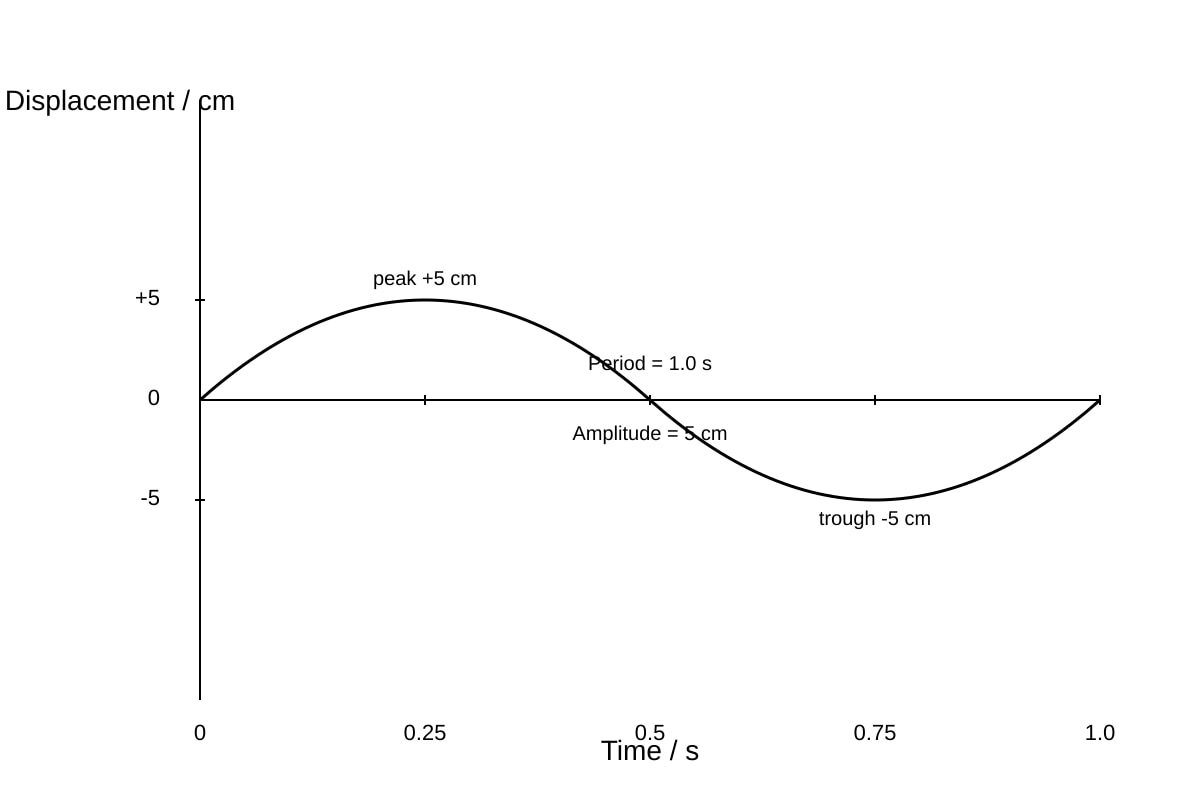
Image pending generation: graph for Q12.
The graph shows the displacement of a point on a wave against time.
(a) What is the period of the wave? (1 mark)
(b) What is the frequency? (1 mark)
(c) What is the amplitude? (1 mark)
(d) Is this a transverse or longitudinal wave? Give a reason from the graph. (1 mark)
-
A student shines a ray of light at 30∘ to the normal from air into a glass block of refractive index 1.50.
(a) Calculate the angle of refraction. (2 marks)
(b) State Snell’s law in words. (1 mark)
(c) What happens to the speed of light in the glass? (1 mark) -
A bat emits a ultrasound pulse and receives the echo 0.10 s later from a wall. Speed of sound in air is 340 m s−1.
(a) Calculate the distance to the wall. (2 marks)
(b) Why must the bat use ultrasound and not audible sound for hunting? (2 marks)
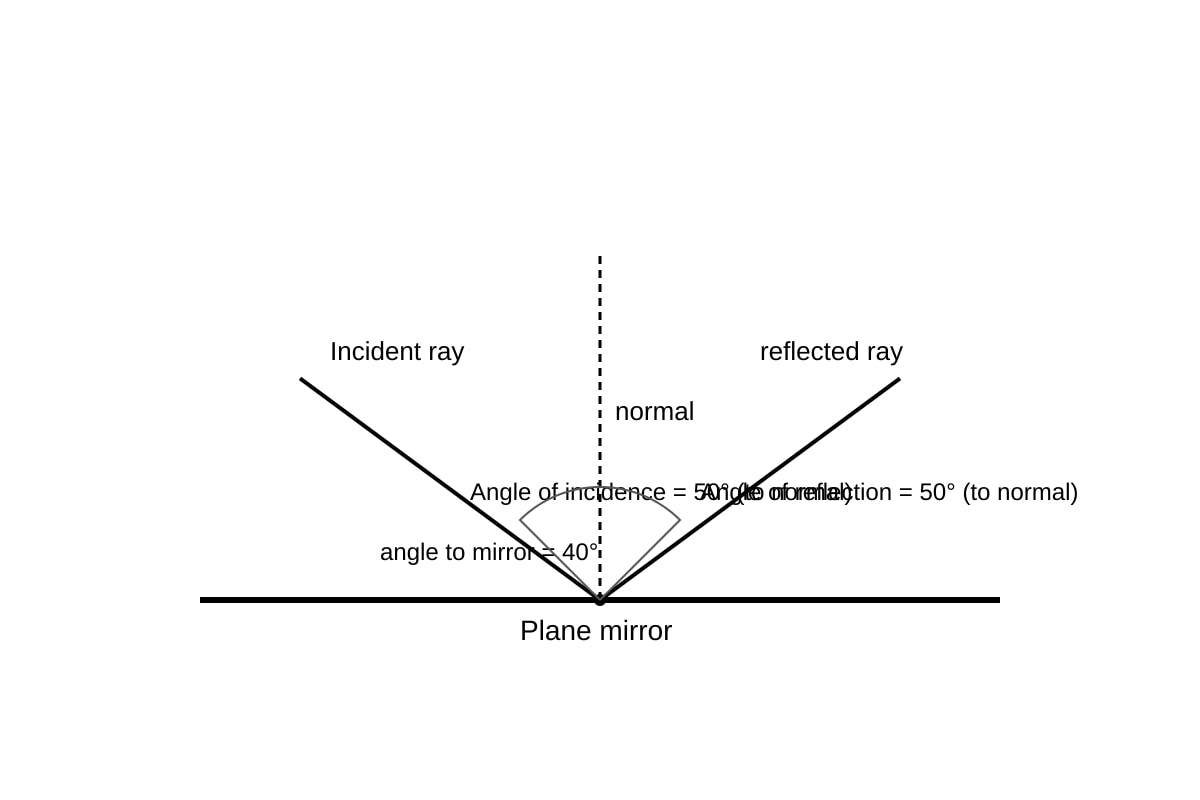
Image pending generation: diagram for Q15.
A ray hits a plane mirror as shown.
(a) What is the angle of incidence? (1 mark)
(b) What is the angle of reflection? (1 mark)
(c) Draw and label the normal on the diagram. (1 mark)
(d) State the law of reflection. (1 mark)
-
A string is stretched between two fixed ends. It vibrates to form three loops (3rd harmonic). The length of the string is 1.2 m.
(a) What is the wavelength of the stationary wave? (2 marks)
(b) If the frequency is 150 Hz, calculate the wave speed. (2 marks) -
A convex lens of focal length 10 cm forms an image of an object placed 15 cm from the lens.
(a) Use the lens formula f1=u1+v1 to find the image distance v. (2 marks)
(b) State one property of the image (real/virtual, magnified/diminished). (2 marks)
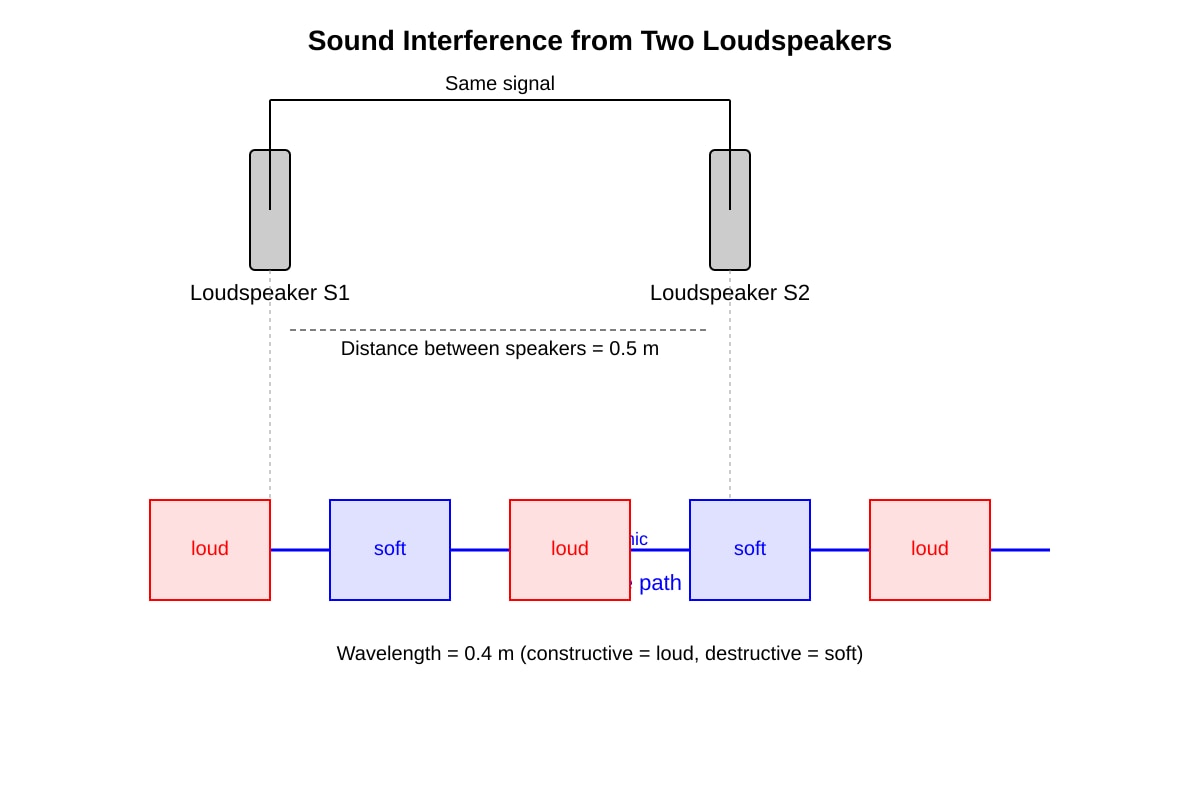
Image pending generation: diagram for Q18.
The diagram shows sound interference from two speakers.
(a) Name the phenomenon. (1 mark)
(b) Explain why loud and soft regions are formed. (2 marks)
(c) What happens to the pattern if frequency is increased? (1 mark)
-
A light ray enters a glass prism (refractive index 1.5) from air at 0∘ to the normal on one face, then hits the second face at 45∘ internally. Critical angle for glass-air is 42∘.
(a) Calculate the critical angle using sinc=n1. (1 mark)
(b) What occurs at the second face? (1 mark)
(c) Explain your answer. (2 marks) -
A student measures the speed of sound using a 200 m track. A flash and bang are made at one end; the time delay at the other end is 0.59 s.
(a) Calculate the speed of sound from the data. (2 marks)
(b) Give one reason why the value may differ from 340 m s−1. (2 marks)
Answers
Secondary 3 Physics Quiz - Waves Sound Light (Answer Key)
Total Marks: 40
Teaching notes included for each question.
Section A (1 mark each)
- B – In a transverse wave, particle vibration is perpendicular to energy transfer direction. (A is longitudinal; C and D false.)
- B – Sound is longitudinal (vibrations parallel to travel) and needs a medium; cannot travel in vacuum.
- A – Speed of light in air ≈ 3.0×10⁸ m s−1. (340 m s−1 is sound in air.)
- B – Light slows in glass, so bends towards normal (Snell’s law). Frequency unchanged.
- C – Echo = reflection of sound from a surface.
Section B (2 marks each)
- Speed v=fλ=50×4=200 m s−1. [1 mark formula, 1 mark answer]
- Sound needs a material medium (solid/liquid/gas); light can travel through vacuum. [1 mark each point]
- Pitch increases. [1] Shorter vibrating length → higher natural frequency. [1]
- Bends away from normal. [1] Light speeds up leaving denser (water) to less dense (air). [1]
- Diffraction. [1] Waves spread out after passing the gap. [1]
Section C
-
(a) λ=v/f=340/440=0.773 m (accept 0.77 m). [2]
(b) Wavelength halves. [1] Since v constant in same medium, λ=v/f; doubling f halves λ. [1] -
From placeholder Q12-fig1:
(a) Period = 1.0 s [1]
(b) f=1/T=1.0 Hz [1]
(c) Amplitude = 5 cm [1]
(d) Transverse [1] because displacement is plotted against time showing oscillation; graph alone shows time-based displacement typical of transverse representation (or state: graph shows particle displacement, consistent with transverse). -
(a) Snell: n1sini=n2sinr; 1×sin30∘=1.5sinr → sinr=0.5/1.5=0.333 → r=19.5∘. [2]
(b) Ratio of sine of angles equals ratio of refractive indices. [1]
(c) Speed decreases (v=c/n). [1] -
(a) Total distance = v×t=340×0.10=34 m; to wall = 17 m. [2]
(b) Ultrasound has high frequency, short wavelength → better resolution for small prey, not heard by humans/insects. [2] -
From Q15-fig1: angle to mirror 40° → incidence to normal = 50°.
(a) 50° [1]
(b) 50° [1]
(c) Normal perpendicular at point. [1]
(d) Angle of incidence = angle of reflection. [1] -
(a) 3 loops → L=3λ/2 → λ=2L/3=0.80 m. [2]
(b) v=fλ=150×0.80=120 m s−1. [2] -
(a) 1/10=1/15+1/v → 1/v=0.1−0.0667=0.0333 → v=30 cm. [2]
(b) Real (positive v), magnified (v>u). [2] -
From Q18-fig1:
(a) Interference. [1]
(b) Loud = constructive (waves in phase), soft = destructive (out of phase). [2]
(c) Fringe spacing decreases (wavelength shorter). [1] -
(a) sinc=1/1.5=0.667 → c=41.8∘ ≈ 42°. [1]
(b) Total internal reflection. [1]
(c) Internal angle 45° > critical 42°, so TIR occurs. [2] -
(a) v=200/0.59=339 m s−1. [2]
(b) Temp/wind/humidity differ from standard; measurement error. [2]
Free quiz and exam paper access
Enter your details to view this paper
Your access is remembered on this device.