AI Generated Quiz

Secondary 3 Physics Thermal Physics Quiz

Free Sec 3 Physics Thermal Physics quiz, Nemo3 AI version, with questions, answers, and O Level-style practice for Singapore students.

These static practice materials are generated from the site's syllabus and paper-generation workflow, with source and model context shown so students and parents can evaluate the material before use.

Secondary 3 Physics AI Generated Generated by NVIDIA Nemotron 3 Ultra 550B A55B Free Updated 2026-06-18

Questions

<!-- TuitionGoWhere generation metadata: stage=5-1; model=nvidia/nemotron-3-ultra-550b-a55b:free; model_label=NVIDIA Nemotron 3 Ultra 550B A55B Free; generated=2026-06-18; Sources: Stage 4-0 LLM templates, syllabus context, and Stage 2 evidence where available. -->

Secondary 3 Physics Quiz - Thermal Physics

Name: ___________________________
Class: ___________________________
Date: ___________________________
Score: _____ / 40

Duration: 45 minutes
Total Marks: 40

Instructions:

  • Answer all questions.
  • Write your answers in the spaces provided.
  • Show all working for calculation questions.
  • Use g=10 N/kgg = 10 \text{ N/kg} where needed.
  • The number of marks is given in brackets [ ] at the end of each question or part question.

Section A: Multiple Choice Questions (10 marks)

Answer all questions. Choose the correct option and write the letter (A, B, C, or D) in the box provided.

1. [1 mark]

Which of the following statements about internal energy is correct?

A. Internal energy is the sum of kinetic energy of all molecules only.
B. Internal energy increases when a substance melts at constant temperature.
C. Internal energy depends only on the temperature of the substance.
D. Internal energy is the same as heat energy transferred.

Answer:

2. [1 mark]

A 200 g block of copper at 100°C is placed in 500 g of water at 20°C. Assuming no heat loss to the surroundings, which statement is true when thermal equilibrium is reached?

A. The final temperature will be exactly 60°C.
B. The final temperature will be closer to 20°C than to 100°C.
C. The final temperature will be closer to 100°C than to 20°C.
D. The copper block will have a higher final temperature than the water.

Answer:

3. [1 mark]

The specific heat capacity of substance X is 900 J/(kg⋅°C)900 \text{ J/(kg·°C)} and substance Y is 450 J/(kg⋅°C)450 \text{ J/(kg·°C)}. Equal masses of X and Y receive the same amount of heat energy. Which statement is correct?

A. The temperature rise of X is twice that of Y.
B. The temperature rise of Y is twice that of X.
C. Both substances have the same temperature rise.
D. The temperature rise of X is four times that of Y.

Answer:

4. [1 mark]

During boiling, the temperature of a liquid remains constant because:

A. Heat energy is used to increase the kinetic energy of molecules.
B. Heat energy is used to overcome intermolecular forces and do work against atmospheric pressure.
C. No heat energy is being supplied during boiling.
D. The liquid loses heat to the surroundings at the same rate it is supplied.

Answer:

5. [1 mark]

Which of the following processes involves heat transfer by convection only?

A. Heat from the Sun warming the Earth.
B. A metal spoon becoming hot when placed in hot soup.
C. Warm air rising above a radiator.
D. Heat transfer through the vacuum of a thermos flask.

Answer:

6. [1 mark]

A student measures the specific latent heat of fusion of ice using a heater immersed in a funnel of melting ice. The mass of water collected in time tt is mm. The heater operates at voltage VV and current II. Which expression gives the specific latent heat of fusion LL?

A. L=VItmL = \frac{VIt}{m}
B. L=mVItL = \frac{m}{VIt}
C. L=VIt2mL = \frac{VIt}{2m}
D. L=2VItmL = \frac{2VIt}{m}

Answer:

7. [1 mark]

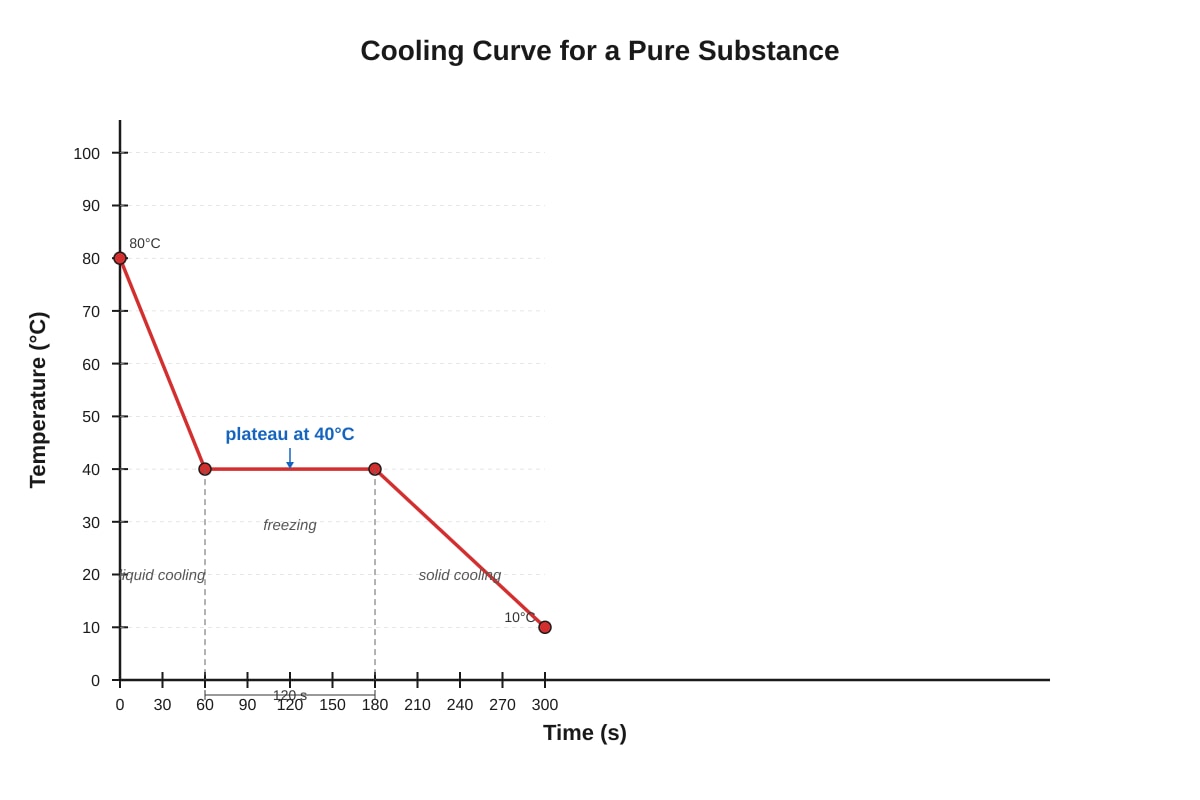
The diagram below shows a cooling curve for a pure substance.

<image_placeholder> id: Q7-fig1 type: graph linked_question: Q7 description: Cooling curve graph showing temperature vs time for a pure substance. Horizontal axis: Time (s) from 0 to 300. Vertical axis: Temperature (°C) from 0 to 100. Graph shows a sloping line from (0, 80) to (60, 40), a horizontal plateau from (60, 40) to (180, 40), then a sloping line from (180, 40) to (300, 10). labels: Time (s), Temperature (°C), plateau at 40°C values: Initial temp 80°C, plateau at 40°C for 120 s, final temp 10°C at 300 s must_show: Clear plateau region, sloping cooling regions before and after plateau, labelled axes with units </image_placeholder>

What is the freezing point of the substance?

A. 10°C
B. 40°C
C. 80°C
D. 60°C

Answer:

8. [1 mark]

Two identical metal cans, one painted matt black and the other painted shiny white, are filled with equal amounts of hot water at 80°C and left in a room at 25°C. After 10 minutes:

A. The water in the matt black can will be cooler.
B. The water in the shiny white can will be cooler.
C. Both cans will have water at the same temperature.
D. The temperature difference depends on the room temperature only.

Answer:

9. [1 mark]

A bimetallic strip consists of brass and steel bonded together. When heated, the strip bends with brass on the outer curve. This is because:

A. Brass expands more than steel for the same temperature rise.
B. Steel expands more than brass for the same temperature rise.
C. Brass conducts heat faster than steel.
D. Steel conducts heat faster than brass.

Answer:

10. [1 mark]

A thermocouple thermometer is preferred over a liquid-in-glass thermometer for measuring rapidly changing temperatures because:

A. It has a larger range.
B. It has a smaller heat capacity and responds faster.
C. It does not require a power supply.
D. It is more accurate at high temperatures.

Answer:


Section B: Structured Questions (18 marks)

Answer all questions in the spaces provided.

11. [3 marks]

(a) Define specific heat capacity of a substance.


(b) A 0.5 kg aluminium block (c=900 J/(kg⋅°C)c = 900 \text{ J/(kg·°C)}) is heated from 25°C to 75°C. Calculate the heat energy absorbed by the block.


12. [4 marks]

An electric kettle rated 2.0 kW is used to heat 1.5 kg of water from 20°C to 100°C. The specific heat capacity of water is 4200 J/(kg⋅°C)4200 \text{ J/(kg·°C)}.

(a) Calculate the heat energy required to raise the temperature of the water to 100°C.


(b) Calculate the minimum time taken for the kettle to heat the water to 100°C, assuming no heat losses.


(c) In practice, the actual time taken is longer than the calculated minimum time. State one reason for this.


13. [4 marks]

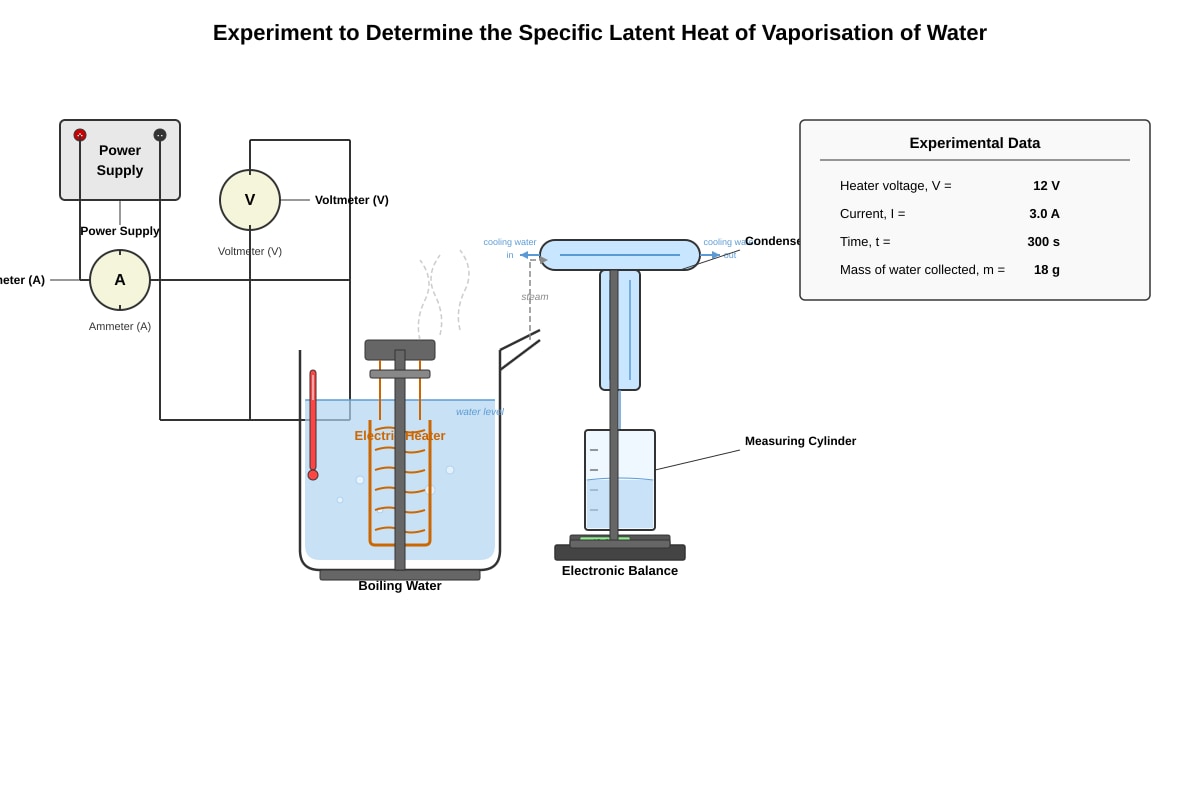
The diagram below shows an experiment to determine the specific latent heat of vaporisation of water.

<image_placeholder> id: Q13-fig1 type: experimental_setup linked_question: Q13 description: Experimental setup for specific latent heat of vaporisation. An electric heater immersed in a beaker of boiling water. The heater is connected to a power supply with ammeter and voltmeter. Steam escapes and is condensed in a cooled condenser, with condensed water collected in a measuring cylinder on a balance. labels: Electric heater, boiling water, power supply, ammeter (A), voltmeter (V), condenser, measuring cylinder, electronic balance values: Heater voltage = 12 V, current = 3.0 A, time = 300 s, mass of water collected = 18 g must_show: Complete circuit with meters, heater in water, condenser collecting steam, balance measuring condensed water mass </image_placeholder>

The heater operates at 12 V and 3.0 A for 300 s. During this time, 18 g of water is collected as condensate.

(a) Calculate the electrical energy supplied by the heater.


(b) Calculate the specific latent heat of vaporisation of water from this experiment.


(c) The accepted value for the specific latent heat of vaporisation of water is 2.26×10⁶ J/kg2.26 \times 10^6 \text{ J/kg}. Suggest one reason why the experimental value may differ from the accepted value.


14. [3 marks]

(a) Explain, in terms of molecular motion, why the temperature of a substance remains constant during melting.


(b) State the difference in molecular arrangement between a solid and a liquid of the same substance.


15. [4 marks]

A 100 g piece of metal at 150°C is dropped into 200 g of water at 25°C in a polystyrene cup. The final temperature of the mixture is 35°C. The specific heat capacity of water is 4200 J/(kg⋅°C)4200 \text{ J/(kg·°C)}. Assume no heat loss to the surroundings and negligible heat capacity of the cup.

(a) Calculate the heat gained by the water.


(b) Calculate the specific heat capacity of the metal.


Section C: Longer Structured Questions (12 marks)

Answer all questions in the spaces provided.

16. [6 marks]

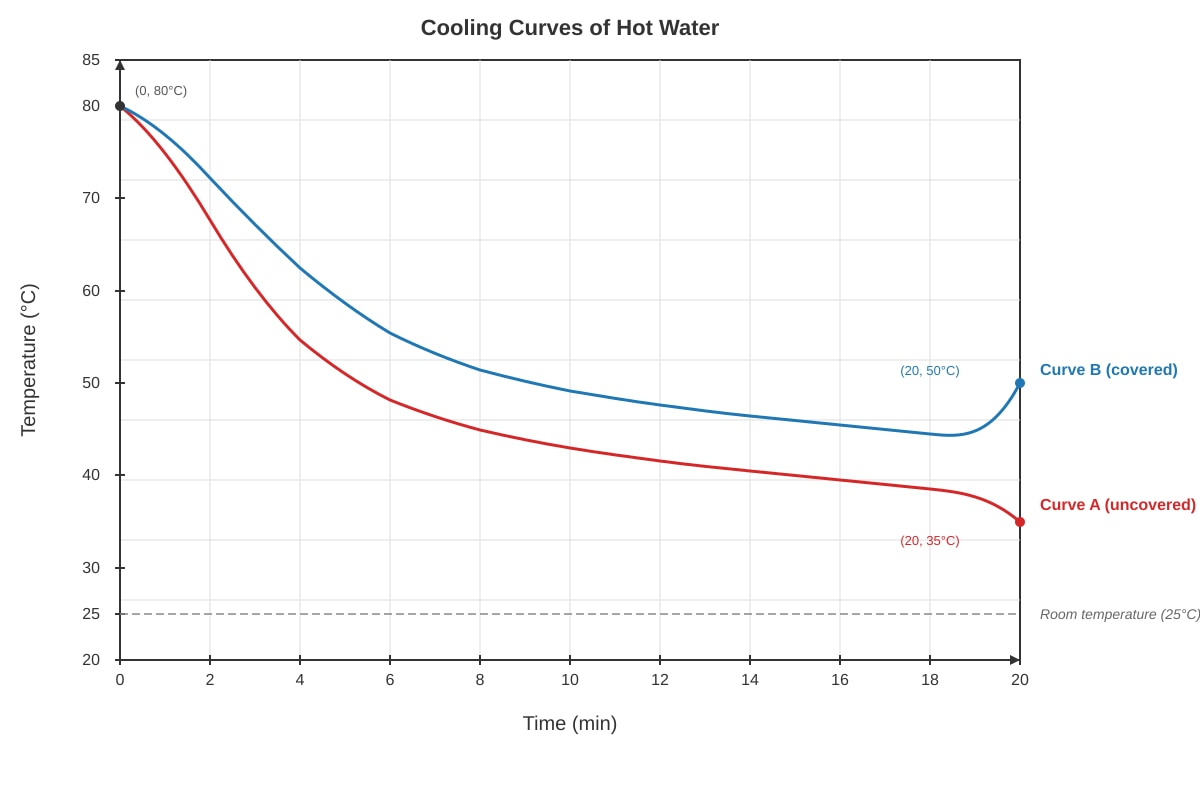
A student investigates the cooling of hot water in two identical beakers. Beaker A is left uncovered. Beaker B is covered with a lid. Both beakers contain 200 g of water initially at 80°C. The room temperature is 25°C. The student records the temperature every 2 minutes for 20 minutes.

<image_placeholder> id: Q16-fig1 type: graph linked_question: Q16 description: Two cooling curves on same axes. Horizontal axis: Time (min) from 0 to 20. Vertical axis: Temperature (°C) from 20 to 85. Curve A (uncovered) starts at (0, 80) and drops steeply to (20, 35). Curve B (covered) starts at (0, 80) and drops less steeply to (20, 50). Both curves approach room temperature asymptotically. labels: Time (min), Temperature (°C), Curve A (uncovered), Curve B (covered), Room temperature (25°C) values: Initial temp 80°C, room temp 25°C, Curve A at 20 min = 35°C, Curve B at 20 min = 50°C must_show: Two distinct cooling curves on same axes, labelled, with clear difference in cooling rates, room temperature line indicated </image_placeholder>

(a) On the graph axes above, sketch the expected cooling curves for Beaker A (uncovered) and Beaker B (covered). Label each curve clearly. [2 marks]

(b) Explain why the cooling curve for Beaker B is less steep than that for Beaker A.


(c) The student calculates the rate of heat loss from Beaker A at the start of the experiment (first 2 minutes). The temperature drops from 80°C to 72°C in the first 2 minutes. Calculate the initial rate of heat loss in watts. (Specific heat capacity of water = 4200 J/(kg⋅°C)4200 \text{ J/(kg·°C)})


17. [6 marks]

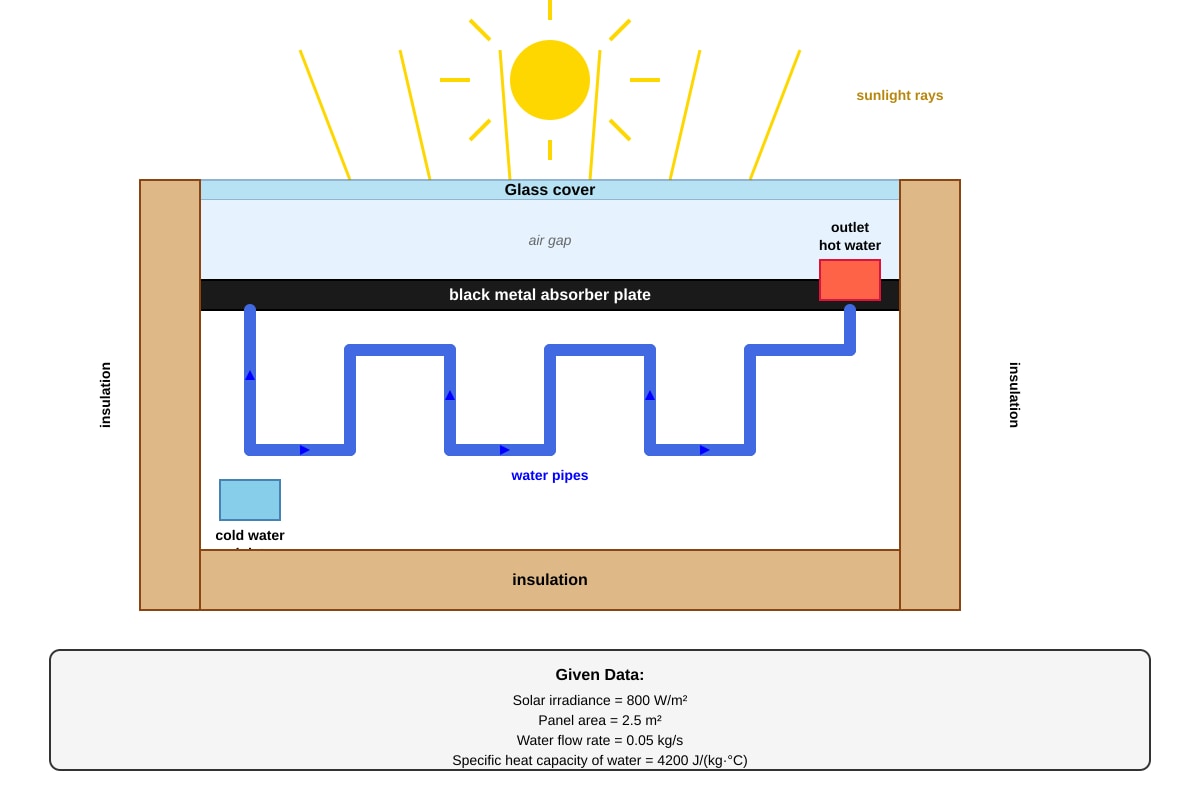
A solar water heater consists of a black metal panel with water pipes behind a glass cover. Sunlight passes through the glass and heats the panel. Water flowing through the pipes is heated.

<image_placeholder> id: Q17-fig1 type: diagram linked_question: Q17 description: Cross-section of a solar water heater. Glass cover at top, air gap, black metal absorber plate with water pipes attached, insulation at bottom and sides. Sunlight rays entering from top, passing through glass, absorbed by black plate. Water flows through pipes from bottom (cold) to top (hot). labels: Glass cover, air gap, black metal absorber plate, water pipes, insulation, sunlight rays, cold water inlet, hot water outlet values: Solar irradiance = 800 W/m², panel area = 2.5 m², water flow rate = 0.05 kg/s, specific heat capacity of water = 4200 J/(kg·°C) must_show: Clear layers, flow direction, sunlight entering, labels for all components </image_placeholder>

(a) Explain why the metal panel is painted black.


(b) Explain the purpose of the glass cover.


(c) The solar irradiance is 800 W/m² and the panel area is 2.5 m². Water flows through the pipes at 0.05 kg/s. Assuming 60% of the incident solar energy is transferred to the water, calculate the temperature rise of the water as it passes through the panel.


18. [5 marks]

A 2.0 kW electric heater is used to heat 0.8 kg of a solid substance in a well-insulated container. The substance has a melting point of 60°C and a specific latent heat of fusion of 1.5×10⁵ J/kg1.5 \times 10^5 \text{ J/kg}. The specific heat capacity of the solid is 1200 J/(kg⋅°C)1200 \text{ J/(kg·°C)} and of the liquid is 2400 J/(kg⋅°C)2400 \text{ J/(kg·°C)}. The initial temperature of the solid is 20°C.

(a) Calculate the time taken to heat the solid from 20°C to its melting point at 60°C.


(b) Calculate the time taken to completely melt the solid at 60°C.


(c) Sketch a temperature-time graph for the process from 20°C until all the substance has melted. Label the axes and indicate key temperatures and times.


19. [4 marks]

A double-glazed window consists of two glass panes separated by a 1.5 cm gap filled with argon gas. The thermal conductivity of glass is 1.0 W/(m⋅K)1.0 \text{ W/(m·K)}, argon is 0.016 W/(m⋅K)0.016 \text{ W/(m·K)}, and air is 0.026 W/(m⋅K)0.026 \text{ W/(m·K)}. Each glass pane is 4 mm thick. The window area is 2.0 m². The temperature difference across the window is 20°C (inside 25°C, outside 5°C).

(a) Explain why argon gas is used instead of air in the gap.


(b) Calculate the rate of heat conduction through the double-glazed window. Assume steady-state one-dimensional conduction and ignore convection and radiation within the gap.


20. [5 marks]

A student performs an experiment to determine the specific heat capacity of a metal block using an electrical method. The block has a mass of 1.0 kg. A heater rated at 50 W is embedded in the block. The initial temperature is 25°C. The heater is switched on for 10 minutes and the final temperature is recorded as 65°C.

(a) Calculate the specific heat capacity of the metal based on these readings.


(b) The accepted value for the specific heat capacity of this metal is 450 J/(kg⋅°C)450 \text{ J/(kg·°C)}. Calculate the percentage difference between the experimental and accepted values.


(c) Suggest two improvements to the experimental setup to obtain a more accurate result.


End of Quiz

Answers

<!-- TuitionGoWhere generation metadata: stage=5-1; model=nvidia/nemotron-3-ultra-550b-a55b:free; model_label=NVIDIA Nemotron 3 Ultra 550B A55B Free; generated=2026-06-18; Sources: Stage 4-0 LLM templates, syllabus context, and Stage 2 evidence where available. -->

Secondary 3 Physics Quiz - Thermal Physics (Answer Key)

Total Marks: 40


Section A: Multiple Choice Questions (10 marks)

1. [1 mark] Answer: B

Explanation: Internal energy is the sum of kinetic and potential energies of all molecules in a substance. During melting at constant temperature, heat energy (latent heat) is supplied to overcome intermolecular forces, increasing the potential energy component of internal energy while kinetic energy (temperature) remains constant.
Common mistake: Option A is incorrect because internal energy includes potential energy. Option C is incorrect because internal energy also depends on mass and state. Option D confuses internal energy (a property of the system) with heat (energy in transit).

2. [1 mark] Answer: B

Explanation: Water has a much higher specific heat capacity (4200 J/(kg⋅°C)4200 \text{ J/(kg·°C)}) than copper (385 J/(kg⋅°C)385 \text{ J/(kg·°C)}). The water also has a larger mass (500 g vs 200 g). The heat capacity (mcmc) of water is 0.5×4200=2100 J/°C0.5 \times 4200 = 2100 \text{ J/°C}, while for copper it is 0.2×385=77 J/°C0.2 \times 385 = 77 \text{ J/°C}. The final temperature will be much closer to the initial water temperature (20°C) because water can absorb much more heat per degree temperature change.

3. [1 mark] Answer: B

Explanation: Q=mcΔθQ = mc\Delta\theta. For equal mm and QQ, Δθ1c\Delta\theta \propto \frac{1}{c}. Since cX=900c_X = 900 and cY=450c_Y = 450, cX=2cYc_X = 2c_Y. Therefore ΔθY=2ΔθX\Delta\theta_Y = 2\Delta\theta_X. Substance Y has half the specific heat capacity, so its temperature rises twice as much for the same heat input.

4. [1 mark] Answer: B

Explanation: During boiling, the supplied heat energy (latent heat of vaporisation) is used to overcome intermolecular forces holding molecules together in the liquid phase and to do work against atmospheric pressure as the volume expands significantly during the phase change to gas. The kinetic energy of molecules (and thus temperature) does not increase during the phase change.

5. [1 mark] Answer: C

Explanation: Convection is heat transfer through fluid motion. Warm air rising above a radiator is a classic example of natural convection. Option A is radiation (through vacuum). Option B is conduction (through solid metal). Option D describes a vacuum which prevents conduction and convection; heat transfer in a thermos flask vacuum is by radiation only.

6. [1 mark] Answer: A

Explanation: Electrical energy supplied = VItVIt. This energy melts mass mm of ice: VIt=mLVIt = mL. Therefore L=VItmL = \frac{VIt}{m}.

7. [1 mark] Answer: B

Explanation: The plateau on a cooling curve represents the phase change from liquid to solid (freezing). The temperature remains constant at the freezing point during this phase change. The graph shows a plateau at 40°C, so the freezing point is 40°C.

8. [1 mark] Answer: A

Explanation: Matt black surfaces are good emitters of infrared radiation, while shiny white surfaces are poor emitters. Both cans lose heat by radiation (and convection/conduction). The matt black can radiates heat faster, so its water cools more quickly.

9. [1 mark] Answer: A

Explanation: A bimetallic strip bends because the two metals have different coefficients of thermal expansion. The metal with the higher expansion coefficient (brass) expands more and becomes the outer curve when heated. Brass expands more than steel for the same temperature rise.

10. [1 mark] Answer: B

Explanation: A thermocouple has a very small sensing junction (low mass, low heat capacity), so it reaches thermal equilibrium with the measured object very quickly. Liquid-in-glass thermometers have a larger bulb with more thermal mass, resulting in slower response times.


Section B: Structured Questions (18 marks)

11. [3 marks]

(a) [1 mark] Specific heat capacity of a substance is the amount of heat energy required to raise the temperature of 1 kg of the substance by 1°C (or 1 K).
Accept: "per unit mass per degree Celsius/Kelvin"

(b) [2 marks]
Q=mcΔθQ = mc\Delta\theta
Q=0.5×900×(7525)Q = 0.5 \times 900 \times (75 - 25)
Q=0.5×900×50Q = 0.5 \times 900 \times 50
Q=22500 JQ = 22\,500 \text{ J} (or 22.5 kJ22.5 \text{ kJ})
1 mark for correct substitution, 1 mark for correct answer with unit

12. [4 marks]

(a) [2 marks]
Q=mcΔθQ = mc\Delta\theta
Q=1.5×4200×(10020)Q = 1.5 \times 4200 \times (100 - 20)
Q=1.5×4200×80Q = 1.5 \times 4200 \times 80
Q=504000 JQ = 504\,000 \text{ J} (or 504 kJ504 \text{ kJ})
1 mark for correct substitution, 1 mark for correct answer with unit

(b) [1 mark]
P=Qtt=QPP = \frac{Q}{t} \Rightarrow t = \frac{Q}{P}
t=5040002000=252 st = \frac{504\,000}{2000} = 252 \text{ s} (or 4 min 12 s4 \text{ min } 12 \text{ s})
1 mark for correct answer with unit

(c) [1 mark] Heat losses to the surroundings / heat absorbed by the kettle itself / some energy used to heat the kettle body / not all electrical energy converted to heat in water.
Accept any reasonable heat loss explanation.

13. [4 marks]

(a) [1 mark]
E=VIt=12×3.0×300=10800 JE = VIt = 12 \times 3.0 \times 300 = 10\,800 \text{ J}

(b) [2 marks]
E=mLL=EmE = mL \Rightarrow L = \frac{E}{m}
m=18 g=0.018 kgm = 18 \text{ g} = 0.018 \text{ kg}
L=108000.018=600000 J/kg=6.0×105 J/kgL = \frac{10\,800}{0.018} = 600\,000 \text{ J/kg} = 6.0 \times 10^5 \text{ J/kg}
1 mark for correct mass conversion and substitution, 1 mark for correct answer with unit

(c) [1 mark] Heat losses to surroundings (not all electrical energy goes into vaporising water) / some steam escapes without being condensed / condensation incomplete / heat absorbed by apparatus / measurement errors in mass/time/voltage/current.
Accept any valid experimental error/heat loss reason.

14. [3 marks]

(a) [2 marks] During melting, the supplied heat energy (latent heat of fusion) is used to overcome the intermolecular forces holding the molecules in fixed positions in the solid lattice. The energy increases the potential energy of the molecules as they gain freedom to move past each other, but the average kinetic energy of the molecules (which determines temperature) does not change. Hence temperature remains constant.

(b) [1 mark] In a solid, molecules are closely packed in a fixed, ordered arrangement (lattice) and vibrate about fixed positions. In a liquid, molecules are still closely packed but have no long-range order; they can move past each other and slide over one another.

15. [4 marks]

(a) [2 marks]
Heat gained by water = mwcwΔθwm_w c_w \Delta\theta_w
=0.200×4200×(3525)= 0.200 \times 4200 \times (35 - 25)
=0.200×4200×10= 0.200 \times 4200 \times 10
=8400 J= 8400 \text{ J}
1 mark for correct substitution, 1 mark for correct answer with unit

(b) [2 marks]
Heat lost by metal = Heat gained by water (no heat losses)
mmcmΔθm=8400m_m c_m \Delta\theta_m = 8400
0.100×cm×(15035)=84000.100 \times c_m \times (150 - 35) = 8400
0.100×cm×115=84000.100 \times c_m \times 115 = 8400
cm=84000.100×115=840011.5=730 J/(kg⋅°C)c_m = \frac{8400}{0.100 \times 115} = \frac{8400}{11.5} = 730 \text{ J/(kg·°C)} (or 730.4 J/(kg⋅°C)730.4 \text{ J/(kg·°C)})
1 mark for correct principle and substitution, 1 mark for correct answer with unit


Section C: Longer Structured Questions (12 marks)

16. [6 marks]

(a) [2 marks]
Graph sketch requirements:

  • Two curves starting at (0, 80°C)
  • Curve A (uncovered) steeper, reaching ~35°C at 20 min
  • Curve B (covered) less steep, reaching ~50°C at 20 min
  • Both curves labelled clearly
  • Room temperature (25°C) indicated as horizontal asymptote 1 mark for correct shape and labelling of both curves, 1 mark for correct relative steepness and asymptotic approach to room temperature

(b) [2 marks] The lid reduces heat loss by convection (traps air above water, preventing warm air from rising and being replaced by cooler air) and evaporation (prevents water vapour from escaping, which would carry away latent heat). The uncovered beaker loses heat by convection, evaporation, and radiation from the water surface, while the covered beaker mainly loses heat by conduction through the lid and radiation from the outer lid surface.

(c) [2 marks]
Q=mcΔθ=0.200×4200×(8072)=0.200×4200×8=6720 JQ = mc\Delta\theta = 0.200 \times 4200 \times (80 - 72) = 0.200 \times 4200 \times 8 = 6720 \text{ J}
Time = 2 minutes = 120 s
Rate of heat loss = Qt=6720120=56 W\frac{Q}{t} = \frac{6720}{120} = 56 \text{ W}
1 mark for correct heat energy calculation, 1 mark for correct rate with unit

17. [6 marks]

(a) [1 mark] Black surfaces are good absorbers of radiation. Painting the panel black maximises absorption of solar radiation (visible and infrared), converting it to thermal energy to heat the water.

(b) [2 marks] The glass cover creates a greenhouse effect: it allows short-wavelength solar radiation to pass through and be absorbed by the black panel, but traps long-wavelength infrared radiation re-emitted by the hot panel (glass is opaque to IR). It also reduces convection losses by trapping a layer of air above the panel.

(c) [3 marks]
Incident solar power = 800×2.5=2000 W800 \times 2.5 = 2000 \text{ W}
Power absorbed by water = 0.60×2000=1200 W0.60 \times 2000 = 1200 \text{ W}
Energy per second = 1200 J/s1200 \text{ J/s}
Mass flow rate = 0.05 kg/s0.05 \text{ kg/s}
Q=mcΔθΔθ=Qmc=12000.05×4200=1200210=5.71 °CQ = mc\Delta\theta \Rightarrow \Delta\theta = \frac{Q}{mc} = \frac{1200}{0.05 \times 4200} = \frac{1200}{210} = 5.71 \text{ °C}
1 mark for incident power, 1 mark for absorbed power, 1 mark for correct Δθ\Delta\theta with unit

18. [5 marks]

(a) [2 marks]
Q=mcΔθ=0.8×1200×(6020)=0.8×1200×40=38400 JQ = mc\Delta\theta = 0.8 \times 1200 \times (60 - 20) = 0.8 \times 1200 \times 40 = 38\,400 \text{ J}
P=2000 WP = 2000 \text{ W}
t=QP=384002000=19.2 st = \frac{Q}{P} = \frac{38\,400}{2000} = 19.2 \text{ s}
1 mark for correct heat energy, 1 mark for correct time with unit

(b) [2 marks]
Q=mL=0.8×1.5×105=120000 JQ = mL = 0.8 \times 1.5 \times 10^5 = 120\,000 \text{ J}
t=QP=1200002000=60 st = \frac{Q}{P} = \frac{120\,000}{2000} = 60 \text{ s}
1 mark for correct heat energy, 1 mark for correct time with unit

(c) [1 mark]
*
Graph sketch requirements:

  • Axes labelled: Temperature (°C) vertical, Time (s) horizontal
  • Line from (0, 20) to (19.2, 60) with positive slope
  • Horizontal line from (19.2, 60) to (79.2, 60)
  • Key points labelled: 20°C, 60°C, 19.2 s, 79.2 s 1 mark for correct shape with labels

19. [5 marks]

(a) [1 mark] Argon has a lower thermal conductivity (0.016 W/(m⋅K)0.016 \text{ W/(m·K)}) than air (0.026 W/(m⋅K)0.026 \text{ W/(m·K)}), so it reduces conductive heat transfer across the gap more effectively, improving the window's insulation.

(b) [4 marks]
Thermal resistance of one glass pane: Rg=dkA=0.0041.0×2.0=0.002 K/WR_g = \frac{d}{kA} = \frac{0.004}{1.0 \times 2.0} = 0.002 \text{ K/W}
Two glass panes: 2×0.002=0.004 K/W2 \times 0.002 = 0.004 \text{ K/W}
Thermal resistance of argon gap: RAr=0.0150.016×2.0=0.0150.032=0.46875 K/WR_{Ar} = \frac{0.015}{0.016 \times 2.0} = \frac{0.015}{0.032} = 0.46875 \text{ K/W}
Total resistance: Rtotal=0.004+0.46875=0.47275 K/WR_{total} = 0.004 + 0.46875 = 0.47275 \text{ K/W}
Heat conduction rate: ΔTRtotal=200.47275=42.3 W\frac{\Delta T}{R_{total}} = \frac{20}{0.47275} = 42.3 \text{ W}
1 mark for glass resistance, 1 mark for argon gap resistance, 1 mark for total resistance, 1 mark for final answer with unit

20. [5 marks]

(a) [2 marks]
Electrical energy supplied = Pt=50×(10×60)=50×600=30000 JPt = 50 \times (10 \times 60) = 50 \times 600 = 30\,000 \text{ J}
Q=mcΔθc=QmΔθ=300001.0×(6525)=3000040=750 J/(kg⋅°C)Q = mc\Delta\theta \Rightarrow c = \frac{Q}{m\Delta\theta} = \frac{30\,000}{1.0 \times (65 - 25)} = \frac{30\,000}{40} = 750 \text{ J/(kg·°C)}
1 mark for correct energy, 1 mark for correct specific heat capacity with unit

(b) [1 mark]
Percentage difference = 750450450×100%=300450×100%=66.7%\frac{|750 - 450|}{450} \times 100\% = \frac{300}{450} \times 100\% = 66.7\%
1 mark for correct calculation with unit

(c) [2 marks]

  1. Insulate the metal block (e.g., wrap with polystyrene/lagging) to reduce heat losses to surroundings.
  2. Use a thermometer with smaller heat capacity / better thermal contact (e.g., digital probe in a drilled hole with oil) to measure block temperature more accurately.
    1 mark each for any two valid improvements addressing heat loss or measurement accuracy

Marking Notes:

  • Allow ecf (error carried forward) where appropriate in multi-part calculations.
  • Units must be included in final answers for full marks.
  • Significant figures: typically 2-3 SF acceptable unless specified.
  • For graph questions, shape, labels, and key values must be clear.
  • Molecular explanations should reference kinetic/potential energy and intermolecular forces.