AI Generated Quiz
Secondary 3 Physics Thermal Physics Quiz
Free Sec 3 Physics Thermal Physics quiz, Kimi2.6 AI version, with questions, answers, and O Level-style practice for Singapore students.
These static practice materials are generated from the site's syllabus and paper-generation workflow, with source and model context shown so students and parents can evaluate the material before use.
Questions
Free quiz and exam paper access
Enter your details to view this paper
Your access is remembered on this device.
Answers
Secondary 3 Physics Quiz - Thermal Physics: Answer Key
Section A: Multiple Choice
1. B — K
The kelvin (K) is the SI base unit for temperature. Degrees Celsius (°C) is a derived unit for temperature intervals, and degrees Fahrenheit is not an SI unit. The joule (J) is the unit of energy, not temperature.
2. B — 35°C
At thermal equilibrium, two objects in contact reach the same temperature. The metal ball and water both end at 35°C. This is the defining characteristic of thermal equilibrium—no net heat transfer between objects at equal temperature.
3. C — Radiation
Radiation is heat transfer by electromagnetic waves (infrared) that can travel through a vacuum. Conduction requires particle collisions in solids/liquids/gases. Convection requires bulk fluid movement. Evaporation is a phase change process, not a heat transfer mechanism.
4. C — 400 J raises 1 kg of copper by 1 K
Specific heat capacity is defined as the amount of energy required to raise the temperature of 1 kg of a substance by 1 K (or 1°C). The correct definition links: energy per unit mass per unit temperature rise. Students often confuse this with latent heat or total energy for mass changes.
5. A — Land heats up faster than sea; warm air rises over land
Sea breeze formation: land has lower specific heat capacity than water, so it heats faster. Warm air over land becomes less dense and rises, creating low pressure. Cooler, denser air from the sea flows inland to replace it. The cycle reverses at night (land breeze).
6. D — Good emitters are also good absorbers
Kirchhoff's law of thermal radiation: at the same temperature, a good emitter of radiation is also a good absorber. Black, dull surfaces are good emitters and good absorbers; shiny, polished surfaces are poor emitters and poor absorbers. All objects above absolute zero emit radiation, and radiation travels through vacuum (it's how the Sun warms Earth).
7. D — 252 kJ
Using :
- kg
- J/(kg·K)
- K
J = 252 kJ
8. B — Ensure better thermal contact with the heater
Crushed ice has larger surface area and packs around the heater more uniformly, ensuring better thermal contact and more accurate temperature measurement (ice at 0°C throughout). Large cubes may trap air gaps, leading to uneven heating and inaccurate latent heat determination.
Section B: Short Answer and Structured Questions
9. [2 marks]
Light-coloured (especially white) surfaces are poor absorbers of infrared radiation [1] — they reflect most incoming radiant energy rather than absorbing it. Dark-coloured (especially black) surfaces are good absorbers [1], so they absorb more solar radiation, convert it to thermal energy, and transfer heat to the wearer.
Key concept: Surface colour affects absorption of radiation. Good absorbers appear dark; good reflectors appear light.
10. (a) [1 mark]
Specific heat capacity is the amount of energy required to raise the temperature of 1 kg of a substance by 1 K (or 1°C). [1]
(Accept: energy per unit mass per unit temperature rise, with correct units)
(b) [2 marks]
Water has a very high specific heat capacity (4200 J/(kg·K)) compared to oil [1]. This means water can absorb large amounts of heat energy from the engine with only a small temperature rise, effectively carrying heat away to the radiator without boiling [1]. Oil would not absorb as much heat before reaching dangerous temperatures.
Common error: Students say "water is cooler" or mention conduction without referencing specific heat capacity.
11. [3 marks]
Method:
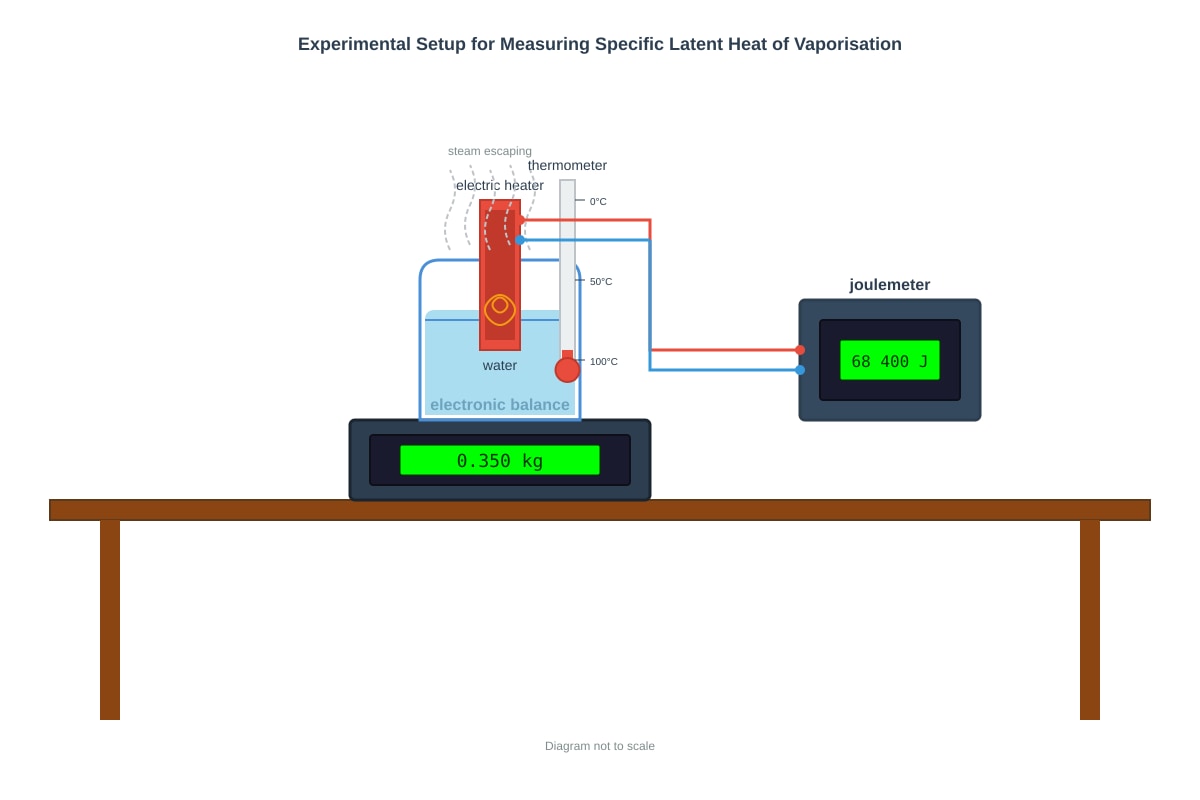
- Mass of water vaporised: kg [1]
- Energy supplied: J
- Using : [1]
Calculation: [1]
Acceptable range: 2.2–2.4 × 10⁶ J/kg (accounting for heat loss). The accepted value is 2.26 × 10⁶ J/kg. Marking note: Deduct 1 mark if student forgets to convert grams to kg, or if no formula stated.
12. (a) [2 marks]
Any two from:
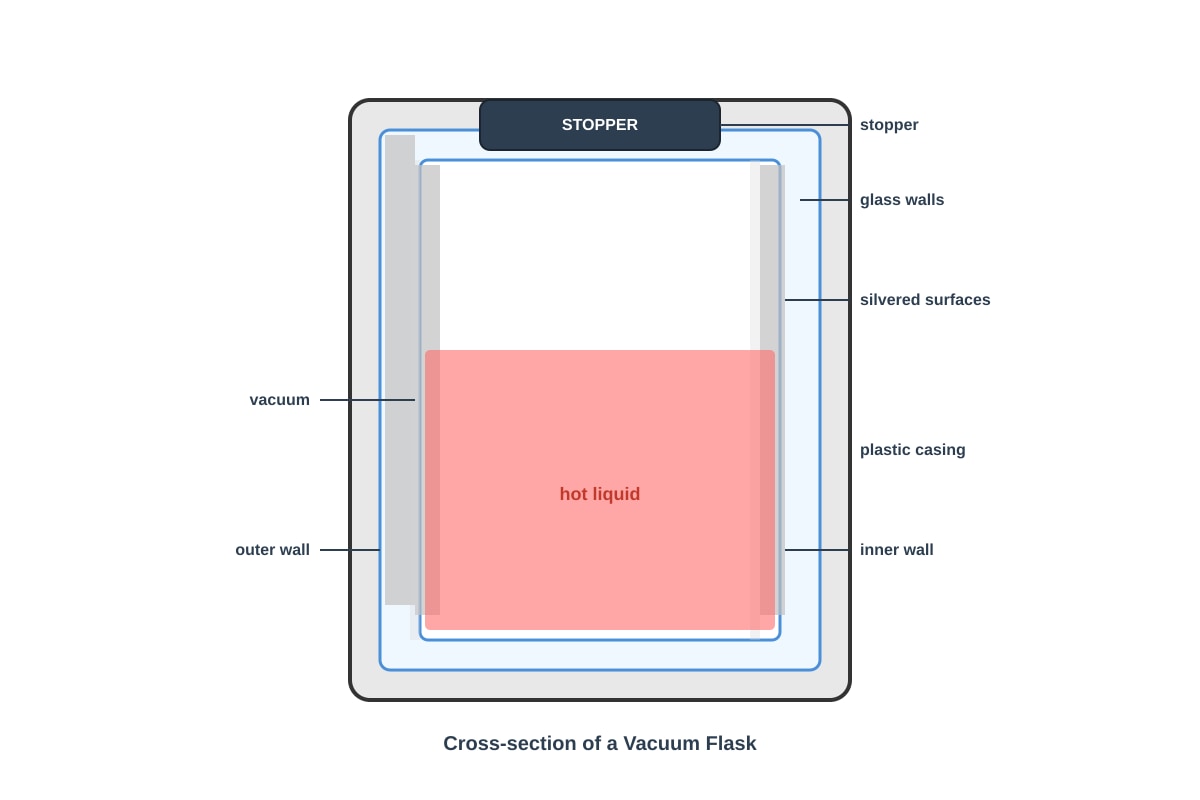
- Vacuum between double walls — removes material medium, preventing conduction through the gap [1]
- Stopper/cork — poor conductor reduces conduction at the opening [1]
- Glass walls — while glass conducts some heat, the vacuum gap dominates the conduction reduction [1]
(Any two valid features = 2 marks)
(b) [2 marks]
Silvered surfaces are polished and reflective [1]. They reflect infrared radiation back into the hot liquid, reducing heat loss by radiation [1]. Silver is a poor emitter of radiation, so little radiant energy escapes from the inner surface.
Key concept: Shiny surfaces are poor emitters and poor absorbers of thermal radiation.
13. (a) [4 marks]
Principle: Heat lost by aluminium = Heat gained by water (conservation of energy, assuming no heat losses)
Heat lost by Al: Heat gained by water:
Setting equal: [1 for equation]
[1 for expansion]
[1 for rearrangement]
[1 for final answer]
Accept 34.8–35.0°C. Common error: Using (θ - 150) for aluminium and getting negative — remind students that cooling objects lose heat: use (T_initial - T_final).
(b) [1 mark]
Any one: Heat lost to the container/insulated container is not perfectly insulating [1]; heat lost to surroundings [1]; some water may evaporate during the process [1].
14. (a) [2 marks]
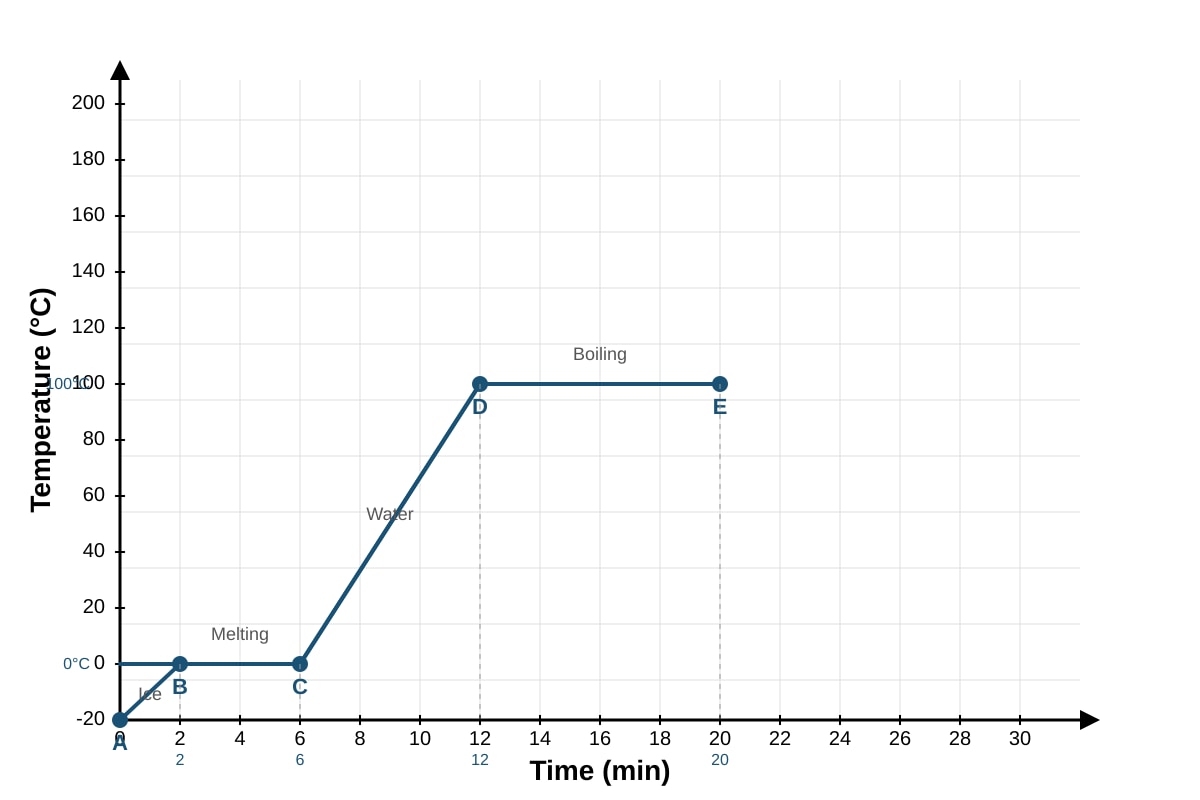
Between B and C, the ice is melting (phase change from solid to liquid) [1]. The energy supplied is used to break intermolecular bonds in the ice lattice (latent heat of fusion) rather than increase kinetic energy of molecules [1]. Since temperature measures average kinetic energy, it remains constant at the melting point.
Key distinction: Specific latent heat changes state without temperature change; specific heat capacity changes temperature.
(b) [3 marks]
From graph: melting takes 4 minutes (from t = 2 min to t = 6 min) Mass of ice: 2 kg
Energy to melt ice: J [1]
This energy is supplied in 4 minutes = 4 × 60 = 240 seconds [1 for time conversion]
Rate of energy supply: W ≈ 2.8 kW [1]
Accept 2780 W or 2800 W. Alternative: Can use boiling plateau (8 min) with J/kg to check consistency — should yield same power if no heat losses.
Section C: Application and Analysis
15. [3 marks]
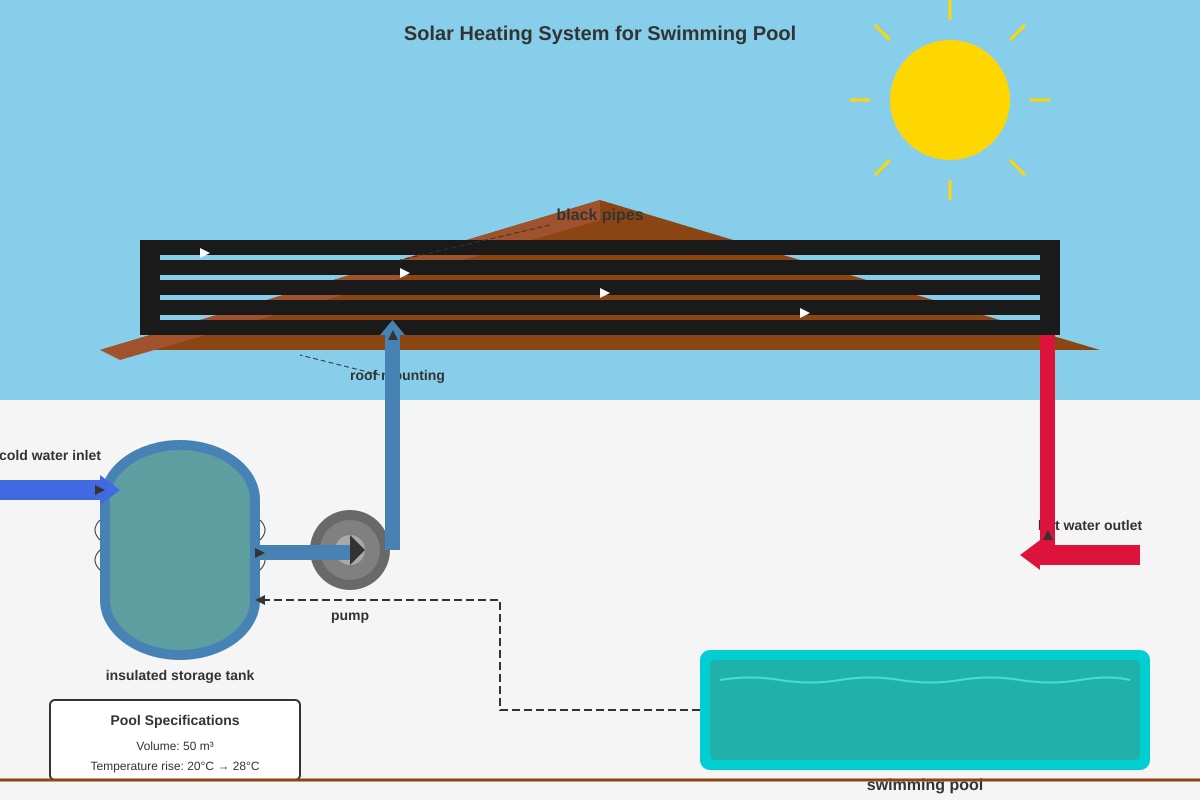
- Black pipes: Black, dull surfaces are excellent absorbers of infrared radiation [1]. They absorb maximum solar energy, heating the pipe and water inside efficiently. Shiny or light-coloured pipes would reflect solar radiation, reducing heating.
- Direct sunlight: Ensures maximum intensity of solar radiation reaches the pipes [1]. In shaded areas, scattered/diffuse radiation has lower intensity, making water heating slower and less effective [1].
Links to syllabus: Surface properties for radiation; practical applications of thermal physics.
16. [4 marks]
Energy needed to heat copper saucepan: [1]
Energy needed to heat water: [1]
Total energy required: [1]
Minimum time: [1]
Note: "Minimum time" assumes no heat losses to surroundings. Marking: Deduct 1 mark if saucepan mass omitted (common error). Accept 129 s.
17. [2 marks]
- Conduction delay: Heat must conduct through the glass bulb wall, then through the liquid (usually mercury or alcohol) inside the thermometer [1]. Glass and the liquid have thermal capacity and are not instantaneously heated.
- Thermal capacity: The glass bulb and liquid require energy to raise their own temperature to the liquid's temperature [1]. This takes time — they do not respond instantly to temperature changes.
Key concept: Thermometers have their own thermal capacity and must reach thermal equilibrium with the measured object.
18. [3 marks]
Apparatus: Two or more identical containers (e.g. tin cans) painted with different surfaces — one shiny/metallic, one black/dull, one white [1]. Each filled with same volume of hot water at same initial temperature. Thermometer for each. Insulating stand to prevent conduction losses.
Measurements: Record temperature of water in each can at regular intervals (e.g. every minute) for fixed time period; or time taken for each to cool by fixed temperature (e.g. 10°C) [1].
Fair test controls: Same initial water temperature; same volume/mass of water; same starting time; same surrounding conditions; identical can shapes and sizes; thermometers with same response [1].
Alternative: Leslie's cube experiment with infrared detector — also acceptable if fully described.
19. (a) [2 marks]
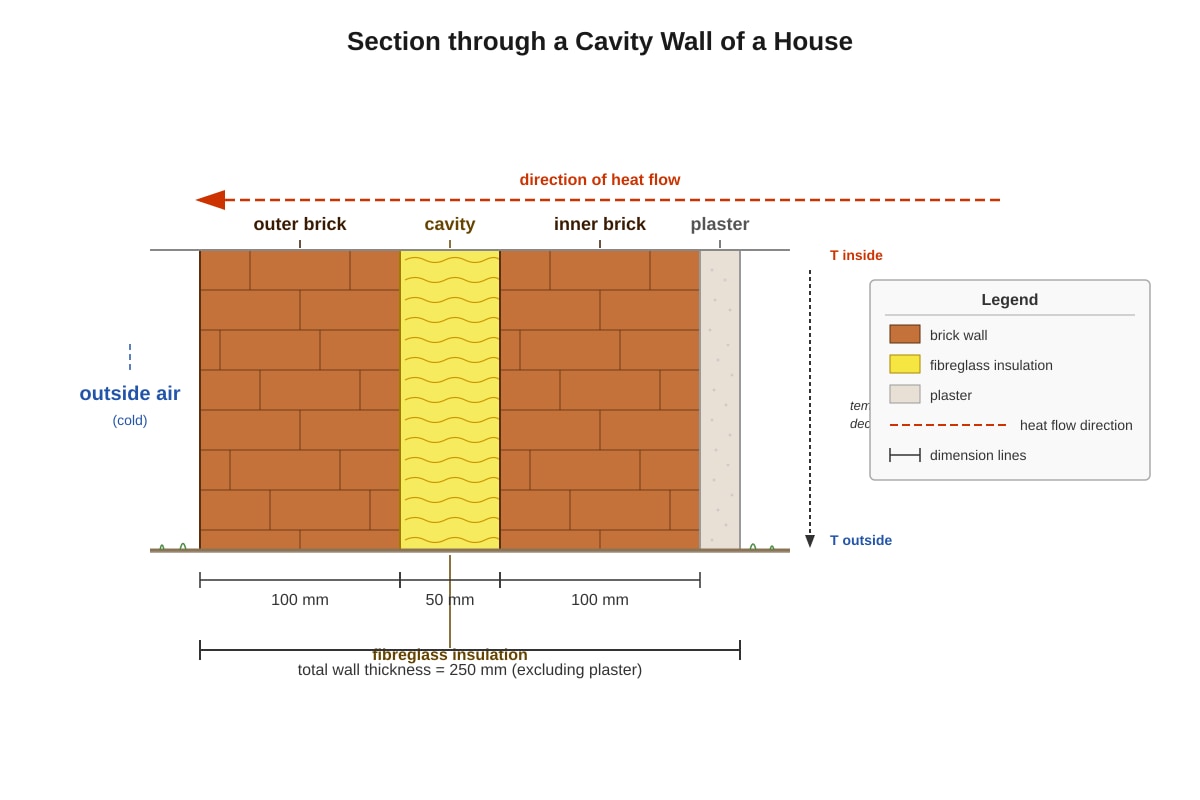
- Air cavity with fibreglass: Fibreglass traps air in small pockets. Still air is a poor conductor of heat [1], so conduction across the cavity is greatly reduced.
- Fibreglass fibres: The fibres themselves disrupt convection currents that would form in an empty cavity, and the material reflects some radiant heat. Overall, the composite structure greatly reduces heat transfer compared to solid brick, which conducts heat readily [1].
Note: Fibreglass also reduces convection in the cavity and provides some radiation reflection.
20. [3 marks]
The student's reasoning is incorrect [1] (or partially correct but conclusion wrong). While aluminium is indeed a good conductor, this is precisely why it is poor at keeping drinks hot [1]. Good conductors quickly transfer thermal energy from the hot drink to the cooler surroundings. To keep a drink hot, we need good insulators (poor conductors) such as plastic, ceramic, or vacuum flasks that slow heat transfer [1]. The aluminium foil would accelerate cooling by conduction and radiation, unless combined with insulating layers.
Evaluation structure: Identify error in reasoning → Explain correct physics → State what would actually work.
END OF ANSWER KEY