AI Generated Quiz
Secondary 3 Physics Thermal Physics Quiz
Free Sec 3 Physics Thermal Physics quiz, HY3 AI version, with questions, answers, and O Level-style practice for Singapore students.
These static practice materials are generated from the site's syllabus and paper-generation workflow, with source and model context shown so students and parents can evaluate the material before use.
Questions
Secondary 3 Physics Quiz - Thermal Physics
Name: ______________________
Class: ______________________
Date: ______________________
Score: _______ / 40
Duration: 50 minutes
Total Marks: 40
Instructions: Answer all 20 questions. Show your working where calculation is required. Use g=10 m s−2 and cwater=4200 J kg−1 ∘C−1 where needed.
Section A: Multiple Choice and Short Answer (Questions 1–8)
1. Which of the following is the correct SI unit for temperature? [1 mark]
A. °C
B. K
C. J
D. W
2. State what is meant by the specific heat capacity of a substance. [1 mark]
3. A metal block of mass 0.20 kg is heated and its temperature rises by 15 ∘C. If 1800 J of heat is supplied, calculate its specific heat capacity. [2 marks]
4. Which process transfers heat by the actual movement of fluid particles? [1 mark]
A. Conduction
B. Convection
C. Radiation
D. Insulation
5. Explain why a shiny surface is a poor radiator of heat. [1 mark]
6. Define latent heat of vaporisation. [1 mark]
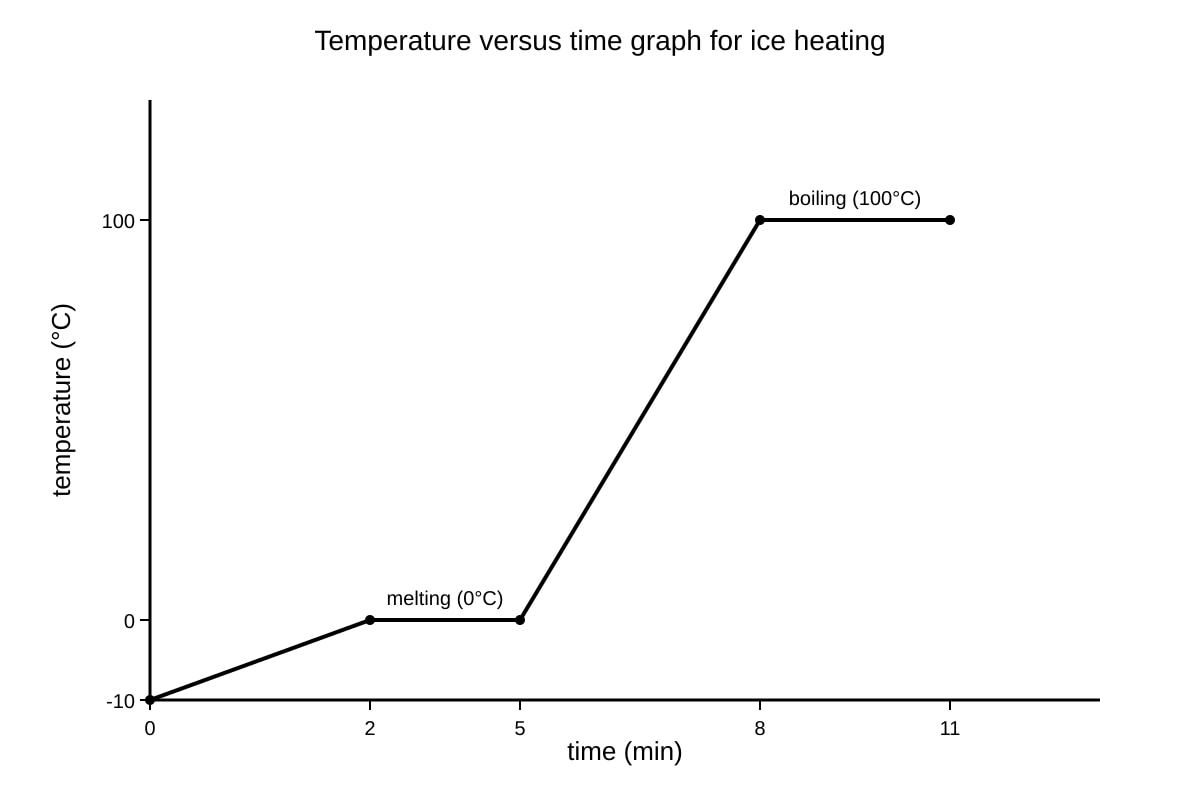
7. The temperature-time graph below shows ice warming, melting, and then water heating.
Image pending generation: graph for Q7.
State the temperature at which the ice melts. [1 mark]
8. Calculate the heat required to raise the temperature of 0.50 kg of water from 20 ∘C to 100 ∘C. [2 marks]
Section B: Structured Questions (Questions 9–15)
9. A copper block of mass 0.40 kg at 95 ∘C is placed in 0.25 kg of water at 18 ∘C. The final temperature is 33 ∘C.
(a) Calculate the heat gained by the water. [2 marks]
(b) Calculate the specific heat capacity of copper. [2 marks]
10. Describe an experiment using a copper calorimeter to measure the specific heat capacity of a liquid. Include the measurements needed. [3 marks]
11. 0.10 kg of ice at 0 ∘C is converted to water at 0 ∘C. The latent heat of fusion of ice is 3.34×10⁵ J kg−1.
(a) Calculate the heat needed. [2 marks]
(b) State what happens to the energy supplied during melting. [1 mark]
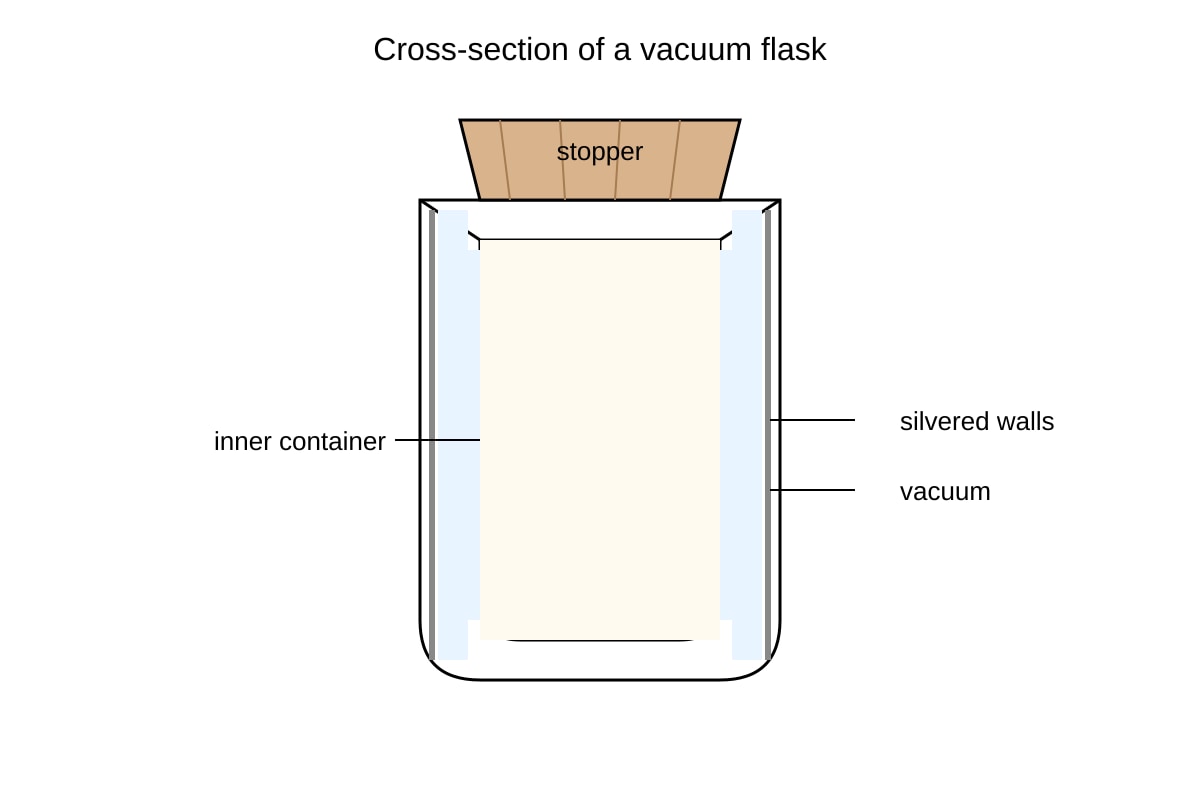
12. The diagram shows a vacuum flask.
Image pending generation: diagram for Q12.
Explain how the flask reduces heat loss by conduction and radiation. [2 marks]
13. A heater of power 50 W is used to heat 0.40 kg of oil. The temperature rises from 25 ∘C to 45 ∘C in 4 minutes. Calculate the specific heat capacity of the oil. [3 marks]
14. State two differences between boiling and evaporation. [2 marks]
15. A black metal plate and a white metal plate of same size are placed equally near a heater. Explain which plate becomes hotter and why. [2 marks]
Section C: Applied and Extended Questions (Questions 16–20)
16. A student claims: "When water boils, its temperature keeps rising if heating continues." State whether this is correct and explain. [2 marks]
17. A household kettle has a power of 2.0 kW. It is used to boil 1.5 kg of water from 20 ∘C to 100 ∘C.
(a) Calculate the heat required. [2 marks]
(b) Calculate the minimum time needed if all energy is transferred to the water. [2 marks]
18. Describe how you would use a cooling curve to determine the melting point of a wax sample. [3 marks]
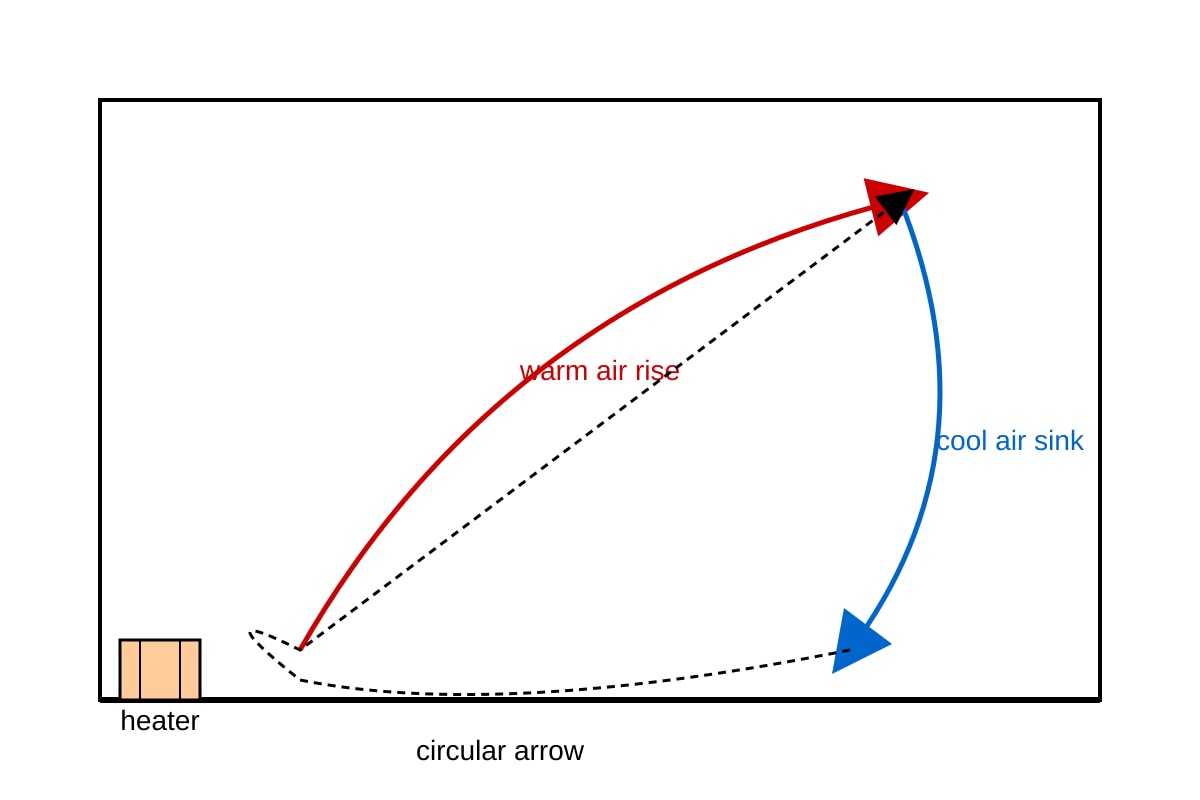
19. The figure shows a convection current in a room with a heater on the floor.
Image pending generation: diagram for Q19.
Explain how convection circulates the air in the room. [3 marks]
20. A 0.30 kg aluminium block (c=900 J kg−1 ∘C−1) at 100 ∘C is placed into 0.50 kg of water at 15 ∘C in a polystyrene cup. Assuming no heat loss, calculate the final temperature. [4 marks]
Answers
Secondary 3 Physics Quiz - Thermal Physics (Answer Key)
Total Marks: 40
Teaching notes included for each question.
Section A
1. B [1 mark]
Temperature in SI is measured in kelvin (K). °C is common but not SI base; J is energy; W is power.
Teaching note: The SI base unit for temperature is the kelvin. Always link units to quantities.
2. [1 mark]
Specific heat capacity is the amount of heat energy required to raise the temperature of 1 kg of the substance by 1 ∘C (or 1 K).
Teaching note: Definition must include per unit mass and per degree temperature rise.
3. [2 marks]
Use Q=mcΔT
m=0.20 kg, ΔT=15 ∘C, Q=1800 J
c=mΔTQ=0.20×151800=31800=600 J kg−1 ∘C−1
Marking: 1 mark formula/substitution, 1 mark answer with unit.
4. B [1 mark]
Convection is heat transfer by movement of fluid (liquid/gas) particles.
5. [1 mark]
Shiny surfaces reflect infrared radiation and emit less radiation; thus they are poor radiators.
Teaching note: Good reflectors are poor emitters and poor absorbers.
6. [1 mark]
Latent heat of vaporisation is the heat required to change 1 kg of a liquid at its boiling point into vapour without temperature change.
7. 0°C [1 mark]
From graph, flat region at 0°C is the melting phase.
Visual check: Q7-fig1 shows flat at 0°C from 2–5 min.
8. [2 marks]
Q=mcΔT=0.50×4200×(100−20)=0.50×4200×80=168000 J
Marking: 1 mark working, 1 mark final answer.
Section B
9. [4 marks total]
(a) [2] Heat gained by water: Qw=mwcwΔTw=0.25×4200×(33−18)=0.25×4200×15=15750 J
(b) [2] Heat lost by copper = heat gained by water = 15750 J
cCu=mΔTQ=0.40×(95−33)15750=0.40×6215750=24.815750≈635 J kg−1 ∘C−1
Common mistake: using wrong mass or final temp difference.
10. [3 marks]
- Place liquid of known mass in copper calorimeter. [1]
- Record initial temp, heat with known-power heater for set time, record final temp. [1]
- Use E=Pt=mcΔT to find c; measure mass, temps, time, power. [1]
11. [3 marks]
(a) [2] Q=mL=0.10×3.34×105=3.34×10⁴ J
(b) [1] Energy breaks bonds / changes state, temperature unchanged.
12. [2 marks]
Vacuum between walls stops conduction (no particles). [1] Silvered surfaces reflect radiation. [1]
Visual: Q12-fig1 must show vacuum and silvering.
13. [3 marks]
Energy supplied: E=Pt=50×(4×60)=50×240=12000 J
Q=mcΔT⇒c=0.40×(45−25)12000=0.40×2012000=812000=1500 J kg−1 ∘C−1
Marking: 1 energy, 1 substitution, 1 answer.
14. [2 marks]
- Boiling occurs at fixed temperature; evaporation at any temperature. [1]
- Boiling throughout liquid; evaporation only at surface. [1]
15. [2 marks]
Black plate becomes hotter. [1] Black surfaces absorb radiation better than white/shiny surfaces. [1]
Section C
16. [2 marks]
Incorrect. [1] At boiling, temperature stays constant until all water turns to vapour. [1]
17. [4 marks]
(a) [2] Q=mcΔT=1.5×4200×(100−20)=1.5×4200×80=504000 J
(b) [2] P=2.0 kW=2000 W, t=PQ=2000504000=252 s (or 4 min 12 s)
18. [3 marks]
- Melt wax and let it cool, record temp vs time. [1]
- Plot cooling curve. [1]
- Flat portion indicates constant temp = melting point. [1]
19. [3 marks]
Heater warms air near floor. [1] Warm air rises (less dense). [1] Cool air sinks and is drawn to heater, forming convection current. [1]
Visual: Q19-fig1 shows loop.
20. [4 marks]
Heat lost by Al = heat gained by water
mAlcAl(100−T)=mwcw(T−15)
0.30×900×(100−T)=0.50×4200×(T−15)
270(100−T)=2100(T−15)
27000−270T=2100T−31500
27000+31500=2370T
58500=2370T⇒T≈24.7 ∘C
Marking: 1 eqn, 1 expand, 1 solve, 1 answer.
Free quiz and exam paper access
Enter your details to view this paper
Your access is remembered on this device.